


Google News and Weather joins the modern age with Now-like cards

The stock Android faithful have been peering at the same UI inside its News and Weather app for quite some time, but today there’s a welcome update. Folks carrying the unskinned version of Google’s OS are now privy to Now’s card-based organization for recent headlines with the weather forecast for the current location situated up top. You can toggle that meteorology widget off and on, or set it to stay with a locale of your choosing or track conditions in multiple places. Swipe through sections with ease, and as you might expect, those handy home screen widgets got a refresh of their own to match. The update seems to be rolling out to compatible devices now, so if you can’t snag it yet, sit tight ’cause it’s on the way.
Via: Android Central
Source: Google Play
.CPlase_panel display:none;
Back to School 2014: The 10 best tablets

By design, tablets are less about work and more about play — though you’ll find some notable exceptions in our roundup of top slates for the back-to-school season. Among them are Microsoft’s Surface Pro 3, which features a keyboard case that makes typing on the go bearable, and the ASUS Transformer Book, which also gives you hardware keys via a bundled dock. Of course, there are still plenty of slates made for enjoying your downtime. Click through the gallery below to see them all, and don’t forget to check out the rest of our guide!
Filed under: Apple, Sony, Microsoft, Nokia, ASUS, Google, Amazon, Acer
.CPlase_panel display:none;

Google’s app for presentations, Slides, launches on iOS

It took quite a while to get here, but Google has finally brought its Slides app to Apple’s mobile platform. Roughly three months ago, the search company introduced standalone apps for creating/editing documents, spreadsheets and presentations, but Slides didn’t arrive until weeks later, and only on Android. As of today, Google’s application for PowerPoints presentations is now also available on iOS. Those of you who own an iPhone, iPad or iPod touch can use Slides to make, edit and view files, which shouldn’t come as a new experience if you’re already familiar with the Docs and Sheets apps. Speaking of which Docs and Sheets as well — Google notes it’s now easier than ever to work on projects from any of your devices, anywhere, thanks to enhanced saving and offline editing features.
Filed under: Cellphones, Tablets, Software, Mobile, Google
Source: App Store
.CPlase_panel display:none;

The NSA’s search tool is a Google for the world’s communications data

If sharing really is caring, then the NSA must care a lot. That’s the thrust of a new report from The Intercept that pulled back the curtain on a search system called ICREACH — launched in 2007, the system allows members of more 20 different US agencies to quickly sift through the communications metadata of both foreigners and citizens on US soil. And the reason for all this? Well, the stated goal was to allow members of these government agencies to identify persons of interest and help agents monitor the activities of “intelligence targets” at home and abroad. Putting aside its ability to crawl through some 850 billion metadata records (and growing), one of ICREACH’s greatest assets might be its straightforward interface. It’s referred to in internal documentation as being “Google-like” and allows researchers to dig into metadata records by punching in simple “selectors” like email addresses and phone numbers.
This isn’t the first time the name ICREACH has been made public knowledge (barring all the Google search results for job openings for people fluent in intelligence tools like it). Glenn Greenwald’s book No Place To Hide included a slide among its myriad documents that highlighted the some of the metadata types that were accessible through ICREACH:

According to The Intercept’s Ryan Gallagher, it’s that bit about foreigners that affords ICREACH much of its immunity from congressional oversight. The system was designed to cull information primarily from foreign communications networks (which is kosher thanks to President Reagan’s Executive Order 12333), though The Intercept asserts that the system also contains “millions of records on American citizens who have not been accused of any wrongdoing.” The metadata itself — the sender and recipient of a call or message, identifying information about the device used, etc. — might not seem terribly troubling, but in aggregate it could provide a fairly comprehensive picture of what a given person was doing when, and where. All told, it’s a scarily powerful bit of tech at the disposal of multiple agencies, and since much of the information released was based on documents that are years old, it’s not clear how ICREACH’s, well, reach has shifted or expanded since.
Source: The Intercept
.CPlase_panel display:none;

Amazon reportedly ready to snatch Twitch away from Google

Remember that rumored $1 billion deal Google worked out to purchase the internet’s most popular game-streaming service? Amazon may be taking it over. According to The Information, folks close to the deal say that Twitch and Amazon are in late stage talks for a $1 billion acquisition. Why the change in buyer? It’s not clear (or confirmed), though it might be a response to concerns that joining Google could stifle innovation or competition. Either way, neither company is talking about the rumor right now, though one person involved suggested that the deal could be formerly announced soon.
Filed under: Gaming, Google, Amazon
Source: The Information
.CPlase_panel display:none;
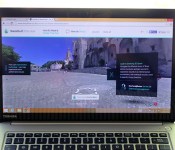
Sounds of Street View takes you on a virtual vacation

You can only experience so much of a place by poking around it in Google Maps, and that’s why Amplifon, a hearing aid company from the UK (seriously), put together a little getaway-in-a-browser called Sounds of Street View. The name really says it all – once you pop on your headphones (trust us, it’s important), you can virtually explore Place du Palais, Hawaii’s Hapuna Beach and Balboa Park in San Diego complete with some much-needed aural ambience. It’s a surprisingly comprehensive experience too: as you “cruise” down the streets of Avignon, France, you’ll hear the lilting tune of an accordion give way to the din of a dining crowd and a church bell ringing in the distance. Is it just like being there? Erm, not quite, but it’s way cheaper than a plane ticket at the very least. Alas, those are the only three locales available at the moment so you can’t vicariously experience the ceaseless thrum of Hong Kong or New York City… until a crafty developer uses the provided cobbles together the soundscape for you, anyway.
Source: Sounds of Street View
.CPlase_panel display:none;

Huawei boss says Tizen has ‘no chance’ of success

Fans of mobile operating systems not called “Android” or ‘iOS” might be sad to hear what Huawei’s head honcho just told the Wall Street Journal. In an interview, Richard Yu spoke about the company’s plans regarding Tizen, Windows Phone and a long-rumored homegrown OS, and basically said they were all doomed.
According to the executive, unnamed mobile networks had asked Huawei to make Tizen smartphones, but Yu feels that the platform has “no chance to be successful.” It’s a bit of a u-turn, since the company has previously had a research unit looking into the Samsung-made software, but Yu said that he shut it down.
On the subject of Windows Phone, Yu conceded that Huawei had spent two years losing money on its W series handsets, saying “it has been difficult to persuade customers to buy a Windows phone.” That’s why, at least for now, a follow-up to the promising, yet flawed W1 and W2 is off the table.
That leaves the company with Android as the only thing its handsets can run, and when asked about this potential over-reliance on Google, Yu admitted that he’s concerned, but has “no choice.” On the upside, he did emphasize that he has a “good collaboration” with the search engine, before swiftly moving on to other matters, like writing off any plans for a homegrown operating system of its own. In his own words, Yu feels that “it’s easy to design a new OS, but the problem is building the ecosystem around it.”
Filed under: Cellphones, Software, Mobile, Samsung, Microsoft, Google
Source: Wall Street Journal
.CPlase_panel display:none;

How would you change Google Glass (Explorer Edition)?

It’s always tough asking for people’s opinions on a device when so few instances of the hardware are available. Even a year after its release, getting hold of Google Glass (Explorer Edition) is a long and expensive process that few outside of the tech fraternity will bother with. Still, we’re fairly sure that plenty of you have at least tried a pair on – the last time we were in the same city as Alexis Santos, he was stopped every five minutes by curious passers by. Now, when we forced Mr. Tim Stevens to review it, he said that Google Glass was a fascinating prototype, with plenty of potential, but unless you’re the sort of person who would describe $1,500 as chump change, you should steer clear. The two-hour battery life wasn’t ideal, and there were more than a few privacy concerns that, in hindsight, have been borne out. Personally, the most exciting feature for me was the navigation coupled with the bone-conducting headphone, and there’s nothing greater than having directions beamed directly into your cranium. Still. The question here is simple: if you had a meeting scheduled with Sergey Brin, what would you tell him to change for version two?
Filed under: Wearables, Google
Source: Engadget Product Forums, Engadget Product Database
.CPlase_panel display:none;

App security flaw makes your iPhone call without asking

If you’re an iPhone user, you may want to be cautious about opening messages that contain phone numbers in the near future; they may cost you a lot of money. Developer Andrei Neculaesei notes that maliciously coded links in some apps will abuse the “tel” web handler (which covers dialing) to automatically make a phone call the moment you view a message. Potentially, an evildoer could force you to call an expensive toll number before you’ve had a chance to hang up. The exploit isn’t limited to any one app or developer, either. Facebook Messenger, Gmail and Google+ all fall prey to the attack, and it’s likely that other, less recognizable apps exhibit similar behavior. Apple’s Safari browser will ask you before starting a call, but FaceTime’s behavior lets you pull a similar (though not directly related) stunt.
In many cases, it’s the developers who are to blame. They’re supposed to put tighter controls on what happens when a number comes in, such as giving you a warning. However, Apple could theoretically mitigate the issue by requiring prompts for all phone links. You may not have to worry about a spam flood in practice, but let’s hope app writers act quickly — as Android users have already learned, “tel” exploits can cause a lot of grief if left unchecked.
Filed under: Cellphones, Internet, Mobile, Apple, Google, Facebook
Via: PCWorld
Source: Algorithm.dk
.CPlase_panel display:none;

LG will reveal a circular smartwatch next week to compete with the Moto 360

Of the three Android Wear smartwatches introduced at Google’s developer conference in June, the Moto 360 was by far the crowd favorite; its circular watchface gives it a classic, elegant look, and a stark contrast to the squarish Samsung Gear Live and LG G Watch. It turns out that LG wasn’t very excited about its first Wear watch either: It’s going to introduce a round-faced sequel — called the LG G Watch R — next week in Berlin, shortly after Motorola officially launches its new timepiece.
The teaser, provided to us by a trusted source, is currently unlisted on LG Mobile Global’s YouTube channel and embedded above. Plenty of details are left out — gotta leave something for the big reveal, of course — but you can clearly see a circular display (we’re assuming R stands for Round) with several new watchfaces. And unlike the original G Watch, the R comes with a button on the side. We also caught a few brief glimpses of a digital step counter, distance meter and compass. Finally, the teaser proclaims that we’ll learn more at IFA 2014 next week.
The short turnaround between G Watches (2.5 months) is indicative of LG’s strategy. A typical product development cycle spans the course of several months, and depending on the device, could take up to a year or more. This means the G Watch R was in development alongside the original, so the square model was likely a proof of concept; something to satisfy the early adopters and work out bugs while the stylish version wrapped up development. In other words, the R is the marquee smartwatch LG’s really banking on, and the fact that it’ll be introduced just hours after the 360′s launch means that all of the momentum and hype Motorola has spent months building up may quickly vanish. Whether it was a stroke of luck or brilliant timing on LG’s part, it shows either way that the competition will be heating up next week.
LG’s not the only manufacturer coming out with a new watch soon. ASUS will launch one at IFA as well (though its shape is square in its teaser); HTC has something in the works for later this year; Samsung could easily launch another Gear or five for the holidays; and let’s not even get into the Apple watch speculation. The Moto 360 is still the best-looking smartwatch we’ve seen thus far, but the space is becoming much more crowded than it was two months ago, and it may not retain that top-dog status for long after it finally gets released.

Filed under: Cellphones, Wearables, Wireless, Mobile, Google, LG
Source: LG Mobile Global YouTube
.CPlase_panel display:none;

