


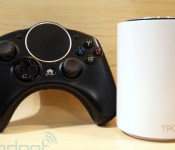
Huawei hops on the Android gaming bandwagon with Tron mini-console

The jury’s still out on Android gaming (exhibit A: OUYA), but that’s not stopping Huawei from taking a dive into that niche corner of the industry. Its Tegra 4-based Tron mini-console, announced here at CES 2014, pairs a cylindrical-shaped hub with a Bluetooth controller that hews quite closely to the Xbox 360 mold OUYA also went after. Before we get your hopes up though, take note that Tron’s for China only — at least, for now anyway. A Huawei rep did say that the company’s looking into further market expansion, but given its track record with smartphones in the US, we have a hard time believing Tron will see these shores anytime soon.
The Tron console itself runs a half-skinned version of Android JellyBean (version 4.2.3) that presents a clean menu overlay with feature tiles for access to games, Huawei’s store, video, application, settings and featured titles. That slick menu selection comes to a screeching halt, however, as soon as you attempt to select anything other than games, bringing you face-to-face with Android’s ugly underbelly — much like on the OUYA.
Storage-wise, the Tron will come in 16GB/32GB configurations, but that space can be expanded up to 64GB via a microSD slot at its base. There’s also support for Ethernet, USB 3.0, audio out, WiFi a/b/g/n/ac and 2GB RAM to aide the Tegra 4 chip inside. The Tron console, of which there are black and white versions, is housed in a glossy plastic shell (sorry, no flashing strips of neon light) with a large power button that nearly occupies its entire top. Overall, it’s an underwhelming design — something more than one Engadget editor referred to as “wastebin-like.” You can judge for yourself in the gallery below.
The Tron controller is an Xbox 360 controller by way of OUYA. So much so, that the button placement is nearly identical save for that giant, circular touchpad smack dab in the center. Users that pick up the controller will be greeted with four actions buttons (X, Y, A, B), four shoulder triggers, as well as buttons for home, mute, view and menu. There’s even a headphone jack just tucked beneath the front face. The controller is actually incredibly light, but that lightness comes across as a con rather than an asset. It just makes the whole thing feel cheap and disposable, an impression not helped by the materials used.
Gameplay was good, not great. There was a slight latency noticeable when effecting button presses, but nothing that seemed like it’d get in the way of the onscreen action. We weren’t able to get much clarity on the openness of the platform — a Huawei rep told us games would need to be optimized for Tron before appearing in the Store — but we assume side-loading Android games wouldn’t pose any problem. 4K playback is also supported on the console and was demoed from within the video submenu.
Huawei hasn’t locked down final pricing on the Tron just yet, but we’ve heard the Android mini-console should arrive with a sub-$150 price point. Again, it’s destined for China-only in Q2 of this year, but if you really need to get your hands on it, there’s always the option to import.
Watch Engadget’s CES SuperSession featuring Pebble, Oculus, 3D Systems and Leap Motion

Welcome to CES 2015. When we were originally batting around ideas for this year’s Supersession, we suggested something further off, centered around predictions about where all of this is headed in the decades to come. But while CES is all about looking forward, the show’s real bread and butter centers around something more immediate: the gadgets that will define the year to come. With that in mind, we pulled together an all-star panel of forward-thinking innovators who are creating products that are available now (or, in one case, soon to be available). These are companies that aren’t looking to shift paradigms in the future — they’re ready to move and shake things now.
Panelists for the session included Leap Motion CEO Michael Buckwald, Oculus CEO Brendan Iribe, Pebble CEO Eric Migicovsky and 3D Systems CEO Avi Reichental. Full video of the session can be found in the source link below.
[Photo by Will Lipman]
Filed under: Gaming, Meta, Peripherals, Robots, Wearables
Source: CES

Live from the Engadget CES stage: Razer CEO Min-Liang Tan

Like you, we’ve always thought of Razer as a gaming hardware manufacturer. And like you, we were caught a bit off-guard when the company tossed its hat in the crowded fitness-tracking landscape. We’ll be discussing the company’s diversifying line and place in the rapidly evolving gaming landscape with CEO Min-Liang Tan.
Filed under: Gaming

Live from the Engadget CES Stage: Stern Pinball CEO Gary Stern

It wouldn’t be Vegas without some pinball. For the second year in a row, Stern Pinball CEO Gary Stern will be hitting the stage to talk about building machines in the age of the video game.
Filed under: Gaming
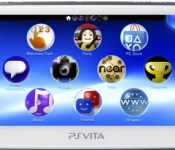
Amazon offers another chance to pick up a white PlayStation Vita

Fancy a limited edition Crystal White PS Vita bundled with Assassin’s Creed III Liberation for just $180? Well, sorry old bean, but you’re too late. That particular deal ended ages ago and the Liberation bundle is now selling for ludicrously high prices (oh, the cruelty of it). But here’s something we didn’t expect: the rare white version of the handheld has just reappeared at Amazon as a not-so-limited standalone product priced at $200, i.e., the same money as the common black option. Aside from the color scheme, this is a traditional unit with an OLED display, rather than the Japanese LCD version that has better battery life. However, it’ll look great during these icy winter months and, by summer, it’ll bask in the warmth of Sony’s exciting new game streaming service, PlayStation Now.
Filed under: Gaming, Handhelds, Sony
Via: Joystiq
Source: Amazon.com
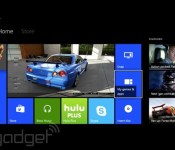
Xbox One’s first big update will address ‘the Live experience,’ expect streaming before E3

Xbox — and Microsoft in general — doesn’t really show up for CES. It’s not hard to understand why: for a big company like Microsoft, there’s no point in competing with the cacophony of voices shouting for attention. “Whenever we want, we can talk about Xbox stuff and get coverage. Why try to talk with 100,000 other things going on?” Xbox chief product officer Marc Whitten told us in an interview this week. Though Xbox isn’t here to show anything off, Whitten’s in town to meet with partners and, as he put it, “It’s just a good time to pop up and see an environmental scan you can get in an immediate dose.” After a long 2013 head down on the Xbox One launch, he’s finally got a second to take the temperature and see the world outside of Microsoft’s Bellevue, Wash. campus.
But we’re not here to ask Whitten about the past. Yes, he’s “really thrilled” with the console’s launch (over 3 million sold by the end of 2013). And yes, he’s very happy with the reaction from consumers. That doesn’t mean work’s over, of course. “There are seams in the product [XB1]. There are still seams in the 360, nothing’s ever done,” Whitten said. As such, first up on the fix docket is what Whitten called, “the Live experience.” Essentially, that’s much of the social features on the latest Xbox console. Whitten takes that stuff personally, having worked on Xbox Live as a service for the last 10 years:
“The feedback we’ve gotten is pretty valid; some of the social stuff is hidden or harder to use than it was on the Xbox 360. So you’re gonna see us come out with an update where, well, we’re going to fix those things. As a person who’s been pretty involved in building Xbox Live for the last decade, I take it pretty seriously when people say it’s harder to get into a party, and the defaults aren’t right, and I don’t like the model. So what I’m trying to do with the team is kind of theme some stuff up. Let’s take an update and really go through a big list of what we’re hearing from customers, what we know is broken with the architecture, areas that we want to improve or complete. I think that’s a theme you’ll really see us push on — that Live experience.”
Based on our conversation with Whitten, it sounds like those Live fixes are coming sooner than later. Promised game streaming functionality, however, may not be coming as quickly. “This is not 100 percent,” Whitten prefaced his statement with. “But my general strategy at E3 is to talk about things that are gonna happen from that E3 to the next E3. So, we are not yet to the next E3,” he added with a smile. So, uh, before June then!

Updates in general, though, will come much faster. While Whitten said we’ll still see the traditional large Dashboard updates, the Xbox One was designed around lessons learned from the 360 before it. One major facet of that design facilitates more regular updates. “The Xbox 360, which I’m still very very proud of, the software architecture was built in 2003. Rethinking [updates] based on everything we learned from 360 was a lot of what went into the Xbox One,” he told us. “You’re still gonna see the big, ‘Hey, here’s the cool stuff we’re doing.’ But you’re also gonna see the box just get better faster than you did in the past.”
First up on that front? “Everything from getting more apps out faster, some of the TV stuff — improving some of that, getting the scale of that internationally where we don’t have some of that. So I think you’re gonna see that come pretty quickly,” Whitten said.
The next big push for Microsoft’s Xbox One starts by March’s Game Developers Conference. As it turns out, the Xbox One gets its first major exclusive game that month in Titanfall as well. And hey, if you ask us, there’s serious incentive for Microsoft to have partying up perfected in time for Respawn Entertainment’s big game.
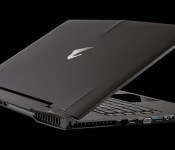
Gigabyte’s dual GPU Aorus gaming laptop is less than an inch thick

To impress us with a gaming laptop these days requires more than just spec-bombing, but Gigabyte‘s Aorus has grabbed our attention. For starters, the 17.3-inch model is a mere 0.9-inches thick and weighs 6.4 pounds, rather insane numbers considering that it packs a pair of NVIDIA GTX 765M chips in an SLI configuration. In comparison, the 17-inch Razer Blade Pro is almost exactly the same size with a single GPU. To achieve that, Gigabyte made the case out of solid aluminum with a sculpted look only a gamer could love, while packing copious vents and ports to duct away the hot air. The rest of the specs are also top-tier: a 17.3-inch, 1080p display, Intel Core i7-4700HQ CPU, up to 32GB of RAM, three USB 3.0 slots, 500GB of mSATA SSD storage max, and up to a TB of 2.5-inch HDD storage. Gigabyte calls it a “powerplant on your lap,” and it’ll arrive around March for $2,099 -$2,799 depending on options. If you’re interested, some heat-proof pants might also be in order.
Via: The Verge
Source: Gigabyte
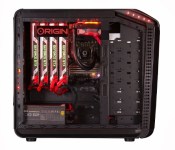
Origin’s Genesis and Millennium PC cases take customization, expansion to new heights

Honestly, gaming PC cases are already pretty customizable and flexible, but Origin seems to think there’s room for improvement. In order to accommodate as many possible configurations of components, Origin has made it possible to mount a motherboard in one of four different orientations: standard ATX, inverted ATX, rotated 90 degrees or rotated 90 degrees and inverted. That means it can handle practically any combination of high-powered graphics cards and over-the-top water-cooling systems you can imagine. In addition, the company will be selling an expansion kit that will turn the mid-tower Millennium into the full-tower-sized Genesis that allows you to add either a giant radiator or 24 additional hard drives. Though, even the Millennium has room for five hot-swappable drives. So you should be pretty set on storage even with the “entry-level” model. And we use that phrase pretty loosely, since the Millennium starts at $1,629 and the Genesis weighs in at $1,849. You can see the whole system in action after the break.
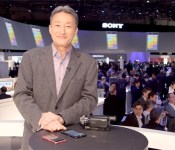
Kazuo Hirai on unifying Sony through Ultra HD and PlayStation Now (video)

Sony CEO Kazuo Hirai left the theatrics at home during his opening day keynote this morning, instead choosing to focus on the company’s vision of the future and his push to unify its disparate divisions. Since he took the reins last year, he’s been preaching a unified approach, something he calls “One Sony.” That approach manifested itself in a collaborative effort to push 4K content, distribution and devices, and, as of today, a new service called PlayStation Now. That service will allow users to stream PlayStation content to gaming devices, tablets, smartphones and Bravia TVs. We met up with Hirai at Sony’s CES booth where he told us to expect more collaboration in the future and, eventually, PlayStation Now on iOS, Android and beyond. For more of Hirai’s plans for the future of Sony, check out our interview after the break.
Filed under: Cellphones, Cameras, Displays, Gaming, Home Entertainment, Software, HD, Mobile, Sony
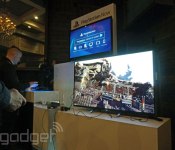
PlayStation Now actually works! (hands-on)

You’ll excuse us if we didn’t expect PlayStation Now to work so well. It’s a game streaming service, and the history of game streaming services is littered with dead bodies. When Sony spent an unbelievable $380 million on Gaikai, it seemed impossible that the service could ever live up to that incredible sum. While PlayStation Now may not live up to that massive payout, it does, in fact, work. And it works really well.
We got our hands on PlayStation Now today at a CES 2014 PlayStation event, where we tried God of War: Ascension on a Bravia TV (without a PS3) and The Last of Us on a Vita. Both games played like there was a local PlayStation 3 (including the incredibly long initial load for The Last of Us) and ran without a hitch. There was zero perceptible lag in our (admittedly brief) playtime, and we suspect that the internet Sony’s using is of the very strong variety.
The service is set to launch later this month in closed beta, and later this summer on PlayStation 3, PlayStation 4 and Vita. As for mobile devices and Bravia support, that’s expected by years end. Given the relative earliness of PlayStation Now, the UI we saw was non-final (and looked like little more than placeholder art). The same goes for the list of supported titles via streaming — the service will launch with a variety of “marquee PS3 games,” though nothing’s set in stone thus far. We expect the God of Wars and Gran Turismos of the world will be there on day one, but only time will tell.
Beyond full games, there’ll be rental and demo options available through PlayStation Now. But again, none of this is final, and only one facet of PlayStation Now was available for testing here at CES. What we did see was impressive and fulfilled the promises Sony’s made when it comes to game streaming, but there’s a long way to go before PlayStation Now launches this summer.

