



Oculus Rift’s latest prototype features positional tracking, an OLED screen, and kills motion blur (hands-on)

The newest version of the Oculus Rift headset is another major step toward the retail version promised for some point in 2014. It takes the existing HD headset we saw at E3 2013 and swaps an LED screen for OLED. It adds an external camera, and positional markers on the headset, to track your position depth-wise. Perhaps most importantly, it kills motion blur — one of the biggest issues with previous versions of Oculus VR’s incredible Rift headset.
The latest prototype, dubbed “Crystal Cove,” is here at CES 2014, and we’ve just gotten out of an EVE Valkyrie cockpit to tell you all about how much of an improvement this new guy is over the previous model.
Leaning forward in the cockpit of an EVE Valkyrie dogfighter, there’s readable text on a smattering of control panels. The forward thrusters, it turns out, are about to be engaged, hurtling us into space amongst a volley of other spaceships out for blood. Oculus VR director of dev relations Aaron Davies has us pause so that he can toggle one of Crystal Cove’s newest features: “low persistence.” We turn from left to right, unable to read the blurred text in front of us. He flips a switch, and voila: no motion blur. Well, very little. It’s a far cry from the first Kickstarter dev kit we used many moons ago and, despite the importance of positional tracking, makes a tremendous impact on the usability of the Rift.

In the same breath, let’s not discount how amazing it is to move our head forward and have that action replicated one-to-one in-game. This means that the gauges in our cockpit more than just window dressing: that’s the HUD. Another demo, specially made for Crystal Cove by Epic Games, had us sitting in the Unreal Engine 4 demo with the…er…magma lord (?) that previously terrified us at E3. Looking down between where he’s seated and our own position, a little world of creatures in a castle are available for torture should we push the face buttons. Push A, fire rains down and decimates the little guys. It’s a bit like The Seventh Seal, but less existential. Thus far, position tracking is handled by adding a camera to the equation which tracks a handful of sensors on the front of the Rift. CEO Brendan Iribe made sure to note that the camera is not final and may never ship with the final product. It’s just the easiest solution for now. See those little white dots all over the headset? Those are the sensors.

And all of this looked far, far crisper than previous units — that’s due to the new OLED screen inside and a 30 millisecond lag time (down by half from the previous dev kit). As far as when all these new bells and whistles will arrive in developer hands is another question altogether — we’re told by Oculus that the Crystal Cove prototype is just that: a prototype. With around 46,000 dev kits out in the wild already, it’s probably unfair to ask all those folks to re-buy kits. That said, we expect it won’t be long before new dev kits are available, and not long after that for the world of VR to expand dramatically. If 2013 was the year of proof-of-concept for Oculus Rift and modern virtual reality, 2014 seems poised to be the year when it comes into its own. With Crystal Cove, that possibility is greater than ever.
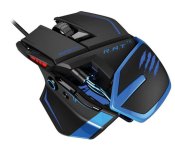
Mad Catz’ Tournament Edition Rat is lighter, faster and brighter

If you didn’t have enough transforming mice in your cursor collection, Mad Catz has one more for you: the Rat TE (Tournament Edition). It’s the latest in the company’s line of formerly Cyborg-branded mousing products and is designed specifically, as the name implies, for professional and competitive gamers. That means its lighter (to improve inertia, the company says), offers faster reaction times and has been outfitted with a new 8200 DPI laser sensor. Mad Catz has also given the mouse the ability to adjust its lift-off height calibration, giving pro gamers one more aspect of play to fine-tune. That said, it’s not a exactly a dead-ringer for the original Rat – the horizontal scroll wheel is missing and the ever-important sniper button is twice as large as the mouse’s first design. Mad Catz hasn’t announced the teal-accented mouse’s price yet, but expect to see it ship in early 2014.
Filed under: Gaming, Peripherals
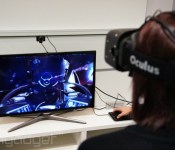
Internal game development at Oculus VR is already happening (and yes, it involves John Carmack)

It’s hard to imagine John Carmack not developing games. Sure, he signed on to Oculus Rift as Chief Technology Officer, but he’s also the man who co-created such gaming classics as Doom, Quake and Wolfenstein 3D. With Oculus Rift, Carmack and the many talented game developers working at Oculus VR have a new test on their hands: showcasing their new device with impressive software. Thus far, Oculus has relied on third-parties to create demonstrations of the Rift. From our conversation this morning with CEO Brendan Iribe and director of dev relations Aaraon Davies, it sounds like that may change in 2014.
“He’s working on a lot of exciting tech,” Iribe told us of Carmack’s role. “But, his heart and soul and history certainly lies in the game development side.” That means, like Epic Games before them and id Software before Epic, Carmack and co. are working on software that’ll showcase the Rift’s many functions. “That’s always been Epic’s philosophy. And it’s what allowed them to make what they made. It’s certainly been id’s philosophy in the past. It’s been John Carmack’s philosophy — you gotta eat your own dog food here, and develop internal content also,” he told us.
So that’s what Carmack and Oculus are doing, with plenty of game developers in-house to expedite the process. “You’ll see, over the next six to 12 months, if you monitor the careers page, we are putting up our team out there. We wanna make this a very open company. Pay attention to that page and you’ll see more and more game developers showing up,” Iribe added.
That’s to say nothing of supporting external dev studios, both big and small, or even outright publishing third-party games. The company even hired ex-EA Partners director David DeMartini to lead that charge. There’s also a blend of the two, where the folks at Oculus discover an especially exciting mechanic but don’t have the means to dig in themselves. “When we catch on to a nugget that seems like it should become a full experience, we may end up doing it ourselves. We may end up putting it out and working with a third-party studio that does. We’ve actually started to engage with third-party studios like that through the relations group, the publishing group, as well as our own development,” he said.
Of course, when the Rift ships later this year, it’ll have some form of UI built in for navigation and management. All that is being developed in-house at Oculus VR. In terms of internal game development, though, that avenue is just now being explored. “We’ll see where it goes,” he added. “But I wouldn’t be surprised if we didn’t do more and more internal development.”

Live from the Engadget CES Stage: NVIDIA VP Ujesh Desai

NVIDIA Vice President of Corporate and Product Marketing (and self-proclaimed “avid gamer”) Ujesh Desai will join us on stage to discuss the company’s broadening plays in the gaming world, including the hand-held powerhouse Shield.
Follow all the latest CES 2014 news at our event hub, and check out our full stage schedule here.

PlayStation 4 sales hit 4.2 million as of December 28th

SCEA CEO Andrew House just took the stage during Kaz Hirai’s CES 2014 keynote to announce some PS4 sales numbers: 4.2 million units sold, as of December 28th. That’s exactly double the figure the company told us last month, notching 2.1 million cumulative sales by December 1st. It’s a seriously impressive start for Sony’s next-gen console, putting it clearly ahead of the 3 million Xbox One sales recorded in 2013 (although Microsoft’s console is available in fewer markets right now).
Moving forward, Sony will build on its sales momentum by launching PlayStation Now, a service that’ll eliminate cross platform compatibility issues by letting gamers stream titles on their PlayStation 4, PlayStation Vita, smartphone and tablet directly from the cloud. Based on Sony’s acquisition of streaming outfit Gaikai, PlayStation Now will come as part of a new subscription model for users, and will kick off with a limited beta starting later this month, followed by a full US rollout in the summer.
Andrew House on stage: “@Playstation 4 sold over 2.1 million units in just 2 weeks. Today we announce we’ve surpassed 4. million.” #CES2014
– Sony Electronics USA (@SonyElectronics) January 7, 2014
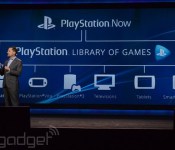
PlayStation Now streams PlayStation games to PS4, Vita, PS3, tablets and smartphones

Sony has just announced PlayStation Now, a new service for PS4, Vita, PS3, tablets, smartphones and Bravia TVs based on its acquisition of streaming outfit Gaikai. It represents a new subscription model for PlayStation users, and will kick off with a limited beta on PS3 starting later in January, with a wider US release slated for this summer. Games can be rented by the title or subscription and will support PSN features like multi-player, online, trophies and messages, even when you’re on the road. During his CES 2014 keynote, Sony chief Kaz Hirai said that it’ll “enable streaming across your smartphone, Vita, tablet and PS4 wherever, whenever,” even at the same time. To enable that, PS Now is tied to a brand new cloud service, also just announced. There’s no more details for now, but Sony will be showing off the tech here at CES 2014, so stay tuned for more details.

Project Christine offers a glimpse of Razer’s insane future through modular computing

Razer’s Project Fiona was all the talk of CES 2012 — it married console-like controls with a tablet form factor, and packed in real computing power to boot. At the time, CEO Min-Liang Tan was cagey about its retail availability; heck, it didn’t even have a product name at the time. By CES 2013, “Fiona” had become the Razer Edge, and Min’s tune changed from prototype talk to retail ready models.
At CES 2014, the cycle begins anew. Razer’s introducing Project Christine this morning as the show officially opens and thousands of people descend on the Las Vegas Convention Center. Like Fiona before it, Christine is an ambitious project from an ambitious company: a modular-computing initiative with a form factor space aliens would appreciate.
Beyond the news of what Project Christine is, we spent an hour with Razer’s passionate CEO and his support crew diving into what Christine means for the future of Razer, what they think it means for the future of PC gaming and how Christine will go from project to reality by next year.
Fresh off 24 hours of travel, Tan excitedly jumped into pitch mode right after greeting us in a 48th floor Las Vegas hotel suite. Had we seen Razer’s latest Adaro headphones? And how about Nabu, the new wearable Razer’s also debuting at CES? Pay no attention to that shrouded table in the corner.
Of course, the shrouded table was where Christine resided: a massive black PC tower with varying sizes of individual pods (modules), a green underglow vignetting out from underneath its base, all cooled by mineral oil running vertically down the middle. Tan was smart to lead with Nabu and Adaro, as Christine easily sucks the air out of the room. Before we learned about what Christine does, just looking at the prototype was disarming enough. Frankly put, it looks like no other gaming PC we’ve ever seen. That’s a good thing! In its own weird way, Project Christine is a beautiful piece of hardware. It looks like a computer sent from the future, after the Industrial Design Revolution of 2135.
Just look at those modules! Aren’t they bizarre little pods? They enable a wide variety of setups — from the tri-SLI GPU setup running on the reference model here to integrated processing and graphics on a single chip for less-hardcore users. The idea here is to both combat the waste in the PC world of buying annual hardware refreshes and to push back on massive price spikes for PC gamers. “We’re really looking at other models,” Tan told us. “Perhaps to say a subscription model of sorts, that we could interchange modules when they come in. Users don’t have to worry about a huge bump every time there’s new architecture out there.”

Of course, those modules have to be made by someone, and that someone will exclusively be Razer. As of right now, each module uses two self-sealing ports for literal plug-and-play functionality. Adding a new GPU is as simple as plugging one in to the back, and the same goes for more storage, RAM, ports or any other accoutrements you might want.
Modularity requires customization. Anyone who’s tried installing a new video card knows how much fuss can go into even that relatively simple process, and Christine aims to cut that out. As such, the traditional motherboard is broken up into a variety of pieces and scattered throughout the middle spine of the tower. We’re reticent to go into specs of the reference design, if only because it’s just one of many, many builds one could create with Christine. Don’t like that LCD screen? Swap it for a power button. Wanna go all digital and cut Blu-ray from your life? That’s an option. The pieces of Christine that are set in stone, however, are the tower design and modular approach.
That said, Christine is still very much in the “project” stage. Tan’s hoping Christine will generate as much buzz at CES 2014 as Fiona did before it, catapulting the ambitious product from concept to reality. If you ask us, our vote is in with a solid “yes.” But our vote only counts for so much — we’d suggest letting Tan know how you feel directly on Twitter so that we may see a finalized Christine at CES 2015. The cycle must continue!

How to make a CES keynote

Last night, director Michael Bay made an abrupt stage exit during Samsung’s day zero CES press conference. It was awkward, but little more than a square of toilet paper on the bottom of a tennis shoe compared to last year’s Qualcomm keynote. A bizarre mix of stilted theatrics, celebrity appearances and product demos, the presentation was like nothing we’d ever seen — until we took a look back. Qualcomm may have jacked its keynote up on steroids, but many of the tricks it pulled out were already tried-and-true standards. As Sony’s Kaz Hirai prepares to kick things off at CES 2014 this morning, we reflect on 20-plus years of innovative speeches, futuristic predictions and just plain strange behavior.
This is how you make a CES keynote.
Step 1: Think big

John Sculley with Apple’s Newton PDA (Photo by Marty Katz//Time Life Pictures/Getty Images)
When former Apple CEO John Sculley took the stage at the 1992 Winter CES, he set in motion a decade of digital divining by industry bigwigs like Aereo champion Barry Diller and Sony CEO Sir Howard Stringer. Sculley presented a bold vision of the future not only for the US economy and workers on the whole, but also for Apple’s future. His was a world where hand-held devices would lead to a fundamental shift in the way we work and learn. He saw computers, and PDAs specifically, as “revitalizing America’s role” in the global economy by making everyone more productive. The eventual offspring of this line of thinking was the ill-fated Newton. Of course, Apple would eventually return to the idea of a portable computer that embraced many of Sculley’s ideas, but his predictions weren’t exactly spot-on.
Sculley’s not alone. Many of CES’ keynote speakers have painted pictures of the future that were either ill-timed or just plain off. Michael Bloomberg kicked off the 1997 CES with a speech that focused on a new era of digital media distribution. He foretold a robust publishing industry, where writers were in higher demand and readers received the news on digital broadsheets. “The newspaper of a few years from now is made of cloth with transistors hidden in it and essentially a cellular phone with a battery hidden it there as well,” he said.
One year earlier, Compaq CEO Eckhard Pfeiffer spoke of a robust connected home becoming the norm in 2000. His theoretical abode had a computer in every room, each tailored to the needs of its user. In the kitchen, a touch- and gesture-based computer would bring the man of the house CNN Headline News, email, fax and the day’s appointments while he sipped his coffee. In the bedroom, his wife would connect with her doctor through a large-screen PC that also provided weather alerts and restaurant reviews for an upcoming trip to China. Meanwhile, his teenage daughter would connect to her friends in Germany via her I-phone (that’s a capital “I” for internet).
Step 2: Announce something

Bill Gates first appeared on the CES stage in 1995, and in 2000, he gave his first CES kickoff keynote, beginning a 12-year run for Microsoft in that slot. In just over a decade, he and his successor, Steve Ballmer turned the opening night talk from a look at tech’s crystal ball into a platform for launching new products, services and ideas. In 2000, Gates introduced the company’s new Pocket PC and Reader e-book software. The following year, he upped the game showing off the Xbox and teasing “the future of gaming.” Some of these talks were more product heavy than others, but in the time that he was at the helm, Gates announced and demoed everything from smartwatches to internet-connected TVs and HP’s aptly named TouchSmart PC.
It wasn’t all about gadgets during Microsoft’s keynote reign, however. When Ballmer took over in 2009, he announced availability of Windows 7 beta in addition to Windows Live partnerships with Dell, Facebook and Verizon. The following year, Microsoft gave the audience a glimpse at what would become Kinect. That focus on product releases took a turn for the dramatic in 2013, when Qualcomm’s Dr. Paul E. Jacobs took to the stage with a smattering of disparate cultural personalities to unveil its latest processor, the Snapdragon 800.
Step 3: Hire a celebrity

Bill Gates and the Rock show off the Xbox (Photo by Jeff Christensen/Liaison)
With a cast of characters like Archbishop Desmond Tutu, Pacific Rim director Guillermo del Toro, Maroon 5 and even Big Bird, you’d be forgiven for thinking last year’s keynote felt more like an incredibly intricate high school production of Xanadu than a self-serious press conference. While Jacobs’ state of the industry addresses was by far the most star-studded to date, employing celebrities for the occasion isn’t new. Gates enlisted Dwayne “The Rock” Johnson to show off the Xbox in 2001. In 2004, Jay Leno joined him in introducing MSN Video, followed by Conan O’Brien in 2005. To mark his last appearance as the opening keynote speaker in 2012, Ballmer sat down for a conversation with Ryan Seacrest. The following excerpt from that interview demonstrates just how awkward these cameos can be.
Seacrest: I like that. When you said Metro you looked at me in a strange way, or I thought. Is it the jacket, or the sweater, or the combination?
Ballmer: I was going to say it’s a new design and a new year, but you take it from there, for Microsoft and Ryan.
Seacrest: I’m your mascot.
Step 4: Man up

Steve Ballmer crashes the Qualcomm keynote (Photographer: Andrew Harrer/Bloomberg via Getty Images)
As in the boardroom, so on the CES stage. Over the past 20 years, only four of 63 headlining keynote speakers have been women. Of course, Yahoo CEO Marissa Mayer is slated for a talk of her own on Tuesday and Facebook’s Carolyn Everson will return for her second appearance during a panel discussion Wednesday, but all of their fellow speakers share two things in common. You guessed it: an X and a Y chromosome. This may not come as a shock to those who follow the tech industry closely, but it’s a particularly vexing state of being for a conference (and an entire market) that thrives on innovation and change.
Step 5: If all else fails, get weird
Lead image: AP Photo/Julie Jacobson
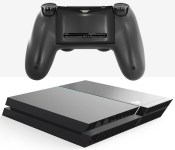
Nyko unveils Qi wireless charging dock, Intercooler for PS4 and a DualShock 4 controller extended battery

It’s CES time, folks, and that means that Nyko’s got a slew of gaming peripherals to show us all. Naturally, next-gen is the order of the day, with the reveal of an Intercooler device that attaches to the rear of your PlayStation 4 to keep it cool. Nyko’s also rolling out a PowerPak replacement battery for Sony’s DualShock 4 controller that doubles up the standard battery pack with a 1,000mAh cell. Additionally, and perhaps puzzlingly, the company is also announcing a Qi wireless charging dock, called the Power Base, built to fit Samsung Galaxy S 4 and Nexus 5 handsets. You can get a glimpse at pictures of all the products in the gallery below, but alas, renders are all we can give you for now — the real products, prices and arrival dates won’t be available until long after CES 2014 is over.
Filed under: Gaming

Here are all of Valve’s Steam Machines from CES 2014, in specs

Remember those Steam Machine partners we heard about? Gabe Newell just took the stage at Vavle’s CES 2014 event and made them official, doling out specs for gaming rigs from Alienware, CyberPower, Gigabyte, iBuyPower, Falcon Northwest, and more. There are thirteen machines in all, varying from $500 to $6000 a piece. Not all of them revealed their full hardware specifications, but skip past the break, and we’ll give you a rundown of what we know.
Alienware — Price TBD

The folks at Dell were kind enough to reveal their machine at Valve’s event, but didn’t happen to clue us in what it contains. What we can see is that the case is a fairly basic black box, flaunting only an Alienware and Steam logos for flare and offering a pair of front-facing USB ports. We can’t guess at what’s inside just yet, but given the company’s tradition of configurable hardware, we’re sure they’ll be multiple options.
Alternate — $1339

This simple cube won’t win any beauty contests, but it has some decent internals. Alternate’s Steam Machine is kitted out with an Intel Core i5 4570, An NVIDIA GTX 760 GPU from Gigabyte, 16GB of RAM and up to 1TB of storage, via a hybrid solid state hard drive.
CyberPowerPC — $499 and up

Looking for something that resembles an original Xbox-era game console? Take a look at Cyber Power’s rig. We already know quite a bit about this unit: It’s packing a 3.9GHz A6 CPU from AMD, a 2GB Radeon R9 270 GPU, up to 8GB of RAM and 500 gigs of internal storage. Not in to AMD internals? No worries, CyberPowerPC is offering an Intel based alternative with a 3.5GHz Core i3 and a GeForce GTX 760 instead, with dozens of other configurations available at a customer’s whim. Oh, and it’s shipping in the second half of the year, too.
Digital Storm “Bolt II” — $2,584

The Bolt II is another Steam Machine that debuted ahead of Valve’s event, though Digital Storm was tight lipped on its specs. Still, Newell’s crew spilled a few beans: the Bolt II will be outfitted with an Intel Core i7 4770K, a GTX 780 Ti graphics processor, up to 16GB of RAM and a traditional one-two HDD / SDD combo: 1 terabyte of storage on the traditional platter disc and 120GB on the speedy solid state drive. Oddly, it has yet again another price, well above the $1,500 we originally heard it was going to go for, but we’ll chalk that up to custom configurations.
Gigabyte “Brix Pro” — Price TBD

This dimuntive box appears to be a little wider than a DVD, but also seems to suffer for its size. Although it’s Intel Core i7-4770R CPU is speedy enough, Valve’s press materials describe it as having integrated graphics — Intel Iris Pro 5200, specifically. Integrated chips have come a long way in recent years, but definitely worth noting. The box also sports 16GB of RAM and a 1TB SATA HDD.
iBuyPower — $499 and up

Like so many Steam Machine builders, iBuyPower is known for offering its customers customizable boxes, which is why the company didn’t specify only one type of processors. The company’s Steam Machine will offer CPUs from both AMD and Intel, and promises a graphics card from AMD — a Radeon R9 270, as we’ve heard. The box also packs in 8GB of RAM and over 500GB of storage. Plus, if you’ve got a thing for consoles, you’ll love it’s case, which looks like an odd mix of the PlayStation 4 and Xbox One
Falcon Northwest “Tiki” — $1,799 – $6,000

Falcon Northwest’s Tiki PC isn’t exactly a newcomer, but the Steam Machine version certainly is. It’s a direct replica of the currently available Tiki, albeit with SteamOS and a Steam Controller packed in when it arrives later this year. In terms of specs, there’s a pretty wide range: up to GTX Titan in terms of GPU, 6TB of storage (seriously!), and up to 16GB of RAM. If that weren’t enough, the outside is emblazoned with the…planet on fire imagery seen in so much Steam Machine marketing.
Materiel.net — $1,098

Materiel is aiming at your game consoles with a box packing just a tad more power than what Microsoft and Sony are offering. An Intel Core i5 CPU, an NVIDIA GTX 760 GPU, 8GB of RAM and 1TB of storage round out the box’s specs, and the price is just right — a slight step above the newest game consoles and comparable boutique PCs, with a big enough power upgrade to justify the price.
Next “Spa” — Price TBD

Next’s Steam Machine is just a step above the Xbox One and PlayStation 4, offering an Intel Core i5 CPU, an NVIDIA GT 760 GPU, 8GB of RAM and 1TB storage. There’s no price for Next’s Steam Machine just yet, but it looks like it’ll land just below a grand.
Origin PC “Chronos” — Price TBD

Origin’s taking a configurable approach with its Steam Machine, offering up to an Intel Core i7 CPU, two (!) NVIDIA GTX Titan GPUs, 32GB of RAM and 14TB of storage (with swappable drives). There’s a good reason that price isn’t announced yet — because it’s gonna cost a tremendous amount of money for this Lamborghini PC setup.
Scan “NC10″ — $1,090

Scan’s flat, long Steam Machine is a mix of high end (NVIDIA GTX 765M GPU) and low end (Intel Core i3 CPU), and seems destined for mostly game streaming. 8GB of RAM and 500GB of HDD storage mean you’ll be able to do at least a modicum of gaming right on the NC10, but a powerhouse it ain’t.
Webhallen — $1,499

Webhallen’s version of the Steam Machine is of the higher-end variety, with an Intel Core i7 CPU, an NVIDIA GTX 780 GPU, 16GB of RAM, and a 1TB SSHD — clearly they’re not kidding around! Of course, that kind of power comes with a hefty price: $1,499. It might be double the power of new game consoles, but more than double the price makes Webhallen’s model a bit of a hard sell.
Zotac — $599

Zotac’s got an especially small little box, with an unnamed Intel Core CPU, an NVIDIA GTX GPU (also TBD), and unknown storage and RAM. What we can see thus far looks to be a box on the level of a new game console, and the price matches up with that intent.
Richard Lai contributed to this report.
Filed under: Gaming

