


Next-gen strategy game engine lets you control an army of 5,000 units at one time

Every real-time strategy game has some kind of population cap, limiting the number of units that can be placed simultaneously on a player’s terrain. This limit can stem from the designers’ need to balance competition between armies, but ultimately it’ll also have something to do with the underlying hardware in a PC or console, because a processor will slow down if it’s asked to simulate too many independent, physical 3D objects at once. Some RTS games set the limit at 50-70 units, while others can cope with as many as 500, but a new demo game called Star Swarm takes things to a new level: it uses AMD’s Mantle programming tool to speed up communication between the CPU and GPU, allowing up to 5,000 AI- or physics-driven objects (i.e., not mindless clones or animations) to be displayed onscreen at one time. Coming up, we’ve got a 1080p video of what this looks like, plus an explanation of how Oxides Games, the company behind Star Swarm, made this possible.
As you’ll hear from the video’s narration, Star Swarm is a demo game that is built to show off Oxide’s new engine, Nitrous, which is being licensed to other developers. At least three Nitrous-based RTS games are currently in production and Oxide believes that these games will represent a major leap forward for real-time strategy genre thanks to the “epic scale” permitted by the high population limit.
“It’s a difference of at least an order of magnitude,” says Oxide founder Dan Baker (who was previously Graphics Lead for Civilization V). “Take the most complex scene you’ve ever seen in StarCraft II and multiply it by ten.”
There are a couple of ingredients that are essential for delivering these huge 5,000-unit spectacles. Firstly, you need a robust CPU, since processing this quantity of AI and physics relies on general computing power just as much as on graphics. Unlike many games on the market, Star Swarm is designed to use many CPU cores at the same time. The configuration in the video includes a aging but powerful six-core Intel Core i7 980.
“Take the most complex scene you’ve ever seen in StarCraft II and multiply it by ten.”
Secondly, to allow for both scale and enhanced visual effects such as motion blur, the graphics-side of the system must contain a recent AMD GPU that supports the Mantle programming tool. As we’ve reported before, Mantle brings hardware-specific (read: brand-specific) programming to PC games, because it allows developers to code directly for AMD’s Graphics Core Next architecture rather than going through fluffy, hardware-agnostic middlemen like Microsoft’s DirectX drivers. In this instance, Mantle speeds up the communication between the CPU and GPU, allowing multiple CPU cores to talk to the GPU at the same time without causing a jam. (For deeper technical detail on this, check out Oxide’s presentation at APU13.)

Star Swarm is actually the first hard evidence we’ve seen of what Mantle can do, and the numbers speak for themselves: with everything else being equal, enabling Mantle increased the demo’s frame rate by nearly 300 percent, from an unplayable 13 fps to a buttery 44 fps. AMD promised as much when it launched its Kaveri APU earlier today, adding that Star Swarm will run at playable frame rates even on low-power 65-watt versions of the APU (versus 95-watts for a regular desktop chip).
More Info
Separately, AMD claims that a forthcoming Mantle update for Battlefield 4 will boost performance in that title by as much as 45 percent. We’ve also heard some gossip that the PC version of Sniper Elite 3 will support Mantle, likely reflecting the fact that its developer, Rebellion, is making PS4 and Xbox One versions of the first-person shooter and is therefore already accustomed to optimizing its code for AMD’s architecture. All in all, if these games leave up to the precedent set by Star Swarm, it could well be worth having some Mantle juice in your gaming rig in 2014.

AMD says its next PC chip trumps Intel with 12 ‘compute cores’ and smoother gaming

A decade ago, AMD brought us the first dual-core x86 processor. Then, starting in 2008, the company came out with tri-core and quad-core designs in quick succession, leading up to octa-core chips in 2011′s FX range as well as in the latest AMD-powered game consoles. Today, we’re looking at a fresh leap forward, albeit one that will take a bit of explaining: a desktop and laptop chip called Kaveri, which brings together up to four CPU cores and eight GPU cores and gives them unheard-of levels of computing independence, such that AMD feels justified in describing them collectively as a dozen “compute cores.”
Marketing nonsense? Not necessarily. AMD is at least being transparent in its thinking, and besides, if you’ve been following our coverage of the company’s HSA project, and of GPU compute in general, then you’ll know that there’s some genuine technology underpinning the idea of GPU cores being used for more than just 3D rendering. Nevertheless, even if you don’t go for the whole 12-core thing, AMD still makes some down-to-earth promises about Kaveri’s price and performance — for example, that it matches up to Intel chips that cost a lot more (the top Kaveri desktop variant costs just $173, compared to $242 for a Haswell Core i5), and that it can play the latest games at 30fps without the need for a discrete graphics card. These are claims that can — and will — be put to the test.
“Compute cores”

Let’s start with the theoretical stuff, even though it’s largely academic until more software comes along that can make use of it. The reason AMD calls the GPU cores inside Kaveri “compute cores” is that they’re said to be fundamentally different to the GPU cores in other PC processors. This difference lies in the fact that they’re able to function as equal citizens: instead of relying on the CPU to orchestrate their workload, they can access system memory directly and take on tasks independently — almost like a CPU core does. The only difference is that they can’t take on the same types of tasks as a CPU, as they’re better suited to simple parallel chores rather than complicated serial processing.
As things stand, software developers are already able to exploit the GPU for general computing using tools like OpenCL, which can be used to accelerate anything from Photoshop to big spreadsheets. But OpenCL requires reams of code and a lot of inefficient to-ing and fro’-ing between the GPU and CPU — all of which, AMD says, will be drastically reduced if developers latch onto HSA. That’s a big “if,” of course, but now that AMD has recruited a bunch of partners into its HSA Foundation, and now that it has managed push its silicon into millions of households via next-gen games consoles, developer interest looks more likely, and Kaveri’s compute cores at least bring it some future-proofing as a result.
Gaming

Bearing in mind that we’re mostly reliant on AMD’s in-house test results for now, until independent reviewers put their graphs online, let’s look at that basic claim about Kaveri undercutting Intel as a gaming processor. The chart above shows a top-end Kaveri A10-7850K pitted against Intel’s Core i5-4670K for games being played at 1080p with max settings (or at least close to max settings — there’s a bit of ambiguity there, but it doesn’t affect the comparison). In each case, the processor is paired with a discrete graphics card, AMD’s mid-range Radeon R9 270X, presumably because most enthusiasts would still avoid relying solely on integrated graphics. As you can see, Intel is slightly ahead in a number of games, but never by a significant margin, suggesting that spending $70 more on Intel’s chip doesn’t add much to the experience.
Power efficiency and onboard graphics

In addition to Kaveri’s suitability for gaming when paired with a separate graphics card, the slide above suggests the chip also has an advantage over a Haswell Core i5 on certain synthetic benchmarks, likely due the fact that it has a bigger GPU than you’d find on an Intel processor. Kaveri’s built-in GPU accounts for 47 percent of all transistors in the chip (over a billion in total), and is potentially meaty enough for it to run games without the need for a discrete graphics card, thereby saving energy and money while also allowing for much smaller PCs. In practice, we played through a level of Bioshock: Infinite at 1080p with low settings, with Kaveri running beneath a little third-party cooler, and we experienced a steady frame rate of 30fps. This is something AMD claims is also possible in other big titles like Battlefield 4, which it’s bundling free with high-end boxed Kaveri chips, but again, you have to be prepared to accept low detail settings.
For the sake of balance, it’s important to point out that an Intel’s chip is likely to be more power-efficient in its own right. Haswell has fewer transistors (1.4 billion instead of Kaveri’s 2.3 billion) and its transistors are also significantly smaller (22nm instead of 28nm), which should equate to reduced power draw — something that’s especially when you think about notebook or hybrid/tablet versions of these chips, particularly ones that don’t need to focus on 3D graphics (or, equally, which delegate all such tasks to a separate GPU).
Mantle and TrueAudio

Speaking of Battlefield 4, we arrive neatly at Kaveri’s other big claim to fame — and it’s a claim that requires a much smaller leap of faith than HSA does. You see, Battlefield 4 is one of a growing number of games that will take advantage of an AMD-tailored programming tool called Mantle, which promises big boosts in performance even on lower-power (e.g., HTPC and laptop) versions of the chip. Mantle runs on any AMD graphics card that contains the newer Graphics Core Next (GCN) architecture, and since Kaveri’s graphics processor is based on GCN, it can run Mantle-optimized games and applications too, resulting in claimed performance increases of up to 45 percent in BF4 (once it gets its Mantle update later this month) and as much as 300 percent in real-time strategy games running on the new Star Swarm game engine. (For more on Mantle, read this.)
Finally, in addition to Mantle, Kaveri also brings another feature across from AMD’s latest graphics cards: TrueAudio. This is a dedicated, programmable audio processor that sits on the chip and helps to improve the audio in games by decoding data about location (giving sounds a feeling of directionality and distance) and also increasing the total number of voices and effects that can be heard at one time.
Wrap-up

Kaveri apparently took four years to develop, due to all the extra gubbins AMD has squeezed onto it, including HSA, Mantle and TrueAudio. This also explains why Kaveri chips are priced significantly higher than their predecessor, Richland: the lower-specced A8-7600 will start at $119, rising to $152 for the A10-7700K and, as we’ve mention, $173 for the flagship A10. Will they be worth the money? We’ll wait to round-up independent reviews from specialist sites before we make any final judgement, but it certainly looks like AMD has brought some clever additions to this generation that could boost its value. It looks good as a traditional gaming processor right now, especially if you intend to pair it with a Radeon graphics card in order to enable Dual Graphics (with the GCN cores in Kaveri’s GPU and in the discrete GPU effectively being added together), but we’ll need to see more Mantle- and HSA-enabled software before we’re ready to believe it can tackle Intel on general computing.

Valve’s VR-friendly Steam UI launches in beta prior to its headset reveal

If Oculus Rift’s new “Crystal Cove” prototype is anything to go by (it’s seriously guano, if you hadn’t heard already), then gamers are really going to appreciate the virtual reality revival. It’s no secret Valve, too, is cooking up its own VR headset, and the company recently added a new search filter to its Steam client to highlight games supporting such hardware. Today, the headset-friendly Steam overlay that’s been in the works, now called “SteamVR,” is available in the platform’s beta client, and those who’ve got it working are seeing what’s essentially a floating and curved version of Steam’s Big Picture Mode. The launch of this experimental feature lands immediately before the Steam developer conference, where we fully expect to see Valve’s own VR hardware finally become a… well, you get it.
Filed under: Displays, Gaming, Peripherals, HD
Via: Road to VR
Source: Valve
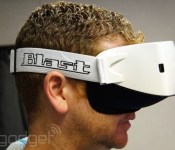
GameFace Mark IV: The other VR headset at CES 2014 (hands-on)

After all the time we’ve spent with Oculus VR’s latest Crystal Cove prototype last week — our first Best of CES award winner! — you might think we’re all VR’d out. You’d be wrong, and when the folks at GameFace Labs offered us a chance to check out their Android-based, standalone VR headset, we jumped at the chance.
The Mark IV model of GFL’s unnamed headset is a 3D-printed proof of concept, and it serves that goal fantastically. We put on the headset, were handed a paired Bluetooth gamepad (Sony’s DualShock 3) and were instantly transported to a lower-res version of the Tuscany demo we’ve seen running previously on the Rift. Only there’s one major difference here: no wires.
Pushing one of three front buttons on the outside of the headset, we jumped back out to a basic (placeholder) app grid where a handful of demos were selectable. Using the DualShock 3, we next jumped into a roller coaster demo where disorientation hit an all-time high — it was the first time this writer’s ever felt nausea while playing any VR demo.

That disorientation may be a standard of GFL’s VR headset, at least for now…and it’s kind of not their fault. The act of standing up and using a VR headset, untethered, is extremely scary. With a VR headset strapped on, there’s no way to re-center yourself in reality. After moving around, the only way to figure out where you are (again, in real life) is by removing the headset. By that point, you’re feeling really disoriented. Or at least we did.
All that said, it’s incredible using a VR headset without even one wire running out of it. The model we tried had a Tegra 4 powering games, meaning stuff like Dead Trigger and the Tuscany demo rarely hitched, or tore, or any other issues we’d expect to see with a low-horsepower device. A 5.2-inch LED panel with 1,920 x 1,080 resolution is cradled inside the headset, though a larger size is in the works. The folks at GFL are also planning on building out an Android VR store to support the headset, as playing games on the scale of the Oculus Rift simply isn’t possible (which makes sense, given that the Rift is powered by your PC).
But that’s okay, because for now, operable VR is impressive enough to circumvent graphics complaints. A platforming demo really sold us on GFL’s headset: a snaking, thin platform must be navigated, and the DualShock 3 only controls forward momentum and jumping. To turn or look, you must physically move your head and body. Oh, and the world is floating in the sky — which is terrifying. That last bit cannot be overemphasized. Despite rough graphical chops, the sense of vertigo was nearly overwhelming.
GFL’s got big plans for the Mark IV, which includes retail availability by the end of this calendar year as the device goes from prototype to product. The company’s even in talks with NVIDIA to potentially incorporate its new K1 chip, which would assuredly add another layer or two of processing power and graphical chops (as well as Unreal Engine 4 support).
Filed under: Gaming, Peripherals, Wearables, HD, NVIDIA

SimCity getting offline mode ‘soon,’ aims to fix long-broken relaunch

EA’s reboot of SimCity remains in a state of disarray, and the latest effort to correct the situation is an upcoming offline mode for the otherwise always-online game. This is a pretty major change considering all the noise made about SimCity depending on cloud computing to run, and creative director Lucy Bradshaw saying “significant engineering” would be required to take the game offline. It’s not completely clear how the offline mode will work, though we do know it’ll add a single player mode and offer local saves.
“You can save and load to your heart’s content,” EA Maxis studio manager Paul Buechner said in a blog post this morning, which longtime SimCity fans know is a main pillar of the series. The update is coming “soon,” and Buechner also confirms that city sizes will not be increased (another major request from players) and modding will be all the easier with players not affecting the overall online world.
Filed under: Gaming
Source: SimCity blog

Tell-all explores the Wii U’s development problems

It’s no secret that some game developers dislike the Wii U — performance issues, limited internet features and relatively slow console sales have made it tough for companies to justify support. But have you ever wondered what, exactly, went wrong? Wonder no more, as an anonymous developer has just shared many of the gritty details with Eurogamer. The insider claims that the sluggish CPU has been a concern since the beginning, and that the programming tools (not to mention feedback from Japan) have been sub-par. Nintendo’s inexperience with online services is also very clear. The company created chaos for Wii U developers with network code that only arrived at the last minute, and a key team hadn’t even tried PlayStation Network or Xbox Live before the Wii U’s launch. Price cuts and high-quality first-party games have helped Nintendo since then, but the source suggests that the firm can only do so much to court third-party developers entranced by more powerful hardware.
Source: Eurogamer

CES 2014: Gaming roundup

Gaming is once again a thing at CES! Since splitting from the Consumer Electronics Show in 1995 and creating E3, the game industry has sat out much of the past 20 years. Between last year’s big news from Valve and this year’s reappearance of Sony’s PlayStation, it’s never been a better time to be a journalist covering gaming at CES.
In case the resurgence of gaming news wasn’t enough to solidify our belief, the first ever Engadget-hosted Official CES Awards Best of Show trophy went to Oculus VR’s Crystal Cove Rift prototype. Gaming, as it turns out, is more innovative and exciting than the curved TVs and psuedo-fashionable vitality monitors of the world — not exactly a surprise, but validating our years-long assertion feels so, so right.
CES 2014 saw Steam Machines third-party support go official — we even told you about all 14 partners a full 24 hours before Valve loosed the info — a new, crazy/ambitious project from Razer, and Oculus VR’s latest prototype. And that’s to say nothing of Sony’s PlayStation Now and Huawei’s China-exclusive Android game console, or the dozens of interviews we did.
Steam Machines

The ongoing saga of Valve’s PC gaming living room initiative continued at CES 2014, with company head/beloved game industry leader Gabe Newell introducing just over one dozen third-party Steam Machines at a press conference. This is Valve’s second consecutive year attending CES, and the company behind Steam (not to mention gaming classics like Half-Life and Left 4 Dead) made another big splash in 2014. Pricing, specs, and rough launch windows were given to the various Steam Machines, which brings us all one step closer to the much-ballyhooed “Steambox” reality we’ve been hearing about for years now. Heck, iBuyPower’s is named “SBX” — take a wild guess what that’s short for.
Oculus VR’s Crystal Cove prototype

Depth-tracking? Check. Motion blur vastly reduced? Check check. A fancy new OLED screen? Yup, that’s in there too. The latest virtual reality headset from Oculus VR is nicknamed the “Crystal Cove” prototype — for reasons the company isn’t saying — and it offers a massive step up from even the HD prototype we tried back at E3 2013. The first of the trio of new features is accomplished by adding IR trackers to the front of the Rift headset, combined with a camera facing the player (in-tandem with other data collected via internal sensors).
After trying the latest Rift, I spent the rest of CES evangelizing the device to my colleagues. From mobile phone geeks to in-house photog Zach “Honey” Honig (Hi Zach!), no staffer came away unimpressed. Two evenings of heated arguments later, and we chose Crystal Cove for our Best of CES award.
Razer’s Nabu and Project Christine

A wearable from a gaming company? You’ll forgive my confusion, but Nabu is pretty far from normal for Razer. If anything, perhaps we shouldn’t expect Razer to be pedestrian — this is the company, after all, that created the Razer Edge and routinely names its devices stuff like “Kraken.” Between the unbelievably low price ($50 for the dev model), the two OLED screens, and the sophisticated abilities Nabu offers, though, we’re convinced it’s a great, if bizarre, idea.
Where Nabu is ambitious, Project Christine is insane. The crazy-looking modular gaming PC isn’t the same iterative, bland exercise so much of the PC world continues to produce: it’s exactly the kind of bold experiment we’re excited to share with you. Beyond the fact that it’s a modular PC — which, unto itself, is relatively unknown territory — it’s got a custom motherboard, mineral oil cooling, and a design that dramatically stands out from the pack. Christine isn’t necessarily destined for retail (Razer’s still waiting to hear how consumers respond post-CES), but we sure hope it does become widely available at some point.
The Rest
Microsoft and Xbox weren’t really at CES 2014, but I did spend some time speaking with Xbox head Marc Whitten about the Xbox One’s first big post-launch update and his thoughts on the evolving world of gaming. And beyond our hands-on time with the new Rift prototype, company CEO Brendan Iribe talked to us about Oculus VR’s internal game development aspirations. Company founder Palmer Luckey joined us on the show floor stage once again to talk Crystal Cove, as did the always gregarious Razer head Min-Liang Tan. Sony head Kaz Hirai sat down with managing editor Christopher Trout to talk PlayStation 4, “one Sony,” and the just announced PlayStation Now game streaming service. In case it weren’t already clear, there’s a ton of great original gaming coverage to pour over as the weekend rambles on. And that’s just gaming!
Filed under: Gaming, Wearables, Software, HD, Sony, Microsoft

Microsoft’s Xbox head isn’t worried about Steam Machines and Oculus Rift; he’s excited
Two of the biggest stories at CES 2014 involve gaming, and neither involves the big three entrenched console makers (Sony, Microsoft and Nintendo). Oculus VR’s latest prototype, dubbed “Crystal Cove,” and Valve’s Steam Machines initiative are overshadowing even Sony’s big PlayStation Now news, to say nothing of curved displays and wearable whatevers. Despite that overshadowing, Xbox Chief Product Officer Marc Whitten isn’t too worried about either — in fact, he’s really excited about both and what they mean for the larger game industry he loves.
“This is literally the most golden of golden ages that I’ve ever seen around gaming,” Whitten told us in an interview this week at CES 2014. “I think this is what makes gaming great. And you love seeing the passion of seeing someone like Palmer [Luckey] and those guys at Oculus. And seeing someone like John Carmack get on and really be focused on it is great. I don’t know how it could be anything but good.” He didn’t say whether or not dev kits are with Microsoft, but he’s used the headset and likes what he’s seen.
Moreover, he isn’t worried about it cannibalizing Xbox One sales. “It’s just gonna increase the surface area, and I think that’s an incredible thing,” Whitten said. Valve’s Steam Machines initiative is another story.

First things first, we had to know if Whitten had a response to Valve head Gabe Newell’s jab at Xbox One’s 3 million sales number. (Spoilers: he didn’t.) “The last thing I’ll ever do in my entire life is get into a flame war with Gabe Newell. There’s no win in that,” Whitten laughingly told us. Jokes aside, he’s skeptical of the Valve initiative. “I personally don’t know how to think about Steam Machines yet,” he said. “I’m not knocking it or whatever. I continue to think that PC gaming — the sort of uber configuration and I can change everything and I can mod — that’s an important thing and there’s a lot of people that wanna do that.”
Specifically, we wanted to know if he sees the initiative as competition for both the Xbox One and PlayStation 4. Frankly, he doesn’t. “When you get into that living room environment, you don’t want to spend any of your brain cells doing anything but being entertained. I don’t want to work on it; I don’t want to feel like I have to know how it works. I would like to be blowing things up now, or watching a thing now. That’s the fundamental thing that you want to do,” he said. “I think there’s space for both. I’m not sweating it.”
So far, we agree with Whitten’s assessment. The living room experience on a game console like Xbox One or PlayStation 4 remains vastly superior to that of even Steam’s long-running Big Picture Mode (intended for living rooms). In 2014, Valve’s SteamOS and Machines initiative still needs to prove competitive with the new game consoles. With the competition stiffer than ever, we can’t wait to see what everyone has in store. As Whitten said, all of this is nothing but good for gamers.

Nintendo boasts ‘record-setting’ 16 million 3DS game sales in 2013

Nintendo’s handheld business is booming right now, and the company has the stats to prove it. In its annual overview released today, the company says it sold a record-breaking 16 million 3DS games in 2013, which translates to a 45 percent increase over last year. US consumers played a big part in Nintendo’s bumper year, accounting for 11.5 million of Nintendo’s 35 million 2DS and 3DS lifetime sales. Despite its precarious financial situation and a recent ruling requiring it to share some of its 3DS sales revenue, Nintendo reckons it has plenty more left in the tank: “We’re not slowing down in 2014,” says Scott Moffitt, Nintendo’s EVP of Sales, “the best days of Nintendo 3DS are still to come.”
Source: Nintendo (BusinessWire)

Google update paves the way for more multiplayer games in the Play Store

Google’s latest update to Play Services should keep its mobile OS developers busy for a bit, particularly if they’re making games. Android’s SDK now has asynchronous multiplayer baked in, the kind of turn-based system that makes playing Words With Friends with distant pals possible. The update also features a developer preview of the new Google Drive API, better auto-complete options when sharing to Google+, and fixes the battery-draining bug that affected some Android 4.4 KitKat devices. Thrilling updates? Not quite, but it’s good to see Google investing in its budding games services.
Filed under: Gaming, Mobile, Google
Source: Android Developers Blog

