


Microsoft built 75 Xbox One prototypes before settling on its finished design

Gadget design is rarely a simple process, and we now know that the Xbox One is no exception to the rule. Microsoft designer Carl Ledbetter has revealed that the game console went through many 3D-printed incarnations before the company settled on a final product; there were 75 system prototypes, 100 for the Kinect and 200 for the gamepad. The development team spent a long time finding a balance between familiar Xbox design cues and the desire for an always-on media hub, Ledbetter says. Whether or not you think Microsoft achieved its goal, it’s clear that the Xbox One’s current look was never guaranteed.
Filed under: Gaming, Microsoft
Source: Microsoft
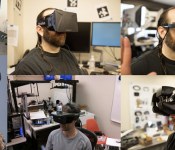
Valve: The future of Virtual Reality is just one year away

The most exciting aspect of contemporary virtual reality is its implications. Even using Oculus VR’s early duct taped-prototype, most users immediately “get it.” You’re transported to, say, Tuscany, or an underwater exploration vehicle, or a space fighter, and that experience is enough to trigger a flood of ideas for other potential interactions — interactions that are dramatically heightened by employing a VR headset. How about deep-sea exploration in 4K? Or maybe Mars? And we’re not talking just video games, but experiences. Valve VR lead Michael Abrash detailed that notion in a recent talk:
“Not only could VR rapidly evolve into a major platform, but it could actually tip the balance of the entire industry from traditional media toward computer entertainment.”
Abrash believes that VR headsets so vastly outperform other interaction methods (TV, theaters, etc.) that how folks absorb media in general may be impacted by the coming wave of head-mounted displays. His concept of our potential future may be distant-sounding, but the beginning of consumer-grade, extremely polished VR headsets isn’t far off: 2015. At least that’s what Abrash and Valve are targeting as primetime for VR, and they’re laying the groundwork right now.
 This is a VR prototype headset from Valve
Valve’s first ever game developer conference, dubbed Steam Dev Days in honor of the company’s ubiquitous digital storefront/ongoing socio-economic experiment, took place this week. Abrash gave a talk titled “What VR Could, Should, and Almost Certainly Will Be Within Two Years,” where he detailed the current state of VR, what challenges the technology faces going foward, and when he (and Valve) believe it’ll be ready for primetime. In it, he established a baseline of standards for VR: perfect timing to lay a base given Oculus VR’s own standards for VR game development going live at nearly the same time.
First, any VR headset needs to create “presence” for the person using the headset. Abrash defined presence as such:
“It’s the sense of being someplace else while in virtual reality; many people feel as if they’ve been teleported. Presence is an incredibly powerful sensation, and it’s unique to VR; there’s no way to create it in any other medium.”
Cliché as it is, VR headsets aim to do exactly what their name implies: simulate a new reality for the user, real enough to fool the human brain. Oculus VR CEO Brendan Iribe echoed that sentiment to us earlier this year when he said that the closer the experience is to reality, the better the experience is for the user. Sadly for us writers, “presence” — or rather the experience of using a virtual reality headset and being convinced – is incredibly hard to convey with just words. “Most people find it to be kind of magical, and we think that once people have experienced presence, they’ll want it badly,”Abrash noted during his talk.
Moreover, Abrash thinks that the VR hardware available right now — including the latest Oculus Crystal Cove prototype — is still a step or two away from the specs required for true presence. He even has a list of target specs required for creating presence (which Valve has functioning in an R&D headset right now, and was shown to developers during Steam Dev Days):

The Crystal Cove prototype that Valve provided support for is “a big step in the right direction” Abrash said, but still not enough to create the sense of presence he and Valve are aiming to achieve. While Valve continues R&D on virtual reality hardware — Abrash said “several” companies are working on VR headsets, though we only know of two officially creating consumer products (Oculus and GameFace Labs). The company’s also building out Steam’s VR software support to stay ahead of the curve. That’s why SteamVR just went live (a VR version of Big Picture Mode) in beta; why VR games now have their own category in the Valve’s store; and why the company created the SteamVR API (read: it makes games play nice with the SteamVR platform).
Valve’s yet to give press a chance to try its VR hardware prototype, but developers who tried it at Steam Dev Days are responding positively thus far. It apparently has specs similar to what’s detailed above, and we’re not entirely clear on whether or not it uses a camera in conjunction with the headset for positional tracking (a la the latest Rift prototype). Given Valve’s openness during Dev Days and Abrash’s assertion that Valve is open to working with any partners to push VR forward, we’re certain to hear more in the coming year(s).
Abrash ended his speech with a confident, thrilling statement regarding VR:
“A great VR system at a consumer price in 2015 is more than just possible – it’s sitting there waiting to happen. And it will happen, if not in 2015, then soon after. Virtual reality on the PC over the next few years may be as exciting as anything that’s ever happened in games. We’re sharing what we’ve learned with you, and we’ll continue to do so. There’s a huge amount to be learned and figured out about VR, and we certainly can’t figure it all out by ourselves; I hope that as you dive into VR, you’ll make it a two-way exchange, so together we can make VR one of the great entertainment evolutions.”
Filed under: Gaming, Peripherals, Wearables, Software, HD
Source: Michael Abrash (PDF), Joe Ludwig (PDF)

Gran Turismo documentary ‘Kaz’ premieres on Hulu January 22nd

If you were wondering exactly when and where you’d be able to watch the Gran Turismo documentary, we have the answer. On January 22nd, Kaz: Pushing the Virtual Divide will make its way into your home via Hulu streaming. PlayStation is hosting a round-table discussion with the filmmakers and Kazunori Yamauchi himself via its Twitch.tv channel that day, too. Need an incentive to tune in? Well, during the broadcast, you’ll have a chance at winning $1,000,000 — in Gran Turismo 6 bucks, of course. Now if you’ll excuse us, we need some time to ponder why Sony didn’t debut the film on its own streaming video service.
Filed under: Gaming, Home Entertainment, HD, Sony
Source: PS Blog

Sony patent filing would let you reshape your PlayStation Move controller

Typically, motion controllers aren’t very good at adapting to different gameplay situations — not unless you’re willing to slap on a cheap plastic shell, anyway. Sony may improve that state of affairs in the future, though, as it recently filed for a patent on a modular PlayStation Move controller. The concept lets gamers attach parts to the Move that change not just how it feels, but how it behaves in-game. A set of “limbs” would turn it into a humanoid, for example, while a rotating part could switch between a gun and a sword. It’s an intriguing idea, although we wouldn’t count on seeing it any time soon. A modular system would likely raise the price of a future Move controller, and Sony has lately focused more on the DualShock 4′s Move-like features than dedicated peripherals.
Filed under: Gaming, Peripherals, Sony
Via: Push Square
Source: USPTO

AMD Kaveri review roundup: a solid gaming chip that’s ahead of its time

It’s been a busy week for AMD news, what with the launch of the Kaveri APU and then our first real evidence of how the new Mantle drivers can impact on PC gaming. But now’s the time to kick back and check out some full reviews of Kaveri over at the specialist sites. We’ve rounded up some of the best articles after the break, and if you’re looking for brutally short executive summaries, we’ve got some of those for you too.

AnandTech — Based on a suite of traditional, real-world application benchmarks such as WinRAR, Kaveri usually struggled to match a Core i3 — except in those few applications that made good use of GPU compute via OpenCL. With games, on the other hand, Kaveri was usually better than a Core i7 in the more challenging scenarios, and you really should check out the site’s full frame-rate charts. The A10-7850K is actually able to play F1 2013 at max detail and 1080p resolution with a frame rate of 31fps, for example, versus 14fps from a much more expensive Core i7-4770K. Overall, Anandtech concluded that Kaveri could be an “ideal fit” for many people who aren’t power users but who like to indulge in a bit of gaming, but its reviewers also highlighted the fact that AMD has been tepid about supporting dual graphics for those who want to pair Kaveri with an Radeon R7-series graphics card (Kaveri also uses R7 graphics, so theoretically it should be possible to add the two GPUs together).

HotHardware — This site focused on the A8-7600, which can be customized to burn at 45W or 65W and is therefore aimed at small form factors (like HTPCs and Steambox-like gaming builds). In a number of synthetic graphics-focused benchmarks, such as 3DMark, this scaled-down processor was actually very close to (and sometimes better than) AMD’s flagship 95W from the previous generation (Richland), and also often better than any full-powered Haswell chip. Overall, despite it lagging behind Intel in single-threaded tests, HotHardware gave the A8-7600 its “Approved” badge.

ExtremeTech — This site spent a bit more time taking account of AMD’s new HSA technology. In its most practical sense, HSA is a fresh approach to GPU compute, but there is no mainstream software that makes use of it just yet. Instead, ExtremeTech ran a few niche HSA-enabled benchmarks to explore HSA’s potential, and they were pleasantly surprised: a JPEG decoding test showed that the A10-7850K was almost twice as fast as a Core i5-4670S, and even the A8-7600 was quicker than any Intel chips. A second test based on number-crunching within LibreOffice’s Calc spreadsheet application showed that the A10-7850K was about five times faster than the Core i5. Overall, this review concluded that, aside from its obvious gaming prowess, “Kaveri will only be competitive if developers implement the necessary optimizations for HSA,” and that pretty accurately sums up where AMD’s newest APU stands right now.


The Engadget Show 49: CES 2014 wrapup

Grab a wearable, switch on the ‘ole curved TV and fire up your favorite 3D printer. We came, we saw, we conquered and now we’re ready to distill it all for you in the form of some high-quality video content. We’re not going to suggest that it’ll replace the seemingly endless stream of posts we’ve churned out over the past week or so, but if you’ve got a cocktail party full of guests you need to impress tonight, it’ll help you drop some serious CES 2014 tech news knowledge on their collective heads.
We’ve pulled together some top editors to offer up an abbreviated view of tech’s biggest show of the year, charting trends in old standby categories like HDTV, mobile, tablets and cars, to emerging spaces set to define the changing face of the show for years to come. Oh, and we’ve also tossed in some fun video of the show’s gadgets, because, well, it wouldn’t be much of an Engadget Show without that sort of thing, now would it? Toss in a bit of video of your long-time host getting a bit welled up the end, and you’ve got yourself a little thing we like to call The Engadget Show 49.
‘Til we meet again, Engadgeteers.
Filed under: Announcements, Cellphones, Desktops, Cameras, Displays, Misc, Gaming, GPS, Handhelds, Home Entertainment, Household, Laptops, Meta, Peripherals, Podcasts, Portable Audio/Video, Robots, Tablets, Transportation, Wearables, Wireless, Storage, Networking, Science, Internet, Software, HD, Mobile, Alt, Apple, Samsung, Sony, Microsoft, HTC, Nokia, ASUS, Google, Amazon, Verizon, Sprint, AT&T, LG, AMD, Intel, Blackberry, T-Mobile, HP, Dell, Acer, NVIDIA, Nikon, Canon, Facebook, Nintendo
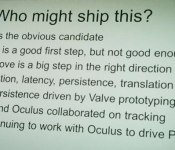
Valve’s investing in VR, but has no plans to release its own hardware

Remember that Oculus Rift prototype that ran away with our Best of CES 2014 award? Turns out Valve helped make it a reality. Speaking at Steam Dev Days, Valve’s Michael Abrash explained that the two companies collaborated on the Crystal Cove prototype’s new tracking features, which combines sensors, markers and an external camera to keep track of the user’s head and body position. In fact, the software company seems to be pitting most of its hopes for the space on the VR startup, noting that it currently has no plans to ship a Valve-produced headset. Although Abrash doesn’t expect virtual reality technology to become mainstream for another two years, he does say that the Crystal Cove prototype is a big step in the right direction.
Even so, there’s still a lot of room to grow: headsets still need to shed their tethers, improve optics and solve multiple head and eye tracking issues. There are also content hurdles to overcome. According to Oculus founder Palmer Luckey (also taking the stage at Steam Dev Days), developers should be focusing on creating experiences tailored to VR. “Stop thinking about porting existing games,” read one of his slides. We’d have to agree: EVE’s Valkyrie demo is one of the most compelling VR experiences one can have, and it’s built specifically for the Rift. Despite the issues facing the budding technology, Valve seems confident that it will flourish, and pledges to continue working with Oculus to drive the VR revolution onward. Sounds mighty fine to us.
[Image credit: @DaveOshry]
Filed under: Gaming
Source: Twitter (1), (2), (3)

Microsoft: Xbox One is #1 in the US for December with 908,000 consoles sold

Microsoft and Sony already went head to head with worldwide sales numbers for 2013 and while the PS4 rode is out front there (4.2 million to 3 million), the Xbox One apparently sold more systems in the US last month. December figures from the NPD group arrived today, and Microsoft is touting 908,000 sales for the XB1 that put it atop the next-gen videogame systems, and 643,000 for the Xbox 360. That puts it third overall on the home hardware list and first for its generation of hardware. Per Joystiq, Sony’s response to the data is that the PS4 remains “cumulative leader for next-gen sales” since its launch November 15th, a week ahead of the Xbox One.
Nintendo hasn’t released specific data yet, but the 3DS was the highest selling console overall for both the month of December and all of 2013, and Liam Callahan of the NPD said the Wii U enjoyed its “highest month for unit sales.” The NPD’s release has more details about software, where GTA V took the crown overall for 2013, ahead of Call of Duty Ghosts, Madden NFL 25 and Battlefield 4. Microsoft is also pointing to those numbers, saying the Xbox One took six of the top 10 spots for next-gen game sales, and total software sales of 4.8 million to PS4′s 4.2 million. Now that fans have plenty of sales numbers to represent why their chosen next-gen game system is the best, the rest of us can get to the exciting business of waiting for the first round of major software updates.
NPD: Xbox One and Xbox 360 were the top selling consoles for each generation in the US in December. 908k (Xbox One) and 643k (Xbox 360)
– Larry Hryb (@majornelson) January 16, 2014
Some good #NPD SW facts: #XboxOne YTD 2013: 4.8M retail games vs. 4.2M for PS4. COD & BF4 both sold better on #XboxOne.
– Aaron Greenberg (@aarongreenberg) January 17, 2014
Filed under: Gaming, Home Entertainment, HD, Sony, Microsoft, Nintendo
Source: Xbox News Wire, Joystiq

HBO Go is coming… to PS3 and PS4

HBO Go is en route to PlayStation. While there isn’t a release window for the premium service’s streaming app, Sony’s VP of business development assures it’ll be “soon” for the PS3, with the PS4 version to follow. However, we do know that as with other streaming services on the platforms (including Amazon Instant Video and Netflix), the app’s functionality won’t be locked behind a paywall, like it is on Sony’s biggest console rival.
PS3 getting its very own @HBOGO app, with a PS4 app to follow: http://t.co/L82wJr8eyb Time to catch up on Game of Thrones!
– PlayStation (@PlayStation) January 17, 2014
Filed under: Gaming, Home Entertainment, HD, Sony
Source: PS Blog

Oculus’ best practices explains how to create a VR experience that doesn’t make people sick

Couldn’t make it out to Valve’s Steam Dev Days to hear Palmer Luckey gab about how to build a good virtual reality experience? No worries – Oculus’ new VR Best Practices guide will fill you in on the details. The 39-page document is designed to help combat simulator sickness, which can leave users of a poorly optimized virtual reality experience feeling nauseous, disoriented and uncomfortable. Inside it has guidelines for minimum framerates, graphics aliasing and response times, but most of it focuses on creating an experience that feels natural to the user.
Seemingly simple things, like a player’s walking speed or limitations in camera control, can have a major impact on how uncomfortable a player can feel in a virtual space. The user’s awareness of their own presence in VR is also pretty important. “Looking down and having no body is disconcerting,” the document reads. “A full character avatar can do a lot to ground the user in the virtual environment.” The guide has health warnings too, suggesting that users take 10 to 15 minute breaks for every hour spent in the Oculus Rift and declaring its 3D technology potentially unsafe for children. Gee, that sounds familiar.
Today, we’re excited to share our VR Best Practices with all of you: https://t.co/GY6FNDvOyx
– Oculus VR (@oculus) January 16, 2014
Filed under: Gaming

