



Tokyo Toy Show 2014: Robot pets, maglev toys and more!

It’s our first year touring Japan’s premier toy show, and we’d be happy to do it again. Among traditional wooden blocks, tricycles, action figures and card games (so many card games!) there’s a number of toys with a high level of technology — like maglev toy trains. Japanese toymakers continue to produce robot toys, hoping for either AIBO-like moment of fame, or at least a hit for the holidays. Several companies were also trying to convince not-quite-teens to get their parents to pay out for (admittedly cheaper) smartphone-like gadgets. One LINE-branded gadget even lets tweens play games, send stickers and messages once it’s either within range of a friend’s (actual) smartphone or through WiFi — it uses a low-fi, simpler version of the messaging app. Surprisingly, for a trade show, nearly every product on show here already had a price and a launch date — at least for this side of the Pacific. Many, many more toys, after the break.
MiP: the controllable toy robot waiter

MiP is a two-wheeled robot that keeps itself upright Segway-style, and generally hurls itself around without bumping into things… most of the time. By rotating the wheel, the robot cycles through seven modes, with a dance, balance (for carrying things around), running, controller, free running and study modes. With sensors built into the front, you can can either rebuff his advances, or gently steer him by gesturing to the left or right of the robot’s eyes. With a smartphone, you can draw a route with your finger, battle other MiPs or just get it to dance along with your music collection.
We were most impressed with it’s ability to carry around small objects (our drinks), although it looks like you’ll have to place the drink on MiP’s tray before ordering it somewhere, which defeats the purpose of it, namely our own laziness. The robot is being pitched as a toy for both kids and adults, and it’s an undercurrent of the entire show. A decreasing population and low birthrate has meant that Japan’s toymakers are casting their net wider than normal: if adults are interested, then there’s simply a better chance of it being to a top-selling toy. MiP will launch this week for 15,000 yen.
Pet robot cats! (And dogs. And chicks)
Dream Cat Celeb is here. That’s a direct translation of this furry, carry-able (weighs as much as a cat?) robot with touch sensors along its head, chest, back and tail. Just like the real thing, it doesn’t like it when you touch its tail. The facial expressions are pretty good, although robotic whirring and squeaking needed to accomplish that ruins the effect a bit. This new model is set to arrive in Japan next onto, priced at 12,000 yen ($117) but Hasbro says the cat is still in development, so this may not be the very final model. We’d like the fur to be a bit more natural. It has a plastic, artificial feel to it, but it remains a luxury version of Hasbro’s Furreal toy range from a few years back.

A more portable, cheaper, pet than the cat, this chick will also arrive next month, priced at around 2700 yen ($26), and it packs a single sensor on the top of its head. Pet it properly, and its tiny wings will flutter. If you’re into neon-colored chicks, the company also had blue, mint green and pink versions, although theses were currently only for show.

Primed to capitalize on that meme, the bigger (and heavier), Shiba-chan can run on its battery, or while being plugged in. It reacts to voice commands, (the makers say it has 85 different behaviors) although the current developmental model had some issues hearing through the noise and general mayhem of a toy show. In Japanese, it was able to shake hands, sit up and beg, while petting it right will make Shiba-chan wag its tale and “make happy noises”. There’s even the obligatory toy bone that it’ll hold onto if you offer it up to his mouth. Man’s best robot friend won’t be cheap: when it launches this November, it’ll be priced at 40,000 yen ($392) .
Toy smartphones

That smartphone boom? Toymakers want to get young-’uns hooked early with substantially cheaper (and let’s not kid ourselves) less advanced communication devices. They run the full gamut of functionality: some were running Android (with app store access), while others had their own UI that looked like Android but were actually pretty bare-bones — they did connect to purikura photo booths — they’re very big in Japan. The LINE “My Touch Smart” mentioned in the intro runs everything from a LINE-styled portal, although the admittedly chunky device did have a camera, over 300 stickers built-in and a micro-SD slot for music playback. The other phone toys are heavily bejeweled, and you can any color as long as it’s pink (and possibly powder blue.) Prices for these hover around the $100 mark, however, making it a whole cheaper than an iPod touch.
More coverage from the Tokyo Toy Show 2014:
High-speed maglev toys are coming in 2015
This remote-controlled car moves on land, air and sea
Filed under: Cellphones, Gaming, Peripherals, Robots, Transportation
This remote-controlled car moves on land, sea and air

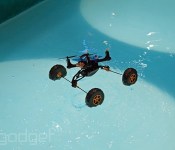
We probably have drones to thank. They’ve helped the price of flying vehicles plummet from the days of gasoline-powered helicopters, but what about water? Or racing on land? For those, you might want to consider Takara Tomy’s newest radio-controlled vehicle, the Earth Rider RC (or the 陸海空RC, “Land Sea Air RC”). At the Tokyo Toy show, we got to see it fly down roughly six feet to neatly land on the water, where its tires keep the car afloat — and those important electronics out of harm. The same propellers that can put it into the air can then glide the RC across the water, like like a pond skater, except for, well, the propellers, wheels and things…
You’ve probably heard of vehicles that transition between areas before, but the appeal here is how it transfers to the air (or water) without any transformation or mode change. It appears that the wheels aren’t powered, but that the force from the quad-copter blades compels it to move it somehow like a car. Also, as it’s a mere 50 grams, the toy company says it will move/fly/float for around five minutes after a 30-minute charge, while the controller itself runs on six AA batteries. This all-in-one RC launches in Japan this October for around $91 (9,250 yen), but there’s no news on whether it’ll make it across to the US — whether it can roll on water or not.
Filed under: Gaming, Transportation
Source: Takara Tomy (Japanese)

Feedback Loop: Discussing E3, Nintendo, live streaming and more!

This week’s edition of Feedback Loop is packed with gaming goodness. We discuss all the E3 things, analyze Nintendo’s upcoming titles, share the worst games we’ve ever played and find out if watching feeds of other people gaming is any fun. You’ll find all this and more in our fabulous forums after the break.
Share your thoughts on E3!
Sony, Microsoft and Nintendo all announced a slew of new games this week. Whether you’ve got a next-gen console or not, there’s plenty of eye candy for everyone. Head over here and let us know which are the must-haves for your collection.
Breaking down Nintendo’s new games
We love Mario… and Link. There, we said it. And that’s why we loved Nintendo’s announcements at this year’s E3. Open-world Zelda game? Check. Designing your own Super Mario Bros. levels in Mario Maker? Check. Head to the forums to share in our collective joy? Check.
What is the worst game you’ve ever played?
Some people consider the Atari game E.T. to be among the worst video games of all time. With all the E3 news going on this week, playcrazy thought it would be a perfect time to talk about the most awful games that we’ve ever played. Go ahead, tell us yours. Do your worst.
Do you watch live streams of games?
Live streaming is the future, right? Twitch is all over next-gen (at least according to Microsoft and Sony). Kris ponders Nintendo’s streaming aversion and why people enjoy watching other people play games. Which kind of person are you?
That’s all this week! Want to talk about your favorite gadget or have a burning question about technology? Register for an Engadget account today, visit the Engadget forums and start a new discussion!

Gadget Rewind 2006: Nintendo Wii

Nintendo planned a “Revolution” for your TV. When it arrived in 2006, it was a lot more fun than the confrontational term might imply. Revolution turned out to be the code name for the company’s new console, and just before E3 that year Nintendo ditched the subterfuge and unveiled its official title: Nintendo Wii. It was revolutionary, using motion-tracking remotes to get players off the couch and involved in the action. The Wii rapidly became the centerpiece at parties, stepping into the arena with classics like Pictionary and charades. The console’s popularity was also a welcome turnabout for Nintendo, which had been languishing over its latest console’s missteps.
When the Nintendo Wii launched in late 2006, it made the holiday deadline, but also ended up in head-to-head competition with Sony’s PlayStation 3. While the PS3 and Xbox 360 offered higher-resolution games and more complex titles, they didn’t really have the motion-tracking magic that Nintendo brought to the table. At least not until 2010, when Sony’s PS Move and Microsoft’s Kinect appeared on the scene.
The Wii’s success was about accessibility. Nintendo games like Wii Sports — wisely bundled with the console — and WarioWare showcased the system’s uniquely intuitive controller. Players got to act out their favorite sports: swinging the remote around like a baseball bat, golf club or bowling ball. Even mundane activities like cooking could be transformed into hours of enjoyment through the Wii. Sadly, third-party game studios never quite figured out how to mirror the success of Nintendo’s first-party. As a result, few third-party games were sold on the Wii, which led most studios to give up on supporting the system.
Even though the console was an enormous hit, Nintendo decided that it would have to evolve in order to compete with emerging trends. In late 2012, Nintendo launched the Wii’s successor with a slightly tweaked moniker: Wii U. Its GamePad controller was aimed at challenging tablet gaming and providing a “second screen” experience. Unfortunately, the launch left many confused. With such a subtle name change, it was often misinterpreted as an add-on for the existing Wii system — which it wasn’t.
Just like life, Nintendo’s consoles seem to have lots of ups and downs, at least in terms of market success. The Wii was definitely a high point in its history of gaming systems. It sold over 24 million units by its second year and surpassed 100 million units in its lifetime. The impact of that system even served to inform future consoles of competing brands. The mainstream affinity for Wii Sports led to developments like Wii Fit and its Balance Board accessory, which took things a step further by adding fitness tracking and exercise programs into the mix. The living room could now serve double duty as a gym, and children (as well as adults) no longer needed to suffer the oppressive nature of “going outside” just to get some exercise.
Did you own a Nintendo Wii? Add it to your Engadget profile as a device you had (or still have) and join the discussion to reminisce or share photos of your device with other like-minded gadget fans.

These are the biggest Nintendo games at E3 2014

Nintendo’s in a weird place. The company’s got a game console that no one’s buying, the Wii U, and it’s the only place to play some of gaming’s biggest franchises: Super Mario, The Legend of Zelda, Metroid, Donkey Kong. The list goes on. Nintendo’s also got a tremendously popular handheld game console, the 3DS, but Wii U software was the focus of E3 2014. Rather than a press conference like in the past, Nintendo chose to unveil its E3 news in a digital venue: a Nintendo Direct video stream. Much of Tuesday morning’s announcements were available to play at E3, impressions of which we’ve shared below.
And yes, we played a lot of Smash Bros.
YOSHI’S WOOLLY WORLD
For those who don’t remember Kirby’s Epic Yarn, the cutesy platforming game that came out on Wii in 2010, allow us to jog your memory. It’s a standard Kirby platforming game — relatively easy, the same chameleon mechanics Kirby is known for — but the world (and all of its characters, including Kirby) is made of yarn. As if a fluffy pink ball of a character wasn’t cutesy enough, eh?
In 2015, the Yoshi’s Island-themed iteration of Epic Yarn is coming to Wii U in Yoshi’s Woolly World. Like Yoshi games before it, you jump on enemies, consume them to create shootable eggs, and exaggeratedly jump across gullies as Mario’s goofy green dinosaur. Like Epic Yarn, well, everything’s made of yarn. Rather, it’s made of “woolly” things this time around. The levels are gorgeous and look like real, living worlds, only everything’s made of craft store items. Secrets abound, and the textured cloth effect is hidden everywhere. In the demo we played, there weren’t any GamePad-specific features beyond off-screen play.
We’re not exactly upset, but the GamePad not being featured was a theme among the demos we played.
CAPTAIN TOAD: TREASURE TRACKER
Super Mario 3D World was a highlight of 2013, if not the best game released on game consoles last year. And a highlight of Super Mario 3D World was Toad’s puzzle levels, wherein you navigate a twistable 3D maze using a light helmet-wearing Toad. They were a welcome aside, and a notable deviation from the usual Mario formula. Nintendo apparently recognized their excellence as well, awarding Toad his own game — Captain Toad: Treasure Tracker — and making the puzzles better than ever.
In 3D World, Toad’s worlds were limited. In Captain Toad, they range in size dramatically, from the standard-ish 3D cube to a vertical world inside a volcano. On one puzzle, we had to carefully time our movements based on the attacks of a fire-breathing lava monster. On another, we struggled with deciphering the twists and nooks of a floating world. We’re told it’s not a digital game, but a full release; Captain Toad: Treasure Tracker arrives this holiday.
Oh, and most importantly, there’s a button reserved for making Toad say silly things. Perfect. If we could somehow get a level that involves Toad wearing an astronaut suit on the Moon, that’d be great. Thanks Nintendo.
SUPER SMASH BROS. FOR 3DS / WII U
You’ll have to excuse me as I break format here for a moment: I come to Super Smash Bros. for Wii U/3DS as a longtime player of the series and a total Smash nerd. I’m going to restrict this piece to a broader approach, but I welcome your questions on Twitter. That said!
Super Smash Bros. for Wii U and Super Smash Bros. for 3DS are completely different beasts. The issue isn’t so much that they’re different games — they are, but not that different — but that the control methods for each are so wildly different. Even on a 3DS XL, which we used to play Super Smash Bros. for 3DS, it’s really tough and kind of painful. Blocking is a central component to any fighting game, and in Smash Bros. it’s handled by the shoulder buttons. In practice, this means discomfort at least and, more likely, frustrating hand cramps.
3DS control issues aside, both games play a lot like you’d expect. Nintendo favorites return and new favorites are added; it’s the same raucously fun affair it’s always been. We loved Little Mac — he’s fast and brutal — and Samus — she’s better than ever. Mega Man was seemingly less powerful than we expected, but with only 10 rounds to play, we’ll need much more time before leveling any real judgment. Though the 3DS version is noticeably pared down, both games are very pretty and run just as smoothly as we hoped. Both versions of Super Smash Bros. are set to arrive this holiday, with the 3DS version launching a bit sooner in October.
HYRULE WARRIORS
The folks behind Dynasty/Samurai Warriors were given access to the world of The Legend of Zelda. The result is Hyrule Warriors, a third-person action game that revolves around quickly disposing of large quantities of enemies to achieve an ever-changing set of goals. It’s fun, quick, and light. There are plenty of Zelda references embedded, from the loading screen 8-bit animation to the trademark jingle that plays when treasure chests are opened, but this is pretty far from a main series Zelda game.
Hyrule Warriors is fine, but nowhere near the grandeur or delivery of a standard Zelda entry. Sadly, all we have for now is a 2015 window and a brief tease of the actual next series entry from longtime producer Eiji Aonuma.
MARIO MAKER
We’re not even gonna bother with this one — check out Brad Molen’s lengthy writeup right here. We can confirm that Mario Maker is a treat!
Someone is making a handheld Steam game system

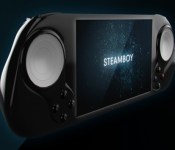
Every Steam Machine shown so far has amounted to a small desktop PC. But what if you want to take that gaming experience on the road? Well, you might get your wish — meet Steamboy, a handheld take on Valve’s platform. On the outside, it’s pretty much what you’d expect; it looks like an Steam Controller prototype (including the signature touchpads) with a 5-inch display slotted in between. Its creator (Steamboy Machine) isn’t giving out many other details right now, but it tells The Escapist that the device’s quad-core processor (likely either an Intel Atom or AMD A4) and 4GB of RAM “won’t be as powerful” as other Steam Machines. That’s not surprising given the size, however, and it should play the “majority” of titles. There are also promises of 3G mobile data and 32GB of built-in storage.
It sounds promising, even if the device is likely going to be limited to low-intensity games. However, that’s also assuming that this mini Steam Machine makes its 2015 release window. Right now, Steamboy exists as little more than a slick teaser video and a set of specifications — there’s no prototype to prove that this will be a real product. We’ve reached out to the team for more details, but you might not want to cancel that 3DS or PS Vita purchase until it’s clear that Steamboy will ship.
Filed under: Gaming, Handhelds
Via: The Escapist, Engadget Spanish (translated)
Source: Steamboy Machine

Weekends with Engadget: E3 2014, getting sweaty with Sony’s Project Morpheus and more!

This week, we stormed the floors of E3 2014, interviewed Shuhei Yoshida and Phil Spencer, took Sony’s Project Morpheus for a test-run and watched Amazon launch its Prime Music streaming service. Read on for Engadget’s news highlights from the last seven days. Oh, and be sure to subscribe to our Flipboard magazine!

Getting sweaty with the future of Sony’s virtual reality
Sony wants to be the one to take VR mainstream, but according to its senior director of R&D Richard Marks, that push won’t happen in 2014. Read on as our own Joseph Volpe investigates the company’s plans for Project Morpheus and, of course, takes the headset for a spin.

What you need to know about commercial drones
Drones have the potential to fundamentally change certain businesses and industries, so why aren’t the skies filled with commercialized UAVs? Well, mostly because they’re illegal. Read on as our own Steve Dent discusses the ABCs of drone flight in the US.

Xbox at E3 2014: an interview with the head of Xbox, Phil Spencer
This week’s Xbox press conference was 90 minutes of games and more games, but that’s not to say Microsoft doesn’t have other irons in the fire. Watch our interview with Xbox head Phil Spencer as we discuss VR, Xbox 360 gaming on the One and more.

Open-world ‘Zelda’ game heading to Wii U in 2015
This week at E3, Eiji Aonuma announced that Nintendo’s reviving the exploratory essence of the original Legend of Zelda with a new, open-world title. This time, Link has new duds, better weapons and can go wherever he pleases.

Honeywell’s Lyric thermostat has the looks and smarts to take on Nest
Honeywell, the original thermostat manufacturer, announced this week that it’s taking on Nest with a brand new model called Lyric. The cylindrical device packs a proximity sensor and full connectivity via its own Android and iOS apps. What’s more, it will be available at the start of August for $279.

What you need to know about the Electronic Entertainment Expo (E3)
Earlier this week, we joined thousands of developers, publishers and video game fanatics in Los Angeles, California for one of the biggest industry trade shows in the world: the Electronic Entertainment Expo. Read on for everything you need to know about this gigantic three-day event.

PlayStation at E3 2014: an interview with Worldwide Studios head Shuhei Yoshida
This week at E3, our own Ben Gilbert sat down with Sony’s Shuhei Yoshida to discuss PlayStation Now. Launching as an open beta later this summer, the game-streaming service is just the beginning of Sony’s initiative to bring PlayStation games to many devices.

What you need to know about Amazon Prime Music
It looks like the glut of rumors were true: Earlier this week, Amazon launched its very own music streaming service. Exclusive to Prime members, Prime Music brings adless access to over a million tunes via the Amazon Music app.

How I got stabbed in the chest at E3 2014 (an Oculus Rift tale)
Demos are a thing of the past: Oculus Rift’s second development kit was running full-on games at E3 2014, and Ben Gilbert was there to take part in the action. He also got (virtually) stabbed in the chest by an alien.

Powerbeats2 are Beats by Dre’s first wireless earbuds
Beats by Dre is now in the wireless headset business. Dubbed the Powerbeats2, these cord-cutting $199 buds feature an adjustable hook-over-the-ear design and boast six hours of battery life. What’s more, you don’t have to worry about getting overly sweaty at the gym thanks to its IPX4 water resistance.

Recommended Reading: sexist video games and origins of forensic science
Recommended Reading highlights the best long-form writing on technology and more in print and on the web. Some weeks, you’ll also find short reviews of books that we think are worth your time. We hope you enjoy the read.

Is ‘Assassin’s Creed’ Sexist? Is Link a Girl? And More Fun Questions From This Year’s E3
by Emily Yoshida, GrantlandPocket!function(d,i)if(!d.getElementById(i))var j=d.createElement(“script”);j.id=i;j.src=”https://widgets.getpocket.com/v1/j/btn.js?v=1″;var w=d.getElementById(i);d.body.appendChild(j);(document,”pocket-btn-js”);
The sad truth is, if Samus (the heavily armored hero in Metroid) made her debut today, her big reveal would probably be just as shocking today as it was in 1986. While attitudes towards women — even in the decidedly male-dominated world of gaming — have matured, putting a female protagonist in a video game is still something of a rarity. (And, if you believe representatives of Ubisoft, something of a technical challenge… but that feels disingenuous.) Emily Yoshida shares what it’s like to be a woman at E3, perhaps the most testosterone-drenched tech convention of the year.
|
Murder in Miniature Forensic science is a field that is centuries old. But it wasn’t until the 1800s that it began to truly mature as a form of criminal investigation. And, if you ask some, it wasn’t until Frances Glessner Lee came along in the mid 20th century that our modern concept of it really took hold. The daughter of wealthy, but extremely conservative parents, Lee eventually earned the nickname “the mother of forensic investigation” after she used the family fortune to spread the gospel of “legal medicine.” Oh, and she built terrifyingly accurate recreations of crime scenes as training tools. Pocket!function(d,i)if(!d.getElementById(i))var j=d.createElement(“script”);j.id=i;j.src=”https://widgets.getpocket.com/v1/j/btn.js?v=1″;var w=d.getElementById(i);d.body.appendChild(j);(document,”pocket-btn-js”); |
Partial Recall Remember that movie Eternal Sunshine of the Spotless Mind? Well, what if we told you it could become very real one day? Researchers like Daniela Schiller have begun to crack the complex molecular code that make up memories. But Schiller, like many in her field don’t want to simply blast away painful memories. Instead they want to break the chemical bonds between traumatic experiences and the emotional pain that surfaces when recalling them. In essence to rewrite, rather than erase, our memories. Pocket!function(d,i)if(!d.getElementById(i))var j=d.createElement(“script”);j.id=i;j.src=”https://widgets.getpocket.com/v1/j/btn.js?v=1″;var w=d.getElementById(i);d.body.appendChild(j);(document,”pocket-btn-js”); |
|
The Nightmare on Connected Home Street Ten years down the road there’s a good chance almost everything in your home will be connected to the internet. Your alarm clock, your locks even your coffee machine. Of course, the connected home offers plenty of convenience, but there’s also terrible risk. Mat Honan lets his imagination run wild and explores a worst case scenario where entire neighborhoods get computer viruses that put poltergeists to shame. Pocket!function(d,i)if(!d.getElementById(i))var j=d.createElement(“script”);j.id=i;j.src=”https://widgets.getpocket.com/v1/j/btn.js?v=1″;var w=d.getElementById(i);d.body.appendChild(j);(document,”pocket-btn-js”); |
The 25 year journey of Wasteland 2 Before there was Fallout, there was Wasteland, the original post-apocalyptic RPG. Despite being both a critical darling and a commercial success when it was released in 1988, attempts at a sequel failed to come to fruition. Roughly 25 years later the creator of the landmark title, Brian Fargo turned to Kickstarter to give his magnum opus the proper follow up it deserved. |

Xbox One July update brings help for Achievements and ‘Likes’ on recordings

Microsoft gave viewers a peek at the continuing evolution of the Xbox One just ahead of its E3 press conference, but everyone should get to try out the new Snap mode for Achievements next month. That’s because the feature is a part of the July update about to start testing, along with a few other tweaks. In case you missed the E3 preview, there’s a video demo of the multitasking-ready new Achievements mode after the break, showing how it lets players track their progress while staying in the game, and even search for help on how to reach their goals.
Another change is helpful to gamers rocking a Kinect-less Xbox One, as double tapping the home button will pull up the Snap menu (since they clearly can’t say “Xbox, Snap (insert app here)” and choose an app to run in the side bar. Double tapping already served to switch back and forth between running apps, but now it has another use. There’s also a tweak to let people choose which language model their Xbox One responds to, even if it doesn’t match the country they live in, and support for game publishers to sell digital bundles and sic compilations in the future. Last but not least, the activity feed and Game DVR are getting some post-MySpace style social features. You can “like” your favorite recorded clips, or notes that pop up in the activity feed while you’re using the SmartGlass remote app. We wonder if those likes will ever cross over into other social networks or apps like YouTube and Twitter, but we’ll have to wait for the full release next month to know how everything works for sure.
Achievement Snap Mode and more coming to Xbox One in July http://t.co/F1hKHKADbZ
– Larry Hryb (@majornelson) June 13, 2014
Filed under: Gaming, Home Entertainment, HD, Microsoft
Source: Xbox Wire, Xbox (YouTube)

These are the biggest Xbox One games at E3 2014

Sure, you could spend the rest of your days playing Titanfall online, but what if you’d like to give your Xbox One something a little different to play? Microsoft’s message for this E3 was clear: games, games and more games. We took to the company’s booth this week to find out what you’d be playing this fall, and whether you like shooters, driving games or indies, you should be all set for first-party titles. How does Redmond stack up to Sony’s plan for the PlayStation? We’ll let you be the judge.
FABLE LEGENDS

For a lot of people, the Fable franchise has been heartbreaking from the word “go.” The series’ promise of ultimate freedom was never truly fulfilled and even the series’ creator, Peter Molyneux, has said the last was a “train wreck.” If the past three entries left you wanting, Fable: Legends might not change that. Instead of going for the series-typical action-RPG, Legends looks more like a shallow co-op romp than a lengthy single-player game where your actions determine your appearance (doing good deeds caused a halo to form around your head, for example). Three players work to take down waves of enemies and gather loot; even if you play solo, you’ll have comrades fighting alongside — they’ll just be AI-controlled. Where it gets unique, however, is when a fourth person plays as the villain. From there, you’re taking almost a tower-defense-style look at each match, and directing enemies toward the advancing heroes.
I thought this aspect was fun, but couldn’t help but pine for a traditional Fable game where I could kick chickens, have a wife (or husband) in every city and collect a trail of flies. A beta for the title launches this fall, and a full release is planned for next year.
SUNSET OVERDRIVE

Sunset Overdrive is absolute mayhem. Developer Insomniac Games’ latest takes everything it’s known for (colorful action, ingenious weapon systems and pure irreverence) and poured it into a game where you can fire explosive propane tanks at glowing orange monstrosities whilst grinding around on power lines and defending a vat of the energy drink from the monsters it created. In the multiplayer match I joined, there were countless explosions, particle effects and monsters on screen at the same time, and the game never once stopped being silky smooth as I bounced off of trampolines and onto roofs so I could rain hell from above with a freeze ray — even with seven other players. Granted, this was a very controlled setup in Microsoft’s E3 booth, so anything could happen when it launches this fall. While I’m confident that multiplayer should be a blast, I’m curious as to how the experience translates to a solo campaign. Insomniac knows how to tell a story though (just look at Resistance 3, for example), so I’m not too worried.
FORZA HORIZON 2

Not everyone wants to spend more time virtually tuning an absurdly expensive car’s engine than they do actually, you know, racing it. Forza Horizon 2 doesn’t force that, much like its predecessor didn’t. For better or for worse, Horizon 2 doesn’t immediately feel all that different from the first Horizon. I drove my bright red Corvette Stingray through the desert, carving out corners on cliffside roads, shunting anyone who came too close, while electronic dance music beats thumped in my headphones. Looking back, however, at least one aspect of my race stood out: I was encouraged to drive off-road. It sounds minor, yes, but seeing the suggested racing line (and my opponents) lead into tall grass changed the pacing of the competition a bit. We were all in low-slung, high-powered automobiles designed for racetracks — this forced us to slow down, and gave me a chance to overtake those who decelerated too much. And when I crossed the finish line in eighth place? A few fighter jets scrambled overhead, leaving multicolored contrails in their wake. It seemed a bit familiar, yes, but I was okay with it and I can’t wait to get behind the wheel this autumn.
ORI AND THE BLIND FOREST

Ori and the Blind Forest is one of the bigger pushes for Microsoft’s indie-game initiative, and it’s gorgeous. During my brief demo, I guided a charming, little white creature around a beautiful setting, hopping from platform to platform and launching fire attacks at pink and pulsing enemies. The PR reps on hand told me that all of the backgrounds are procedurally generated, meaning an algorithm assembles them, so if you go back through the same area three different times, you’ll see three different backdrops. Given that this game plays in the style of a classic Metroid or Castlevania where earning new abilities opens hidden areas in previously traveled areas, you’ll probably see the same scene more than once when the game launches this fall.
HALO: THE MASTER CHIEF COLLECTION

You didn’t think we’d keep Halo out of this, did you? Halo: The Master Chief Collection (MCC) packs four games onto one disc, some 100 multiplayer maps, a totally remastered Halo 2 and a whole lot more all into one $60 package this fall. Halo 2′s overhauled graphics don’t measure up to other recent shooters, but pressing the Xbox One controller’s “view” button brings the original 2004 graphics back, and you can see just how different the two games look. Better shadows, more detailed textures and, well, a lot more drama, come to light with the new visuals. Developer 343 Industries is remastering the audio, too if you’re into that sort of thing. Halo: Combat Evolved Anniversary, Halo 3 and Halo 4 aren’t getting revamped, but that’s because they already looked pretty great running on the Xbox 360. I was told, however, that some post-processing effects have been added so they look a touch better. What’s more, the MCC is how you’ll access the Halo 5: Guardians beta this December, and Ridley Scott’s Halo: Nightfall live-action series after the collection’s November 11th release.
[Image credits: Microsoft]
Filed under: Gaming, Home Entertainment, HD, Microsoft

