



Playdate: Engadget plays the Destiny alpha on PS4!

Welcome, ladygeeks and gentlenerds, to the new era of gaming. The one where you get to watch, and comment, as other people livestream gameplay from next-gen consoles. Because games! They’re fun!
PlayStation’s Adam Boyes dropped a bomb during Sony’s E3 media briefing this week: PlayStation Plus members would get to check out a test-version of Bungie’s newest shooter, Destiny. Don’t have a PS4 or can’t otherwise jump in? Join us here at 7 pm Eastern / 4 pm Pacific as we explore a ruined Russia, drive speeder bikes and shoot lots and lots of aliens.
Watch live video from Engadget on www.twitch.tv
Filed under: Gaming, Home Entertainment, HD
Source: Twitch

Can Electronic Arts make a ‘Battlefield’ game that works?

I stopped playing Battlefield this year. Why did I stop playing the massively popular first-person shooter? Because it never works when it launches. For those who haven’t experienced the promise and defeat of a Battlefield launch, it goes as such:
- A multiplayer beta precedes the launch, often by a slim few months, which is chocked up to server testing.
- Players enjoy the beta, which is sometimes buggy, but often stable enough. And hey, it’s a beta.
- The game launches; millions of players splash into online servers; and it becomes unplayable for days, weeks and often months at a time.
Battlefield games come out every year. This was not always the case, but in the past four years, we’ve seen three Battlefield games. Zero of those three worked at launch (I actually wrote about this back when Battlefield 3 came out, at our sister site Joystiq). Battlefield 4 launched last October; it just started operating consistently. At E3 2014, EA announced this year’s entry in the series: Battlefield Hardline. It’s with this tremendous amount of baggage that I approached our interview with Battlefield studio head Karl Magnus Troedsson.
“You man up to the problems you’ve had, and you fix it.”
Troedsson knows my plight well. Aside from having heard as much from me in the past, my issues with Battlefield are far from unique. One look at the Battlefield help site demonstrates how widespread the issues are. In so many words, he hears complaints about Battlefield 4 quite often these days. As such, he’s prepared a characteristically positive response. Troedsson asks me, “I hear you. I hear you absolutely. But have you played Battlefield 4 lately?”
I haven’t. After several months of major issues — buggy gameplay, being kicked mid-game from online servers, unbalanced weapons, straight-up glitches — I quit. And I’m not alone. Around 150,000 people are actively playing the game across five game platforms: Xbox 360, Xbox One, PlayStation 3, PlayStation 4 and PC. Estimates put sales of Battlefield 4 in the range of 7 million. It’s pretty stark. How many of those folks will come back this holiday when the next game, Battlefield Hardline, launches?
Troedsson says the only thing he can do is be much more vocal with the community and create a great game. He says the studio culture has changed as a result of the last several years of botched launches. He says evidence already exists of that change.
“It’s a cultural thing of how we engage with the community. It’s a hardening experience to launch these kind of games, especially when we have challenges at the launch. The easiest way of going about something like that is becoming more closed off. As a company, as teams, it’s basically a human reaction to something like this. We’ve decided to opt the other way — to open up the kimono and say, ‘You know what? You know why it’s hard to make these games? Because it’s very complicated.’ That’s not an excuse!”
Except that it is an excuse. And Troedsson knows it, because he said, “That’s not an excuse!” before I could point out that customers who pay $60 for a broken product aren’t assuaged when the product maker says, “Making this product is really tough.” It absolutely is complicated making games, especially ones as sprawling as Battlefield 4. That, of course, doesn’t excuse DICE from making a working product.
So, will Battlefield Hardline function when it comes out this year? I truly doubt it, but — for what it’s worth — DICE is introducing a beta earlier than ever. Troedsson called it a “true beta.” Keep in mind that the last several Battlefield games all had beta periods ahead of launch. What’s a “true” beta, then? That remains unclear. It’s not that I didn’t ask, but this is what I was told when I did:
“The Battlefield 4 beta for instance; that was pretty close to the actual launch. That was more for the actual backend system. Because from that perspective, it is a true beta. The actual clients that people are playing on are very near final, but the backend is about doing the beta testing on those kind of systems.”
Regardless, considering Battlefield 4 only just recently started working, why in the world is EA releasing another Battlefield game this year? It’s hard to not see it as a naked cash-in on a franchise being milked for all it’s worth. Troedsson defends EA’s decision.
“We’re shipping another Battlefield game a year after, which some people feel is too close. But there is a commitment here from us that we’re gonna keep taking care of the products much more in a parallel way. People shouldn’t think of this as a serial exercise of dropping games; as soon as one is dropped, the other one dies. Naturally, unless people really scream for it, we perhaps won’t continue building a lot of paid DLC for BF4 after Hardline comes out, but will we still take care of the experience? Absolutely. If new problems occur, will we take care of them? Absolutely.”
Here’s the thing: Troedsson’s missing the whole point. It’s not just that fans who bought the past several games feel burned because they worry the game they bought will stop receiving support. The issue is that EA is asking them for money hardly a year after selling them a broken product. And the new product looks an awful lot like the broken one from last year.
Troedsson and I spoke for almost 20 minutes about mostly this. I’ve included the full audio below, which longtime Battlefield fans may be interested to hear. Troedsson is sympathetic to the plight of spurned fans, no doubt, and it’s worth hearing his tone. Though I might not agree with all his answers, he’s at least trying. Check it out for yourself below.
An interview with DICE head Karl Magnus Troedsson

Ridley Scott’s ‘Halo’ project is a prequel to the next major ‘Halo’ game

In a way, director Ridley Scott’s Halo-themed project, dubbed Nightfall, brings Microsoft’s tentpole shooter franchise full circle. Master Chief’s galaxy-spanning exploits owe a giant debt to the filmmaker’s iconic tale of deep-space horror, Alien, and now Scott is helping establish where the franchise goes on the Xbox One. As 343 Industries head Bonnie Ross said during my meeting at E3 this week, working with him “kind of upped the bar” on the series, especially compared to 343′s last attempt at live-action, the Halo 4 lead-in Forward Unto Dawn. “Hopefully we get better each time,” she said. Nightfall tells the origin story for Agent Locke, a character Ross said plays a “pivotal role” in Halo 5: Guardians. As far as story, that’s as much as we know so far. Ross isn’t sure how many episodes Nightfall will span, but said that there will be five of them leading into Halo 5‘s beta timeframe.
She cited Forward Unto Dawn as a learning experience. But, without it, we likely wouldn’t have Nightfall.
“I think we had over 59 million views on Machinima for Forward Unto Dawn,” she said. “It was definitely the feedback that we got from all of our research studies that [the series] did actually make a difference” of how people experienced Halo 4. She said that the direct responses to the series makes it a lot easier to tell stories in the future. “Our books are on the New York Times best-seller list, but they’re not getting 60 million [readers].”
The episodic series was eventually released as a single film to home video, but didn’t quite satiate fans clamoring to see Master Chief on the big screen and all that that would entail. Ross doesn’t see the franchise heading that way, though.
“Fans keep asking for a Halo movie, and we feel that with what we have on Xbox One, TV suits us better,” she said. “We’re able to tell al larger story on a regular cadence; this is sort of our training wheels for Xbox One.”
Filed under: Gaming, Home Entertainment, HD, Microsoft
Oculus game teaches journalists how to survive in war zones

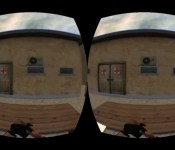
You’re sat in the back of an armored personnel carrier when, suddenly, something hits you and the lights go out. Stumbling out of the darkness, you emerge onto the battlefield armed with just a video camera and a first-aid kit. Laying in front of you is a wounded soldier screaming for help, but would you know what to do? This is Stringer, an Oculus Rift title designed not as an alternative to Battlefield or Call of Duty, but to teach journalists sent into war zones how to survive.
The figure behind the project is former soldier turned journalist Ben Sainsbury, who was inspired by the story of a war correspondent who died because they lacked even basic first-aid training. Afterwards, he learned that writers that are sent into combat zones rarely receive any sort of survival awareness, let alone know how to properly tie a bandage. That’s why, alongside Ali Kokulu, he began developing a game that would give civilians a safe taste of life on the front line, and hopefully teach them some very basic first aid. Unfortunately, work on the game has currently stopped, but we can imagine that plenty of people would fancy giving this a try — after all, this is just the sort of immersive experience that VR was built for.
Filed under: Gaming
Via: Motherboard

Aaron Paul is messing with people’s Xbox Ones

If you sell a voice-activated console, it’s probably wise not to have people in your advert uttering the key phrase. Someone at Microsoft missed that point when they asked Aaron Paul to bark “Xbox on” at his TV to promote the Xbox One. More than a few people have commented on Twitter that the Breaking Bad star has inadvertently activated their consoles thanks to Kinect’s well-tuned microphones. Cheaper faster and now immune to celebrity interference? The reasons to buy a Kinect-free Xbone are stacking up.
Filed under: Gaming, Microsoft
Source: BBC News

How I got stabbed in the chest at E3 2014 (an Oculus Rift tale)

There I was, impaled by an alien. I was carefully walking around a space station, with nothing more than my (admittedly dim) wits and a motion tracker, watching a large, terrifying alien stamp about. My only direction was to survive. “You had one job!” I failed at it.
The tech demos are over: Oculus Rift’s second development kit at E3 2014 isn’t running any dalliances aimed at proving the tech. It’s running real-ass games. Alien: Isolation was the third game I played, and it was by far the most terrifying. You’re not a space marine, and you’re not named Ripley. You’re just some unwitting sheep running from assured death at the hands/tentacles/teeth of an H.R. Giger-designed alien. Delightful.
ALIEN: ISOLATION
Alien: Isolation is being made by Sega’s recently acquired game studio The Creative Assembly. Hell, it’s coming out this year on game consoles and PC. Again, the demos are over — there are entire game dev teams dedicating time to virtual reality at this point. Isolation is proof of that, and it’s a great first example. It’s not even clear how people will be able to play Isolation‘s VR mode at this point; the game’s headed to PC, but there’s no VR headset to buy just yet enabling said functionality. Sure, you could buy a dev kit and stuff, but that’s pretty far from ideal.
Anyway, Alien: Isolation is meant to terrify you. You’re stuck in a confined area of a space station while the aforementioned alien stomps about. If it sees you, you’re done. Not, “Oh, I’ll turn and run.” Not, “Shoot her! Shoooooooot herrrrr!”, Jurassic Park-style. It comes right at you and the motion sensor in your hand doesn’t offer any defense. So while I snuck from room to room looking for an out, I was able to avoid interacting with the hulking beast a few times. About three minutes in, though, he spotted me dead on. I turned to run. He caught up quickly and stuck me through with a vicious-looking appendage. I looked down and saw said appendage sticking out of my chest, blood dripping from it. The future of gaming is pretty messed up, y’all.
LUCKY’S TALE

Do you like Super Mario 64? How about Super Mario 3D World? Or Ratchet & Clank? Well you should be super pumped about Lucky’s Tale, the second game being published directly by Oculus VR. It’s being made by the folks behind Words with Friends and, before that, they were Ensemble Studios alums (Age of Empires, Halo Wars, etc.). It’s a colorful, cutesy third-person platformer. You feel a bit like god, looking down on a cartoony world filled with stars to grab and platforms to bounce on. “So what, it’s a platformer!” you say. Okay, okay — cool it.
What makes Lucky’s Tale especially cool is the gameplay implications of wearing a head-tracking VR headset. Lucky has to throw bombs occasionally; simply look at your target and push a button. Boom! How about hidden secrets? Just look around the level; having a VR headset on means the 3D platforming world of Lucky’s Tale is a physical platform just a few feet away from your gaze, able to be explored more deeply than ever before. What’s that next to the ledge? Just bend your head around the corner and take a look, why don’tcha? While the game at first feels like little more than a pretty 3D platformer, it quickly becomes a whole new experience in VR.
SUPERHOT

First and foremost, you can play Superhot right now. And you absolutely should, because it’s super boss. Check it out right here.
That aside, playing Superhot in VR is bananas. The conceit of the game is that time moves forward as your character moves. So it’s a first-person shooter, but the bullets only move toward you as you move your character. It’s kind of like living in The Matrix‘s bullet-time sequences; you can literally watch a bullet as it whizzes past your head, slowly moving forward as the bullet slowly creeps past you. It makes the whole shooting experience far more personal. One bullet takes you down, and there are many bullets. Playing Superhot feels like a game of virtual reality Twister. I found myself moving in short bursts, advancing time and carefully moving my head as to avoid the bullets flying my way.
Forget Team Fortress 2‘s VR support — Superhot is where it’s at for first-person shooting in virtual reality.

‘Halo: The Master Chief Collection’ has what you expect and a whole lot more

We told you that Halo: The Master Chief Collection (MCC) existed before anyone else, but thanks to the package being officially official, we now have a veritable truckload of details about it. When the game releases November 11th, just over 10 years after Halo 2‘s launch, it’ll pack remastered audio and visuals, four whole games on one disc, a staggering number of multiplayer maps and even a few surprises.
“We think about our fans,” 343 Industries head Bonnie Ross said during the presentation I attended at E3. “We’re going for the nostalgia play, but [MCC] is about providing a new way to play. For us that are geeking out on story, it’s about being able to connect to Master Chief’s past.”
The future, however, is the impetus for that past. Developer 343 Industries (Microsoft’s internal Halo studio) knows that there’s an entire generation of gamers that weren’t even born when the franchise launched in 2001, and the team doesn’t want people to avoid next year’s sequel simply because they aren’t caught up on the decade-plus narrative. The MCC serves to address that by putting Master Chief’s story all in one place to give context for next year’s Halo 5: Guardians.
“We want you to know the full story [of Master Chief],” Ross said. “We want to make it incredibly accessible and so that the pieces are aligned leading up to Halo 5.”
Where Halo 4 tucked a lot of its story within semi-hidden computers in the game, those will be unlocked from the outset in MCC, and Halo 2 is getting a series of those off-the-beaten-path narrative points, too. Those will serve as a “breadcrumb trail” to Halo 5 and also flesh out the tale of The Arbiter, the disgraced alien general. Blur Studio, the company responsible for some of Halo 4‘s TV spots, is also creating narrative book-ends for the prologue and epilogue of the MCC, which should help fill in the gaps for those who haven’t been following the franchise’s wealth of expanded fiction, too.
I was told that the game is expected to be sold digitally, but if all you want is Halo 2, you’re out of luck: 343 isn’t breaking the game into discrete pieces; you have to buy the entire collection as a whole.

MCC’s playlists in action
So as not to alienate returning players, every campaign mission from every game is unlocked at the outset — pretty great news for those who don’t want to slog through “The Library” from Halo: Combat Evolved ever again. This aspect consequently gave 343 the chance to introduce curated playlists that let you bounce around the best moments from all four games’ campaigns back to back to back. Want to play the last level of each game in succession? Do it. To be clear, however, these are put together by the development team, not the users. At least, not yet.
“It’s something [the MCC developers] started out trying to do,” Ross told me. “It may be something we get back in. It’d be pretty cool to send your own custom playlists to your friends; it’s just we’re doing a ton with this project already. At first, we’re going to get community feedback so it feels like there are more personalities than just 343 making [the playlists].”
MCC lead Dennis Ries agreed, but said it isn’t something he and his team can do right now — they’re working to get the base game out to fans this November. Any suggested additions at this point will likely come post-launch.
“That’s something that we know we can give to our audience,” he said. “If we have that opportunity, we’re going to.”
With 2014 being Halo 2‘s 10th anniversary, 343 is remastering it with even more care than it gave to the game’s forebearer. It’s a Halo 2 that’s been gussied up aurally and visually, with its roughly 50 minutes of cinematics getting entirely rebuilt by Blur Studio. Like its predecessor, you’ll also be able to swap between old and new graphics with a push of a button.
Some of Blur’s previous Halo work
This time out, though, there isn’t a brief pause as it happens; the trick is instantaneous. There was a live demo during the presentation where whoever was playing jumped back and forth between modern and classic graphics while popping off headshots, all without missing a single kill. The Xbox One’s horsepower advantage over the Xbox 360 is readily apparent here.
The love for the title that legitimized console-based online shooters doesn’t stop there, either. Six of Halo 2‘s classic adversarial maps got the remaster treatment as well, including “Lockout,” “Ivory Tower” and “Ascension.” If those get boring, there are still some 97 other maps to keep you busy: Every map that’s ever shipped for a Halo game is included in the MCC, even if they were exclusive to PC ports of the first two titles. Yes, you’ll finally be able to play online pistols-only matches on “Wizard.” I’m stoked too. The MCC flavors of Combat Evolved‘s maps use the PC version as their base, so while “Hang ‘em High” won’t look as good as something from, say, Halo 4, it will likely look better than it did 13 years ago.
Each Halo‘s online combat has been markedly different, however. To address that, 343 is isolating each release’s unique features to their respective title. It might sound disappointing that you can’t use a Halo 3‘s bubble shield on “Sidewinder” from Halo: Combat Evolved, but it’s probably for the best; each title’s maps were designed to handle those wrinkles. Keeping the entire online experience cohesive is a voting system similar to what’s been in previous games. Pick your desired game-type; pick from a Halo 1, 2, 3 or 4 map; murder; finish and repeat.
Keith David’s voice makes every video better
The inclusion of every game in Chief’s saga into the MCC might have a downside, though. Come 2017 and 2022, we might not see anniversary packages for Halo 3 and Halo 4, respectively, because they’re represented here. Those games, along with Combat Evolved Anniversary, are more or less being left alone in terms of remastering because they appeared on the Xbox 360 to start. I was told they’d run at 60 frames per second and get some additional post-processing effects, but that an overhaul wasn’t in the cards — especially since Halo 4 still looks incredible.
“The internal Halo 4 team all said ‘this is what it was supposed to look like on Xbox 360!’” Ross excitedly told me. “It looks amazing.”
Filed under: Gaming, Home Entertainment, HD, Microsoft

The man who made the game in ‘Her’ is about to release a game you can play

He’s fresh to game development, but David O’Reilly has already created a game you likely know very well: the game in Spike Jonze’s excellent film, “Her.” While that “game” was, ya know, in a film and not a real game, he’s just about to release his first actual game in Mountain. O’Reilly describes it as a “mountain simulator” — he explained to a crowd at Los Angeles’ Museum of Contemporary Art this morning that it enables you to “live out all your dark twisted fantasies” of, uh, being a mountain. Okay, so what in the world is happening here? In actuality, it’s a game about interacting with a relatively static mountain. Weather changes, music changes, and you can input melodies (via touch on iOS, keyboard on PC/OS X) which alter the state of the world.
Sometimes you push forward time, sometimes you change the weather, sometimes you zoom out into outerspace — where your mountain lives, apparently! O’Reilly says it’ll be out in the next few weeks, and it’ll cost “about a dollar.”

With the PlayStation TV, Sony’s going after families with kids

The PlayStation TV is a curious oddity. The $100 device, a rebranded Vita TV that’s slated to launch in North America and Europe later this fall, is Sony’s direct answer to the Apple TV, Roku and Amazon Fire TV streaming boxes currently flooding the market. It’s also the only box of the bunch capable of offering a video game experience that goes beyond just casual gaming. In fact, the PlayStation TV’s library of titles spans several platforms: the PS Vita, PSP, PS One, PS3 (via PS Now’s cloud streaming) and PS4 over Remote Play. It’ll also offer consumers the ability to stream video content. But with the PS4 occupying the top spot in the PlayStation totem pole, we have to wonder: Just who is the PlayStation TV for?
“We’re really going after this new audience of families with kids that can play [PlayStation TV] together, with games that are accessible.” That’s what Sharon Kapitula, platform planning manager for PlayStation, had to say about Sony’s plan to launch the tiny streaming/gaming box in the US. In fact, you can see this approach in the company’s decision to offer a bundle with The Lego Movie Videogame and a DualShock 3, the controller that shipped with the PS3, in the box. “[We] feel like that’s the easiest and most accessible [way] for people just coming into the PlayStation ecosystem,” she said. “We figure the guys or girls that already have a PS4 will already have a DualShock 4, so they can transfer it… if they’re buying the standalone hardware.”

The PlayStation TV is a Trojan horse of sorts for PlayStation; it’s a low-cost way for non-gamers to enter the ecosystem. Sony’s hoping the device will help reintroduce consumers who may have lost interest in gaming back into the fold with familiar experiences.
The company’s also making sure to educate developers working on PS Vita titles so that controls remain compatible when played with the DualShock 3. That said, Sony’s not mandating developers tailor every experience to the PlayStation TV. Kapitula said that most are “keeping that in mind … when they’re building their titles. And most games, if it makes sense, they’ll have it on both. But that’s not to say that if we did happen to have another amazing title like Tearaway that needs to be Vita exclusive, then it wouldn’t happen.”
There’s just one major unknown in Sony’s announcement of the PlayStation TV and that’s what third-party streaming-video apps it’ll launch with, if any. Kapitula wouldn’t directly comment on which apps we’d see make their way to the device, but she did say Sony is “looking to partner with the different companies [it] partnered with on other platforms.” It’s the strongest hint that we’ll be seeing the likes of Netflix, Hulu, Amazon and even HBO Go arrive on PlayStation TV. Whether they’ll be around on day one, though, is an entirely different matter.
[Image credit: Sony PlayStation]

Getting sweaty with the future of Sony’s virtual reality

The private room, elevated above the crazed throngs of E3 attendees, was dark and oppressively stuffy. Inside, Conan O’Brien lay on a beanbag in front of Sony’s newest virtual reality demo for its Project Morpheus headset: Street Luge. And he was surrounded by two Nintendo booth babes — an awkward collision of rival gaming worlds that wasn’t lost on Sony PR. Conan was finishing up a shoot for a spoof segment on Morpheus and I had to wait for the celebrity fanfare to stop.
I mention Conan not to drop a bold-faced name, but because his interest and involvement in Sony’s Project Morpheus at E3 represents a visible tipping point for VR. The technology is about to go mainstream; it’s very nearly ready for prime time. Soon, non-gamers will be donning VR helmets and exploring simulated worlds. It’s the reason why Facebook purchased Oculus VR for $2 billion and also why movie studios are currently in talks with Sony to create VR experiences. A cultural shift is coming and Sony wants to be right out in front riding that wave. It just won’t be doing that in 2014.
“We’re still just at this point able to say it’s not this year,” said Richard Marks, Sony’s senior director of research and development. “We don’t have quite the number of experiences that we feel would be a good value for people to buy some special hardware for it.” That may be true, but it’s not for a lack of effort on Sony’s part. Marks said that a number of studios, both third-party and internal, are hard at work on titles or demos for Morpheus. So far, though, Sony’s only opted to show demos — the aforementioned Street Luge simulator and Castle — created by its London Studio since “they’ve been working with [Morpheus] the most.”
For E3, Sony made slight tweaks to the Castle demo it debuted alongside Morpheus at the Game Developers Conference earlier this year. Anton Mikhailov, one of the principle engineers working on Morpheus, said slight improvements to the graphics, like antialiasing, were made, along with the inclusion of a new weapon: the mace. Castle is by far the most comfortable Morpheus experience to demo as there’s not much movement required on the player’s part. The experience centers mostly on manipulating and damaging a suit of armor with your hands, a control scheme made possible by a pair of the PlayStation’s Move controllers. It’s impressive stuff, especially when a dragon pops in to tower over and terrify you. I may have even let out a small squeal in excitement when it happened.

But it was Street Luge, Sony’s new racing sim, that really drove home the physical effects Morpheus can have on players. I was sweaty and slightly nauseous when the demo had come to end; an aftereffect I found to be partly thrilling and partly alarming. But first, let me explain how I got to that point.
“We don’t have quite the number of experiences that we feel would be a good value for people to buy some special hardware for it.”
To play Street Luge, I lay down on the very same beanbag that Conan had nestled into earlier and strapped on Morpheus. Steering controls were handled only by the left and right movements of my head and nothing more. I couldn’t stop or slow my luge as it plummeted down a road through winding cliffs and tunnels and straight into oncoming traffic. And all of it was fine, really, thanks to improvements made to Morpheus’ tracking. The speed was brisk enough so that I could admire the fleeting scenery, but not quite fast enough to make me want to break contact with the virtual world. That is, until I hit a steep downhill drop that caused my stomach to lurch and that indescribable butterfly nausea to creep into my chest. It was exactly as exhilarating as plunging down an actual hill in a car or on a roller coaster, except this was VR; this wasn’t real. But as Mikhailov pointed out, it was definitely done on purpose.
Mikhailov elaborated on that particular element of the demo, saying that its inclusion and the resulting discomfort was intentional. The Morpheus team is using these E3 demos as a sort of real-world lab and the press and general public attendees as guinea pigs. Mikhailov’s aware that this kind of visceral experience could diminish over repeated playtime, especially as gamers become acclimated to VR. But what he’s most interested in is whether or not gamers want that nervous sensation to stick around with each playthrough. Does VR become less real when we can no longer physically feel it? That’s the question Mikhailov is seeking to answer with Street Luge — the question of standards. It’s something Sony plans to address not only as a cooperative effort with other VR firms, but also for its own Morpheus gaming platform.

Street Luge doesn’t require any physical controller, just the headset and PlayStation Camera. Which makes it the exact type of VR experience Sony wants to lead with when it eventually launches a consumer model of Morpheus. As Marks explained, “Actually, Street Luge is great because you just put [the headset] on and there’s no controller or anything … I don’t think it’ll be that complicated for those first experiences. But then when you really want to get fully immersed and do things with the controller, Move or two Moves — that probably won’t be the first thing you try. But Street Luge is actually a great one to be first.”
The speed was brisk enough so that I could admire the fleeting scenery, but not quite fast enough to make me want to break contact with the virtual world. That is, until I hit a steep downhill drop that caused my stomach to lurch.
The Morpheus of today likely won’t resemble the Morpheus that launches at retail. Marks said Sony’s consumer electronics division is working to refine its design and form factor for better ergonomics and weight. It’ll even ship with “very short headphones” packed in the box, although Sony wants gamers to have the option to use the headset of their choice. But one thing that’s sure to remain consistent from now until the release of the first consumer model is its wired connection. “Wireless is challenging,” Marks said. “There’s a lot of data. All of the visual data that’s being transmitted to the displays — sending that wirelessly is challenging. It’s something we’re looking at, but it’s a very tricky engineering problem.”
As for hands-free gesture input, Marks said that it’s something his team is “looking at for the long-term future,” but that teaching a gesture language presents problems for ease of use. But there’s also another issue holding up development on that end: the PlayStation Camera. “It has the ability to create a depth map and then analyze the depth map,” he said, adding that, “It’s tricky to do that at the same time as you’re tracking the colored lights because we have specialized exposure settings and things in the camera to match the lights. And so then the rest of the image gets a little bit dark.” Because of that, the Move controllers are Sony’s preferable input choice.

Right now, there’s no magic bullet for Morpheus or VR in general. “No one’s really found the killer genre yet,” said Jeff Stafford, Sony’s other lead engineer working on Morpheus. “It’s too early. There’s not enough development yet.” To that end, Stafford explained that Sony is encouraging developers to “go crazy and explore all different things” and not restricting dev time to any particular genre.
One genre that Sony is actively avoiding for Morpheus game development, though, is the first-person shooter. Stafford elaborated: “Everyone assumes the most natural genre is the first-person shooter. Actually, we find that first-person shooter, because of the TV screen and the way that they’ve evolved; you’re running around at very unnatural speeds — that’s not so great for VR.”
“No one’s really found the killer genre yet. It’s too early. There’s not enough development yet.”
Genres for VR may, mostly, be wide open for studios to experiment with, but that also goes hand in hand with the amount of time gamers spend immersed in VR. None of the current Morpheus demos extend beyond five minutes, but that’s not because Sony thinks extended sessions are harmful to gamers. In fact, Stafford, who spends countless hours hooked up to Morpheus each day, said that he “could see people playing in VR for maybe two hours” at a time, realistically.

Though Sony acknowledges Morpheus will eventually branch out beyond gaming, for now its efforts are focused squarely on the PlayStation 4. Marks said this is because the PS4 is a known quantity for developers and consumers, and also because of its rapidly growing install base. “We have a known box, which has very known graphical capabilities … We have known controllers … So that’s our focus; to have this really known experience that we can share with people. And it could be shared across all those millions of PlayStation 4s.”
Sony also has one other focus for Morpheus, or whatever it ends up calling the headset when it’s released, and that’s on approachability and ease of use. It’s the key to making VR a mainstream product and a profit driver for the company. As Marks explained, Sony’s vision for the consumer model is simple: “[You] just basically hook it up, plug it in, put it on and you’re able to get into VR. We really want to make it this an easy experience for people.”

