



Chubby Checker’s ‘Dig Dug’ was unearthed by the son of an Atari VP

You’ve probably heard or Dig Dug, and if you were born before 1983, you might even remember seeing a bizarre, upbeat commercial for the game in movie theaters — but did you know that the video game miner’s theme song was almost sung by Chubby Checker? It totally was. Matt Osborne, son of former Atari VP of coin-op marketing Don Osborne, recently uncovered an alternate version of the commercial’s catchy song with the iconic singer’s vocals. “The only info that I have about it was that Atari had envisioned a somewhat ’50’s styled take on the song, inspired in part by Chubby Checker’s hit ‘The Twist.’” Apparently, Osborne’s father managed to get the man behind the twist to sing his own rendition, but until now it was lost to the ages. That may have been young Matt Osborne’s fault.
“I’m not sure how I actually ended up with it,” he wrote in an Facebook Atari Museum group post, “but he may have lent it to me and I just never gave it back or he never asked for it to be returned.” Osborne found the song languishing on an old cassette tape, and says he can’t find any other information about Chubby’s recording elsewhere on the web. “How funny would it be that the only reason they never used Chubby’s version of the Dig Dug song was because I never got the only known recording of it back to my dad?” Osborne has recorded the cassette to his PC and uploaded the song to SoundCloud. There was probably a better master of the song somewhere, but he says he doesn’t know where it is — he’s asking former employees and diehard fans in the Atari Museum group to offer any information they might have.

Check out the full, ridiculous track on Osborne’s SoundCloud account, or at the embedded player below. Want to compare it to the version used in the commercial? We’ll embed that too — but make sure your speakers are on: audio only comes out of the right channel.
Via: Wired, Laughing Squid
Source: Facebook, SoundCloud
.CPlase_panel display:none;

Buy ‘Destiny’ on PS3 or Xbox 360 and upgrade to new-gen for free

The wait is almost over: Destiny, former Halo-developer Bungie’s ambitious shooter, releases this coming Tuesday. If you’re holding out on it because you don’t have a PlayStation 4 or Xbox One, though, there’s no reason. Bungie has announced that should you purchase the game for PlayStation 3 or Xbox 360, until next January 15th you’re eligible for a free upgrade to a current-gen digital copy. That’s as long as you within the console family you bought the game for originally. Meaning, if you buy the game for PS3 you’ll get a download of it on PS4, gratis. Any extra content like season passes will carry over too — just like your character’s progress and gear.
This goes way beyond what we saw a handful of titles offer around this time last year in a few different ways. For starters, this costs 100 percent less than the upgrade program for, say, Assassin’s Creed IV: Black Flag or Call of Duty: Ghosts did. The other thing is that you won’t have to start from scratch (regardless of how many hours you’ve invested) when you jump to new hardware; Bungie is making the transition as painless as possible.

Speaking of transitions, Bungie hopes to make Remote Playing its latest effort on the PS Vita simple too. Sony’s handheld may be a capable piece of kit but it’s lacking total parity with the PlayStation 4’s DualShock 4 when it comes to controls. To make up for the handheld’s shortage of buttons, Bungie designed a control scheme specifically for playing Destiny on the portable. While the DualShock 4 has a touchpad, the Vita has an entire touch-friendly screen. Bungie has assigned ancillary tasks like tossing grenades, summoning the floating and robotic Peter Dinklage and executing wicked melee attacks to the left, center and right portions of the Vita’s display. And, as Eurogamer noticed, since the portable’s analog sticks don’t click in like their PS4 counterparts, running in-game is handled by pressing down on the system’s D-pad.
Why the extra effort? Well, according to the PlayStation Blog, the short-lived Destiny beta was the number one game Remote Played of any PS4 games for all of this past July. Excited? Well, NeoGAF has noticed you can start pre-loading right now.
Filed under: Gaming, Home Entertainment, HD
Source: Destiny, PlayStation Blog (EU), NeoGAF
.CPlase_panel display:none;
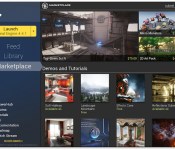
Would-be game makers can sell each other new levels, art in Unreal Engine 4

Let’s say you’ve been fiddling with Unreal Engine 4 for months and want the world to see the lovingly detailed recreation of your first college apartment — right down to the hemp wall tapestries and the weird stains on the living room rug. Well, with the newly launched Unreal Engine Marketplace you can do just that. In addition to anything that’s been released through other channels before, your custom wares will sit alongside sample scenes and games (like Tappy Chicken), as well as bits of C++ code, art and audio. And if you’re looking to turn a profit, or, at least recover the toolset’s monthly subscription fee, you can even put a price-tag on your digital wares.
What’s more, Eurogamer has spotted that the Unreal overlords at Epic Games have announced that in an effort to foster a lively game-development scene, they’re waiving the cost of Unreal Engine 4 for schools and universities. So long as you’re a student enrolled in a qualifying degree program, you’ll have access to one of the most prominent game engines in the business for free. Well, there’s still that pesky thing called tuition, but until you have to start paying back those student loans, that mostly feels nonexistent too. Who knows, though, maybe you could strike it big and make a game that’d cover the cost of college while you’re still enrolled. If that is the case, though, you’ll have to pony up the standard 5 percent royalties for on any quarterly profits exceeding $3,000.
Filed under: Gaming, Home Entertainment, HD
Via: Eurogamer
Source: Unreal Engine (1), (2), (3)
.CPlase_panel display:none;

‘The Sims 4’ turns into a pixelated mess if you pirate it

Media piracy likely isn’t going away anytime soon, but a few game developers have designed clever ways to deal with it as of late. Take the newly released The Sims 4, for example. In series tradition, just before your virtual people shed their skivvies (for whatever variety of reasons), a pixelated censor cloud appears over his or her nether regions. As Kotaku spotted via Reddit, however, If you happen to illegally download the game, that tiny cloud will obscure more than just your sim’s reproductive plumbing: it’ll expand to cover everything onscreen. It makes the virtual ant-farm look a lot like Minecraft or Superbrothers: Sword and Sworcery EP, if you ask us. Annoying? Perhaps, but if you’re bothered by this maybe you shouldn’t be illegally downloading stuff in the first place.
[Image credit: nihwtf / Imgur]
Filed under: Gaming
Source: Reddit, Player Attack
.CPlase_panel display:none;

Twitch wants to be the conduit for professional eSports

What do you do after Amazon purchases your start-up for almost $1 billion? If you’re Twitch CEO Emmett Shear, you stay the course. “Amazon has a very specific track record of retaining founding teams for a long time,” he told The Information in a recent interview. “The idea is that we get to operate in San Francisco independently.” Shear has said it again and again since the acquisition: Twitch chose Amazon for autonomy, the freedom to control its own destiny. Shear seems optimistic about the company’s future — it’s experimenting with music broadcasting, and sees e-sports as an area ripe for expansion. More than anything, Shear seems to want the company to become the community’s go-to provider for streaming content.
“We’re not really a content producer,” he says. “I hope that we can provide more the equivalent of the Comcast of gaming.” Launching off a prompt from The Information, Shear explains that he wants to be the provider to professional eSports content, like Comcast to ESPN. If Twitch became a creator of content, it would be competing with its best content providers — Shear would rather be the conduit of great entertainment in gaming than its author. The young CEO expands on the idea in an interview with Bloomberg. “There’s potential for eSports to be listed in that same pantheon as football and baseball in the states.”
“I hope that we can provide more the equivalent of the Comcast of gaming.” – Emmett Shear, Twitch CEO
It’s a natural expansion for the game streaming company, but its pursuing new avenues of entertainment as well. Just last month, Twitch steamed its first live concert: a set from DJ Steve Aoki. Shear says the experiment was met with “phenomenal” response, and other artists have started looking to Twitch as a music streaming platform. Still, Twitch is expanding its horizons with caution.
“The last thing you want to do is take your eye off what customers really want,” Shear told The Information. “It’s certainly a thing we’re thinking about, but not if it comes at the cost of gaming.” Shear’s biggest concern is losing focus — being too strategic and making a decision that alienates the customers that made Twitch what it is today. “That’s when things go wrong,” he says. “Are we producing stuff that’s awesome still?” He says he turns to Reddit AMAs to find out. The CEO wouldn’t say what his next experiments for Twitch are, but suggests that Amazon understands his vision. The company’s promised autonomy might pay off in the long run. His biggest fear, post-acquisition? “To look back in five years and say, ‘Damn, I sold way too early.’”
[Image credit: Bloomberg via Getty Images]
Source: The Information, Bloomberg
.CPlase_panel display:none;
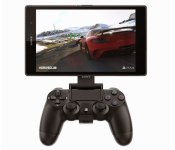
Sony PS4 Remote Play and Game Control Mount coming to Z3 devices

Sony has announced that its new Z3 lineup will exclusively get PS4 Remote Play, a service that has so far only worked with the Vita. The console will detect your Z3 device over WiFi and unlock it, letting you play with a Dualshock4 wireless controller using the new GCM10 Game Control Mount (see the image below). On top of playing games, you’ll also be able to use a Z3 device as a second screen to view livestreams (of games, of course) or chat over the Playstation Network. Sony kept using the word “exclusive” with Remote Play, so if you’re using a non-Z3 handset it seems you’ll be out of luck. The mount and service will likely arrive when the Z3s do, along with the pricing.

Filed under: Gaming, Peripherals, Sony
.CPlase_panel display:none;
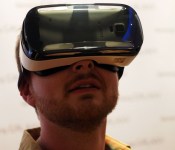
Samsung and Oculus partner to create Gear VR, a virtual reality headset that uses the Note 4 (hands-on)

Facebook’s Oculus VR is creating the Rift. Sony’s PlayStation is creating Project Morpheus. Google is… well, Cardboard exists. And now Samsung’s getting in on the virtual reality action, announcing Gear VR at IFA 2014 today in Berlin, Germany. Gear VR is a virtual reality headset with a removable front cover where Samsung’s newly announced Note 4 slips in, acting as the screen. Paired with adjustable lenses built into the headset and a comfy strap, Gear VR turns Samsung’s next Note into a virtual reality machine. And what’s the first thing you’ll see when you strap on Gear VR? Oculus VR’s handiwork. The company behind the re-birth of virtual reality is partnering with Samsung on Gear VR: Samsung handles the hardware, Oculus offers up its software prowess.
Unlike Sony, Oculus and Google’s VR projects, though, Samsung’s delivering a consumer product this year with Gear VR. But is it too early?
First things first, let’s answer that question: no, it’s not too early. While there are major technological limitations with mobile VR — horsepower, among many other issues — Samsung’s Note 4 is a shockingly capable device for virtual reality experiences. In our time with it, video looked sharp, there was no perceptible lag between turning my head and what I saw on screen, and navigating the UI was a snap. Is it hot? Yes. Are the graphics less impressive on Gear VR than on, say, Sony’s Project Morpheus or Oculus VR’s latest dev kit? Absolutely, no question about it. But is it capable of providing a great virtual reality experience, regardless of those handicaps? I believe it is.
SET UP
I plugged the Note 4 into the Gear VR headset by removing the headset’s front cover and slotting the phone into a microUSB dock. The parallel area has a latch where the top of the phone nestles in, and that’s it: the Note 4 is paired with the Gear VR headset.
If you want to slot the cover back on the Gear VR, you can. Or not! If you want to adjust the straps so it stays snug to your head, that’s another option. And when you’ve finally got it secure on your noggin, an adjustable dial on the top of the headset allows for focusing your view (that means no changing out lenses for near and farsighted folks — just adjust the distance as needed).

Notably, I encountered a few issues while removing and placing the phone: if you accidentally open up an application on the phone while placing it, for instance, that might break the pairing. A few times, Samsung reps had to outright reset the Note 4 and start from scratch because it froze. These are prototype devices and not the final product that’ll ship to consumers later this year, but there’s some roughness to how the phone is physically paired. A slight jingle plays when it connects, which is a nice touch, but I’d also like a more secure docking area. It feels like trying to jam a phone into a microUSB port at an awkward angle, and that’s not a great first experience.

Samsung product manager Joo Namkung told me his team named the first Gear VR the “Innovator Edition” specifically because of these rough edges. Samsung’s PR for the device describes the first Gear VR in a similarly couched way: “Designed for innovative consumers, specifically VR enthusiasts, developers, mobile experts and professionals, and early technology adopters.” While the headset is certainly a play for the mainstream, Samsung is keenly aware that it’s got improvements to make in the next model — if there is a next model, of course.
HARDWARE
Let’s get the unexciting stuff out of the way right now: Gear VR has an accelerometer and a gyrometer for tracking head movement. That means it only tracks where you’re looking and not depth; if you move your head forward or backward in the real world, that movement isn’t reflected in the virtual one. And that stinks.
When you turn your body all the way around and look behind where you’re sitting (in the real world), and there are no wires stopping you from looking wherever you want, that is magical.

This duality is at the heart of Gear VR, but it applies to all mobile VR at the moment. No wires means better immersion, which is crucial for delivering the promise of “presence.” No wires also means no dedicated video feed from an autonomous device (like a PlayStation 4 or a PC, for instance). While Sony tackles depth tracking with its PlayStation 4 camera and Oculus handles it with a camera peripheral of its own, Gear VR is dependent on the hardware in the phone and headset. That is both a benefit and a curse with current technology.
There is no “screen” — Gear VR uses your Note 4 screen, which is of the 5.7-inch Quad HD (2,560 x 1,440) Super AMOLED variety. It looks crisp, and the Cirque du Soleil video I watched was neat. When I turned quickly, I wasn’t able to discern any major irregularities (“screen-tearing” or other nasty hitches). It’s got a 96-degree field of view (just four shy of Oculus Rift’s latest kit) and a 60Hz refresh rate. There’s a square touch pad, a back button, and a volume rocker on the right side of the headset; the touch pad is used for tap-based selecting, while the back button is both for exiting software and enabling pass-through video mode (both of which I’ll get to in the next section).
Gear VR isn’t very large (198 x 116 x 90mm), nor is it very heavy (exact specs aren’t available), and I wasn’t ever uncomfortable wearing it. The padding around the eyes can be replaced easily, which Namkung calls a necessity for long-time users.

Samsung’s been working on the Gear VR for approximately 1.5 years now, and Namkung says some of the development units — the ones we heard about so much back in May — got a little rough around the edges after prolonged use.
Audio is handled by the Note 4, and it’s of the “3D spatial sound” variety. That just means that it sounds like it’s going to both of your ears despite the fact that it’s coming out of the Note 4′s non-stereo speaker setup. This actually works better than expected: audio consistently sounded like it surrounded me, which makes the immersive experience all the better.
SOFTWARE
This is Oculus’ first consumer product and, bizarrely, it’s on a Samsung device. Oculus VR CTO John Carmack personally led the mobile software development team at Oculus, and the software interface is all built in collaboration with Samsung. It’s basic: point a reticle in the middle of the screen at what you want to select and and tap the touch pad to select it. The options are sparse and base level, and the only content management that exists right now is a store of sorts. It looks like the Google Play store to an extent, except it’s floating in space.
There were a few demos to check out, and they were mostly video. The aforementioned Cirque du Soleil performance that puts you directly on stage for the show was a standout, as was an underwater game where a whale floated past. None of this was meant to demonstrate launch content, but to demonstrate the potential of the hardware.
Do I want to sit and watch a film in a VR headset? I’m not sure that I do, but maybe you do! It’s a neat gimmick to turn and look around the stage where Cirque du Soleil performs, and Samsung’s got a bunch of heavy-hitting Hollywood folks on board with VR, but it’s hard to get excited about just yet. Without interactivity, it’s just a 360-degree head-mounted display device, and that’s not what I want from virtual reality. When filmmakers start shooting with VR in mind, then we’ll see.
The most important software on Gear VR is video passthrough. By long-pressing the back button on the headset, the Note 4′s 16-megapixel rear camera shows a feed of the real world (albeit a slightly delayed one). While this can be used for augmented reality applications, it’s also sure to be a standard in all VR headsets going forward. Using a headset and want to sip your tasty beverage? Video passthrough. The dog’s barking and you’re wondering what’s up? Video passthrough. You want to do literally anything without having to remove the whole headset? Video passthrough. Seriously, this is a standard-setting situation. Expect it from the competition.
Okay, one major question remains: since the Note 4 is a phone, what happens if you get a notification when you’re using it with Gear VR? Samsung doesn’t know. Namkung said his team is split on the decision, with some arguing the phone aspect should trump the immersion of VR. In so many words, people won’t want to ignore their phone just because they’re using Gear VR. But getting a ringing phone call in your face all of a sudden sounds pretty intense! It’s certainly an issue Samsung is aware of, though the decision hasn’t been made just yet. Might I suggest making it optional?
WHEN DOES GEAR VR COME OUT? HOW MUCH DOES IT COST? WHAT’S THE DEAL?

The only information on availability is “this year,” and there is no price just yet; it’ll be available for purchase online and through “select carriers.” Considering how low-tech Gear VR is, and the fact that Samsung’s pushing a product into a market that doesn’t really exist just yet, I expect the company will aim as low as possible in terms of pricing.
When you do get one, it comes with a 16GB microSD pre-loaded with a variety of “360-degree videos and 3D movie trailers from major studios” (that’ll go into the Note 4, naturally). Oh, and you’ll need a Note 4 (not a Note 4 Edge — just the Note 4), as Gear VR is built to work with only that device.
Filed under: Cellphones, Gaming, Peripherals, Wearables, Software, HD, Mobile, Samsung, Facebook
.CPlase_panel display:none;

Lenovo’s new gaming laptop is surprisingly light for a 17-inch machine

Slimmed-down gaming laptops seem to be all the rage, but most of the designs we’ve seen don’t have anything larger than a 14-inch display. Lenovo, however, appears to be taking a chance on big screens. The company just announced the Y70 Touch, a 17-inch machine that manages to come in at just 7.5 pounds, making it surprisingly thin and light for its size class. Other than having a larger screen, it features the same design as the existing Y50, which is to say it sports a brushed-metal chassis and red backlit keyboard (you can’t have a gaming laptop without red accents, apparently). Tucked on the bottom you’ll find a subwoofer with JBL speakers. Unfortunately, the touchscreen is slightly less impressive: It tops out at 1,920 x 1,080 resolution, whereas many smaller systems now give you the option of playing at 3,200 x 1,800 or 2,560 x 1,440.
Under the hood, the Y70 combines a quad-core Haswell-series Core i7 processor and up to 16GB of RAM and NVIDIA GTX graphics, with a 4GB 860M GPU being the highest-end option. As for storage, you can opt for either a 256 SSD or a 1TB hybrid hard drive with 8GB of cache. Battery life, meanwhile, is rated at five hours — not that you’re likely to travel without a charger. Look for it in October, starting at $1,299. As ever, Lenovo won’t let you configure these to order; there’ll instead be several pre-configured models to choose from.
Lastly, Lenovo also announced a new gaming desktop, the Erazer X315. To be clear, this won’t replace either the existing X510 or X700; this is just meant to be a more affordable option, at $599. For the money, you get up to an AMD Kaveri A10-7850K processor, a 2GB R9 260 GPU, up to 12GB of RAM and up to 2TB of storage with 8GB of cache to go with it. Expect that to go on sale sometime in November.
Filed under: Desktops, Gaming, Laptops, Lenovo
.CPlase_panel display:none;
‘Minecraft’ hits Xbox One this Friday and an upgrade only costs $5

Let’s face facts for a minute: you’re probably still playing Minecraft on your Xbox 360 more than anything on the Xbox One that’s sitting under your flat-screen. That’s perfectly fine! To sway you into spending more time with Microsoft’s new console, however, Redmond has a clever plan in mind. When the game releases this Friday, you’ll get a hefty 75 percent discount off the $20 purchase price. That’s right, Minecraft: Xbox One Edition could cost you as little as $5. You simply need to own and have played the previous version and have it tied to your Xbox Live account, according to Xbox Wire. Pretty rad, yeah? Just when you’d finally recovered from the news that importing saved worlds from the previous hardware was a thing, boom, this hits like a creep in the night. It’s a bit later than earlier promised, sure, but unlike the PlayStation 4 and PS Vita versions, at least there’s a firm date in sight. Lady geeks and gentlenerds, ready your pick-axes.
Filed under: Gaming, Home Entertainment, HD, Microsoft
Source: Xbox Wire
.CPlase_panel display:none;

Explore the world of ‘Destiny’ through Google Street View

Whether it’s touring an insanely large cruise ship or the Polar Bear capital of the world, Google’s Street View has you covered. But the search giant doesn’t want to limit that virtual experience to tangible, real-life things, which is why it’s teamed up with Bungie to let you experience the magical nature of Destiny by way of Street View. Once inside, explorers can choose to wander around and learn more about places which are key elements to the storyline of Bungie’s new franchise. Destiny Planet View, as the map is officially known, offers detailed, 360-degree views of locations inside Mars, Venus and the moon, It gives the break down on various hotspots, more information on characters from a particular territory and allows users to Destiny tips along the way. Bungie points out that this is the first time Google’s mapped a video game world, and it’s a good one — sure, it’s pretty to look at, but the real goal is to get you even more hyped up ahead of Destiny’s launch, next week on September 9th.
Filed under: Gaming, Home Entertainment, Internet, Google
Source: Destiny Planet View
.CPlase_panel display:none;


