



Bungie’s leap forward with ‘Destiny’ isn’t gameplay: it’s social

“Waffles. Waffles with Swedish fish in them!” Destiny developer Bungie’s community manager Eric Osborne is telling me about his crew’s Halo LAN-party ritual. Lugging bulky CRT TVs everywhere (“You didn’t have a 36-inch [Sony] Trinitron Wega?” he asks), snaking ethernet cable around a possible stranger’s house, sipping Mountain Dew in the kitchen between games of capture the flag, eating lots of cheap pizza. Or, in Osborne’s case, breakfast food sprinkled with candy. “That was my experience!” It’s easy for him to chuckle at how ridiculous his go-to game fuel sounds in retrospect.
Back then, host advantage wasn’t having non-lagging bullets – it was knowing where the bathroom was and not having parents home. Times were a lot simpler.
When Halo 2 released in 2004, though, that all stopped. Mostly because Bungie more or less made LAN parties obsolete by taking them online with a sort of “virtual couch” that let you keep playing with the same buddies all night long in a, err, party. Fast forward ten years and much of the groundwork that the team laid for Halo 2 is boilerplate for any successful online game regardless of genre. Hell, much of Bungie’s conventions for online play (party chat, ranking systems, game invites) are baked directly into the online infrastructure of modern consoles.
Our interview with Destiny publisher Activision’s CEO Eric Hirschberg
The leap in social interactions between Halo: Combat Evolved and its sequel was nothing short of a paradigm shift, but where does Osborne see the change between its last game, Halo: Reach and its latest, the just released Destiny?
“I don’t know if you call it community or social play; I’ve heard some people call it ‘mingleplayer.’ I’m in a world, it’s my story, it’s my character. All the gear is mine; I’ve earned it in a bunch of different story missions,” he says. “I encounter some random people and we do a lot of stuff together and it’s super fun. But, I’m not bound to them in any way. I don’t need to lug a TV or even send them a friend request.”
He’s speaking of course about Destiny‘s unique take on traditional single-player campaigns in shooters. Though Bungie hasn’t quite come out and said the game is a massively multiplayer online title (MMO) like World of Warcraft, at its core that’s what the game is. When you start a new character, you drop into a world, quickly find an assault rifle and start shooting at aliens. In pretty short order, it becomes apparent that you aren’t alone. There are hundreds (if not thousands or even millions if pre-order numbers are to be believed) doing the same thing as you, and some are even doing it right alongside you. Should you desire, you can jump into their pick-up group – or, as they’re called in Destiny – a fire-team, and fight through scads of aliens together without much effort.

“In previous games, sending a friend request took you out of the flow of gameplay,” Bungie’s server software engineering lead Roger Wolfson says. He describes meeting someone online, then backing out of the actual game and wading through layers of menus and a massive list of recent players, just to interact with someone that you just met. It’s a hassle.
“And then you find out they’re a racist later,” Osborne says. He’s joking, but unfortunately that situation is’t far from the truth.
It’s why I, and most people I know, choose to not play online with anyone but a carefully curated group of friends. For me it helps preserve a shred of that LAN experience.
“A lot of times, you want to have a multiplayer experience where you don’t want to have to send a friend request,” Osborne says. “It can take a lot even in person to say, ‘Oh, I’ll give that person my phone number.’ Or, ‘I’ll give that person my email address.’ We’re cognizant that these types of things need to be lightweight and positive – that’s where the term ‘mingleplayer’ comes from.”
This, more than anything, is what Bungie thinks sets Destiny apart from any of its previous games: it’s taking all of the knowledge of how people interact online and how people want to interact online, that its gleaned even since launching Minotaur on the Mac in 1992, and putting it into motion. It’s what the team refers to as “lightweight social connections” that make the difference in Destiny. Stuff like walking up to a warlock with bad-ass armor and emoting a salute at him or her. Or, just kicking a ball around in The Tower, the in-game social plaza, with another player while she waits for her fire-team member to grab a new rifle or armor piece.

“You can choose to have positive interactions and you can choose to have negative interactions,” Wolfson says. “The most pestering a person can be is just running up to you and emoting a lot.”
That’s a far cry from tea-bagging the corpse of the flag carrier you just pistol-whipped from behind. What the team is trying to do at its core is eliminate a lot of the barriers that make it hard for people to have fun together.
“It’s so important to remember that what we’re doing is making a game, and a game is just a rule-based system that allows people to have fun and challenge themselves, share victory and social connections,” he says. “I think we’re celebrating that with Destiny.”
We’ll fire up the waffles.
Filed under: Gaming, Home Entertainment, Software, HD, Sony, Microsoft
.CPlase_panel display:none;

Sony’s sold over a million PlayStation 4 consoles in the UK

With over 10 million worldwide sales, Sony’s PlayStation 4 has enjoyed a very solid start. It’s consistently outselling Microsoft’s Xbox One, and in the UK, it’s already become the company’s fastest-ever selling console. In an interview with Eurogamer, Sony UK boss Fergal Gara revealed that it took the PS4 just 42 weeks to reach one million sales, beating the PlayStation 3 and the PS2 to the same milestone by four and eight weeks respectively. By contrast, the Xbox 360 took a total of 60 weeks, while Xbox One figures remain undisclosed.
Although impressive, the PS4’s race to one million only ranks it as the second fastest-selling home console ever. The top spot actually belongs to the oft-forgotten Nintendo Wii, which notched its first million sales in just 38 weeks. Like this editor, many UK gamers chose Sony when it introduced The Last of Us: Remastered — we wouldn’t be surprised if the same happens again now that the white PlayStation 4 and Destiny bundle is on sale.
Source: Eurogamer
.CPlase_panel display:none;

Documentary chronicles the sounds of console gaming’s early years

When it comes to video games, more often than not audio gets the short shrift because, well, you can’t see music in a screenshot. It’s with that in mind that Red Bull (yes, that Red Bull) is putting together a documentary series about the scene surrounding classic Japanese video-game music called Diggin’ in the Carts. The first episode focuses on the early days of the industry at Namco Bandai and Nintendo and features interviews with, among other luminaries, the first person in charge of game music for the Mario company, Hirozaku “Hip” Tanaka. Tanaka would go on to produce the iconic scores for Balloon Fight and Metroid, as well as design the sound chip for the first Game Boy. This premiere episode, embedded below, also showcases just how early soundtracks were composed. Spoiler: it involved more wave-forms and soldering than it did keyboards and drum machines. Interested in seeing more? A new clip is scheduled to release every week for the next month-and-a-half.
brightcove.createExperiences();
Filed under: Gaming, Home Entertainment, HD
Via: Kotaku
Source: Red Bull Music Academy
.CPlase_panel display:none;

Microsoft’s next Xbox One update makes it act more like the 360

We weren’t lying in our review when we said that the Xbox One felt like a work in progress. From the sounds of it, though, the system’s next update will add features and functionality that frankly should have been in the box last fall. For starters, once the patch rolls out to everyone in October, double-tapping the Guide button on the Xbox One controller will act an awful lot like pressing the Guide button on the Xbox 360 controller does: it’ll give options to bring up your friends list, achievements and messages. Finally! The update is also supposed to make recording video without Kinect voice controls a lot easier by letting you save the last 30 seconds of game-video by double-tapping the Guide and then hitting the X button.
The Xbox One is also beating its competition to the media punch again by adding DLNA support so you can stream videos (yes, including MKV files) from your computer to the console. There are a ton of other smaller, but no less noteworthy, features in the upcoming patch, so be sure and hit Larry “Major Nelson” Hyrb’s blog post for the full details.
Filed under: Gaming, Home Entertainment, HD
Source: Major Nelson
.CPlase_panel display:none;
Overwatch: a smartphone app that makes airsoft more like a video game

Prefer the physical activity (and force feedback) airsoft, paintball and laser tag provide, but miss the peripheral luxuries of the virtual battlefield? Well, now you can have both — we found a new app at TechCrunch Disrupt makes physical warfare games a lot more like video games. It’s called Overwatch, and it gives any player with access to an Android or iOS device access to player stats, live voice-chat, in-game perks and controllable game modes. One feature stands out in particular, however: real-time GPS-radar mapping the locations of all players on the field.
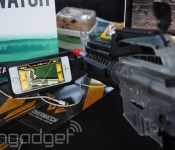
Naturally, the app’s tracking ability only works out if every player on the field participates, but it shows a lot of potential. In our short demo with the product, we saw an airsoft rifle mounted iPhone actively track our location, betraying the location of an nearby enemy player on a simulated radar screen. Aware of our proximity, the opposing player was able to activate a “perk” to jam our radar. The app’s creator, Josh Moody, explained that the app can also be used to facilitate new game modes.
It’s a neat idea, with one flaw: nobody wants to pull a smartphone out of their pocket while they’re on the battlefield. Moody has an answer for that too: Overwatch has partnered with CyberGun, a major airsoft manufacturer to create durable smartphone mounts (pictured above) for recreational weapons. Don’t feel comfortable putting your smartphone on a gun? The company is making a arm-band, too – both will be available at Walmart and airsoft retailers later this year for $14.99 and $8.99, respectively. The app is available for free on iOS now, with an Android version coming soon.
Filed under: Gaming
Source: Overwatch
.CPlase_panel display:none;

Unboxing Sony’s white-hot PlayStation 4 ‘Destiny’ bundle

Remember this (glacier) white beauty Sony announced at E3? Well, after three long months of anticipation, it’s finally here.
The $450 PS4 Destiny bundle, which goes on sale tomorrow in time for the game’s official launch, will net you a physical copy of Bungie’s first person shooter/MMO hybrid, 500GB of hard disk storage, a 30-day trial to PlayStation Plus and, of course, that stark white next-gen console and DualShock 4. But we know how it is: you want to preview the goods before you plunk down the cash. And since we had one in-house here at Engadget, we took the liberty of tearing open the box to show you what’s inside. So go ahead and click. You’ll be glad you did.
.CPlase_panel display:none;

Twitch’s CEO sees Amazon integration as an opportunity, not an obligation

When Amazon purchased Twitch for almost $1 billion, the question burbled to the top of everyone’s mind: which Amazon service will invade the platform first? The idea hangs with minor dread, a concern that a corporate agenda will ruin what customers have come to love about the game streaming service. Twitch CEO Emmett Shear isn’t worried, however. He’s been adamant Twitch sold to Amazon because it promised autonomy. “Our attitude towards it is not that this transaction happened, therefore we have to do integrations,” he explained at TechCrunch Disrupt. “It’s that now we have the opportunity.” Amazon, he explains, offers Twitch new resources for security, licensing and marketing — but says that Twitch will only integrate Amazon services that benefit the consumer.
So, what would be a good Amazon experience for the Twitch consumer? The CEO has some ideas. “What might be a good experience is watching this game on Twitch,” he imagines, “with a way you can buy it right now at a 20 percent discount. That sounds like something our broadcasters would want to offer and our viewers might like it.” Incentive-based Twitch viewing is just one idea, however, and Shear says it’s not something either Twitch or Amazon will force on broadcasters or viewers.
Shear says Twitch is exploring less consumer-facing integrations too — specifically citing issues with content licensing. “We can put our music licensing team with their music licensing team and see if they can interact. We have an opportunity to see if that makes sense or not.” Still, he’s choosing his words carefully: an opportunity, he says again, not an obligation.
Filed under: Gaming
.CPlase_panel display:none;

‘Destiny’ launches tomorrow — watch us play it live today!

The folks who created Halo have a new game, Destiny, and it launches tomorrow on both last-gen and current Xbox and PlayStation consoles. While that prospect might be enough for some folks, there are no doubt many more of you unsure if Destiny is worth your ducats. Thankfully, the game’s servers are online one day early and we’ve got a PlayStation 4 copy handy to give it a live run before it’s officially available tonight at midnight (via retail and for pre-load on current-gen consoles). Join us for a jaunt through the next big online game from Bungie Studios, just beyond the break. And bring your best Peter Dinklage impersonation!
Filed under: Gaming, Software, HD, Sony, Microsoft
.CPlase_panel display:none;
Trading ‘presence’ for untethered virtual reality: Gear VR versus Oculus Rift

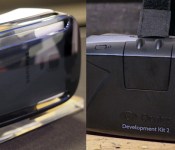
Standing up and moving around with a virtual reality headset is risky. What if you walk into a table? Or step on your dog? Or bash your face into the wall? Standing up and moving around while wearing Samsung and Oculus VR’s Gear VR headset isn’t suggested. But when you put it on, seated, and turn your whole body around to look behind your virtual self, and no cords get in the way, that’s a magical experience. “There are going to be different categories of VR,” Oculus VR CEO Brendan Iribe told Engadget in an interview last week at IFA 2014 in Berlin, Germany.
On one side, there’s a tethered experience like Oculus Rift, where, “There’s going to be this bigger, more expensive experience … that has a much bigger sense of ‘presence’ right now all attached to a computer where you have power plugged into the back,” he said. That’s the concept of being transported to another world and actually being there: a sense of “presence.” On the other side, there’s mobile VR: untethered, intended for mainstream accessibility and able to use your existing devices (such, as, say, your cellphone). “It’s untethered, but there’s now limitations and restrictions around the GPU/CPU,” Iribe said.
Virtual reality, right now, is all about trade-offs. This discrepancy between mobile and tethered VR is the biggest trade-off there is: Do you want convenience, or do you want “presence”?
If you answered, “I want both,” we’re right there with you. Sadly, that’s not a reality just yet. Iribe explained:
“There are certainly trade-offs. We don’t know how long it’ll take to get to the magic VR sunglasses that are untethered. It’s a dream. We all believe in that future of a mobile, VR pair of sunglasses, but that’s pretty far away.”
Gear VR is a staging ground for mainstream virtual reality. It uses the Note 4. It’s focused on media consumption. It’s light and pretty. Heck, when it launches this October alongside the Note 4, everything you can do on it will be free experiences. That’s part of the plan of pushing virtual reality into the mainstream. Hook ‘em with casual VR, then show off the big guns with tethered, interactive virtual reality.
Having spent a lot of time with Oculus VR’s second development kit, I was skeptical of the experience being offered with Gear VR. The graphical fidelity is, of course, nowhere near that of a dedicated PC. There’s no depth-tracking, so if you move your head forward, the scene remains static. These are major barriers to delivering on “presence,” the concept of feeling as though you’re physically there while wearing a VR headset. “Presence” is at the core of VR: It’s what distinguishes virtual reality headsets from head-mounted displays.
Oculus VR CTO John Carmack agreed, and said that his team is hard at work on taking those next, necessary steps to make mobile VR more capable:
“We are absolutely tackling position tracking, multi-user experiences, better gaming — all these things — in the coming year. It’s an exciting train we’re hitched onto with Samsung here, because there technology ticks twice a year. And that’s a treadmill that we’ve chosen to get on, and we’re going to do our very best to stay on that and continue innovating at that pace.”
After Gear VR, Carmack expects the competition from other electronics giants will step up tremendously. “This is good enough that it’s going to attract competition from the other significant players,” he said. And that competition is good for us, the VR users, as it means rapid innovation. Video passthrough on Gear VR is a perfect example: If Oculus’ Rift doesn’t ship with some form of video passthrough — what Carmack calls his “Diet Coke button” — that would be tremendously surprising.
Characteristically, Oculus co-founder Palmer Luckey doesn’t see video passthrough as just the ability to interact with reality while wearing a VR headset. He wants more, like augmented reality. “It’s one thing to have a convenience window,” he told us. “It’s another to try and make something where that’s a core feature of the device like AR. That’s a much harder problem to solve.”
Despite the trade-offs, Gear VR offers Oculus a chance to get its name out there on a virtual reality product and to set a foundation for software on the first consumer version of the Rift. The basics — the dashboard and store UI, for instance — will be familiar on the Rift. “Our dashboard, the basic interface, platform and store: Expect it to be similar between the two,” Carmack said.
It also enables VR developers to start making some money. Beyond just helping push VR into the mainstream, Gear VR enables virtual reality developers to start building a financial foundation for future projects. “The critical thing, from the developer standpoint, is we’re actually going to have a market where they can sell and get checks from Oculus with this sooner than on the PC front,” Carmack noted.
In the long-term, mobile virtual reality and tethered virtual reality won’t be separate entities. Carmack foresees a not-so-distant future where the Rift has a dedicated processor that enables both tethered and untethered VR. That’s always been the end goal, really. How soon it’s coming is up for debate.
“I have my vision for where this goes for Oculus,” Carmack said, “Where Oculus starts building systems that might as well include systems-on-a-chip (SOCs), graphics renderers and things inside ours. Not state-of-the-art necessarily, something that will boost the cost all that far up. But then Oculus version three or five or whatever it ends up being is something that can be use unplugged — we’d have our own Android stuff and all that — but you could plug it into the PC and use that.” An interesting vision of the future indeed. Here’s hoping it’s even sooner than we expect.
Filed under: Cellphones, Gaming, Peripherals, Wearables, Software, HD, Mobile, Samsung, Facebook
.CPlase_panel display:none;

Robin Williams gets the World of Warcraft tribute gamers asked for

Blizzard promised gamers a tribute to the late, great Robin Williams in one of his favorite titles, World of Warcraft, and it looks like the studio has been quick to act on its word. Just days after Wowhead found hidden character code paying homage to the actor, that persona is live in the game. If you’re in the Warlords of Draenor expansion’s beta, you can visit an island with a familiar-looking lamp; rub it and a genie pops out flaunting his “infinite cosmic power,” directly referencing Williams’ beloved role in Aladdin.
That’ s not the only nod to Williams’ legacy, either. You’ll also find a broken egg with machinery inside (an allusion to Mork and Mindy), and there may be subtler odes to both Mrs. Doubtfire and Toys. The in-game memorial won’t be available to everyone until Draenor officially launches on November 13th, but you can get a peek at it right now through the video below.
[Image credit: Haldhur, Wowhead]
Filed under: Gaming
Via: Washington Post
Source: Wowhead, WoW Insider
.CPlase_panel display:none;

