


‘Big players’ from US and China reportedly interested in OUYA

OUYA’s remained relatively quiet over the past few months, aside from making content-focused announcements here and there — such as OUYA Everywhere and the expansion of it. That said, the gaming startup, once a Kickstarter sensation, could be making a very big splash in the near future. Re/code is now reporting OUYA is in the middle of acquisition talks with “multiple big players” in the US and China, citing sources familiar with the matter. Chinese companies said to have had discussions with OUYA are Xiaomi and Tencent, among others; meanwhile, here Stateside, Amazon and Google reportedly took part in “some engagement” over a possible sale. Interestingly enough, though, Re/code notes that these outfits are primarily interested in the sale to acquire members of OUYA’s staff, rather than the business stemming from its tiny game consoles. Only time will tell if anything ends up actually happening — but as they say, where there’s will, there’s a way.
Filed under: Gaming, Home Entertainment, HD
Source: Re/code
.CPlase_panel display:none;

What you need to know about the world’s most popular game streaming service, Twitch

Twitch was an accident. The live video streaming service, which boasts over 55 million unique users each month, began life in 2007 as “Justin.tv”: an all-hours video livestream of co-founder Justin Kan’s life. That wasn’t the whole point of the service, of course; later that year, “Justin.tv” opened up to the public, who could then “livestream” to various “channels.” At its inception, Justin.tv was a form of internet television, offering live broadcasts across a variety of topics. One such topic — gaming — took a particularly large portion of Justin.tv’s audience. So much so that, in 2011, the company spun out gaming into its own website: Twitch.tv. Three years later and Justin.tv is dead, the company is now known as “Twitch Interactive,” and Amazon just bought it for $970 million. Not too shabby for an “accident”.
WHAT IS TWITCH?
Like Justin.tv, Twitch.tv is a live video broadcasting service. Unlike Justin.tv, Twitch focuses solely on gaming. More specifically, Twitch focuses primarily on e-sports: the burgeoning world of competitive games played professionally for money.
For example! Twitch hosts a non-stop livestream of “The International,” an annual game tournament. At The International, teams compete in a Valve game named DOTA 2. Twitch broadcasts those games in real-time. This year, over 20 million people tuned in. Over 2 million people tuned in simultaneously at one point. Oh, and the winning team took home just over $5 million.
So, what are those 20 million people watching? They are literally watching live video of a video game being played by other human beings. The live video often has commentary (sometimes by the players themselves, other times by other folks), and often has a picture-in-picture view of the players face. That description can be applied to much of the content on Twitch, albeit with varying levels of production. The International (seen below) is a massive event, so its stream has very high production value.

In short, Twitch is mainly a venue for e-sports fans to watch live e-sports. But there’s another side to Twitch: participation. Within each Twitch user’s channel is an embedded chat widget, enabling the person (or people) broadcasting live video to interact directly with viewers. Interactivity expands the use of Twitch beyond simply watching e-sports being played live.
For example! Game development studio Vlambeer use their Twitch channel to broadcast a weekly stream of game development. Since their game is already available to purchase, fans can offer feedback directly on what they’ve played, see what’s currently in-development, and even influence the final product. It’s a direct pipeline from development team to player.

But these two examples are exceptions to the rule. They represent the “premium” end of Twitch’s content — the “whales” (especially high viewer numbers). Anyone can broadcast games on Twitch — even Engadget! — and, beyond using the web interface on a computer, it’s built into both the Xbox One and PlayStation 4. There’s even a new Android tablet with Twitch broadcasting capability built in. That accessibility means that the vast majority of video content broadcast on Twitch is, well, “just some person playing a game.” Some channels attract millions of viewers. Some attract single digits.
WHO’S USING TWITCH? AND WHY?
Twitch’s full user base is enormous: over 55 million “unique viewers” use Twitch annually, and over one million people use Twitch to broadcast each month.
 Not these guys
The heavy-hitters — that is, the channels with the most views — tend to be “partners.” Twitch describes its “partner” program as such: “an exclusive group of the world’s most popular video game broadcasters, personalities, leagues, teams and tournaments.” That includes everything from The International to live broadcasts of press conferences; at this year’s big gaming trade show, E3, Twitch carried live broadcasts of every console maker’s press conference.
That said, the people broadcasting on Twitch vary dramatically. Though e-sports dominates the most-viewed list, Twitch is home to some incredible — and incredibly bizarre — user-generated content. Take, for instance, “Twitch Plays Pokémon.” Using Twitch, a programmer in Australia created an interactive game for Twitch viewers. He combined an emulation of GameBoy classic Pokémon Red with a bot that took text from chat. If a viewer entered “up” in chat, the character in Pokémon Red would move up. Simple enough! It becomes far less simple when hundreds of thousands of people are entering commands all at once. The result is what you see below.
 Madness
Unbelievably, the game was eventually completed solely based on community commands. The system actually defeated a whole mess of Pokémon games. And now, fish are getting in on the action. Really!
Yet another use of Twitch: the phenomenon known as “speedrunning.” The term literally means to complete a game as quickly as possible. Sound lame? Watch this incredible video of Nintendo classic Mario 64 being defeated in under 10 minutes.
One particularly interesting subcommunity is helmed by the group “Games Done Quick” (GDQ). Each year, the group holds two marathons of non-stop live speedruns in an effort to raise money for charity (this summer’s event already happened, and they raised over $700K for Doctors Without Borders). In total, the group’s raised just shy of $3 million for charity by playing games as fast as humanly possible while live broadcasting the whole thing.
As for the general public, live broadcasting became far more mainstream when it entered the living room. With Xbox One and PlayStation 4, living rooms were suddenly thrust online in full view of the world. In the case of PlayStation 4 tech showcase The Playroom, Twitch was forced to outright ban the game; it enabled users to directly broadcast a full screen video feed of their living room. As you can imagine, that led to some occasionally lurid content.

Of course, that’s also the exception — many are simply using Twitch, and game broadcasting in general, as a social platform. Their friends are online, and they can participate remotely in each other’s games, follow the same people, and broadcast or watch together. It fosters community, and it’s instantly relatable to a generation that’s grown up with fast internet and computer ubiquity. As Ben Davis wrote in a recent New York Magazine piece, “So much of social life has migrated online already; why wouldn’t it be the entertainment that was live and social and digital that feels most vital?”
WHY SHOULD I CARE?
Perhaps you like money? With Twitch’s huge user base, there’s plenty of opportunity to jump in and get broadcasting. Between running ads on your content through Twitch’s partner program and charging a subscription price to your channel (which gives viewers an ad-free experience), you could make it a full-time gig. Of course, you’re one of millions. But that never stopped anyone before, right?
Okay, okay — let’s appeal to your more reasonable senses. This whole e-sports and live broadcasting thing is quickly becoming a pretty big deal. Maybe you dig traditional sports? E-sports might be your thing. The same rivalries transpire, and it’s full of the same human emotion. All the words they’re saying might sound like jargon at first, but that disappears after a few intense matches pique your interest.
Though e-sports gained prominence with the mass popularity of competitive first-person shooter games like Call of Duty and Halo, the game dominating Twitch’s charts now are of the “MOBA” genre (multiplayer online battle arena). Of this genre, millions are playing League of Legends and DOTA 2. Though from different developers and made independently of each other, both games are nigh identical in the way they play. Like sports, there is only one “arena” where players compete. Teams battle for control of the other’s side, carefully organizing tactics and strategies to win. In so many words, it’s a hell of a lot like traditional sports.
Loaded as the term “e-sports” may sound, Twitch offers a great (and free) opportunity to give them a shot. At very least, the fantasy sports players among you will feel right at home.
WANT EVEN MORE?
Despite Twitch’s relative newness as a company and service, there’s been quite a bit of words spilled in that time. From New York Magazine‘s excellent recent breakdown of the company’s purchase by Amazon, to our sister site Joystiq‘s coverage of Twitch Plays Pokémon, to The Next Web‘s interview with Twitch when the company spun out its video game arm, there’s quite a bit of material out there. Oh, and there’s the BBC‘s recent take on defining the service’s importance to the uninitiated (seen above) and this recent piece from the New York Times which digs in on e-sports.
[Image credit: Twitch (ESL TV), BBC Newsnight (“What is Twitch?”), Suzi Pratt/FilmMagic (The International DOTA 2 Championships, 2014), Vlambeer (Nuclear Throne devstream), Shutterstock (“Gamers”), Twitch Plays Pokémon (via Joystiq), Twitch (Fish Plays Pokémon), Sony Computer Entertainment/Reddit (The Playroom), YouTube]
Filed under: Gaming, Internet, Software, HD, Sony, Microsoft
.CPlase_panel display:none;

‘Summer Lesson’ is the questionable Project Morpheus VR title from the ‘Tekken’ team

Teasing its forthcoming appearance at the Tokyo Game Show later this month, Sony Computer Entertainment Japan revealed a new demo for its prototype VR hardware — with assistance from the creative forces behind the Tekken fighter series. You should probably put all ideas of a first-person punch-em-up aside though, this is very different. Summer Lesson puts the user inside a typical Japanese schoolgirl’s room, where it looks like you just seem to.. chill, interact and hang around, which sounds innocent enough, although there’s certainly a creepy element there just by the premise. The teaser didn’t explain much else, although the Tekken team’s Harada-san was happy to praise the interactivity element of the demo, and the preview video also added some comments about how it felt like someone was really there. We’re expecting to feel suitably embarrassed and awkward when we get to test it out at TGS 2014 in a few weeks — but we’re also hoping to get a better grasp of why the team decided to go with something that could easily be so misconstrued for a very conspicuous, very early Project Morpheus showcase. Take a look for yourself: we’ve posted the entire SCEJ PlayStation press event after the break, and even thoughtfully skipped to the Summer Lesson part, because we’re nice like that.
.CPlase_panel display:none;
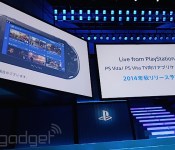
Watch PS4 streams on your Vita with upcoming app

If you’re a fan of Playstation 4 game livestreaming, Sony’s about to have a PS Vita app for that. At a prelude to the Tokyo Game Show (TGS), it announced updates that will let you view live PS4 game action directly from a PS Vita. There are also themes coming to the PS Vita around the same time — Sony showed off one that centered around the popular (and insane) Dangan Ronpa shooter. It also revealed a pink-backed PS Vita with a white front arriving in Japan on November 13th for 18,980 yen (around $182). There’s no specific dates for the new themes and the PS4 game streaming app, but Joystiq pointed out a translated tweet saying it’ll arrive sometime in October.

.CPlase_panel display:none;

Citizen journalism game will show how your photos change the story

As the Ferguson protests made exceedingly clear, citizen journalism is both a blessing and a curse; while it can expose police brutality and censorship, it’s also prone to misinformation. But how do you illustrate the complexity of the subject for the general public? If you’re developer Nicky Case, who has a history of tackling difficult subjects, you build a game around it. His as yet unnamed title will have your character trying to gain Twitter followers (that is, score points) by taking photos at controversial events like protests. The trick will be to accurately capture what’s happening without polarizing any group more than necessary. You may want to photograph police corruption, but the cops could block you from certain areas if you antagonize them too quickly; at the same time, you don’t want to take extreme shots that turn peaceful protests into riots.
The game is a long way from completion, but it’s likely to remain topical so long as people on social networks can tell stories that won’t necessarily show up in the mainstream media… in other words, for quite a while. Even if the effort doesn’t capture widespread attention, though, Case sees it as a commentary on the game industry’s inability to take some subjects seriously. He believes that Battlefield Hardline glorifies police militarization, for example, while Watch Dogs doesn’t do much to address concerns about unchecked government surveillance. As far as Case is concerned, his project will succeed so long as it makes you question whether or not games and news outlets are telling you the full story.
[Image credit: Thomas Hawk, Flickr]
Filed under: Gaming
Source: The Atlantic, Nicky Case (Twitter)
.CPlase_panel display:none;

Recommended Reading: The (second) rise of virtual reality
Recommended Reading highlights the best long-form writing on technology and more in print and on the web. Some weeks, you’ll also find short reviews of books that we think are worth your time. We hope you enjoy the read.

The Rise and Fall and Rise of Virtual Reality
by The Verge
Unless you’ve been under a rock the last couple of years, you’ve read some collection of words about the return of virtual reality at the hands of Oculus and others. Thanks to a multifaceted interactive piece from the folks at The Verge, you can get caught up on the technology’s history, its current state of affairs, VR in pop culture and more. Heck, there’s even a look at a step-by-step process for building a simple, 3D-printed headset for an iPhone.
|
What Happened to Motorola Wondering how Motorola went from a formidable tech company to its Motorola Mobility sector losing $198 million during the first quarter of 2014? This piece for Chicago Magazine takes a look at the history of the company that dates back to 1928 through present day — a few months after Lenovo snatched up its smartphone business from Google for a cool $3 billion. Pocket!function(d,i)if(!d.getElementById(i))var j=d.createElement(“script”);j.id=i;j.src=”https://widgets.getpocket.com/v1/j/btn.js?v=1″;var w=d.getElementById(i);d.body.appendChild(j);(document,”pocket-btn-js”); |
Why Top Tech CEOs Want Employees with Liberal Arts Degrees While you might think you’ll need a degree in science, engineering, math or computer science to nab a career in tech, industry CEOs are saying not so fast. Company heads are holding fast to the idea that folks with liberal arts degrees can make an impact based on education in disciplines like philosophy, religion and other humanities. Pocket!function(d,i)if(!d.getElementById(i))var j=d.createElement(“script”);j.id=i;j.src=”https://widgets.getpocket.com/v1/j/btn.js?v=1″;var w=d.getElementById(i);d.body.appendChild(j);(document,”pocket-btn-js”); |
|
Metro Redux: What it’s Really Like to Develop for PS4 and Xbox One We’ve placed selections that examined the challenges of developing games for both the Xbox One and PS4 in this roundup before, but here, 4A Games’ Oles Shishkovstov gets pretty detailed about the process in a Q&A with Eurogamer. Pocket!function(d,i)if(!d.getElementById(i))var j=d.createElement(“script”);j.id=i;j.src=”https://widgets.getpocket.com/v1/j/btn.js?v=1″;var w=d.getElementById(i);d.body.appendChild(j);(document,”pocket-btn-js”); |
How Steve Ballmer Became a Rookie Basketball Mogul By this point, you’ve likely read one or two headlines about former Microsoft CEO Steve Ballmer snatching the NBA’s Los Angeles Clippers for a cool $2 billion. Now, The Wall Street Journal has a look at the events leading up to the new owner closing the deal. Pocket!function(d,i)if(!d.getElementById(i))var j=d.createElement(“script”);j.id=i;j.src=”https://widgets.getpocket.com/v1/j/btn.js?v=1″;var w=d.getElementById(i);d.body.appendChild(j);(document,”pocket-btn-js”); |
Filed under: Misc
.CPlase_panel display:none;

Dell says its curved monitor will help make you a better gamer

What good is having an ultra-powerful PC if you’re still connecting it to a dusty old monitor? We reckon doing so would be pretty silly. Good thing that alongside the new Alienware Area 51, Dell’s pulled the curtain back on its 34-inch Ultrasharp U3415W display then. It boasts a wider-than-widescreen 21:9 aspect ratio that’s paired with 3,440 x 1,440 lines of resolution (just under 4K’s 3,840 x 2,160) and a curved screen. Dell says that the monitor’s wide field of view mated with its curves will give gamers a leg up on the competition because, compared to flat monitors, less eye movement is needed to take advantage of the player’s peripheral vision. Intrigued to test that claim? You can do so come this December. We’re hoping that regardless of size, though, a curved screen doesn’t necessarily equate to an expensive screen — Dell hasn’t announced pricing for these displays just yet.
Filed under: Desktops, Gaming, Home Entertainment, HD, Dell
.CPlase_panel display:none;

Twitch’s peak viewing numbers rival CNN and MTV’s prime-time audience

So we know that Twitch’s online broadcasts trump those of WWE and traditional sports, but how does it stack up against cable networks like CNN? According to the New York Times, the game-streaming giant’s peak viewership numbers have surpassed the average prime-time viewers for Headline News, CNN, E!, MSNBC and TruTV since this January. At its best, Twitch had over 720,000 viewers in July alone, but as the NYT points out, it’s still pretty far behind the likes of Netflix and YouTube when it comes to total hours-viewed per month. It’s all pretty fascinating stuff, and there are even breakdowns for what competitive gaming tournament broadcasts are getting the most eyes, too. Spoiler: for this month it’s Riot Games’ League of Legends. Considering that we’ve seen Twitch expanding into more than just gaming broadcasts recently (hosting concerts and even entire conventions) it’s pretty likely that the outfit’s numbers will only continue to climb. Surely Jeff Bezos wouldn’t mind.
Filed under: Gaming, Home Entertainment, HD
Via: Joystiq
Source: New York Times
.CPlase_panel display:none;

The Alienware Area-51 gaming rig just got one hell of a redesign

After a few years finding itself/getting a heavy-duty industrial makeover, Alienware’s well-respected (and, importantly, customizable) desktop gaming PC has returned. The Area-51 isn’t small, but it now has a new triangular… hexagonal… something-between-the-two design, intentionally hewn that way to maintain airflow and keep it cool, even when positioned against a wall. It’s certainly come a long way since the tower desktop days of 2011. Given its size, two of the corners have handles to lug it around with — we hope you can bicep-curl 45 pounds though, because that’s how much it weights. It also looks nothing like Alienware’s incoming Steam Machine. (Ironically, the new Area-51 chassis looks far more “Valve,” in a lot of ways.)
Inside that space-age shell, there’s support for up to three full-length graphics cards, Intel’s best and brightest Core i7 six- and eight-core Haswell-E CPUs — all overclockable and liquid-cooled. All the above is backed up with DDR4 RAM support. The early announcement unfortunately didn’t cover pricing or release dates, but expect to see the machine later this year. Oh, and the new model also has nine separate light-up zones for customization. Because customization is key to victory in Counter-Strike. (It isn’t).
Filed under: Desktops, Gaming, Dell
.CPlase_panel display:none;

‘Angry Birds’ maker crowns a new CEO as it reaches a crossroads

Today Mikael Hed announced he would be stepping down as CEO of Rovio and that former Nokia exec Pekka Rantala would be taking his place in 2015. The developer has quickly gone from being a company that no one had ever heard of to one of the biggest names in mobile gaming. How? Almost entirely on the strength of its flagship franchise: Angry Birds. The problem is, nearly five years on, the Angry Birds name just isn’t enough any more. The developer continues to churn out new titles at a fairly regular clip, but many are simple rehashes of the standard formula it debuted in 2009 (see Angry Birds Star Wars, Transformers, Rio, Space, Friends and Seasons). And with profits dropping off at an alarming rate the company is at something of a crossroads. In 2013 the company made less than half of what it raked in during 2012. If the company wants to avoid the fate of Zynga, which quickly fell apart after going public, it needs to change now before its problems become unfixable. Whether or not Rantala, who most recently was CEO at Finnish beverage company Hartwall, can save Rovio from the dustbin of history remains to be seen. But one thing is for sure, if he can stop just one more licensed Angry Birds game from being made, the world will be a better place.
Filed under: Gaming
.CPlase_panel display:none;

