



Sony’s PlayStation 4 VR headset launching in the ‘first half of 2016’

Sony’s PlayStation 4-powered virtual reality headset, Project Morpheus, has new specs and a slightly different look (seen above). Okay, it doesn’t look that different. What’s new? For one, the screen resolution is improved: it’s now 1920 x RGB x 1080. The refresh rate is doubled from last year at 120 Hz, and the new 5.7-inch screen also has a higher field of view (nearly 100-degrees). Oh right! It’s got a new, bigger screen at 5.7-inches! But you already guessed that. Further upping the specs is lower latency, now under 18 milliseconds.
Most importantly, the unit will launch at retail in “the first half of 2016.” That’s…kinda soon? Almost?
Price? No, no price yet. A new name? Nope, this thing is still called Project Morpheus. Sony’s announcements today were all about a new model of Morpheus. Let’s dig in on the news then. How about a review of those specs for starters?

First things first, there’s a new screen and it’s 5.7-inches. It’s an OLED, and the specs specifically are 1920 x RGB x 1080. Wait, what? The long and short is that the screen has a higher resolution than last year’s model. It will help reduce the “screen door” effect that many VR headsets suffer from, in so many words.
The screen is afforded “super low latency” (sub-18 ms) by way of improvements Sony’s made to the software across the past year, and the field of view has been expanded to “nearly” 100-degrees. And the design has changed a bit as well: it’s now got nine LED sensors on the outside, making it way more glowey blue than before, but also offering more points of articulation to be measured by the corresponding PlayStation 4 camera.
Sony also showed off a handful of new demos, which we’re going to go and try right now. Stay tuned!
Don’t miss out on all the latest from GDC 2015! Follow along at our events page right here.
Will you buy Sony’s Morpheus PlayStation 4 VR headset when it goes on sale next year?

CyberPowerPC takes a second shot at Steam Machines

CyberPowerPC’s original Steam Machine plans didn’t amount to much (the company ultimately turned them into Windows boxes), but it’s back again for another round. Its recently established Syber division has revealed that it will launch no less than six of SteamOS computers this fall. The system builder isn’t saying much about its new living room gaming rigs at the moment, but it’ll give Game Developers Conference guests a sneak peek at three systems: the Mini, Mercury and Switch.
Whatever happens, this year’s roster will be cheaper. The starting Steam Machine-E will cost $449 (down from last year’s promised $499) with an entry AMD quad-core chip and unnamed NVIDIA graphics, while the $549 Steam Machine-P will kick that up to a 3.2GHz Intel Pentium and AMD Radeon R9 270X video. Performance-minded players will want to look at the Steam Machine-K, which touts a 3.5GHz Core i5 and NVIDIA’s GeForce GTX 970 for $999, and there’s even a special, eye-searing orange Steam Machine-X at $1,399. That’s a lot to spend on hardware that will likely be a bit behind the curve by the fall, but it’s good to see at least one notable PC maker that hasn’t had second thoughts about backing Valve’s TV gaming efforts.
Filed under: Desktops, Gaming, Home Entertainment, HD
Source: Syber

We’re live at the 2015 Game Developers Conference in San Francisco!

Every year, in late winter, covering the game industry gives me a chance to leave New York City at its most miserable. It’s with great pleasure that I tell you, yes, we’re here in San Francisco — where its 60 degrees and not 34 — to bring all the news, hands-ons, interviews, videos, and combinations thereof, straight from the 2015 Game Developers Conference. From here on out, we’re gonna make that name a bit simpler: GDC 2015. We’ve even got a page right here where you can keep up to date on all the aforementioned coverage. Head below for a brief rundown of the week to come.
What’s happening this year, besides developers talking to each other about the art and business of making games? We’ve already seen a taste, all the way from Barcelona, care of Mobile World Congress.

HTC and Valve are teaming on a virtual reality headset named HTC Vive. Or HTC ReVive. Or maybe just Vive? Or maybe just Revive? It’s a bit puzzling, honestly.
We’re getting a hands-on in the coming days, and we’ve already got some gorgeous detail shots right here featuring British raconteur James Trew.
Additionally, Samsung and Oculus are continuing their partnership on Gear VR with a new, smaller version intended for use with Samsung’s new Galaxy S6 and S6 edge phones. Don’t expect to be blown away: it’s largely the same as the first Gear VR which launched late last year, albeit with a smaller screen. We’ve got more info right here, and beauty shots below.
And today, just before GDC 2015 officially kicks off, Epic Games announced that its widely used game engine, Unreal Engine 4, is now free for all to use on a commercial (or non-commercial) basis. It’s a major move for an engine maker, and it means one more great tool is more widely available to the folks who make the games we love.
As for what the rest of the week holds, only two things are certain: both Sony and NVIDIA are hosting press events. The former is focusing on PlayStation 4’s virtual reality headset, “Project Morpheus”, while the latter is teased as “more than 5 years in the making” and will apparently “redefine the future of gaming”. I expect nothing less than a picante gouda in a holodeck.
Don’t miss out on all the latest from GDC 2015! Follow along at our events page right here.
Filed under: Gaming, Wearables, Software, HD, Sony, Microsoft, Nintendo
Disney wants to help developers make games more interactive

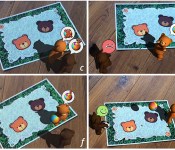
Many RPGs have more than one ending, but even then you still have limited ways to control the story or to interact with the characters. Disney Research, however, wants to make real interactive games — ones where your actions can affect how it progresses and ends — so it has created a platform that can help developers do so more easily than if they use traditional tools. This platform makes it simpler for creators to spin as many story arcs as they want that can be triggered any time by your actions. It also automatically detects and fixes conflicts in the storyline that you’ll inevitably cause as you interact with the characters. Take the bears in the video below the fold, for example.
Say, the story arc calls for a beach ball to be in the scene, but there is no beach ball anywhere, because you were playing God earlier and taking all the props away. If that’s the case, one of the bears will ask you for a beach ball, so the story can run its course. Alternatively, the game can trigger the appearance of a ball vendor and a treasure chest, so the bears can buy a beach ball for themselves.
Ex-Disney researcher and Rutgers University assistant professor Mubbasir Kapadia explained:
We want interactive narratives to be an immersive experience in which users can influence the action or even create a storyline, but the complexity of the authoring task has worked against our ambitions. Our method of modeling multiple story arcs and resolving conflicts in the storylines makes it feasible to author interactive experiences that are free form, rather than constricted.
In short, this method could be used to create some truly open-world choose-your-own-adventure games if developed even further — games you can play again and again and get a different experience each time. The team has uploaded a scientific paper you can sink your teeth into for the technical details, but you can watch the video below for a demo of how it works.
Filed under: Gaming
Source: Disney Research (1), (2)

Mad Catz announces mobile game and media controllers

There are two new controllers announced available for pre-order today from Mad Catz. The company unveiled the L.Y.N.X.3 and S.U.R.F.r controllers for consumers that want optimal gaming and media consumption controllers for their mobile devices. Mad Catz provides plenty of buttons controls while keeping the hardware compact.
For mobile gamers, the L.Y.N.X.3 is the ideal controller as it mimics the design of a standard gaming controller. There are two analog sticks, shoulder buttons, four action buttons, and a directional pad. The L.Y.N.X.3 itself looks so unique because of its ability to fold and fit into tight spaces. The analog sticks fold inward and the clip comes over the entire controller to confirm its closure. Mad Catz ported over the PC, Mobile Game, and Multimedia modes from the bigger L.Y.N.X.9, too. An app available in the Play Store allows gamers to assign controls to specific genres.

Being that it has a full QWERTY keyboard, the S.U.R.F.r acts as the perfect accessory for media consumption. This controller works with various platforms and services such as Android TV and Amazon Fire TV. In addition to a full keyboard and media buttons like any other remote, the S.U.R.F.r has dual analog sticks. And, for some gaming, it has makeshift shoulder and action buttons as well as a directional pad.
Both products will be available for demonstrations at Mad Catz’s booth at MWC 2015. The L.Y.N.X.3 sells for $69 and the S.U.R.F.r’s price is $79.
[L.Y.N.X3 – Pre-order Link] [S.U.R.F.r – Pre-order Link]
Come comment on this article: Mad Catz announces mobile game and media controllers

Masquerada’s gay characters are defined by humanity, not sexuality

In Masquerada: Songs and Shadows, the city of Ombre resembles a fantastical, medieval Venice: elegant stone towers are lined with heavy wood furniture and the people dress in lush fabrics, wielding swords and spears. But Ombre is not Venice; it’s an entirely secular society whose citizens put no stock in the idea of an afterlife, and it’s a land where powerful magic stems from a collection of rare masks. The Inspettore, Cicero Gavar, returns from exile to investigate an earth-shattering kidnapping, with the help of spells, weapons, his team — and his sexuality.
“While having the main character be gay and allowing a romance, as BioWare does, is very empowering to a gay player, we hope to serve them in another way — to show our audience the beauty and humanity of a gay character and how it would translate to real world situations,” lead developer Ian Gregory says.
Masquerada‘s world reflects the lives of its developers in a few ways. It comes from Witching Hour Studios, a development company in Singapore, and the world of Ombre is based on Singapore’s own mutli-cultural, diverse population. The game is a “pause for tactics” RPG, meaning players can stop in the middle of battle and plan out efficient attacks. The art and mechanics are inspired by Bastion, The Banner Saga and Baldur’s Gate, a collection of narrative-driven and innovative tactical titles, all sprinkled with a dash of brilliant neon color.
But, these are the surface aspects of Masquerada. Beneath the gorgeous design lies a deeper message about what it means to be human, shaped by Gregory’s dissatisfaction with the portrayal of gay characters in video games.
“I’m tired that gay characters in games are portrayed [as] oversexualized,” Gregory says. “While some have depth, they seem to be defined by their sexuality and not enough by their humanity. If we’re gonna constantly harp on how different they are just by their bedroom habits, that’s all society will latch on to. We’d like to show the perspective of a gay character whose choices and behaviors are profoundly affected by others’ conflicting attitudes to their sexual orientation — and to do so in a way where the conversation isn’t about romance.”
Basically, Gregory treats Masquerada‘s characters as full, flawed and talented people first, rather than approaching each one from the view of a single, limiting trait. Gregory’s goal is to make his characters relatable and accessible without relying on stereotypes or exaggerated tropes.
“We’re going to explore fear, guilt, loss, redemption,” he says. “A situation where a player would take on the role of a good friend instead of a lover. Perhaps something more familiar to those of us not of the orientation.”
Of course, Masquerada has to be a solid game in order for its characters — gay or otherwise — to have any impact on players or society at large. To that end, Gregory says Witching Hour Studios has partnered with Ysbryd Games, a publisher that provides enough funding for the developers to craft an expansive game with rich lore and no compromises. With support from Ysbryd, the full game is due out on PC and unannounced consoles in early 2016, with no need to turn to crowdfunding or other financing options.
“We’re unlikely to take this to Kickstarter unless we suddenly have a need for half a million to get Daft Punk involved or something,” Gregory says. For what it’s worth, a Daft Punk game soundtrack would probably be awesome.

Witching Hour isn’t concerned about funding and the studio has a clear idea of who Masquerada‘s characters are — that doesn’t mean Gregory has zero worries overall.
“If we were worried about anything, it wouldn’t be about the resources to make the game, but it’d be about overcoming the hurdles of visibility with our intended audience,” he says. “It’s not something you can plan for. It would suck to be drowned out by the next cadre of ‘I Am Call of Battlefield Creed Roguelike Simulator 2016s’ because we ‘didn’t follow trends’ about what’s hip these days. Exhibiting at PAX can only do so much.”
It may not result in much, but Witching Hour is doing it anyway: Masquerada will be in booth 8236 at PAX East 2015, the game convention held in Boston from March 6 – 8. Fans of Bastion, The Banner Saga or fully formed characters, check it out.
‘Fable’ going free-to-play on Xbox One and Windows 10

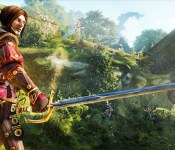
Now you can add “price” alongside “gameplay” to the list of aspects that separates Fable Legends from its forebears. That’s because the game’s launching as a free-to-play title on Windows 10 and gratis with an Xbox Live Gold subscription on Xbox One. What’s it all entail? A lot of similar bits if you’ve paid attention to how free-to-play stuff typically works (microtransactions for cosmetic items, for example), but with a few unique wrinkles. The official FAQ stresses that you’ll be able to play the game from beginning to end without spending any real cash, and that all quests and storylines will be free — same goes for “everything that affects gameplay.” There’s a possibility that some customization options won’t be purchasable with the in-game currency you earn, and with its rotating system for playable characters, you have the option to permanently unlock a favorite character with cold hard cash, too.
This isn’t the first time Microsoft’s stepped into the F2P market, but it’s possibly the highest profile example of it to date. Happy Wars and Project Spark didn’t exactly set the world ablaze (neither did F2P elements that invaded the likes of Forza Horizon and its sequel) so it’ll be interesting to see just how well this does. The PlayStation 4 had its own share of F2P games at launch, too, but when the Xbox One will have a title with a DC Universe Online-level of success is anyone’s guess. But, now that the latter’s developer is free to make games for basically anyone, that could happen sooner rather than later.
Filed under: Gaming, Home Entertainment, HD, Microsoft
Source: Fable Legends (1), (2)

JXE Streams: Taste the rainbow in ‘Kirby and the Rainbow Curse’

What seemed so novel and strange about Kirby: Canvas Curse when it came out now seems almost quaint. Only one part of the screen can be touched at a time? There aren’t gyroscope controls? What is this, an Android store launch game? Please. Just shy of its tenth birthday, though, Canvas Curse still feels like a pristine lesson in touch-control video game design despite its antiquity. It had the depth and challenge of a classic arcade game as well as a strange but clean, immediately understandable interface. Canvas Curse was a colorful dollop of fun that begged for a follow up. Kirby and the Rainbow Curse is finally here, and we’re playing it for the very first time today on JXE Streams.
Starting at 3PM ET, we’re streaming two full hours of Kirby and the Rainbow Curse on Wii U. Anthony John Agnello, a Kirby fan stretching all the way back to Kirby’s Dream Land in 1992, will be firing up the GamePad to check out the claymation style of developer HAL Laboratory’s latest.
JXE Streams broadcasts every Tuesday and Thursday from 3PM to 5PM ET on Engadget.com/gaming and Twitch.tv/Joystiq. Our schedule is going to be ramping up over the coming weeks so be sure to check out what we’re playing and when at the top of Engadget.com/gaming.
[We’re playing a retail copy of Kirby and the Rainbow Curse streamed through an Elgato Capture HD via OBS at 720p.]

‘Bejeweled’ co-creator has a new studio devoted to ‘social’ virtual reality

What do you do after co-founding a studio responsible for myriad massive successes? From Bejeweled, to Peggle, to the massively popular Plants vs. Zombies, former PopCap Games co-founder John Vechey left a wake of breakthrough gaming franchises. After 15 years, he took a brief break. And now, five months after his amicable departure from the studio, Vechey’s taking his hit-making talent to a new medium: virtual reality. Today he announced Pluto VR, an augmented-and-virtual reality studio named after our solar system’s most (loved) distant planet-like mass.
Vechey made it clear that he wasn’t interested half-baked VR experiences. He wants to steer clear of creating something that’s “good because it’s virtual … but is still way worse than real life,” he said when I talked to him recently. “That’s not what we’re aiming for.” Instead, he said Pluto VR is trying to make social experiences and software that are “better than [being there] in person” for the likes of Oculus Rift, Google Cardboard and Samsung’s Gear VR.
The first step is building a technological base that makes it easier to do multi-user virtual reality. Then you have to start developing some concepts for how to bring people together in the virtual world. “Virtual reality is hard. Anything multiplayer is hard,” he said. “They compound each other, it turns out. There’s a huge technological investment that needs to be there.”
Vechey is already thinking about projects like a virtual conference room, replete with an interactive whiteboard (the “number one collaboration tool” in an office, he said). He’s also floating ideas like shared, virtual workspaces and party games like Cards Against Humanity, Apples to Apples, Mafia and Werewolves. “We’re doing the baseline tech around those use cases because a lot of the hard work is similar between all of those,” he said. “All of those seem very different from a feature-set standpoint, but, from a VR multi-user one, in terms of what’s gonna break and what’s not, they’re all pretty similar.” All that is to say, Pluto’s working to crack the hard parts of shared virtual gatherings for everyone else.

Over the course of our hour-long conversation, a few things became pretty clear. Namely, lot of what Vechey said echoes Mark Zuckerberg’s vision for VR: communal social experiences in a virtual world. That, and his team (comprised of four co-founders, including a former director of technology from Walt Disney Animation Studios) has a lot of big ideas, but they all seem early in the conceptual phase. I posed a hypothetical question to him: If a consumer VR product were announced at the Game Developers Conference next week and it would go on sale soon thereafter, when could we see Pluto VR’s first project?
Surprisingly, he said that if making launch day wasn’t possible, it’d be a matter of weeks, not months or years, before the public experienced Pluto’s work. “I think we have enough lessons [learned] that we could get something out that was simple enough and was still cool and usable.”
“It wouldn’t be world-shattering,” he admitted.
“That’s a really long-winded answer saying ‘Yeah, we have something!’” he said. “Would it be Wii Bowling? I can’t say, but would it be something that we stand by and allow people to think about VR differently and allow for something fun and useful? I think so.” Given Vechey’s work at PopCap, I’m inclined to believe him.
[Image credit: Getty Images]
Filed under: Gaming, Home Entertainment, Wearables, Software, HD
Source: Pluto VR

Oculus offers $1 million prize pool for Gear VR developers

Oculus VR has a challenge for aspiring game and app developers: Create something new and exciting for the Gear VR Innovator Edition, Samsung’s Oculus-powered headset, and get a shot at a cash prize from a $1 million pool. The Oculus Mobile VR Jam 2015 kicks off on April 13 and ends on May 11, with sign-ups open now at Challenge Post. The Jam — and the cash — is split between two tracks, “Games” and “Apps or Experiences,” with Platinum, Gold, Silver and Bronze winners in each segment. The top Platinum Game gets $200,000, while the Platinum App or Experience snags $100,000. There are multiple winners for each of the remaining ranks, and prizes bottom out at $10,000 for each Bronze victor.
The Oculus Mobile VR Jam has four must-hit milestones for participants: Pitches are due by April 20, screenshots by April 27, videos by May 4 and the final build is due by May 11 at 9AM PT. After all that hard work, Oculus will announce winners “on or around” June 4. Developers can go in solo, with a team or as part of an organization, and lonesome devs looking for love can put together a group directly on Challenge Post.
This jam is all about the Gear VR Innovator Edition, a virtual reality headset that uses the Samsung Galaxy Note 4, with a side of Oculus VR software. We were reasonably impressed with the Gear VR Innovator Edition in September, though we noted that it had some rough edges, technically speaking. A Samsung rep told us at the time that these technical issues were what made it an “Innovator Edition,” meant for early adopters, VR enthusiasts and professionals. It seems that the Gear VR is sticking around, and we wouldn’t be surprised to see a new, less buggy model featuring Samsung’s flagship phone, the Galaxy S6, at the Mobile World Conference in early March.
Source: Challenge Post
 AIVAnet