


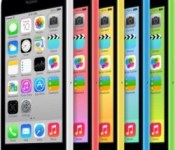
iPhone 5s Demand Higher Than Expected, Took Time to ‘Build the Mix’ Customers Wanted
 Today’s earning’s call revealed that Apple saw lower than expected iPhone 5c sales in the United States, primarily because iPhone 5s sales exceeded Apple’s projections.
While Apple did not break down sales between individual iPhone models, the company did indicate that the iPhone 5c ended up representing a smaller mix of iPhone sales than anticipated.
According to Apple CEO Tim Cook, its iPhone sales growth in North America were not as high as that seen in other countries partially because Apple underestimated demand for the iPhone 5s, with the iPhone mix being “different than we thought.” He also mentioned changes to domestic carrier upgrade plans as a partial reason for weaker-than-expected iPhone sales in the U.S.
The company expected a more balanced demand between the flagship iPhone 5s and the mid-tier plastic iPhone 5c, but actually saw a stronger preference than projected for the 5s, possibly due to a high interest in Touch ID.
It took us some time in order to build the mix that customers were demanding. As a result, we lost some units for part of the quarter in North America.
Cook said that it took Apple the better part of the quarter to get the iPhone into supply/demand balance as a result of the unexpected demand for the iPhone 5s, which was in short supply for several months following its release.
While Apple has not revealed how many iPhone 5c devices it has sold, multiple reports suggested that the phone was seeing poor sales compared to the iPhone 5s, with the 5s outselling the 5c by a two-to-one margin. Shortly after the phones were introduced, Apple cut iPhone 5c production while ramping up iPhone 5s production to meet customer demand.
Apple today reported record sales of 51 million iPhones in the quarter, up from 47.8 million in the same time period last year.
     |

Apple reports record iPhone and iPad sales with fiscal Q1 2014 results

Apple’s earnings are in, and as expected the company got a nice boost in sales over the holidays. We’re talking 51 million iPhones sold — an all-time quarterly record — up from 47.8 million during the same quarter last year. It’s unclear just how the iPhone sales break down between the iPhone 5c and 5s models, as Apple didn’t offer those numbers. iPad sales reached a record quarterly high as well, at 26 million up from 22.9 million during the same year-ago quarter. Profit, meanwhile, comes in at $13.1 billion, showing no change year-over-year.
Mac sales are also up; with a jump to 4.8 million from 4.1 million in the year-ago quarter. Also record-setting was Cupertino’s reported quarterly revenue of $57.6 billion. Apple’s board of directors has also announced that shareholders will receive a $3.05 cash dividend per share early next month.
If Apple took a huge hit anywhere, though, it’s with iPods. Year-over-year sales are down a whopping 52 percent, with revenue down 55 percent. Those figures suggest that the more expensive iPod models took the hardest hit. That ugly stat aside, there are plenty of positive numbers this time around. As always, we’ll be listening in on Apple’s earnings conference call, so stay tuned.
Filed under: Apple

Nintendo’s Mobile Push to Focus on Marketing Demos, Not Full Games
Earlier this month, Nintendo president Satoru Iwata indicated Nintendo was looking into a new business structure involving “smart devices” after the company experienced its third consecutive annual loss in light of increasing competition from mobile platforms.
While that statement was interpreted by some as an indication of Nintendo’s plan to develop game titles for iOS and Android, it appears that the company instead intends to use smartphones to market its existing handheld and console hardware and game lineup.

According to a report from Japanese business newspaper Nikkei [Google Translation] (via Dr. Serkan Toto), Nintendo will introduce a free app that includes information on new games, including videos and character profiles along with some smartphone mini games.
But Nintendo will not simply put Mario, Pokemon or other games on smartphones. According to the report, Nintendo plans to use Android and/or iOS devices (not confirmed at this point) to market its console games.
To be more concrete, The Nikkei writes that Nintendo wants to use smartphones to expand its potential user base by spreading information about new game releases, i.e. by using video to introduce future titles. (This will probably happen through some kind of official Nintendo app.)
Nintendo’s mini games are said to be playable demos of console games, but full versions of the titles will only be available on Nintendo hardware like the Wii U and the 3DS. The idea is to give players a small taste of the gameplay in order to entice them to purchase content on the Nintendo platform.
Mobile devices from Apple and Android and more popular consoles from Microsoft and Sony have devastated Nintendo’s earnings in recent years. According to a report from App Annie, consumer spending on games for iOS and Android is now 4x that of dedicated gaming handhelds and sales of the Xbox and PlayStation have far outpaced Wii U sales. Though Iwata has said that Apple is “the enemy of the future” he has stated publicly that he will not provide Nintendo’s “precious resources” to other platforms.
Nintendo is expected to make an announcement about its new mobile app on Thursday.
| |
Apple Reports Strongest Ever Quarterly Earnings: $13.1 Billion Profit on $57.6 Billion in Revenue in Q1 2014
 Apple today announced financial results for the fourth calendar quarter of 2013 and first fiscal quarter of 2014.
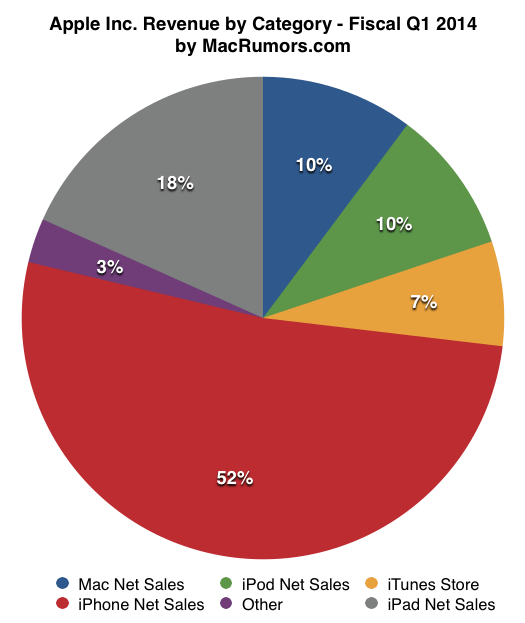
For the quarter, Apple posted revenue of $57.6 billion and net quarterly profit of $13.1 billion, or $14.50 per diluted share, compared to revenue of $54.5 billion and net quarterly profit of $13.1 billion, or $13.87 per diluted share in the year-ago quarter.
Gross margin was 37.9 percent compared to 38.6 percent in the year-ago quarter, with international sales accounting for 63 percent of revenue. Apple also declared a dividend payment of $3.05 per share, payable on February 13 to shareholders as of the close of trading on February 10. The company currently holds $158.8 billion in cash and marketable securities.
Apple had previously issued guidance for the quarter of revenues between $55-58 billion, with gross margin between 36.5 and 37.5 percent.
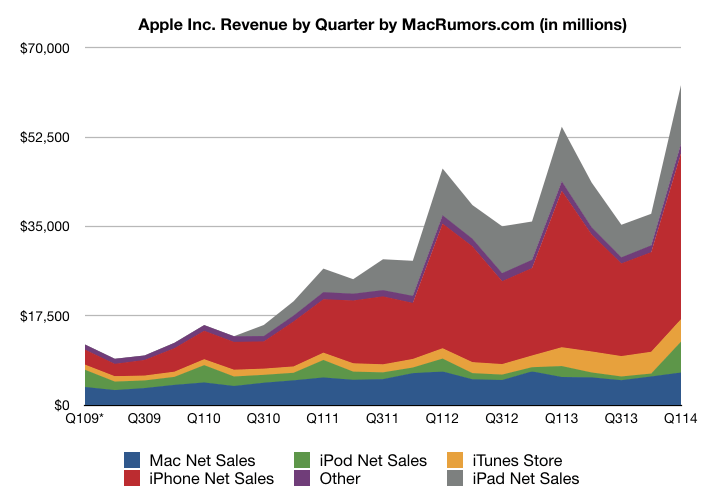
Apple sold a record 51 million iPhones in the quarter, up from 47.8 million in the same time period last year, and the company has now sold 472.3 million smartphones in total. It sold 26 million iPads, a new record, up from 22.86 million last year. Apple has now sold 195 million tablets. It sold 4.8 million Macs during the quarter, compared to 4.06 million in the year-ago period.
“We are really happy with our record iPhone and iPad sales, the strong performance of our Mac products and the continued growth of iTunes, Software and Services,” said Tim Cook, Apple’s CEO. “We love having the most satisfied, loyal and engaged customers, and are continuing to invest heavily in our future to make their experiences with our products and services even better.”
Apple’s guidance for the second quarter of fiscal 2014 includes expected revenue of $42-44 billion and gross margin between 37 and 38 percent.
Apple will provide live streaming of its Q1 2014 financial results conference call at 2:00 PM Pacific, and MacRumors will update this story with coverage of the conference call highlights.
| |

NSA Servers Collect Personal Data Sent by iPhone Apps
 The U.S. National Security Agency specifically looks for data sent by mobile apps in order to capture personal data on targets, according to a new report from The New York Times and other news agencies.
Intelligence agencies can grab data as it travels across the Internet, looking specifically for data from smartphone apps including Google Maps — searches within the app allow Governments to locate users to within a few yards — and even Angry Birds. Much of the information being sent seems to be related to targeted advertising.
The secret report noted that the profiles vary depending on which of the ad companies — which include Burstly and Google’s ad services, two of the largest online advertising businesses — compiles them. Most profiles contain a string of characters that identifies the phone, along with basic data on the user like age, sex and location. One profile notes whether the user is currently listening to music or making a call, and another has an entry for household income.
In addition, apps like Facebook, Instagram, and Twitter all support sending some amount of location data and other information, allowing intelligence agencies significant opportunities to capture personal data in real-time on targeted persons without ever having access to phones, something that was part of a different intelligence strategy revealed in previous leaked documents.

Apple CEO Tim Cook has been vocal in his disapproval of some of the NSA’s methods, meeting with the President to discuss NSA surveillance and more recently saying the NSA “would have to cart us out in a box” to have access to Apple’s servers.
For its part, the NSA says it only analyzes data on foreign intelligence targets and that significant protections exist for data collected on U.S. persons and “innocent foreign citizens”. The NSA has said in the past that collection of this sort of smartphone traffic has been useful in cracking cases.
“N.S.A. does not profile everyday Americans as it carries out its foreign intelligence mission,” the agency said in a written response to questions about the program. “Because some data of U.S. persons may at times be incidentally collected in N.S.A.’s lawful foreign intelligence mission, privacy protections for U.S. persons exist across the entire process.” Similar protections, the agency said, are in place for “innocent foreign citizens.”
Note: Due to the political nature of the discussion regarding this topic, the discussion thread is located in our Politics, Religion, Social Issues forum. All forum members and site visitors are welcome to read and follow the thread, but posting is limited to forum members with at least 100 posts.
| |
Logitech Drops Price on ‘PowerShell’ iOS 7 Game Controller [iOS Blog]
Logitech has dropped the price on its PowerShell iOS 7 MFi game controller from $100 to $70, following a similar price drop on the SteelSeries gaming controller when it launched.
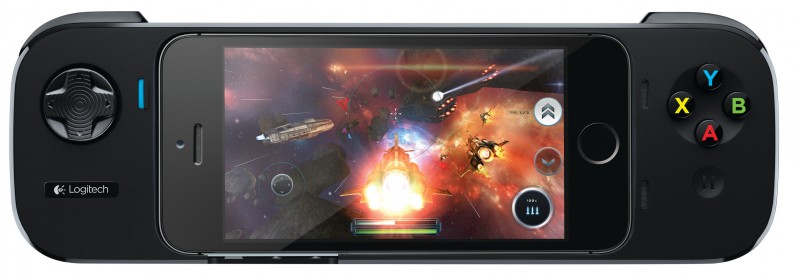
The form-fitting controller is made to plug into the Lightning port on a newer iOS device and features console-style controls including a directional pad, shoulder bumpers, and face buttons. It also allows for headphones to be connected through an included adapter, and also leaves the volume up/down buttons, ring/silent switch, and power/sleep button of an iOS device fully accessible.
Logitech’s controller includes a 1500 mAh battery which will charge an iOS device whiile it is plugged into the controller, and can also be charged simultaneously with a device through the controller’s micro-USB port.
Complaints about the high price tag of the MFi controllers and issues with build quality, could be causing poor sales of the devices, which is the likely impetus for the two price drops.
| |

iPhone Replaces Hotel Room Keys in New Pilot Program
Starwood Hotels & Resorts is implementing a new pilot program that will see two key hotel locations in Manhattan and Silicon Valley allowing guests to enter their rooms with their smartphones, reports The Wall Street Journal.
After installing the Starwood Preferred Guest (SGP) App, guests will receive a virtual key on their iPhone, which can then be used to unlock a door with a tap using Bluetooth 4.0. The newer Bluetooth specification, first introduced with the iPhone 4s, has been used in a similar way for many home locking products like the Lockitron and the August Smart Lock, but this is the first time it’s being used on a larger scale.
Starwood officials are betting that the technology will become the standard for hotels in the future, replacing traditional hotel check-in methods.
“We believe this will become the new standard for how people will want to enter a hotel,” says Frits van Paasschen, Starwood’s CEO. “It may be a novelty at first, but we think it will become table stakes for managing a hotel.”
Bluetooth 4.0 (or Bluetooth LE) is being utilized in a number of innovative ways. In addition to being installed in multiple different home locking products, it has also been used to replace traditional password logins on Macs through the Knock app and to deliver car diagnostics in the Automatic connected car device. Bluetooth 4.0 is also the driving technology behind Apple’s iBeacons, which are rapidly being implemented in retail stores and other locations across the world to deliver location-based notifications.
Two Starwood Aloft hotels, in Harlem, New York and Cupertino, California, will be updated with the Bluetooth 4.0 technology during the first quarter of 2014. Starwood has plans to roll out the system at all of its locations by the end of 2015 should the pilot program be successful.
| |
Apple’s App Store Usage Numbers Put iOS 7 Adoption at 80% [iOS Blog]
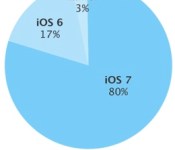
Following approximately four-and-a-half months of availability, iOS 7 is now installed on 80 percent of devices connected to the App Store, according to the newest numbers posted on Apple’s App Store support page for developers.

As iOS 7 adoption numbers grow, iOS 6 usage continues to drop, and the older operating system is now installed on just 17 percent of devices. Three percent of devices also continue use even older versions of iOS.
In early December, iOS 7 usage was at 74 percent, jumping to 78 percent later in December, while iOS 6 usage first declined to 22 percent and then to 18 percent.
Apple’s data, which comes directly from the App Store, represents the most accurate iOS 7 adoption information for developers.
| |

Third-Party Security Lock for New Mac Pro Now Available [Mac Blog]
Apple’s new Mac Pro is immaculately designed to waste as little space as possible, but for a multi-thousand dollar machine, many businesses and schools will look for a way to secure the machine so it isn’t easily stolen.
Some owners have built custom locking systems, while Apple uses an ethernet-based security cable at its Apple Retail Stores that doesn’t actually lock the device, but it does set off an alarm if someone tries to steal it.
For those uninterested in the “do-it-yourself” look, MacLocks.com has created a new security bracket that tucks inside the edges of the rear access panel, around the power cord, adding a more permanent security solution to the Mac Pro.
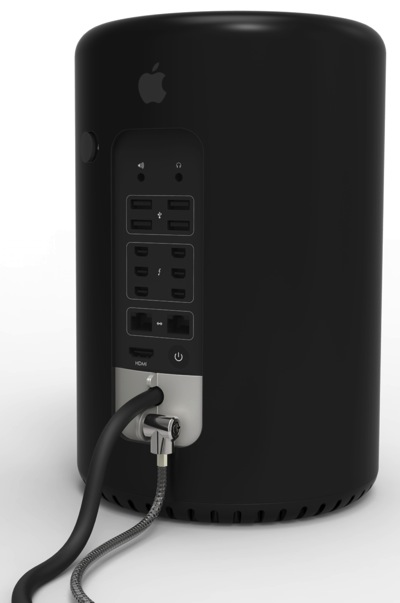
The new Mac Pro Lock Bracket with Security Cable Lock fits comfortably underneath the cylinder lid to offer complete protection of the device and its hardware components. By designing the Mac Pro Lock to fit the curvature of the new Mac Pro and the bracket plate to sit securely over the power cable the lid is now doubly locked into place. The bracket plate has an extended lip that will allow you to attach the included Security Cable Lock ensuring your Mac Pro workstation and all its impressive (and expensive) hardware are not going anywhere.
The Mac Pro Lock Security Bracket is available from MacLocks.com for $90.
| |

OS X 10.10 to Feature ‘Flatter’ Look, but Not as Stark as iOS 7
 OS X 10.10, the next version of OS X which carries the code name of “Syrah”, will take a few cues from iOS 7 with a somewhat flatter look compared to OS X Mavericks, but the changes will not result in as stark a look as seen on iOS 7, according to a new report from 9to5Mac. The report comes on the heels of comments from Apple executives reiterating that convergence of iOS and OS X is a “non-goal” for the company.
Instead [of a complete iOS 7-like overhaul], I am expecting OS X 10.10 to have user-interface tweaks that will make the interface “flatter,” but not as stark as iOS 7′s look. I’d also expect some blur and translucency effects in a few places, but not in anyway that is central to the experience like it is on iOS. There will be a little bit more white space, more defined menu bars, and squared-off window controls, but I would not expect a full color palette change and redesigns for every single application and icon.
The report indicates that internal build numbers for OS X 10.10 are currently around 14Z109 and that new features could include improved notifications, cross-platform AirDrop support to and from iOS 8, and possible Siri integration.
 Visitors to MacRumors.com via Apple’s networks from machines running OS X 10.10
MacRumors has been seeing fairly low levels of activity coming from machines running OS X 10.10 from Apple’s network, and that activity has unsurprisingly been beginning to ramp up this month following the holiday break. With Apple having accelerated its OS X release cycles over the past several major updates, a public release for OS X 10.10 could come late this year or early next year.
| |

