



Russia’s second largest carrier resumes selling the iPhone after three-year split

You could say Apple’s had a pretty successful six months in Russia. After finally opening a localized version of its online store in June, it’s also seen three of the country’s biggest operators begin selling the iPhone again. Reuters reports that Megafon, Russia’s second-biggest carrier, today became the final provider to resume sales of the fruity smartphones, committing to a three-year deal after almost four years on the sidelines. Last year, MTS, VimpelCom and Megafon reportedly suspended sales following a dispute over unfavorable contract terms, but a relaxation in Apple’s distributor sales policy saw two of the three return to the fold by the end of 2013. While the deal isn’t likely to drastically boost Apple’s small share of Russia’s smartphone market (at least right away), competition can only be a good thing — especially given the high pricing on Apple’s online store.
Filed under: Cellphones, Wireless, Mobile, Apple
Source: Reuters
Analysts Predict Apple Will Report Single-Digit Earnings Growth in 1Q 2014
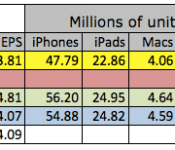
Analysts predict Apple will return to growth when the company announces its quarterly earnings later today, reports Philip Elmer-Dewitt of Fortune. Growth will be in the single digits and will be an improvement over the negative earnings growth the company reported for the previous three quarters. Apple is not, however, expected to return to the 50% growth it achieved between 2010 and 2012.

The consensus estimates among the 47 Apple analysts we’ve heard from so far — 29 Wall Street professionals and 18 Internet amateurs — are for earnings of $14.36 per share on sales of $58.1 billion. That represents year-over-year growth of 4.0% for earnings and 6.6% for revenue.
Eighty percent of Fortune’s surveyed analysts estimate Apple’s revenue will fall within the company’s guidance of $55 to $58 billion. Six analysts predict Apple will beat the street with revenue that tops $58 billion. Consensus estimates also predict Apple will sell a record 55 million iPhones and 25 million iPads in 1Q 2014.
Apple will report its quarterly earnings today after the close of trading, at approximately 4:30 PM Eastern / 1:30 PM Pacific. MacRumors will have full coverage of Apple’s earnings release and the conference call taking place at 5:00 PM Eastern / 2:00 PM Pacific.
     |

Russia’s Megafon Signs Multi-Year iPhone Distribution Deal with Apple [iOS Blog]
Russian wireless carrier Megafon announced today that it has signed a three-year deal with Apple to sell the iPhone, reports Reuters. Megafon first sold the iPhone in 2008 and subsequently halted sales of the handset after it and other Russian carriers could not sell the volume of handsets required by Apple.

Apple allegedly loosened its requirements for partner carriers, which opened the door for the Megafon deal. Competing carrier Vimpelcom signed a similar, direct deal with Apple in October 2013 that allowed the carrier to start selling the iPhone 5s and 5c. Among Russia’s top three carriers, market leader MTS is the remaining holdout, buying its iPhone handsets from third-party distributors instead of Apple directly.
Apple’s iPhone has a 20 percent market share of the smartphone market in Russia based on revenue and a nine percent market share based on units sold in 2013. Besides carriers, Apple also sells the iPhone in Russia through its online store and electronics resellers. 
| |
Three Companies to Share Packaging Orders for Apple’s Next-Generation A8 Chip [iOS Blog]
 Semiconductor companies Amkor Technology and STATS ChipPAC will each handle 40% of the packaging orders placed by Apple for its upcoming A8 processor, while Advanced Semiconductor Engineering (ASE) will obtain the remaining 20% of the orders, according to a new report from DigiTimes.
Apple’s A8 chip will be a package-on-package (PoP) SoC solution comprising processors and mobile DRAM in a single package, said the sources.
Taiwan Semiconductor Manufacturing Company (TSMC) is also believed to have secured wafer-bumping orders for the processor, and will reportedly start ramping up production of the A8 chip using 20nm process technology in the second quarter of 2014, with the processor widely expected to be used in Apple’s next-generation iPhone.
According to a report in September, it is also expected that Samsung will assist with production of A8 chip, with the Korean company expected to handle 20% to 30% of the manufacturing load.
Overall, production plans for the iPhone 6 seem to be gearing up, with a report earlier this month stating that TSMC would be producing fingerprint sensors for the next-generation iPhone using a larger 12-inch fab from the current 8-inch fab to increase production efficiency. It was also stated that TSMC would handle the packaging process for the sensors itself rather than contracting out to other firms in order to centralize control over the component.
| |
iPhone Market Share Holds Strong as Android Increases Lead in Global Smartphone Race
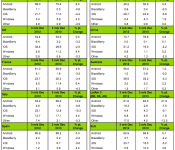
Research firm Kantar Worldpanel has released a new report (via The Next Web) highlighting global smartphone sales over the October-December period, finding that while Apple held strong in key markets such as the U.S. and China, Google’s Android devices increased their lead over other platforms during the end of 2013, registering year-over-year growth in various major markets.

Dominic Sunnebo, strategic insight director at Kantar Worldpanel ComTech, comments: “Android finished 2013 strongly, showing year-on-year share growth across 12 major global markets including Europe, USA, Latin America, China and Japan. Apple has lost share in most countries compared with this time last year, but importantly it has held strong shares in key markets including 43.9% in USA, 29.9% in Great Britain and 19.0% in China.
Apple’s total market share in the U.S. hit 43.9% in December, and was overall lower in most countries compared to the same timeframe last year. However, Sunnebo stated himself in Kantar’s prior report highlighting global smartphone sales over the August-October period that customers generally react more positively to “full” releases than incremental improvements such as the iPhone 5s and the iPhone 5c, which is the likely reason for the drop in market share.
Apple also continues to have strong presence in Japan, as the iPhone has held a steady market share in the months after the debut of the iPhone on the country’s largest carrier, NTT DoCoMo:
In Japan, consumers’ desire for all things Apple continued into the final quarter of 2013, with iOS taking 68.7% share of smartphone sales. Apple’s deal to sell iPhones through Japan’s largest carrier, NTT DoCoMO, has proved an unarguable success with Apple’s share on the carrier reaching 58.1% in the fourth quarter compared with 91.7% on Softbank and 63.7% on AU KDDI.
Despite its strong market share in various countries, the iPhone continues to face challenges in mainland Europe and China, where Android’s market share is around 70% or higher in many countries. Microsoft’s Windows Phone also continues to show growth in many markets, as the platform’s market share has even overtake that of iOS in Italy.
| |
Kantar: Samsung sales stall in China and Europe despite Android’s overall growth

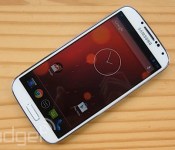
Thanks to its latest earnings report, we already knew that Samsung’s market share dropped last quarter. But the latest report from analytics outfit Kantar now shows mainly where: the all-important Chinese and European markets. Its figures show that the Korean giant has slipped 2.2 percent in France, the UK, Italy, Spain and Germany over last year while remaining flat in China during the same period. Since overall Android market share increased five percent in China, that means Samsung has lost ground to local companies like Xiaomi, which is now the market share leader in that nation.
Meanwhile, though Apple’s iOS dropped in most markets over last year, it held strong in key markets China, UK and the US, counting up 44 percent of holiday handset sales stateside. Cupertino is also king of Japan with 69 percent of total smartphone share, due in large part to Japan’s largest operator, NTT DoCoMo finally carrying Apple handsets. As for the rest of the pack, Windows Phone has picked up significant market share in every region over last year and is even the number two smartphone OS in Italy. That’s mostly at the expense of Blackberry, which now holds a miniscule 0.4 percent of the US market and has declined precipitously everywhere else — to the point that its not a given that it’ll appear on any charts soon.

Filed under: Cellphones
Via: Techcrunch
Source: Kantar World Panel

Original Macintosh Team Gathers to Celebrate 30th Anniversary with Stories, Demos and Laughter [Mac Blog]
Last night, over 100 members of the original Mac team gathered to celebrate the Mac’s 30th anniversary in De Anza College’s Flint Center, where Steve Jobs first introduced the Macintosh 30 years ago. The event was focused around three separate panels: the conception of the Mac, the building of the Mac and the third-party developers who built software for the Mac.
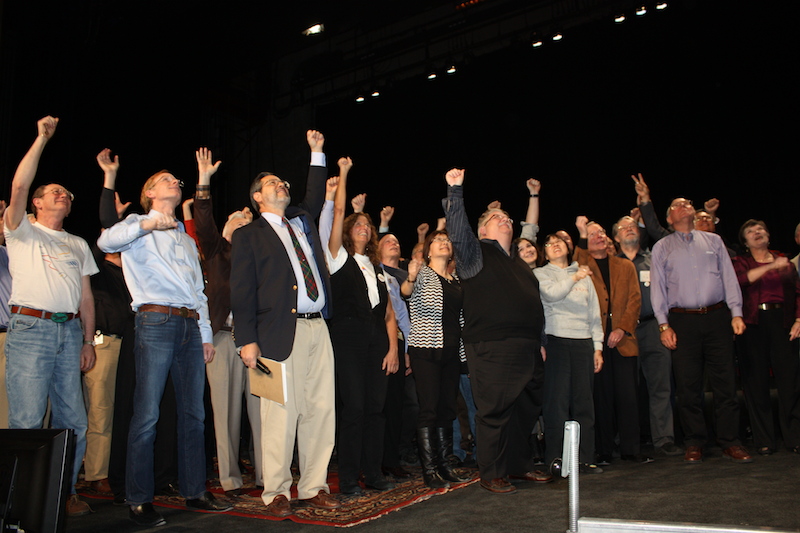
The evening began with video of both Jobs’ introduction of the Macintosh in the Flint Center and a couple minutes of the 90-minute Macintosh presentation at the Boston Computer Society, which was made public for the first time last night. Master of Ceremonies and Apple employee #4 Bill Fernandez then introduced the first panel of the night: the conception of the Mac.
Moderated by New York Times writer John Markoff, the panel included Mac team members Larry Tesler, Daniel Kottke, Ron Holt, Jerry Manock and Mark LeBrun. While introducing themselves, Manock himself recalled that he initially thought he was going to be fired due to a defect on the Apple III’s design that was seen as his fault. Manock states that he was called into Jobs’ office while trying to fix the design and, instead of being fired, was given a job to design the Macintosh.
Later, when asked what carried over from Jeff Raskin’s version of the Macintosh project and Steve Jobs’ version of the Macintosh product, Holt, who developed the power supply for the Apple II, said the main difference was that the computer became a product the team themselves wanted, echoing Apple’s current product philosophy.
From an abstract, it became a reality. But it was the sum of its parts, but the parts were all what people wanted. And that enthusiasm, you see, people put themselves into that computer. It’s the same thing that happened with the Apple II. Everyone worked on that Apple II because they wanted that Apple II. This process of invention was very unusual. I think that this world could use a lot more of that.
The second panel, moderated by Wired’s Steven Levy, focused on the creation of the Mac and included Mac team members Bill Atkinson, Caroline Rose, Andy Hertzfeld, Bruce Horn, Steve Capps, George Crow and Randy Wigginton. During the introductory part of the panel, which detailed how each employee joined the Mac team, Wigginton, who created MacWrite, said “I feel like I’m listening to a bunch of lies, because according to the Ashton Kutcher documentary…” referencing Ashton Kutcher’s Steve Jobs biopic Jobs and drawing a roar of laughter.
The panel then discussed how difficult it was to ship the Mac on time, noting that some of them worked up to 90 hours a week to fix things and get them as good as they could be for shipment. Levy then asked the group about their work with Microsoft, noting Bill Gates’ claim that Microsoft had more people working on software for the Mac than Apple did. Wigginton quickly responded, saying “If they had more people than us then it doesn’t speak very highly of the quality of the people they had,” which drew massive applause and laughter.
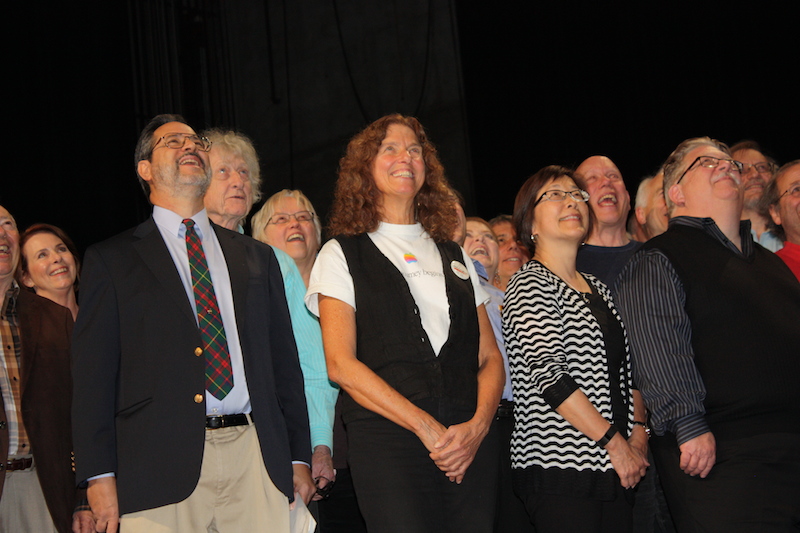
Hertzfeld, who was a software designer on Macintosh, then jumped in, noting Microsoft was the first company that got a Mac and ended up helping shaping the Mac, creating three programs to accompany Apple’s MacWrite and MacPaint to give its young ecosystem a boost. Further, he also noted one of Microsoft’s systems architects kept asking how the internals of the software worked. Hertzfeld said he was curious as to why they kept asking, but eventually assumed why. “I quickly thought ‘maybe they were trying to copy the Mac?’ And sure enough, in 1983, they announced Windows. We were kind of shocked by that.”
Capps, who helped create Finder with Horn and worked at Microsoft from 1996 – 2001, then mentioned that well into 2000 he would be in a product meeting and Gates, when he didn’t like any of the ideas that were presented to him, would say “What would Apple do?” He said that Apple’s ethos and product environment were burnt into his psyche and inspired Gates. Horn then noted the curiosity around Apple still exists today.
Everybody looks at Apple and says ‘what would Apple do?’ and everybody is copying Apple. So something that Steve did and all the people who he hired made Apple have a particular way of thinking and particular passion for the user of the product that is here today for years and years so I think that’s amazing.
Atkinson then said making the Mac was more about creating art for them as opposed to doing work. This mentality, Atkinson stated, was why Jobs made the team have their signatures on the inside of the Mac, because “artists sign their work” and Jobs wanted them to be proud of what they built.
Later on, Caroline Rose, who wrote the Macintosh’s technical documentation, said the team had tears in their eyes and became depressed when it was announced the price of the Mac was raised from $1,995 to $2,495 to offset the massive marketing costs, because the people they built the computer for wouldn’t be able to purchase it.
Apple CEO Mike Markkula then came on stage and thanked the entire Mac team for their accomplishment. Fernandez then symbolically presented Markkula with a plaque that had a trophy on top of it with six arms holding up a Mac, which said: “Apple and Macintosh would never have happened without you. Your participation changed the world.”
After bringing out an original Macintosh and re-demoing the original demo Steve Jobs conducted at the product’s introduction in 1984, Steve Hayden, the copywriter behind many popular Apple ad campaigns, including the famous “1984” commercial, gave a presentation on the history of Apple’s advertising.
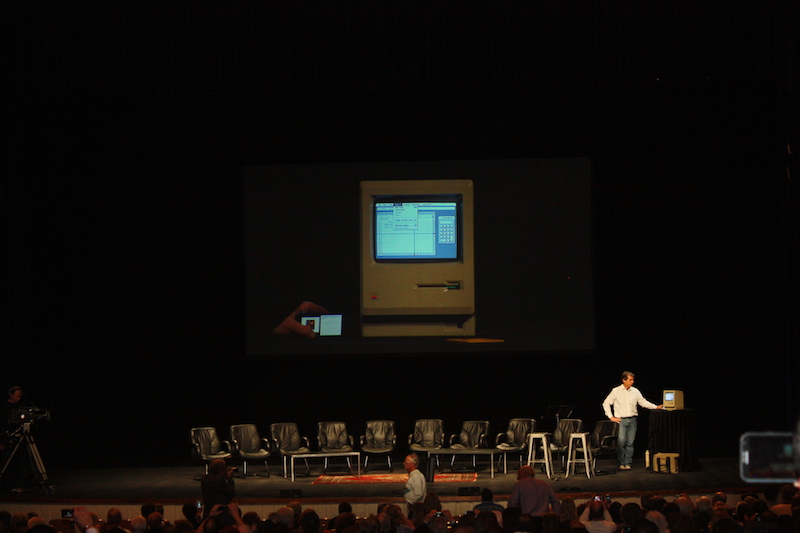
Hayden recounted the early development of “1984″ to the 20-page inserts he helped create to explain how to use a Mac to the “Computer for the rest of us” tagline to the failure of the “Lemmings” Macintosh Office commercial to the resurgence of Apple advertising with the iMac’s “Three Steps” ad.
In the final panel of the evening, CNET’s Dan Farber moderated a panel that included third-party developers Mark Canter, Charlie Jackson, Jim Rea, Heidi Rozen, Ty Roberts, David Bunnell, Maryline Delbourg Delphis, Adam Hertz and Steve Jasik, focusing on how developing for the Mac changed their lives, echoing Apple’s recent efforts to highlight how developing for the App Store and iPad has changed people’s lives today.
Bunnell, who founded MacWorld, remembered how he had worked with Steve Jobs and Apple to develop MacWorld magazine in secret. Jobs initially didn’t want to be on the famous first cover for MacWorld, but was talked into it. Jobs later changed his mind, telling Bunnell he didn’t want to be on the cover anymore, but Bunnell lied and told him it was too late and the magazine was already printed.
Finally, Jerry Manock, Caroline Rose and Patti Kenyon came on stage to read a letter from the Mac team to the Macintosh, and to the various Apple employees that attended the event:
Dear Mac, today you are celebrating your 30th birthday. Here are some things we wanted you to know as you enter your fourth decade. Your early family really loved you. We had lots of fun being pirates and working very hard together, before you were born. You were a cute, chubby little baby who has grown up to be as slender as a No. 2 pencil with the power of an NFL middle linebacker. You were writing and drawing sketches at a very early age, who would have guessed that you’d now be making movies all by yourself and sharing it with people around the world.
Your list of accomplishments is truly astounding. We are very, very proud of all the tasks you have mastered. Many more than we could have ever imagined! Never forget that your parents wanted you to always be respectful of the individuality of your users. And we hope that you will continue to help them communicate their uniqueness to each other.
You can’t let vanity and compliments about your beauty stop you from always remembering your core purpose: fostering innovation and creativity. Finally, don’t forget to keep your sense of humor. True artist not only ship, but laugh! Don’t forget about the little Mac Man who used to run across the desktop every once in a while. So, have an insanely great happy birthday. We all wish you continued success in your next 30 years, helping pilot the Mothership.
Sincerely yours, members of the 1984 Macintosh Development Team.

| |
Watch Steve Jobs demonstrate the first Mac back in 1984

It’s been 30 years since Apple first launched the Macintosh, and this week has been littered with clever tributes to the computer. Members of the Boston Computer Society, however, have unearthed a big treasure in the history of the machine. A week after a bow tie-sporting Steve Jobs famously pulled the machine out of a bag at the company’s shareholder meeting, the CEO made a second presentation at Boston’s John Hancock Hall. The clip hasn’t been shown off publicly for the better part of 30 years, but has now been archived at the Computer History Museum. While the original remains the first unveiling of the unit, this 96-minute clip offers new insight into how users, rather than shareholders, embraced the computer at its launch.
Filed under: Apple
Source: Time Techland

Steve Jobs’ First Public Demonstration of the Macintosh, Hidden Since 1984
 On January 24, 1984, Steve Jobs famously demonstrated the Macintosh for the first time at Apple’s shareholders meeting at the Flint Center at De Anza College.
Less than a week later, Jobs again showed off the Mac. But this time, instead of showing it to Apple’s investors, he showed it to his potential user base at the monthly general meeting of the Boston Computer Society.
This lesser known introduction actually comes off more polished than the more well-known January 24 version, which is viewable on YouTube.
The Boston Computer Society introduction, which runs for 90 minutes, has gone virtually unseen since it took place. Time reporter Harry McCracken managed to track down the tape, locating a Boston-area videographer who had the original tapes in storage on a now-obsolete format called U-matic.
Fortunately for posterity, the production values on the video version of the meeting are quite good — far better than what Apple managed for the shareholder meeting. (In Cupertino, the lighting had been so murky at times that the only thing you can see clearly is Jobs’ white shirt gleaming from inside his jacket.) Apple sprung for multiple cameras, one of which was manned by the BCS’s [videographer Glenn] Koenig. Moments with subpar camera work in the Cupertino video, such as when Jobs pulls the Mac out of its bag and boots it up, are nicely shot in this one.
As presented here, the video — which is a rough cut of the version which the Computer History Museum will preserve — has a few moments which have been reconstructed. The slides which Jobs shows are the same ones he presented in Boston, but they’re borrowed from the video of the Cupertino event. And when Jobs shows a blurry slide of the IBM PC — provoking mirth from the audience and prompting him to say “Let’s be fair” — the blurring is a recreation of what really happened. (To this day, [BCS co-founder Jonathan] Rotenberg isn’t sure whether it was a prank on Apple’s part or a bona-fide technical glitch.)
“It’s so much more intimate,” Rotenberg says of the Boston version of the presentation. “It’s about the users, which is what you don’t get at the shareholder meeting.”
McCracken has much more about the video and the event itself in his Time piece, along with details on the Boston Computer Society, which shut down in 1996. Excerpts of the video were shown at Macworld and the Computer History Museum’s Macintosh 30th Anniversary party, held last night at the same Flint Center where Jobs first introduced the machine to his shareholders.
At the end, it includes a special Q&A session with Macintosh team members, along with a number of software demos — McCracken calls the BCS demonstration “a prototype for the media extravaganzas which we citizens of the 21st century call Stevenotes.”
The never-before seen video is an important piece of Apple history, and, fittingly, the Computer History Museum will be preserving it for posterity.
| |

The Argument for an 11.88-inch Retina MacBook Air
 In October 2013, DisplaySearch analyst David Hsieh first revealed that Apple would be introducing a 12″ Retina MacBook Air in 2014. The report was quickly corroborated by the reliable Ming-Chi Kuo.
It wasn’t entirely clear at the time why Apple would choose to introduce a new 12″ screen model, when their current lineup of MacBook Airs and Pros come in 11″, 13″, and 15″ screen sizes.
Analyst Daniel Matte, however, lays out a convincing argument at his new blog on why Apple would choose that size. Matte believes that the new Retina MacBook Air will be exactly 11.88″ in diagonal screen size, as that would allow Apple to offer a Retina Display (2732 x 1536, twice 1366×768) with the exact same PPI as the iPad Air (264 PPI). The full analysis is worth reading.
It would make sense for Apple to take advantage of the same display technology it has been utilizing for the 9.7” iPads by cutting their panels to this larger size.
Apple is quite deliberate in choosing screen sizes for their new products.
The earliest supply chain rumors of the iPad mini included the specific screen size of 7.9 inches. The reason for that particular size later became apparent as it similarly allowed Apple to use the exact same PPI displays that were used in original iPhone and iPod touch.
The main discrepancy in Matte’s argument is that the original DisplaySearch report predicted a lower resolution (2304 x 1440). Also, in the past, we’d heard very specific display sizes from Apple’s supply chain, such as the 7.9″ iPad mini display rather than 8″ iPad mini display. In this case, the early reports (so far) have been at 12-inches.
Still, the new Retina MacBook Air is not expected in mid-2014, so we should start hearing more as production starts ramping up.
| |


