


New Video Shows ‘iOS in the Car’ Functionality from iOS 7.0.3 in Action
Last week, app developer Steven Troughton-Smith shared a series of screenshots of what seemed to be Apple’s “iOS in the Car” feature announced by Apple as “coming soon” to iOS 7 devices. The feature is intended to allow an iOS device to take over the in-dash display of a car, providing access to navigation, phone functions, messages, and music.
Troughton-Smith has now posted a video showing iOS in the Car in action, via a barebones implementation that is actually present in the already released iOS 7.0.3 but not accessible by default. The video shows the feature being run in the iOS Simulator software for developers, with the in-dash display represented by a separate 800×480 window.
In notes posted alongside the video, Troughton-Smith points out that the iOS in the Car feature supports multiple resolutions of external displays, touch input and hardware controls, and voice input.
– Supports Multiple Resolutions
– Supports touchscreens (presumably single-touch?), hardware buttons, wheels and touchpads
– Does not support multitasking – car display will always show same current on-screen app as iPhone (which can be locked/asleep)
– Whitelisted to specific Apple apps – no public API for developers [yet?]
– Has no keyboard UI – voice recognition as input
– UI clearly subject to change
– Missing functionality in video is due to iOS Simulator not containing all the stock iOS apps
 iOS in the Car from iOS 7.1 (Source: Twitter)
Troughton-Smith does also point out that the user interface is subject to change, and while the demo shown in the video resembles the screenshots shown on Apple’s site, his earlier screenshots and a Twitter response indicate that the overall look has indeed seen a redesign for iOS 7.1, bringing more of the blue text and overall feel of iOS 7 to the in-vehicle display.
     |
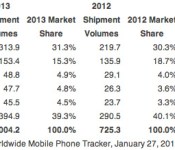
Smartphone sales may have topped 1 billion in 2013, depending on who you ask

You once had to look to the broader cellphone market to see more than a billion phones ship in one year. Well, times have changed… at least, if you ask the right analysts. IDC now estimates that smartphone shipments topped one billion for the first time in 2013. However, Strategy Analytics begs to differ — it reckons that shipments fell just short, at 990 million. Whether or not the industry hit its symbolic milestone, the roughly 40 percent increase over 2012 data shows that the smartphone market had plenty of room to grow last year. Samsung led the pack with 31.3 percent of the the market, while Apple dipped to 15.3 percent as both Samsung and Chinese manufacturers (including Huawei and Lenovo) chipped away at its second-place position.
As for what happened in the fourth quarter? Both analyst groups say that Samsung was once again the top vendor, although they note that the Korean firm’s share was largely flat at 29 percent. Not that Apple fared any better, as its record-setting iPhone shipments weren’t enough to prevent a slide to 18 percent share. Huawei, LG and Lenovo were the real victors — each of them typically gained a point or more of share in the past year. IDC chalks some of this up to the rise of very low-cost smartphones, which are quickly taking over developing markets like China and India. Companies which focus on more expensive handsets, such as Apple and Samsung, have the most to lose in these areas.

Filed under: Cellphones, Mobile, Apple, Samsung, LG, Lenovo
Source: IDC, Strategy Analytics
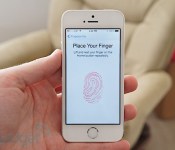
Apple’s next cash cow could be your fingerprint

The mobile payments arena may not seem so big right now, but make no mistake: we’re just seeing the beginning of an exponentially growing trend. Some estimates we’ve seen from market research firms put the future mobile payment market in the US alone at around $90 billion spent in 2017. Compared to that, the $12 billion spent in 2012 is just pocket change underneath the couch cushions. Apple’s very much aware of the revenue potential in this category, and it’s taking the possibility seriously.
“Mobile payments in general is one [area] that we’ve been intrigued with, and that was one of the thoughts behind Touch ID.”
On today’s quarterly earnings call, Apple CEO Tim Cook stated that people love to buy content using Touch ID, the fingerprint reader featured on the iPhone 5s. “Mobile payments in general is one [area] that we’ve been intrigued with, and that was one of the thoughts behind Touch ID,” Cook said. “We’re not limiting ourselves just to that.” This is the first direct confirmation that mobile payments were at least on the table in some form when Apple began developing Touch ID. This wasn’t a promise from Cook that anything will happen in the near future, but it seems as though Apple would be leaving a lot of money on the table if it sat on the opportunity.
As soon as smartphone makers began adopting Near-Field Communication (NFC), the concept of using the tech to facilitate wireless payments began to bloom. Not coincidentally, Apple found itself receiving criticism for not adding the standard into the iPhone. Because of this, mobile payment tech has become a hot-button issue for critics who argue that Apple isn’t keeping up with the rest of the smartphone industry.

Two days ago, however, The Wall Street Journal reported that iTunes and App Store chief Eddy Cue personally met with unnamed industry executives to talk about getting involved with handling payments for goods and services. Whether or not this directly involves NFC remains to be seen, but it at least indicates that Apple is working on moving forward with mobile payments in some shape or form. The publication also reported that the company is shifting some of its executives into roles that will help build some sort of payment business; this isn’t the first time we’ve heard whispers that Apple was looking into the industry, and it’s much more likely to rapidly expand going forward.
Tie these rumors in with Cook’s declaration that mobile payments were a driving force behind Touch ID (Cook didn’t specify how much of a force, but the topic was at least a part of the discussion), and then consider Apple’s inclusion of services like Passbook and iBeacon location sensors, and everything starts to make sense. The company has been hard at work providing a foundation for a possible mobile payment option, and Touch ID is just another logical part of the framework.
The company has been hard at work providing a foundation for a possible mobile payment option, and Touch ID is just another logical part of the framework.
Combining biometrics with wireless payments seems like a natural match, but security and privacy are still significant hurdles that the company needs to jump over before it can become accepted by the masses. Apple is convinced that Touch ID is more secure than any other method of identity verification. Much of the public, however, was not as easily persuaded when the iPhone 5s was announced. The response from the public was mixed, varying anywhere from praise to skepticism and in some cases, to anger; Senator Al Franken even got involved in the discussion, sending Cook a letter addressing the potential privacy concerns involved.
Part of the solution is simply waiting for the right time to dive in. As more Touch ID-enabled iPhones are sold, the feature will continue to become more used and accepted, and most concerns will be soothed. More and more people will start using Touch ID to pay for iTunes purchases as they get comfortable with the feature. Given that iTunes made more than $2 billion this past quarter, it’s not too hard to visualize the benefits of Touch ID progressing into other money-making ventures for Apple.
Even though today’s statement by Tim Cook wasn’t an official guarantee that his company is diving into mobile payments, it’d be silly to expect Apple to just sit idly by in the coming years. With features like Touch ID, Passbook and iBeacons laying the groundwork for a future service, it’s pretty clear that this is an area of intense interest for the company. The next step is to determine when and how to slice up its piece of the pie.
Filed under: Cellphones, Wireless, Mobile, Apple
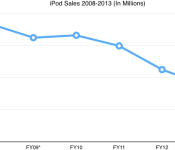
Tim Cook: iPod is a ‘Declining Business’ [iOS Blog]
During its earnings conference call today, Apple CEO Tim Cook commented on the state of the iPod, noting that the product is a declining category for the company:
The way we look at it, our business is a sell-through point of view less iPod — all of us have known for some time that iPod is a declining business.

The iPod was Apple’s “halo” product for years, getting new customers to buy Apple products for the first time. Since their peak in 2008, however, iPod sales have seen a fairly steady decline as the iPhone and iPad have captured more of the market that the iPod occupied previously.
Apple’s last change to the the iPod line came with the debut of a new Space Gray color option for the iPod touch, iPod nano, and iPod shuffle at its September 2013 iPhone event. However, Apple has not updated the iPod classic in over four years, with that device more likely to be discontinued rather than refreshed.
| |
Tim Cook: Innovation ‘Deeply Embedded’ In Apple, Company Has ‘No Issue’ Coming Up With New Ideas
 Apple plans to launch new products in categories where it doesn’t currently operate, according to comments from CEO Tim Cook. During today’s earnings call, Cook said that innovation is “deeply embedded” in everyone at Apple and that the company has “no issue” coming up with new projects to work on.
There’s so much of the world that is full of very complex products. We have zero issue coming up with things we want to do. We must focus on the very few that deserve all our energy. We’ve always done that and we continue to do that.
Since the introduction of the iPod, Apple has concentrated on launching new products in markets where it sees significant room for improvement. With its touch-focused design, the iPhone was significant departure from its competitors when it was introduced in 2007, and the iPad, introduced in 2010 dominated the tablet market from launch.
Currently, Apple is rumored to be working in the wearables category, which Tim Cook previously suggested was “ripe for exploration” as there are no significantly popular products in that market. Apple is researching a host of possible features for its much-rumored smart watch that would set it apart from existing products on the market, including a range of biometric sensors.
Apple has also expressed interest in the television, with Steve Jobs claiming to have “finally cracked” the design for a simple integrated television set that’s simple to use.
While reports have suggested that the iWatch could make an initial appearance in 2014, Apple’s television plans are somewhat more nebulous and may have been put on hold in order for the company to work on wearables, which would be in line with today’s comments on focus.
During the call, Apple Corporate Controller Luca Maestri also confirmed the company is heavily investing in areas that will generate new products and services and Peter Oppenheimer said that Apple “remains confident in the new product pipeline.”
| |
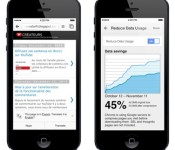
Chrome update for iOS now lets you quickly translate text and save on data too

Even though Chrome promised it would bring data compression and an automatic translation bar to iOS a couple of weeks ago, it hasn’t actually rolled out the update until today. As a reminder, the latest mobile browser release from Google includes a site compression feature, that when enabled promises to reduce data usage by up to 50 percent, which should theoretically help save you a little cash on your monthly phone bill. Additionally, it will automatically offer a “Translate” button whenever it comes across a page in a foreign language. Last but not least, it also has a New Tab Page feature that lists a prominent Google search bar and a list of frequently visited sites so that you can search for stuff that much quicker. If that sounds like an intriguing alternative to Safari for you, go ahead and download the latest Chrome 32 update from the source link below.
Filed under: Mobile, Apple, Google
Source: App Store, Google Chrome Releases
Apple says it received less than 250 National Security Orders in the first half of 2013

Following the terms of an agreement announced today between government agencies and a number of tech companies, Apple has released an updated report on National Security and Law Enforcement requests. Current through June 30th, 2013, it updates the data released last November and in June by breaking out the number of National Security Orders, which falls somewhere in the range between 0 and 250, “regardless of geography.” Apple stated it had not received any requests for bulk data collection — mentioning once again that personal conversations over iMessage and Facetime are encrypted — echoing statements by CEO Tim Cook this weekend that it does not provide the government a backdoor to its servers.
The other data it can now reveal includes exact numbers for account information requests by law enforcement. That includes 2,330 accounts specified in requests, which resulted in information being disclosed for 747 accounts. All in all, the numbers and ranges support claims by the industry that the amount of data requested is very small, but as we’ve learned, the NSA isn’t always concerned with asking about how to get what it wants from accounts, networks and/or mobile devices.
Filed under: Cellphones, Mobile, Apple
Source: Apple

Government to Allow Apple to Disclose More Data on Surveillance Requests
 The United States Department of Justice today reached a tentative deal with Apple and other technology companies on data requests to allow the companies to provide more detailed disclosures on information requests from the NSA Foreign Intelligence Surveillance Court.
As indicated in the Justice Department’s filing with the Foreign Intelligence Surveillance Court, the administration is acting to allow more detailed disclosures about the number of national security orders and requests issued to communications providers, and the number of customer accounts targeted under those orders and requests including the underlying legal authorities. Through these new reporting methods, communications providers will be permitted to disclose more information than ever before to their customers.
The relaxed restrictions on data disclosures come following a concerted effort by Apple and other technology companies to achieve greater NSA transparency. In July, Apple teamed up with multiple firms to request that the government allow them to offer regular reports on security related requests. Apple CEO Tim Cook also met with President Obama and several other tech executives to discuss NSA surveillance methods in December.
The new disclosure terms will allow companies to give out general figures on how often they receive demands for data from National Security Letters or the Foreign Intelligence Surveillance court, according to The Wall Street Journal. Companies are allowed to report each individual category in ranges of 1,000, so if a company receives 2,400 requests, they are able to report that they received between 2,000 and 3,000 requests.
Alternatively, companies are able to report in more specific number ranges in increments of 250 but must lump National Security Letters and FISA requests together.
Companies are also allowed to report in general numbers how many customer accounts have been affected by the requests. While National Security Letter requests from the FBI can be reported in real time, there is a six-month delay in reporting the number of FISA court requests.
Following today’s agreement, Apple posted an update [PDF] on its website with new information on Account Information Requests the company has received. Between January 1, 2013 and June 30, 2013 Apple received a total of 927 account requests in the United States and disclosed data for 747 accounts, Apple objected to 102 requests and disclosed no data in 254 requests, for a total disclosure rate of 81 percent.
Apple also received between 0 and 249 National Security Orders.
Apple has been working closely with the White House, the U.S. Attorney General, congressional leaders, and the Department of Justice to advocate for greater transparency with regard to the national security orders we receive. We believe strongly that our customers have the right to understand how their personal information is being handled, and we are pleased the government has developed new rules that allow us to more accurately report law enforcement orders and national security orders in the U.S.
In June of last year, NSA program PRISM was revealed to be giving U.S. National Security Agency direct access to user data on corporate servers across a wide spectrum of Internet companies, including Apple, Microsoft, Yahoo, Google, Facebook, and more.
Following the reveal, Apple quickly published a statement of “Commitment to Customer Privacy” denying its participation in the NSA program. Last week, Cook told David Muir in an ABC interview that the government does not have direct access to Apple’s servers and that “they would have to cart us out in a box” for that to happen.
Note: Due to the political nature of the discussion regarding this topic, the discussion thread is located in our Politics, Religion, Social Issues forum. All forum members and site visitors are welcome to read and follow the thread, but posting is limited to forum members with at least 100 posts.
| |

Apple Q1 2014 Numbers: $158.8 Billion in Cash, 65 Billion Apps Downloaded, and 420 Total Retail Stores [iOS Blog]
During its financial results conference call covering the 2013 holiday quarter, Apple shared new details on sales at its iTunes Store and Apple Retail segments, in addition to details about how much money the company is paying out to its developer partners on the App Store.

Last quarter, Apple’s customers spent $4.7 billion on iTunes, with $2 billion being paid to developers. The company has paid a total of $15 billion to developers, with half of that coming in 2013. Customers have downloaded a total of 65 billion apps total — an increase of 15 billion from May 2013.
Apple reported $7 billion in revenue generated from its Apple Retail segment, up 9 percent from a year ago. The stores reported record iPhone and iPad sales, with very strong Mac sales. The company remodeled six stores while opening four new ones. At the end of the quarter, Apple had 420 total stores with 166 of those outside the U.S. The company reported 21,000 visitors per store per week and an average revenue per store of $16.7 million.
Apple ended the quarter with $158.8 billion in cash, up $12 billion from the prior quarter. However, of that total, only $34.4 billion was held in the United States, down $1.1 billion. 78 percent of its cash, $124.4 billion, was offshore and Apple can’t use it to make dividend or share repurchase payments without paying a significant amount of U.S. corporate tax.
Overall, Apple shared via its financial results report that it has posted a revenue of $57.6 billion and net quarterly profit of $13.1 billion, or $14.50 per diluted share, compared to revenue of $54.5 billion and net quarterly profit of $13.1 billion, or $13.87 per diluted share in the year-ago quarter.
| |

Tim Cook: Mobile Payments ‘One of the Thoughts’ Behind Touch ID
 During Apple’s earnings call today, CEO Tim Cook indicated that mobile payments were one of the driving forces behind the company’s decision to introduce Touch ID with the iPhone 5s.
The mobile payments area in general is one that we’ve been intrigued with. It was one of the thoughts behind Touch ID.
Cook went on to say that people love being able to buy digital content from their iPhones using Touch ID, because it’s “incredibly simple and easy and elegant.”
He added that while Apple is not planning on limiting Touch ID to digital purchases, the company had nothing to specific to announce today, mobile payments are an opportunity that Apple has been “intrigued with” and there is a “big opportunity on the platform.”
Tim Cook’s comments on mobile payments follow a report last week that suggested Apple is currently working on developing a new mobile payment service that will allow the company to handle payments for physical goods and services in the future.
While Apple currently limits iTunes accountholders to using their stored credit card information for purchases on Apple’s online and retail stores through the Apple Store app, iTunes, and the App Store, stored information could be used in the future for other types of payments with Touch ID technology used to speed up and authenticate real world purchases.
| |

