


Apple Registers New ‘.Technology’, ‘Applestore.berlin’ Domain Names
The land rush on new generic top-level domains (gTLDs) continues this week, and Apple has once again staked its claim to some of new domains being made available to the public. The most relevant new gTLD for Apple is “.technology”, and the company has moved to secure several variants related to its products:
– apple.technology
– ipad.technology
– iphone.technology
– mac.technology

This week’s group is the just the latest batch involving hundreds of new gTLDs going live. Other recent domains secured by Apple include those in the .guru and .camera and .photography families.
As with the previously released gTLDs, Apple appears to have taken steps to block registration of other potential domains involving its trademarks, including some directly related to its business such as macbook.technology and other less related such as apple.construction.
While many of the new gTLDs coming online focus on industries and professions, another group includes geographic themes, and Apple has also signaled its interest in protecting relevant domains in these families. In what appears to be Apple’s first move into this area, the company has registered applestore.berlin, listing the address of the flagship Kurfürstendamm store opened last year on its registration.
     |
Apple ID Two-Factor Verification Expanded to Several New Countries
Apple has completed the rollout of two-step verification in several new countries, reports 9to5Mac. As noted on Apple’s website, these new locations include Canada, France, Germany, Japan, Italy, and Spain. Reports from at least one German user suggests Germany already had two-step verification, but lacked the verification through SMS feature, which was enabled today.

Last May, Apple expanded its two-step verification system to several countries in North America, South America and Europe. This feature apparently was launched prematurely and disappeared shortly after it was enabled.
While it’s always possible the feature might disappear like last time, this time around things look more official with users having full SMS support through local carriers and Apple listing the new countries on its support sites. Apple also has a list of supported carriers for receiving SMS messages by country here that was just updated.
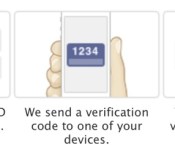
Two-step verification is an optional security feature that requires Apple users to verify their identity before making purchases or logging into their Apple ID account. This extra later of protection requires users to enter a 4-digit verification code sent to a trusted device via Find My iPhone or SMS. Once enabled, this system replaces the standard security questions.
Apple introduced this security feature in March 2013 to users in the U.S., U.K., Australia, Ireland, and New Zealand.
| |

Fleksy’s Predictive Touch Keyboard with Gestures Now Available to All iOS Developers
Back in December, Fleksy announced a toolkit to allow iOS developers to <a href="“>incorporate the company’s popular predictive and gesture-based keyboard into their apps. The initial testing period involved a public launch in four third-party apps of varying types, with Fleksy noting that it would continue to expand the program and eventually open up its SDK to all interested developers.
Today, Fleksy is announcing that next step in its iOS development program, moving the SDK out of private beta and allowing all app developers to easily incorporate Fleksy as an alternative keyboard within their apps.
With its latest update, the Fleksy SDK is now completely free of charge, requires no sign up and allows any developer to implement it in minutes, with zero lines of code and without having to make any changes to their app at all. Switching between Fleksy and the iOS keyboard is also completely streamlined.
Fleksy is one of several alternative keyboard systems that have gained popularity on Android, but Apple’s rules preventing systemwide replacement of the default keyboard have greatly slowed growth of such tools on iOS. As a workaround, Fleksy and other keyboard developers are turning to SDKs that will allow developers to add support for their keyboards on an app-by-app basis. SwiftKey is another such company that launched its own note-taking app several weeks ago and is looking to bring an SDK to select developers initially and all developers over time.
Fleksy offers automated word suggestions while the user types to help improve typing speed, while also incorporating a sophisticated autocorrect engine to help correct typing errors on the fly. Layered on top of those features is a gesture system that allows users to insert spaces and punctuation by swiping to the right and delete words by swiping to the left anywhere on the keyboard rather than having to use dedicated keys. Up and down swipes allow users to cycle through suggested words or undo automatic corrections.
While the Fleksy SDK is now open to all developers, the company has also been working with a number of developers beyond the initial group of four to integrate the Fleksy keyboard into their apps. Several of those are ready to go live today with Fleksy support, including You Doodle, Write for iPhone, Tap Forms Organizer and Secure Database, and Remoter VNC – Remote Desktop.
Fleksy is free for users and developers, and hundreds of developers have already inquired about bringing Fleksy to their apps. As a result, the Fleksy team is optimistic that adoption will grow rapidly given developer interest and the simple integration offered through the company’s SDK.
| |

Tesla CEO Confirms ‘Conversations’ With Apple, Says Any Acquisition ‘Very Unlikely’
 Following a report earlier this week suggesting Apple had considered purchasing Tesla, Tesla CEO Elon Musk today confirmed in an interview with Bloomberg that his company “had conversations” with Apple. Musk went on to say that he could not comment on whether the conversations had revolved around any kind of acquisition, but he did confirm that at the current time, an acquisition of Tesla seems “very unlikely.”
If one or more companies had approached us last year about such things there’s no way we could really comment on that. We had conversations with Apple, I can’t comment on whether those revolved around any kind of acquisition.
News of Apple’s meeting with Tesla first came to light over the weekend, when the San Francisco Chronicle reported Musk had met with Adrian Perica, Apple’s head of acquisitions, and possibly Apple CEO Tim Cook. While the site speculated the meeting pertained to a possible acquisition, other sources have since suggested Apple may have been meeting with Tesla over iOS device integration in the company’s electric cars or about a potential battery deal between the two.
As noted by The Los Angeles Times, Musk last month announced plans for a massive lithium-ion battery plant, which will be constructed in partnership with “some other companies.” Tesla is expected to make an announcement about the plant later this month, and it’s possible Apple, which uses lithium-ion batteries for many of its portable devices, could be involved in that venture.
When asked whether Tesla was for sale, Musk told the interviewer that an acquisition was unlikely because the company needs to stay “super focused” on its goal of creating an affordable electric car, though he did not rule out the possibility of an acquisition entirely.
If there was a scenario where it seemed like it would be more likely that we would be able to create the mass market sort of affordable, compelling car then possibly it would make sense to entertain those discussions. I don’t currently see any scenario that would improve that probability, so that’s why I think it’s very unlikely.
Apple CEO Tim Cook recently said the company is open to making large acquisitions if it makes sense, but he has also said that Apple will focus on the very few products that “deserve all our energy.” Apple currently holds nearly $160 billion in cash while Tesla has a market cap of approximately $24 billion.
| |
Facebook Buying Messaging App WhatsApp for $16 Billion
 Facebook is buying the hugely popular WhatsApp for $16 billion according to a filing with the SEC. The purchase, $4 billion in cash plus $12 billion in Facebook shares and potential for an additional $3 billion in employee stock payouts, will see WhatsApp founder Jan Koum joining Facebook’s board of directors.
WhatsApp Messenger is a hugely popular cross-platform messaging app that allows users to chat with individuals or groups, as well as sending files and pictures back and forth.
Back in December, the service bragged that it had 400 million active users, with 100 million of those added in the last four months of 2013. Back in April of 2013, it was rumored that Google was close to acquiring the company for $1 billion — something WhatsApp denied. Today’s sale price reflects the company’s tremendous growth over the last several months.
The service is one of many messaging services available on iOS and other mobile platforms, including Apple’s own iMessage service integrated into iOS and OS X. Such services have become increasingly popular as users seek to avoid mobile carriers’ SMS charges and expand their conversations to include devices not directly connected to cellular service.
The company’s app is currently the 35th most popular on the App Store. WhatsApp Messenger is a free download on the App Store. [Direct Link]
| |
GBA4iOS Debuts 2.0 Update for Game Boy Emulator With iPad Support, Easy Installation
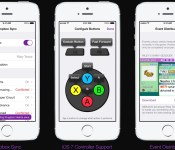
GBA4iOS today introduced a 2.0 update for its popular Game Boy emulator for iOS, introducing a full iOS 7 redesign, iPad optimization, support for original and Game Boy Color games, and a built-in web browser for downloading ROMs.
More importantly, the software is now much easier to install, requiring neither a jailbroken device nor a work around to set the device clock to 2012. Prior to the 2.0 update, installing GBA4iOS without jailbreaking required an iPhone’s date to be set to 2012. Though it doesn’t require an initial date change, GBA4iOS 2.0 does carry a warning that the device clock may need to be set back to 2/19/14 if the app fails to open.

With GBA4iOS 2.0, gamers can play Game Boy Advanced, Game Boy Color, and original Gameboy ROMs directly on their iPads and iPhones. There are dozens of popular games available, including many varieties of Pokemon, Zelda, Final Fantasy, and more.
Downloading games for GBA4iOS previously required navigating outside of the app to find ROMs, but the newest version includes an in-app web browser that can be used to download games from any ROM website. GBA4iOS 2.0 also includes full support for cheats, accepting five different code formats covering everything from Game Genie to Action Replay.
The GBA4iOS update includes an array of controller skins for Game Boy Advance and Game Boy Color games and it supports third party controller skins. It also offers full iOS 7 controller support, Dropbox integration, and “Event Distribution” to allow GBA4iOS unlock and distribute features that are not normally included within games.
While several emulators have snuck into the App Store via shell apps, they are always short-lived as Apple pulls the apps within hours or days of release. GBA4iOS is able to overcome Apple’s restrictions as it is not installed via the App Store. Instead, GBA4iOS can be installed directly on an iOS device from the website, by tapping the download link on an iPad or iPhone.
| |

Samsung Bashes iPhone Screen Size and iPad Multitasking in Two New Anti-Apple Ads
Samsung has released two new anti-Apple advertisements highlighting shortcomings in Apple products to promote both its Galaxy Note 3 and the Galaxy Tab Pro 10.1.
In the first ad featuring the 5.7-inch Galaxy Note 3, Samsung depicts the phablet-sized smartphone next to the 4-inch iPhone 5s. Basketball star LeBron James is on the screen while a voiceover mocks the iPhone’s screen size and quality, along with its lack of a stylus.
“Wait a second, shouldn’t we enjoy this high-definition jam on a screen that’s actually high definition? 5.7 inches of HD? Booyah! Or 4.0 inches of non-HD? LeBron’s literally running away from this phone.”
“And would you look at that? The Galaxy Note 3 comes with a handy little S-Pen. No S-Pen hiding in this other phone. Believe me, I’ve checked.”
The second ad is a riff on Apple’s popular iPad Air ‘Pencil’ spot that compares the ultra-thin tablet to a pencil. It starts off with a pencil, as Apple’s ad did, but eventually reveals an “even thinner” Galaxy Tab Pro behind the iPad. Samsung’s newest tablet measures in at 7.3mm thick while the iPad Air is 7.5mm thick.
“Wait a second, what’s hiding behind that pencil? Ah, an iPad Air! Almost didn’t see it there. And what’s this, hiding behind the iPad? Ah, the even thinner Galaxy Tab Pro 10.1.”
Along with the Galaxy Tab Pro’s thinner profile, Samsung also points out its screen quality and its ability to multitask, which has also been a favorite subject for Microsoft‘s anti-Apple ads. Samsung’s Galaxy Tab Pro has a 1600 x 2560 resolution compared to the iPad Air’s 1536 x 2048 resolution.
Samsung has a long history of mocking Apple products in its commercials and has famously promoted its Galaxy line of phones by making fun of iPhone fans who wait in long lines for hours.
Samsung is expected to release a new flagship smartphone, the Galaxy S5, later this month, along with a new Galaxy Gear smart watch. Apple is expected to unveil both a larger iPhone and a smart watch later this year.
| |
‘Loop Fob’ Allows Swipeless Credit Card Purchases at Any Traditional Swipe Terminal [iOS Blog]
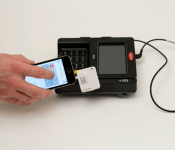
While Apple is reportedly working hard on its own mobile payment service, Boston-based startup Loop has just released its own mobile payments device — one that works at most traditional U.S. retail outlets. The Loop Fob is a small device that allows users to store credit card information on the iPhone, and then wirelessly pay at any traditional magnetic stripe reader.
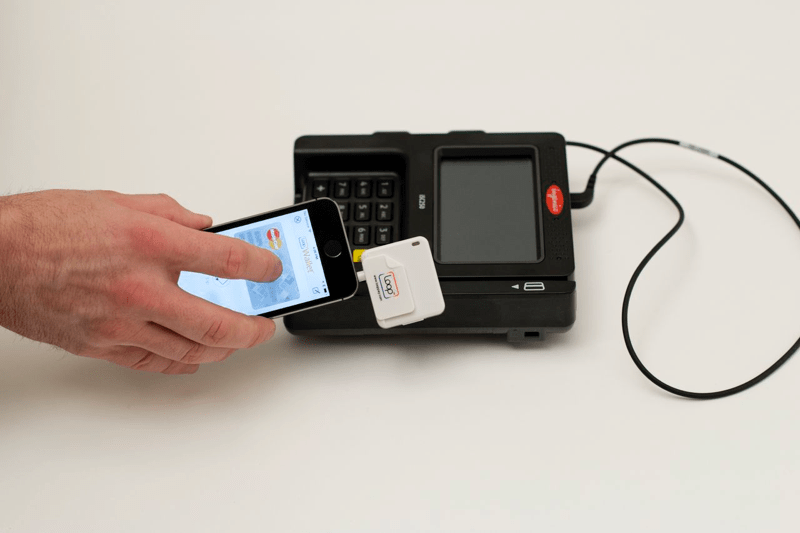
It uses “Magnetic Secure Transmission” to create a small magnetic field via an inductive loop. That magnetic field is detected by the read head of a traditional swipe credit card reader, fooling the device into thinking a normal credit card has been swiped. As a result, the device allows any credit card to be digitally stored in an iPhone and used as needed. It’s a direct competitor to the Coin prototype electronic credit card that attracted attention last year, only it’s been released to the world already. Loop recently took a $10 million funding round based on the success of its Loop Fob Kickstarter campaign.
The Loop Fob can be used while attached to the iPhone, or it can store a single card and be used separately at restaurants and bars. The company says payment data is encrypted and stored on the Loop Fob device, and no credit card info is ever stored on the iPhone.
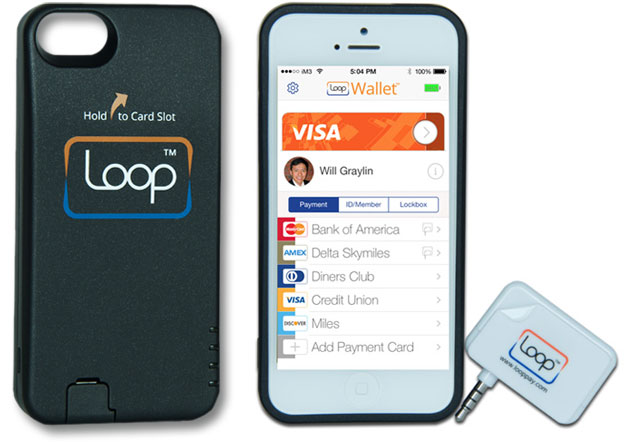
Loop also has a dedicated $99 iPhone case in the works which will be released later this year. It will allow Loop owners to make touchless credit card payments without needing a separate hardware device. All the necessary technology will be built into the iPhone case. The fob will still be used to read credit cards for storage, however.
With its patented technology, payment card data is encrypted and stored in dedicated hardware secure memory, within the Loop Fob or any Loop enabled device. Partnering with payment card issuers, Loop’s technology can also generate dynamic card data every time a payment is made, making such data unusable for those trying to clone a card. Its contactless chip does not wear out and fits into virtually any form factor that consumers want to carry – from smartphones to fobs, to charge cases, to smart watches, the possibilities are limitless.
The LoopWallet app can be downloaded from the App Store, while the Loop Fob adapter can be purchased for $39. The $99 Loop iPhone case will be released later this year.
| |
Square Teams Up With Product (RED) for Special Edition Reader to Fight AIDS [iOS Blog]
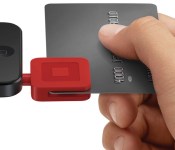
Mobile payments company Square has partnered with AIDS charity Product (RED) to introduce a new special edition “SQUA(RED)” card reader. The reader, which is bright red, is available for a $10 donation with 97.25 percent of that cost going directly to the Global Fund to fight AIDS.
Along with donating funds to charity, Square’s new reader allows customers who swipe their cards to learn more about the project and donate to Product (RED) directly from their emailed receipts.

“Square already helps millions of local sellers run and grow their business, and now with SQUA(RED) Reader, we’re empowering them to raise awareness for an important cause and help save lives in the process,” said Jack Dorsey, CEO of Square.
Apple has a long history with Product (RED) and has sold red-themed devices and accessories in support of the charity for many years. Most recently, Apple’s senior vice president of design Jony Ive teamed up with designer Marc Newson to create a range of products to benefit Product (RED), including a one-of-a-kind red Mac Pro. The duo raised over $13 million, adding to the $65 million Apple has raised for Product (RED) over the last several years.
| |

Switched On: The leader, the bleeder and the reader
Each week Ross Rubin contributes Switched On, a column about consumer technology.

Sony recently bid farewell to three device categories. The long-struggling Japanese consumer electronics giant is selling off its PC division, spinning out its TV group into a separate company and getting out of the e-book business by handing it over to Kobo. While each has a unique history, they all demonstrate the difficulties Sony has had in dominating any one category.
Sony’s introduction of the Trinitron in the 1960s accelerated its ascent to the top of the consumer electronics food chain in the following decades. By the 1980s, virtually any TV buyer knew that nothing compared to Sony and the company’s big-screen offerings were bolstered by the arrival of CRT screens that lacked the convex curve of the time. (Back then, curved screens were passé, not leading edge.)
But that all changed with the arrival of the flat-panel. While Sony sets were still regarded as among the best, they were more seriously challenged by old rivals such as Panasonic with plasma, new rivals like Samsung chasing the design and picture quality and Costco kings such as Vizio building a brand at much lower price points. The company tried to play up its HD heritage in noting that so much HD content was captured on Sony professional gear, but consumers could not keep up with Samsung’s advertising and sponsorship blitz. And Sony’s attempt to capitalize on a “3D World” certainly didn’t help when that world ended not with a bang, but with a whimper.
Unlike with TVs, Sony was a latecomer to the PC market that never found footing for its expensive footwear in the US. Along with a clever logo for VAIO that embraced both the analog wave (the “VA”) and digital data (the “IO”), Sony products featured imaginative industrial design and form factors. They not only included astonishingly thin and lightweight laptops and the elongated VAIO P, but also entrants in doomed categories like the cake-like, round home theater PC and the VAIO UX hand-held PC. While the recent allegation that Steve Jobs offered Sony an exclusive opportunity to use Mac OS on its computers was surprising, the surprise was that Apple would have licensed at all, not that the one company chosen would be Sony.

Compared with the TV and PC markets, the e-reader market is a small one. Its decimation at the hands of tablets has been far more drastic than the declines we’ve seen in TVs and PCs. That said, Sony was a pioneer with its original Japanese Librie product and the plainly named Reader in the US. While pricey, it was a hit at launch, selling out in Sony stores in its debut holiday season. Sony followed up with several more models, adding touchscreens and other enhancements. However, it missed the integrated cellular connectivity that Amazon added. That, plus the retailer’s built-in audience of book enthusiasts, quickly escalated the Kindle to the top of the e-reader category.
As Sony hands off its digital bookstore to Kobo, the company might have been more successful had it partnered with Barnes & Noble in the early days, heading off the Nook and allowing both companies to get an early jump on the Kindle. But for now, the tale of the reader is just a shorter version of what Sony saw with the Walkman without the latter product’s long stretch of success.
Ross Rubin is principal analyst at Reticle Research, a technology, media and telecom advisory firm, and founder of Backerjack, which covers crowdfunded product innovation. He blogs at Techspressive.

