



Mac Pro Shipping Estimates Begin Improving to 1-2 Weeks [Mac Blog]
Shipping estimates for the Mac Pro through Apple’s online store continue to rapidly improve, with the company’s European stores such as the UK now showing 1-2 weeks for new orders. Online stores for other regions are still listing estimates of 2-3 weeks, but they should be seeing a similar improvement shortly.

After months of shortages for the completely revamped Mac Pro following its December launch, shipping estimates have improved rapidly in recent weeks, although it is unclear how much is due to improved supplies as any kinks have been worked out of Apple’s new U.S. production line and how much is due to a slowing of demand after the initial order surge.
(Thanks, Paul!)

Graphene May Be Next Area of Innovation for Apple and Samsung
In a world where mobile devices are becoming thinner and thinner and in some cases being worn on the wrist or other parts of the body, graphene may be the wonder material of the future, with properties that make it stronger than steel, more flexible than rubber and more conductive than most metals. As a result, the material could initiate a new wave of innovation in hardware design and manufacturing that may lead to incredibly thin and flexible devices. According to Bloomberg, it also may become the next battlefield for Apple and Samsung.
Graphene is graphite, the material in pencils, arranged in a layer that is one atom thick. The arrangement of the carbon molecules makes the material stronger than steel and even diamonds. It also is flexible, conductive and so transparent that is nearly invisible to the naked eye. It can be applied to other materials, potentially allowing for the creation of flexible displays and bendable devices.
Apple, Samsung and Google are allegedly in an arms race to acquire patents and other intellectual property to cover the design and use of the material in both mobile and wearable devices. With global mobile device sales predicted to reach $847 billion by 2016 and wearable technology to explode to a $19 billion business in the next five years, the development of graphene may be critical to a company’s ability to compete in the future electronics marketplace.
The biggest hurdle for the widespread adoption of graphene is the high cost of production. These technological and manufacturing issues are being addressed by Seoul National University professor Hong Byung Hee, who owns a patent for mass-producing graphene-based displays.
To unlock that potential, the world’s biggest electronics makers are turning to researchers such as Hong Byung Hee, a professor at Seoul National University, who’s developed a patent for mass-producing graphene-based displays.
“Global technology companies are facing innovation limits in hardware and design, and in order to step over to the next level, they need to adopt new materials like graphene,” Hong said in an interview. “Our key graphene technology is receiving considerable interest from firms including Apple, Samsung and even Google.”
Apple has been silent on its own research into the use of graphene, with Apple spokesperson Kristin Huguet declining to comment to Bloomberg on Hong’s patent and the company’s interest in the material. Unlike Samsung, Apple’s own publicly available patents and applications addressing graphene are scant, but it seems the company is at least exploring what the material might be used for.

Apple Awarded Patent for Contact Aware User Interface in Messaging Applications [iOS Blog]
Apple has been awarded a patent by the U.S. Patent and Trademark Office (via AppleInsider) that details a user interface in messaging apps that dynamically changes its background based on conversation participants. The patent details how this interface would adapt to both single and group conversations, and how it would work with specific data to generate images.

Outlining the “Generation of a user interface based on contacts”, the patent describes how a conversation can be displayed over a background image associated with a contact. Users have the ability to assign a photo to a single contact to serve as a background, while the image itself can be adjusted to be dimmed or alpha-blended with a background color to ensure greater message readability. If an image is not assigned, the interface could also generate a default male or female image based on contact information.

The concept also carries over into group chats, as one user can be highlighted while others are greyed out to display who sent the last message. Alternative methods described in the patent also include showing contact thumbnails in a Cover Flow or carousel fashion, as well as layouts that center and increase the thumbnail of the most recent contacts with animations for emphasis. The patent also describes a potential API for third party developers to integrate the user interface into their own apps.
As with other software patents, it is unknown whether Apple plans to include this dynamic user interface in future versions of Messages or other apps. However, Apple could make changes to the Messages app in iOS 8, which is expected to be unveiled next month at the annual Worldwide Developers Conference (WWDC). Recent rumors have suggested that iOS 8 will feature a focus on health-related applications along with enhancements to Maps and Siri.

Apple’s Purchase of Beats May Not Be Finalized Until Next Week
Following reports last week that Apple had purchased Beats Electronics, it was thought the deal would be finalized and announced this week. However, Re/code is reporting the deal may not be finalized until next week.

Apple’s planned deal to buy Beats Electronics for $3.2 billion may not be finalized until next week, according to people familiar with the transaction. That’s a longer timetable than some people expected as recently as a few days ago.
Once the deal is completed, Beats co-founders Dr. Dre and Jimmy Iovine are expected to take on senior roles at Apple, with Iovine potentially becoming Apple’s new music chief. In addition, Iovine and Dre’s first official appearance as Apple employees is expected to take place at June’s Worldwide Developer Conference.
Ahead of iPhone 6 Launch, One-Third of Smartphones Sold Have Screens Larger Than 5″
With the next iPhone widely expected to be available in larger screen sizes, Canalys reports that a third of all smartphones sold worldwide in the first quarter had screen sizes larger than five inches, a full inch larger than Apple’s 4″ iPhone 5s screen. The size of the five-inch market — some 90 million units in the quarter — shows just the competitive disadvantage Apple is facing the longer it goes without a large screened smartphone.
Internal documents released during the Apple v. Samsung trial show how Apple has been aware of consumer interest in larger screened smartphones for quite some time, and the iPhone 6 is expected to have 4.7-inch and 5.5-inch options to compete in this market.
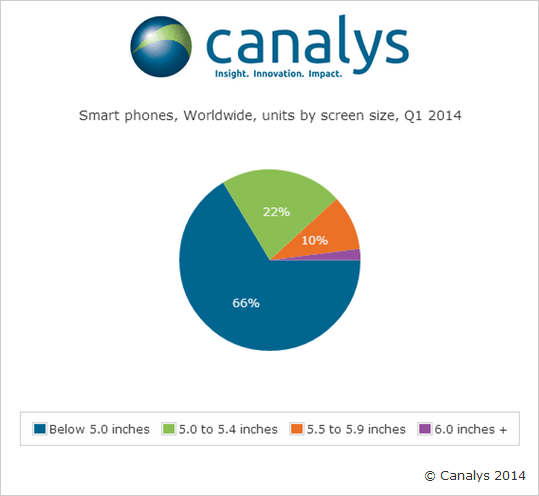
Smart phones with 5″ and larger screens grew 369% – a substantially greater rate of growth than the overall market. Worldwide, they represented just over a third of shipments (34%), and in Greater China the figure hit 39%, and 43% in Asia Pacific.
“This is still a market segment led by Samsung, but the trend is unmistakably toward larger-screen handsets at the high end of the market. It held a 44% share of devices with displays of 5″ and above, and 53% if the view is narrowed to look at 5.5″-plus displays,” said Canalys Analyst Jessica Kwee.
[…]
Consumers now expect high-end devices to have large displays, and Apple’s absence in this market will clearly not last long. It is notable that 5″ and above displays featured on almost half (47%) of smart phones with an unlocked retail price of US$500 or more. Of the remaining 53% of high-end smart phones, 87% were iPhones.
Only 12 percent of smartphones sold had screens of 5.5-inches or larger, with 22% between 5 and 5.4-inches and the rest smaller than 5-inches, including all iPhones.
The iPhone 6 is widely expected to be launched this fall with a a 4.7-inch option, perhaps at 1704×960 pixels, and a larger 5.5-inch version that may launch later due to supply constraints.

Flappy Bird to Return to the App Store in August, Will Be Multiplayer and ‘Less Addictive’
Flappy Bird creator Dong Nguyen today announced plans to return Flappy Bird to the App Store in August in a new interview with CNBC‘s Kelly Evans. According to Nguyen, the new version of Flappy Bird will be a multiplayer title that is “less addictive.”
Back in February, Nguyen unexpectedly pulled Flappy Bird from the App Store after it became wildly popular, due in part to the attention he was receiving. “Please give me peace,” he tweeted just a week before removing the app from the App Store. At the height of its popularity, the game was generating approximately $50,000 per day in revenue from in-app ads, causing a media frenzy.

In a March interview with Rolling Stone, Nguyen confessed that the reason he pulled the app was in part due to the overwhelming amount of attention he garnered from the media, but also because of troubling messages he received from Flappy Bird players about the game’s addictiveness. One woman told him he was “distracting the children of the world.”
Nguyen noted that he had trouble in school in his own youth because of an addiction to video games, and admitted to feeling guilty that Flappy Bird was an “addictive product.”
After Flappy Bird was removed from the App Store, hundreds of other Flappy-style apps flooded the App Store as developers attempted to clone some of Nguyen’s success, and at one point towards the end of February, one-third of new games released over a 24-hour period were heavily influenced by Flappy Bird.
Though the prominence of Flappy Bird clones has died down in recent weeks, fans will likely welcome the return of the original game. As Nguyen has said, “People can clone the app because of its simplicity, but they will never make another Flappy Bird.” While Nyugen has mentioned multiplayer as one new aspect of the game, it is unclear how he plans to make it “less addictive.”
During the interview, Nguyen also relayed some details about his next game, which is said to be a jumping game where players control a character jumping from building to building.

Artist stuffs Wikipedia into apple DNA to create real trees of knowledge

If DNA is code, and code can be art, then DNA can be art… right? Harvard artist in residence Joe Davis certainly thinks so. He’s working on a project, Malus Ecclesia, that will insert Wikipedia entries into the non-essential genetic strands of apples. The effort will translate English Wikipedia articles to DNA’s four nucleotide letters (A, C, G and T) and use bacteria to insert the resulting text into saplings. When the saplings are grafted on to apple stock and grow up, they’ll bear fruit with that genetic data (and therefore the articles) intact, producing very real trees of knowledge.
Davis’ living artwork won’t be as revelatory as the biblical tree, though. The bacteria can only hold a few thousand words, while Wikipedia has roughly 2.5 billion; it will take a large grove to hold the entire database. You probably also won’t get to take a bite, since there are tough US regulations on genetically modified plants. Even so, it should be an impressive feat if everything goes as planned — and it could serve as a proof of concept for other, more practical uses of genes as storage systems.
[Image credit: Sami Keinanen, Flickr]
Filed under: Science
Source: The New Yorker

Norwegian Consumer Group Files Complaint Over iCloud’s ‘Convoluted’ Terms of Service [iOS Blog]
 Apple is facing a complaint from the Norwegian Consumer Council over the terms and conditions for its iCloud service, reports ZDNet. The consumer watchdog group claims the agreement violates the Norwegian Market Act, which governs marketing practices in the country.
The complaint arose from a study of seven cloud storage providers offering service in Norway and was part of a broader investigation into how digital services are being offered to Norwegian consumers. The Norwegian Consumer Council cited Apple for its 8,600 word iCloud terms of service, which it claims is “convoluted and unclear.”
Particularly troubling to the Consumer Council were terms that allow Apple to modify the agreement at its discretion without notifying customers of the changes.
“Cloud storage services rely on users’ trust and confidence. However, the current terms undermine this. It is important that consumer rights and privacy also apply to online services. We are convinced that all parties are better served with more user-friendly terms. Apple offers to store valuable information on behalf of its users, but gives itself the right to amend the agreement at its sole discretion. As consumers, we are left with no real rights or security. Receiving notice when terms change should be a bare minimum requirement. The fact that this can be done without informing the users is unacceptable,” Finn Myrstad, head of digital services unit at the Consumer Council, said in a statement.
This is one of several overseas complaints Apple has faced recently, including a Belgian claim that Apple misled consumers about warranty information and an accusation of tax fraud by Italian authorities.
Despite these occasional hurdles, Apple continues to operate a strong global business with international sales accounting for 66 percent of revenue in Q2 2014. Apple also opened its first stores in Brazil and Turkey this year, and now has a retail presence in 15 countries worldwide.


Apple Customer Support Claims Apple Stymied by Phone-Switching iMessage Glitch
 There is a long-standing problem with lost iMessages for select users when they switch from an iPhone to another device. Apple allegedly is aware of the problem and not able to provide a fix, claims former LifeHacker editor-in-chief Adam Pash, whose iPhone was affected by this message delivery problem.
After disabling their iPhones, some users experience an issue where iMessages sent from other iPhone owners are routed to the now-disabled iPhone and not forwarded as a text message to the active phone. The recipient never receives the text message, creating a situation that is frustrating for both people involved in the conversation.
Pash spoke to Apple’s customer support after he stopped receiving messages from iPhone-owning friends when he switched to an Android phone. The support personnel confirmed “this is a problem a lot of people are facing” and “added that engineering team is working on it but is apparently clueless as to how to fix it.”
In the meantime, Apple has completely hijacked my text messaging and my phone number portability (portability between devices, not networks). No one can fix this but Apple because it’s a problem at the device level, which means people in my position have no recourse but to wait for Apple to figure out what the problem is. But Apple isn’t offering any public support on the issue that I’ve been able to find (and it’s worth repeating that proper support is behind a $20 paywall for most people who’ve switched devices, who would also be the most commonly affected by this problem)
This issue with iMessage has been reported as far back as 2011, shortly after the messaging service debuted as a flagship feature of iOS 5. iPhone owners are advised to disable iMessages before they deactivate their phone in order to remove the device from Apple’s system and allow messages to be forwarded properly as text messages to their new handset. This precautionary step of disabling iMessage apparently works for some, but not all iPhone owners who switch to another smartphone platform.
Apple May Adopt 1704 x 960 Resolution Display for Upcoming iPhone 6
Apple’s next generation iPhone 6 may adopt a higher resolution display, jumping from the current iPhone 5s resolution of 1136 x 640 to a sharper 1704 x 960 resolution, reports 9to5Mac. On the rumored 4.7-inch model, this would result in a display with 416 ppi and the same 16:9 ratio of the iPhone 5/5s/5c, while a 5.5-inch model at the same resolution would carry a density of 356 ppi.

With Apple’s rumored move to larger displays in the iPhone 6, much discussion has been centered around what resolution Apple will use and how any changes would affect developers. Some speculation had suggested Apple might simply maintain the same resolution as on the iPhone 5s, making a seamless transition for developers. This stretch process would, however, drop the pixel density of the display below Apple’s criteria for a “Retina” display.
Alternatively, Apple could boost the resolution to maintain or increase the pixel density, although this move would require work from app developers to maintain compatibility with the new devices. KGI Securities analyst Ming-Chi Kuo suggested last month that Apple would maintain the current 326 ppi density, which could be achieved by bumping a 4.7-inch display to 1334 x 750, and we previously explored how that might work.
But according to 9to5Mac, Apple may adopt an even higher-resolution display that triples the base number of pixels of the iPhone screen in both length and width. This “3x” mode would take the base “1x” resolution of 568 x 320 and expand it to 1704 x 960. Using this method, Apple would retain the Retina branding at 416 ppi and keep the current 16:9 ratio of the iPhone 5/5s/5c.
This means that Apple will likely be tripling the aforementioned “base resolution” (568 x 320) of the iPhone screen in both directions, and that the iPhone screen resolution will be scaled with an increase of 150% from the current 2X resolution of 1136 x 640. Of course, Apple tests several different iPhones and display technologies, so it is possible that Apple chooses to take another route for display specifications for the 2014 iPhone upgrade.
Apple has allegedly been testing this 1704 x 960 resolution and while the design specs for the iPhone 6 are undoubtedly complete, it is not known for sure if Apple has elected to proceed with this resolution. Apple may be preparing to launch the 4.7-inch iPhone 6 sometime this fall with a faster A8 processor and improved camera technology.

