


China’s state media wants Apple and Google to be ‘severely punished’ for NSA spying

Today has seen a sudden spike in anti-American sentiment in Chinese state-owned media, with Apple, Google, Microsoft and Facebook all being described as “pawns” of the US government (aka the “high-level hooligan”). Articles in the China Daily and People’s Daily call for these companies to be “severely punished” for their alleged roles in the PRISM scandal, but there’s no obvious trigger to explain the timing of their publication. One possible factor is today’s date: June 4th marks the bloody end of the Tiananmen Square protest of 1989, when government forces killed hundreds of pro-democracy activists in the streets of Beijing. Google and other sources of international news are being subjected to extra censorship in order to control discussion of the Tiananmen anniversary within China, which implies that these outlets are currently even more irksome to the Communist Party than they usually are.
An excerpt from the People’s Daily:
“U.S. companies including Apple, Microsoft, Google, Facebook, etc. are all coordinating with the PRISM program to monitor China… To resist the naked Internet hegemony, we will draw up international regulations, and strengthen technology safeguards, but we will also severely punish the pawns of the villain.”
Another possible explanation for the blanket attack is that fresh evidence of privacy abuses has come to light in China, perhaps involving the NSA and its (unhealthy) relationship with commercial web services. However, no new allegations have been detailed, and Apple and other companies continue to deny that the NSA has backdoor access to their data centers. Alternatively, the wave of press coverage could simply be a response to America’s recent scolding of a Chinese military cyber-espionage unit, or part of a wider governmental push for the use of homegrown rather than US-made technology.
Filed under: Misc, Internet, Mobile, Apple, Google
Source: Reuters

Fleksy Offers Beta Preview as Keyboard Makers Look Forward to iOS 8
Keyboard developer Fleksy today announced that the company has its iOS keyboard alternative running on iOS 8. Apple revealed earlier this week during its WWDC 2014 keynote that iOS 8 will support the system wide implementation of these third-party keyboards.

An alternative to a traditional keyboard, Fleksy boasts improved typing speeds through the use of automated word suggestions and a sophisticated autocorrect engine that corrects errors on the fly. It also incorporates a gesture system that lets users complete common tasks like inserting spaces and punctuation through swipes.
Fleksy tweeted a screenshot of its keyboard on iOS 8, along with an invitation for users to register for a preview of its iOS 8 keyboard app. iPhone and iPad owners running a beta version of iOS 8 on their devices can sign up for a preview on Fleksy’s website. The company will notify customers via email when the public beta program goes live.
Fleksy won’t be the only third-party keyboard available to consumers when iOS 8 launches later this year. Both Swiftkey and popular Android keyboard Swype confirmed they plan to launch iOS 8-compatible versions of their keyboard apps.
“We’re delighted Apple has decided to embrace the importance of opening its platform to third party keyboards.
…
We first brought a taste of our technology to iOS in January this year with the launch of the free note-taking app SwiftKey Note. Are we going to build SwiftKey Keyboard for iOS 8? Of course we are. We’ve already started, writes Swiftkey founders Ben Medlock and Jon Reynolds.”
Both Switfkey and Fleksy already offer versions of their keyboards for iPhone and iPad owners, but their functionality is limited due to iOS constraints that prohibit their system-wide installation. iOS 8 will remove this restriction, making it possible for all keyboard makers, including iOS newcomer Swype, to bring their keyboards to Apple’s mobile platform. The beta version of iOS 8 is available now to developers, with a public release expected this fall.
Accessory Makers Ramping Up for 5.5-Inch iPhone 6, Sparking Speculation of September Launch
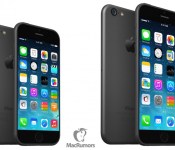
While rumors have pointed to a late 2014 or early 2015 launch of Apple’s rumored 5.5-inch iPhone 6 model, several months later than a 4.7-inch model, Cantor Fiztgerald analyst Brian White points out in a new research note that companies are already beginning to ramp up their production of accessories for the larger device. Based on this observation, White believes the larger-sized iPhone 6 model may in fact debut this fall alongside the 4.7-inch iPhone 6, and his note follows a recent report that Apple has solved its battery issues with the 5.5-inch iPhone 6 and is planning to manufacture 20 million units by the end of the year.

White bases his prediction on observations he made during his recent tour of Computex, which is being held this week in Taiwan and is Asia’s largest technology show.
Also at Computex, we noticed that a few vendors had already started work on accessories for the 5.5-inch iPhone 6 and the pieces were available at the show. Given the lack of data points in recent months around progress with the 5.5-inch iPhone 6 and growing skepticism in the media around a 2014 launch, we view this as a positive development. Based on today’s research, we believe the timing of the 5.5-inch iPhone 6 launch appears to be in sync with our expectation around the unveiling (i.e., September) of the 4.7-inch iPhone 6.
According to White, manufacturers are also showing a “much broader ramp” of accessories compatible with the rumored 4.7-inch iPhone 6. The 4.7-inch version is widely believed to be launching in September and will headline Apple’s fall product lineup, which Apple executive Eddy Cue claims is the best product pipeline he has seen in his 25 years at Apple.
Based on his previous reports, White does not have a particularly solid track record in predicting Apple’s plans, and thus his speculation of a simultaneous launch of both 4.7-inch and 5.5-inch iPhone 6 models should be taken with a grain of salt considering other rumors of a gap of up to several months between the two releases. White does, however, frequently tour Asian suppliers and trade shows and is in a position to observe momentum shifts in the supply chain and accessory maker activity.
While the expected overall form factors of the two rumored iPhone 6 models have been circulating for several months, leading to physical mockups from accessory makers and others, actual claimed part leaks for the new devices have remained fairly rare. We’ve seen a few parts such as an alleged front panel, a display backlight and just last week a rear shell, but typically a number of internal components have leaked by this point in the year and we have yet to see much in that regard.

Intel Demonstrates Cableless Computing Made Possible by Future Skylake Platfrom
At Computex in Taiwan this week, Intel demonstrated a variety of wireless accessories that will be enabled by the company’s future Skylake processor platform, reports CNET. Reference designs for the Broadwell successor will include the possibility of eliminating all of the cables that currently connect to a personal computer, replacing both data and power cables with wireless options.

The demonstration by Kirk Skaugen, Intel’s senior vice president and general manager of the PC Client Group, showcased a wireless display, as well as a computer with wireless docking and charging capabilities. Intel uses technology from A4WP’s Rezence, which transfers power wirelessly using the principles of magnetic resonance, for its wireless charging solution.
The system can be installed under a table surface, with magnetic resonance capable of charging through 2 inches of wood. It can also charge any number of devices at the same time, unlike inductive charging technologies.
Skaugen demonstrated a table that charged a laptop, phone, headset and tablet all at once.
For docking and display purposes, Intel relies on Wi-Gig to govern the wireless data transfer. First outlined in 2010, Wi-Gig is an established wireless standard that uses unlicensed 60 GHz spectrum to provide data transfer rates up to 7 Gbps.
The technology is still in the early stages, with Intel’s Skylake platform expected to debut in late 2015. Products natively supporting these wireless protocols will be available publicly sometime in 2016. Apple is not currently listed as a member of the extensive A4WP consortium, but the company is undoubtedly pursuing its own potential solutions and its use of Intel’s chips in Macs means that it will be able to take advantage of the technologies packaged into the future Skylake platform.

Razer Unveils ‘Junglecat’ Gaming Controller with Slide-Out Design, Companion App [iOS Blog]
Razer has unveiled its Junglecat iOS gaming controller for the iPhone 5s and iPhone 5, bringing a number of hardware features that attempt to make games easier and more natural to play on a mobile device.

The accessory features a slide-out unibody design that contains a Lightning connected upper enclosure for the iPhone, and boasts console-style controls such as a D-Pad, ABXY face buttons, and shoulder bumpers. The Junglecat includes open access to the iPhone’s hardware features including the sleep/wake button, volume buttons, home button, headphone jack, and front/rear cameras.
Razer is also shipping a companion app with the Junglecat, allowing users to remap face buttons and adjust sensitivity on the controller. The app will also include a list of games optimized for controller play, as the app’s interface displays both purchased apps and featured games.

It is unknown if Razer’s Junglecat is a more final version of the company’s “Kazuyo” controller that was leaked earlier this year, however the latter featured a slim hard-shell case design and was rumored to come with full-sized analog sticks. A previous report also indicated that Razer would be shipping a companion app for the Kazuyo as well, perhaps indicating that the company chose a different design for its first iOS controller.
The Razer Junglecat joins a growing market of iOS game controllers, which includes the SteelSeries Stratus, Logitech PowerShell, MOGA Ace Power and Mad Catz’s C.T.R.L.i controller. While all current controllers have attempted to impress consumers with unique designs and buttons, it has been reported that Apple’s strict guidelines have hampered product quality.
Currently, an increasing number of games are offering iOS 7 controller support, including titles like 2K Drive, Dead Trigger 2, and Grand Theft Auto: San Andreas. The number of iOS games supporting controllers is expected to grow as more accessories become available to consumers.
Razer’s Junglecat controller will be available in white and black for $99 when it ships this summer.

Engadget Daily: new features in iOS 8, Apple invades the connected home, and more!

Today, we explore Apple’s push into the connected home, uncover a few lesser-known iOS 8 features, take a look a net neutrality and go hands-on with ASUS’ Llama Mountain reference tablet. Read on for Engadget’s news highlights from the last 24 hours.

Here are a few lesser-known new features in iOS 8
Yesterday, Apple unveiled a bunch of new features coming to iOS 8, but many of them didn’t make it to the spotlight. Read on as our own Brad Molen uncovers a few of the lesser-known but awesome additions to the mobile OS.

Apple attempts to conquer the connected home
Many companies have tried their hands at home automation and failed to stir things up. Android @ Home ring any bells? With its new HomeKit platform, Apple might have the market power to pull it off, but can it succeed?

Intel’s Windows 8.1 Pro Broadwell tablet is thinner than the iPad Air
What you’re looking at is Intel’s Llama Mountain reference tablet, or Pro Broadwell for short. It’s a mouthful for sure, but this slate manages a thinner profile than the iPad Air and has an eight-hour battery life.

Congratulations, internet: you collapsed part of the FCC website with comments
How much does net neutrality matter? Enough that the Federal Communications Commission’s website is receiving so many complaint submissions that it’s suffering under heavy traffic. Read on for everything you need to know about the open internet.
You also might like:
Filed under: Misc

Apple Introduces Lightning Cable MFi Specifications for Headphones
Apple has introduced new specifications for manufacturers in the company’s Made for iPhone (MFi) program that allow them to create headphones that connect to iOS devices via a Lightning cable rather than a regular 3.5mm headphone jack, according to 9to5Mac.

The Lightning headphones will be capable of receiving lossless stereo 48 kHz digital audio output from Apple devices and sending mono 48 kHz digital audio input. The input means that the headphones will also support a microphone for audio input following Apple’s upcoming update. Manufacturers will be able to take advantage of Apple Headphone Remote controls like Volume Up/Down/etc, as well as other buttons for launching specific apps such as iTunes Radio or initiating playback controls on iOS. In addition, the headphones can be made to work specifically with a companion iOS app and launch a specific app when connected to an iOS device.
The specification includes two configurations for headphones. The first is called Standard Lightning Headphones, which uses minimum components when paired to a digital-to-analog converter. The second is called Advanced Lightning Headphones, which allows for more complex features like active noise cancellation.
The Lightning cable-equipped headphones would also allow iOS devices to power or charge headphones that require electricity, and would also allow for headphones to potentially power or charge up iOS devices.
Reports suggest Apple is planning to allow high definition music downloads and playback on iOS devices as well as new in-ear headphones that could take advantage of high-quality audio and take advantage of Lightning Cable MFi specifications. It is also possible Apple uses newly purchased Beats Electronics’ popular headphone line to accelerate adoption for the new standard.

Apple: Putting doctors, trainers and nutritionists in your pocket

It’s been a long day. You were in meetings from nine in the morning until five in the evening, with barely enough time to eat in between. So you gorged on donuts from the cafeteria and indulged in a slice of pizza on the way home. When you enter that dietary data in your nutrition-tracking app on your iPhone, you get a notification that you’ve exceeded your daily caloric amount, sidelining your weight loss goals. Feeling guilty, you lace up your running shoes and head out to the park with a Fitbit in tow, knowing that you need to burn at least 500 calories to get back on track. Feeling pretty good after the run, you get a text from your doctor reminding you to have a good night’s sleep tonight to rectify the erratic sleep patterns she’s been tracking via a daily health report app. You tell her that will definitely not be a problem.
This is a picture of the future that Apple is envisioning with HealthKit, one of the more interesting features of yesterday’s iOS 8 announcement. In essence, it’s Apple’s attempt to unify and share the disparate data of your health and fitness apps with each other, and — if you want — with your medical institution as well. With HealthKit, Apple wants to be the one-stop shop for your health and fitness needs. It’s a rather ambitious goal, but it’s also a necessary one given the increasingly crowded fitness field. And, of course, it also lays the groundwork for that long-rumored iWatch.
Before we get into the ramifications of HealthKit, let’s dive a little deeper into what it is. It’s essentially a set of tools that lets developers integrate health data into other apps, including one from Apple called Health that houses all of that info in one central hub. Currently, information from different apps and devices is siloed — you can’t sync Fitbit data with any other app, for example. With HealthKit, devs can build that kind of cross-app syncing.
This means that you could use devices and apps from different companies — say a Nike FuelBand, a Withings Blood Pressure Monitor and an iHealth Wireless Smart Gluco-Monitoring System — and have information from all of them gathered in the Apple Health app, which serves as a dashboard for your health and fitness data. You could also have applications talk to each other, like a nutrition app syncing with a fitness app to calculate just how many calories you need to burn to lose that extra pound.
But the really interesting part of HealthKit is its potential to enable fitness trackers and health apps that are out there to work together.
Obviously, HealthKit could very well be the foundation for the iWatch, the wearable that Apple’s supposedly been working on for a while. We imagine it could be used to sync with Apple’s Health app so you could view all of your fitness data in one handy, wrist-worn location. After the rumor that Nike would be ending its FuelBand production, we were hoping to hear more on Nike’s and Apple’s collaboration on this front, but sadly that didn’t happen. However, Apple did use Nike’s Fuel on stage as an example of one app that’s HealthKit-compatible, so we wonder if that’s a hint of a hardware partnership to come.
But the really interesting part of HealthKit is its potential to enable fitness trackers and health apps that are out there to work together. Use both a Fitbit and a FuelBand? Not a problem, as the Health app will be able to track info from both. It gives you a much more holistic view of your health, as you could potentially see how the lack of sleep affects your blood pressure, for example. It could also enable a much more advanced and intimate take on health care, allowing patients to interact with their doctors in real time. This lets you, along with your health care provider, make more informed decisions to enhance your overall well-being.

However, in order for HealthKit to truly live up to its potential, a whole mess of developers will need to get on board. There’s certainly a strong incentive for them to do so, but big names need to be involved beyond just Nike. Fortunately, Withings, Fitbit and iHealth already appear to be on the docket, but we’re hoping smaller apps like MapMyRun and Strava get in on the action as well.
Further, there’s a surprising lack of standards compliance across different devices and apps, and it’s not entirely clear how Apple’s HealthKit would resolve it. For example, the number of calories that my Fitbit says I’ve burned can be very different from the number that my FuelBand reports. Will it know to prefer one over the other? Even a metric as simple as the number of steps taken can differ wildly from app to app. Additionally, will companies that deal in proprietary metrics be okay with opening that up to other apps? Nike, to its credit, has agreed to share its made-up Fuel stat with at least a few third-party applications, though it’s still relatively locked down compared to the competition. It remains to be seen how Apple will put all of this together to paint an accurate picture of your health.
Letting different apps and devices talk to each other essentially makes your iPhone the ultimate all-in-one fitness tool.
And, of course, we have to consider the competition. Samsung announced last Wednesday that it’s planning on launching Simband, a modular, wrist-worn reference platform that might inspire a multitude of different Samsung-powered wearables, which could provide serious competition to the fabled iWatch. Simband will also work in concert with SAMI (Samsung Architecture for Multimodal Interactions), the company’s open-source data-collection effort that’ll make all that fitness data accessible to other services and devices — perhaps the very same ones that’ve signed on for Apple’s HealthKit.
HealthKit is iOS 8-only for now, so it likely won’t be compatible with older iOS devices or desktop apps on OS X, which at least hints that Apple is still testing the waters as HealthKit slowly gains momentum. Regardless, the future for HealthKit is great if Apple can pull it off. Letting different apps and devices talk to each other essentially makes your iPhone the ultimate all-in-one fitness tool. As a stream of new wearables and apps place a heavier focus on health and fitness, HealthKit is a clever attempt by Apple to keep those loyal to the iPhone within the fold.
Filed under: Apple
New ‘Send Last Location to Apple’ Feature Added to Find My iPhone in iOS 8 [iOS Blog]
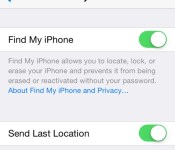
iOS 8 introduces a new feature to the Find my iPhone and Find my iPad functionality on iOS devices, allowing users to select a “Send Last Location” option that will notify Apple of a device’s last known location when the battery drains to a critical level.
Currently, if a device is lost with Find My iPhone on and the battery drains and it cannot be located, iCloud will display the last known location for up to 24 hours, but after that, there is no way for end users to determine the last location of a device.

It appears this new Find My iPhone feature will authorize Apple to store the last known location of an iOS device after 24 hours have passed, potentially allowing customers to contact the company for location information after it is no longer available on iCloud.
The new option can be found in the iCloud section of the Settings app, listed under a new entry for Find My iPhone (or iPad). Tapping on Find My iPhone gives an option to enable the feature and to enable Send Last Location. With iOS 7, Find My iPhone was bundled into the rest of the iCloud settings, with a simple toggle to turn the feature on and off.
(Thanks, John!)

A Closer Look at ‘Handoff’ and Other New iOS 8/Yosemite ‘Continuity’ Features
During yesterday’s WWDC keynote, Apple launched several new “Continuity” features to improve the cross-platform integration of iOS 8 and OS X Yosemite. One of the new abilities designed to allow better transitions from iOS devices to Macs is Handoff, which allows users to start a task on one device and swap to another nearby device.
As described by Apple, Handoff can be used for several different activities, including email and web browsing. Users can begin writing an email on an iPhone, for example, and then switch to a Mac to finish. Websites work similarly, allowing users to browse the web on one device, and then continue looking at the same website on another device. While this is already possible via iCloud Tabs, Handoff makes the entire process easier and extends the functionality to other apps.

We believe you should be able to use the right device for the moment. We want the transitions between these moments to be as absolutely natural and seamless as possible.
When you’re working on your Mac, your devices around you in proximity are aware of each other and are aware of what you’re up to.
As demoed during the keynote, iOS devices and Macs are “aware” of each other, and can pick up a task when nearby. When composing an email on a Mac, for example, users will see an icon on the screen of their iPad or iPhone that can be tapped to allow them to continue writing on the iOS device. Similarly, an iPhone near a Mac will cause the activity to automatically pop up on the Mac’s dock, allowing for a seamless transition between devices.
Handoff currently works with the following Apple apps: Mail, Safari, Pages, Numbers, Keynote, Maps, Messages, Reminders, Calendar, and Contacts. There’s also a Handoff API for developers, which will likely see Handoff capabilities added to a range of different apps.
The enhanced Continuity between OS X and iOS also allows Mac devices in close proximity to an iPhone to both place and receive calls, leveraging Bluetooth and WiFi with the iPhone serving as a relay. Users can answer a call made to their iPhone on their Mac, a useful feature when an iPhone is across the room charging or otherwise inaccessible.
During the keynote, Apple’s software chief Craig Federighi used the calling feature to contact new Apple employee Dr. Dre on his Mac, demoing its ability to place calls.
Similarly, iPads and Macs are now able to receive SMS messages from non-Apple devices, a function previously limited to the iPhone. iPads and Macs are also able to utilize an “Instant Hotspot” feature that allows them to connect to an iPhone hotspot with just a click, and AirDrop is also cross-platform.
Currently, Handoff and the other Continuity enhancements are features limited to developers who are using both iOS 8 and OS X Yosemite, but it will be available to the general public in the fall after the official release of the new operating systems.

