


Taco Bell Launches Mobile Ordering App for iPhone [iOS Blog]
Taco Bell today launched a newly updated Live Mas Taco Bell mobile app that’s designed to allow Taco Bell diners to place and customize their orders ahead of their arrival at the restaurant. After downloading the app, those seeking a Cheesy Gordita Crunch, Doritos Locos Tacos Supreme, or other food item from Taco Bell can tap log in or start a session as a guest.
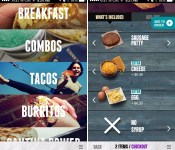
From there, tapping on the “Order” button will bring up a list of all the Taco Bell restaurants that are located nearby, and selecting one will bring up a store’s individual menu. After selecting a location, scrolling downwards will provide a list of food options that have been organized into separate categories like Breakfast, Combos, Tacos, Burritos, and more.
Taco Bell(R) Mobile Ordering is Here. Customize. Order. Pay. All from the new app. Now you can easily select a local Taco Bell, customize your favorite items and pay for your order. No need to select a pick-up time. We make your food when you arrive because just-prepared food is the best. Then skip the in-store line like you own the place. Plus, reordering your favorites is as easy as a twist of the wrist.
Every food order contains customization options so that it can be prepared to a customer’s specification. For example, with the Waffle, it comes with sausage, cheese, egg, and syrup, any of which can be removed. There’s also an option to add extra of any ingredient, and there are options for add-ons like nacho cheese sauce, sour cream, onions, tomatoes, and more. While some options are free, many add an additional cost to an order.
According to Taco Bell, while an order can be placed ahead of time, it is not cooked until a customer arrives at the restaurant they selected and checks in, at which point the employees begin preparing the meal to ensure freshness. Mobile orderers will not need to stand in the Taco Bell line upon arrival, and will be called up to the mobile counter when their meal is ready. Payments are made in the app with a credit card.

The app has options to allow users to sign in to track their most recent orders, which makes re-ordering the same meal easy, and there are e-gift options that let customers send gift cards. Another helpful feature is the Nutritional Info, which lists the calorie content of all of Taco Bell’s offerings.
Taco Bell has been working on adding mobile ordering capabilities to its app for several months now, with the first news of an updated app coming back in February. At that time, Taco Bell’s mobile lead Jeff Jenkins said that mobile is becoming increasingly important to quick service restaurants. “If you can get 10 million people to download your app, you’re putting a portal to Taco Bell in 10 million pockets,” he said.
Taco Bell’s revamped iOS app can be downloaded from the App Store for free. [Direct Link]
iPad Air 2 Material Costs Hold Steady Starting at $275, but New Storage Tiers Erode Profit Margin
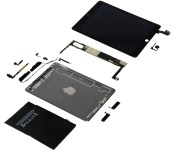
As it always does with Apple’s major new iOS devices, research firm IHS iSuppli has torn down the new iPad Air 2 in an attempt to estimate Apple’s component costs for the device (via Re/code). According to IHS iSuppli’s estimates, the 16 GB iPad Air 2 costs Apple roughly $275 to build, just one dollar more than last year’s iPad Air.

The report unsurprisingly points out that Apple benefits from stronger profit margins as users move to higher capacity models, with Apple paying only about $50 more for 128 GB of storage compared to the base 16 GB configuration while charging users $200 for the upgrade. Still, Apple’s move to eliminate the 32 GB option and slide the 64 GB and 128 GB models down $100 has slightly eroded Apple’s profit margins at the top end.
The latest report from the research firm IHS, due later today and shared exclusively with Re/code, shows that the base model of the iPad Air 2, the 16-GB Wi-Fi version, which sells for a price of $499, costs $275 to build, exactly one dollar higher than the previous base model. The top-end model, the 128-GB LTE version costs which sells for $829 costs $358.
Apple’s implied profit margin on the iPad Air 2 has dropped slightly to a range for 45 percent to 57 percent depending on the device, compared with the original at 45 percent to 61 percent.
Many of the components have remained the same between the iPad Air and the iPad Air 2, with Apple’s use of essentially the same display unit allowing the company to reduce costs of that component from $90 to $77. But with Apple’s move to bond the display to the device’s cover glass and the addition of a new antireflective coating, the same display offers a significantly better user experience.
Other changes include the move to a powerful new A8X chip currently unique to the iPad Air 2, and improved cameras that have resulted in slightly higher component costs.
As always, it is important to note the estimates from IHS iSuppli cover only the cost of the individual components that make up the device and do not include other costs involved in product development, manufacturing, and sales, such as research and development, software, patent licenses, marketing, and distribution expenditures. All of these costs contribute to significantly reduce Apple’s true profit margin from the levels cited by IHS, but the basic component cost remains an interesting glimpse at how Apple brings everything together to consistently hit its retail pricing goals.
Longtime Apple-Exclusive Studio Algoriddim Brings ‘Djay’ to Android [iOS Blog]
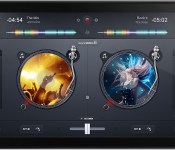
Longtime Apple-exclusive developer Algoriddim has made a name for itself with its popular djay app that first found success on the Mac before moving to iPad and eventually iPhone. The app has been featured prominently by Apple over the years, winning an Apple Design Award in 2011 for the original iPad version, and just this month it was featured as a key music app in promotional materials for the new iPad Air 2.
So after such a long tenure and significant success on OS X and iOS, we were interested to learn that Algoriddim is announcing today an expansion to Android, bringing the full djay experience to that platform. While Algoriddim is by no means the first iOS developer to branch out to Android, it is a high-profile, award-winning one and so we chatted a bit with Algoriddim CEO Karim Morsy to find out more about the how and why of the company’s move, a perspective not frequently shared at MacRumors.
Morsy pointed out that with, or perhaps despite, 15 million downloads on iOS, the number one request from djay users has long been an Android version of the app. With a strong presence on the Mac platform as well, Algoriddim found plenty of Mac and/or iPad users who use Android phones and have been asking Algoriddim in large numbers to bring the app to their phones.

Rather than a simple port of the iOS version of djay, Algoriddim built the Android version of the app from the ground up, replicating the look and feel of the iOS version wherever possible while bringing feature and performance parity, something that was not always a given considering the pace with which proper tools and frameworks for Android were becoming available. But with the release of Android 4.0 three years ago, Algoriddim finally felt the tools were in place to pursue bringing djay to Android.
Morsy expected development to be challenging, and indeed it was, particularly ensuring that djay worked well across the variety of devices running Android, with the diversity of screen sizes and performance-related specs requiring significant amounts of work to optimize for.
We also asked Morsy whether Algoriddim is expecting any backlash from Apple with the expansion of djay to Android, given that Apple likes to tout apps and other content that is exclusive to its own platforms. But Morsy noted that Apple regularly features apps available across multiple platforms and that the history and continued popularity of djay on Mac and iOS is likely to remain a strong factor as Apple weighs future feature opportunities for the music segment.
As was added to djay 2 for iOS earlier this year, djay 2 for Android brings full integration with Spotify’s premium music subscription service, including auto-matching of tracks using technology from The Echo Nest, which was acquired by Spotify in March of this year. The Android version of djay 2 launches today at a limited-time introductory price of $2.99, and users will also receive a free one-week trial of Spotify Premium to test out the service with djay.

Apple Adds ‘Fyi’ and ‘Feeln’ Channels to Apple TV [iOS Blog]
In yet another addition to the growing stable of channels available on the Apple TV, A&E’s Fyi network and Hallmark’s streaming family movie channel Feeln have been added to the set-top box today.

As with many other channels, Fyi offers some free content, but complete access to streaming on-demand episodes requires authentication with a participating cable provider. The television, which launched as a rebranding of The Biography Channel earlier this year, focuses on “contemporary lifestyle” topics.

Feeln’s subscription service is priced at $4.99 per month with a one-week free trial or $47.99 per year with a one-month free trial. The service offers reasonable library of family-friend movies for streaming, including some box office hits, Hallmark originals, and original shorts.


More Details on Next Version of Office for Mac Include Planned Launch in First Half of 2015
Following yesterday’s leak of several screenshots from the next version of Microsoft’s Outlook for Mac, Chinese site cnBeta now shares much more information [Google Translate] about the upcoming version of Microsoft’s productivity suite for Mac.

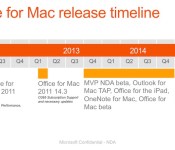
The report shares several presentation slides outlining some of the features of the next Office for Mac, as well as a timeline showing a planned release sometime in the first half of 2015. Microsoft team members had previously suggested the suite would launch this year.
The slides point to four key focus areas for Microsoft during the development cycle of the next Office for Mac, including a modernized look with full Retina support to match the OS X aesthetic while still aligning the experience with Office for Windows, improved connectivity with cloud services including Office 365 and SkyDrive, significant improvements to Outlook, and the addition of OneNote, which appeared as a standalone release earlier this year.
 (Click for larger)
Taking a quick look at some of the changes to the core Office apps, the slides address the addition of the Quick Access Toolbar from the Windows version throughout the upcoming Mac suite, improved organization of tools and formatting, new support for Excel 2013 functions, Threaded Comments and improved Presenter View for PowerPoint, and enhanced Reply Comments and “Expand and Collapse” paragraph view toggles in Word.
Microsoft Office for Mac has not seen a major update since late 2010, when Office for Mac 2011 was released as a comparable version of Office 2010 for Windows. But while Windows saw the release of Office 2013 early last year, no corresponding version of Office for Mac has yet been released. The next version of Office for Windows is similarly expected in the spring of next year.

Apple to distribute over $100 million worth of iPads in underprivileged schools

Students in 114 schools across the country are about to get free iPads straight from Apple, thanks to the tech titan’s $100 million pledge to President Obama’s ConnectED initiative. Cupertino first announced its support for the project (which aims to give students access to high-speed internet) in February this year, but now we know how the company’s fulfilling its multimillion-dollar promise. According to Apple’s ConnectED page, 96 percent of the students in each of its 114 chosen schools are eligible for free or, at least, reduced-priced lunches. Also, half of the schools are in urban areas, with students who are mostly of Black, Hispanic, Native American and Asian heritage. Apple placed emphasis in giving minorities access to technology and knowledge, as they usually don’t, putting them at a disadvantage. The company says it sees “the results of this and other forms of inequality every day”, as “minorities are significantly underrepresented in the technology industry.”
In addition to giving every student in the school an iPad, Apple will also provide each teacher with both an iPad and a Mac and will equip classrooms with Apple TV. The company will be assigning special education teams to oversee each school, tailor curricula for the needs of every institution and work with providers to ensure students and teachers have WiFi or cellular connection, as well. You can check out Apple’s ConnectED page for more details, or the complete list of schools to know if there’s one in your area.
[Image credit: Getty Images]
Inspired by the students, teachers, and administrators at the 114 schools we’re partnering with for ConnectED http://t.co/WTsQT0yAD4
– Tim Cook (@tim_cook) October 27, 2014
Filed under: Desktops, Tablets, Apple
Source: Apple

Apple’s 2014 Annual Report: Insight on Employee Numbers, Sales Growth, Retail Stores, and More
Apple today filed its 2014 10-K annual report with the U.S. Securities and Exchange Commission, offering a look at how the company has grown over the past year. Among the interesting details included in the report:

– The iTunes Store generated a total of $10.2 billion in net sales during 2014, up from $9.3 billion in 2013. Apple credits the growth to an increase in revenue from app sales, but acknowledged that digital music sales were in decline and partially offset the growth.
– Apple noted that it now has 92,600 full-time equivalent employees, up from 80,300 at the end of fiscal 2013. The majority of that growth was outside of the company’s retail division, which grew by 3,400 to 46,200 full-time equivalent employees.
– Apple’s store count increased by 21 during fiscal 2014, with average revenue per store increasing slightly to $50.6 from $50.2 million in 2013. As noted during its earnings conference call last week, Apple expects to open 25 new retail stores in fiscal 2015 with three-fourths of those stores being outside of the United States. Apple is also planning to remodel five of its existing stores.
– Apple spent a total of $6.0 billion on research and development in fiscal 2014, up significantly from the $4.5 billion spent last year. That amount contributed towards the company’s efforts to “develop new technologies to enhance existing products and to expand the range of its product offerings.” As noted by the Financial Times, Apple’s $6.0 billion investment is the highest level relative to revenues since 2007, which is the year that the iPhone was released.
– Real estate holdings increased slightly, with Apple now owning or leasing 19.7 million square feet of building space, up from 19.1 square feet at the end of 2013. Apple says that most of the building space is in the United States, and is expanding its existing office space and customer support call center in Austin, Texas. Work also continues on the company’s new campus in Cupertino, which is once again said to contain an estimated 3.6 million square feet of space.
– Apple is expecting its capital expenditures to rise to $13.0 billion in 2015, up from the $11.0 billion spent in 2014. $600 million of that amount will be allocated towards retail store facilities, while $12.4 billion will be used for other expenditures including manufacturing process equipment, data centers, and product tooling.
Apple’s annual report, which is mostly targeted at investors and regulators, contains a number of other details about the company’s operations. The report also provides an analysis of current product lines and addresses topics like executive compensation, investments, taxes, and more.

Tim Cook talks Apple Watch, TVs and the power of the iPhone

Tim Cook started out his talk with Gerard Baker, Wall Street Journal’s editor-in-chief, at the WSJD Live conference with a very obvious statement: “The phone is the majority of the company’s revenue,” and it will continue to be for the foreseeable future. Apple doesn’t just make money from phone sales, but also everything that comes with it — apps, iTunes media and, yes, Apple Pay. Cook was eager to point out that Apple Pay reached over a million card activations in just the first 72 hours, and that Visa and Mastercard said that Apple Pay is already the number one player in contactless payments.
When asked what he thought of retailers like CVS and Rite Aid disabling Apple Pay due to a rival technology, he said it was a skirmish. He added that “over the long arc of time,” retailers are only relevant if customers love them and that they’ll need to adapt eventually. He said that Apple Pay is “the first and only mobile payment system that is easy, private and secure.” “We don’t want to know what you buy, we’re not into collecting data, we’re not Big Brother,” Cook said. “We’ll leave that to others,” he added, as if to imply Google might be the Big Brother in question.
Cook said that [the Apple Watch] is something that you would use so much that “you will end up charging it daily.”
Phones aside, Cook also touted other areas of growth for the company. Mac sales, for example, grew “remarkably” last quarter, adding that he thinks the Mac has a great future. Of course, he also mentioned the much-hyped Apple Watch, which he says opens up two new categories for the company: Health and fitness plus fashion. “We didn’t announce a product, we announced three collections,” Cook said, referring to the Watch. “We saw that something you wear has to be more personable, more customizable … the fashion thing is totally new for us.” As for the Watch’s battery life? Though he wouldn’t give details, he did say that it’s something that you would use so much that “you will end up charging it daily.”

As for televisions, Cook reiterated what he said during his Charlie Rose interview, describing today’s TV experience as outdated and “straight from the 1970s.” He praised HBO’s streaming-only service, and says consumers are increasingly trying to get away from a cable TV subscription. As for what Apple’s going to do with TV? Cook played coy and didn’t offer much details, but he seemed optimistic: “I believe something great can be done.”
Answering a question about whether the Android vs. iOS wars will end up like the Mac vs. PC one, Cook said that wasn’t a fair comparison. “There weren’t enough apps on the Mac,” he said. “That isn’t a problem for iOS.” He adds that iOS has over 1.3 million apps, and that generally speaking, developers are writing iOS apps first and then porting them to Android. “We sold a quarter billion iOS devices last year. I wouldn’t call that a low-volume business.”
Cook also tackled privacy at the end, a recent hot button topic. “Your data is yours,” said Cook, emphasizing that the company takes privacy and security very seriously. “We don’t read your iMessages. We designed iMessage as such that we don’t read any of it,” adding that if the government were to ask for it, they couldn’t supply it. After fielding a question over the demise of the iPod Classic among others, Cook hinted that he’s open to a collaboration with AliPay, Alibaba’s online payment system. Jack Ma had said he wanted to work with Apple Pay in a previous talk at WSJD Live. “If we can find some areas of common space, I’d love it.”
Filed under: Cellphones, Apple

In 72 hours, Apple Pay is already the wireless payment leader in the US

Paying with your phone still feels fancy, and at WSJD Live today, Apple CEO Tim Cook explained that the company has already registered 1 million customers. Compared to say, iPhone sales, it might not seem all that impressive, but Cook added that Visa and Mastercard apparently said that if you summed up everyone else in the contactless payment market together, these numbers make Apple number one in wireless payments. Already.
Nicole Lee contributed to this story.
Filed under: Cellphones, Mobile, Apple

Tim Cook explains why the iPod Classic had to die

It was the best question pitched to Apple CEO at WSJD’s Live conference: Why was the iPod discontinued? Apparently it’s a very simple reason: “We couldn’t get the parts any more,” explained Tim Cook. “They don’t make them any more.” While the iPod Classic isn’t exactly a creaky transistor radio just yet, that’s how it went down. “We would have to make a whole new product…. the engineering work to do that would be massive.” The difficult truth that some of you probably don’t want to hear: “The number of people who wanted it is very small.” So pour one out for the iPod Classic — and hit up eBay if you’re still craving a clickwheel.
Nicole Lee contributed to this story.
Filed under: Portable Audio/Video, Apple, E-book

