


SunTrust Bank and BI-LO, Winn-Dixie, Harveys Grocery Stores Add Apple Pay Support
Apple Pay this week continued its retail expansion with the mobile payment service now being adopted by SunTrust bank and Bi-Lo holdings, which manages BI-LO, Harveys, and Winn-Dixie grocery stores. The latter announcement follows our earlier report of Winn-Dixie and BI-LO beginning to go live with Apple Pay support late last week ahead of an official debut, despite not being included on Apple’s “Coming later this year” list.
Customers with a SunTrust credit or debit card will be able to add their card to Apple Pay and use it to make purchases at participating retailers. Headquartered in Atlanta, SunTrust bank has 1,497 bank branches across eleven southern states and Washington, D.C.

At the same time SunTrust has added Apple Pay support for its card holders, supermarket chain Bi-Lo Holdings also added Apple Pay as a payment option during checkout. Customers who shop at the primarily southeastern supermarkets of BI-LO, Winn-Dixie, and Harveys will be able to use their iPhone 6 of 6 Plus to streamline their grocery purchases.
“Customers want a shopping experience that is convenient, easy and secure, which is why we’re so pleased to announce support for Apple Pay,” said Bert DuMars, vice president, digital marketing at Bi-Lo Holdings. “Bi-Lo Holdings is prioritizing digital mobile solutions for our customers, and Apple Pay is an exciting first step in our journey.”
Apple Pay debuted last month alongside iOS 8.1 and has seen strong adoption in the month following release. According to a recent New York Times report, Apple Pay transactions accounted for 50 percent of recent tap-to-pay purchases at McDonald’s and doubled the number of mobile payments processed by Walgreens. Currently, there are almost 40 retailers that officially support Apple Pay, with the number continuing to grow.

Some OS X Yosemite Users Still Experiencing Wi-Fi Connection Issues Even After 10.10.1 Update
 Yesterday, Apple released OS X Yosemite 10.10.1, which brought improved Wi-Fi reliability after a number of users reported connection issues with the new operating system. However, Computerworld reports that a number of users on Apple’s support forums are still claiming to have issues with Wi-Fi even after updating to OS X 10.10.1, with some saying that they are still not able to connect at all while others note that their Wi-Fi has remained significantly slow.
The largest thread on Apple’s support forums discussing the Wi-Fi problems in OS X Yosemite has grown to 1,120 replies with more users reporting issues with a number of Macs and a variety of router types. Members of the MacRumors forums have also reported problems with Wi-Fi after updating to 10.10.1 even when using their computer in different areas. One user even reported Wi-Fi issues with the iMac with Retina 5K Display and the newest Time Capsule networking device.
Currently, some users are finding success with performing a clean install of Yosemite, running their routers in “Access Point” mode, switching their connection a 2.4 GHz band, or running a user-created script to restart OS X’s Wi-Fi Monitor. However, there appears to be no general solution for users still having Wi-Fi issues. In addition to Wi-Fi issues, other users are reporting problems with OS X Yosemite’s Dark Mode on non-Retina displays, unstable Bluetooth connections, and high CPU utilization.
Apple has not issued an official statement on the reported users issues, although Apple support representatives have instructed users to remove excess preferred networks in the Network section of System Preferences and to reset the System Management Controller. It is likely that Apple will issue more fixes with forthcoming software updates to OS X Yosemite, although there is currently no timetable as to when those updates might come.
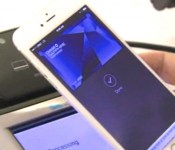
Apple’s Eddy Cue Shows Off Apple Pay at Panera Bread, Bloomingdale’s, and Disney Store in News Segment
Earlier tonight, KTLA 5’s The Tech Report aired a segment (via AppleInsider) centering around Apple Pay, which featured Apple’s SVP of Internet Software and Services Eddy Cue using the mobile payments solution around Santa Monica. The segment, which can be viewed here, followed Cue and reporter Rich Demuro as the Apple executive utilized his iPhone 6 Plus and Apple Pay to purchase a meal at Panera Bread, sunglasses at Bloomingdale’s, and merchandise from the Disney Store.

For their meal at Panera Bread, Cue is shown utilizing Apple Pay inside of the restaurant’s official app to pre-order food simply and securely. At Bloomingdale’s, Cue is shown using Apple Pay and his iPhone at a payment terminal to purchase sunglasses, which he is required to sign for. However, Cue was not required to sign for the two dolls he purchased at the Disney Store with Apple Pay. Cue then notes that users will sometimes be required to sign for more expensive purchases made with Apple Pay in-store.
The pair also visit an Apple Store to discuss Apple Pay on the company’s new line of iPads. While users can’t make in-store purchases with the iPad, Cue points out that users can still make in-app purchases with Apple Pay and Touch ID on the tablet.
Cue also spoke on the security of Apple Pay and how tokenization helps keeps credit card numbers away from malicious users:
You’ve seen these hacks that are happening in the systems where thousands of credit cards are getting exposed, and so you have try to protect that number. Well, with Apple Pay, the number that’s being given to the terminal is a one-time number that’s created for that transaction.
A report from The New York Times over the weekend shed some light on Apple Pay’s early successes, noting that the service doubled mobile wallet transactions at Walgreens and accounted for 50% of tap-to-pay purchases at McDonalds. Whole Foods shared earlier this month that it processed 150,000 Apple Pay transactions between October 20 and November 6, and the service has increased consumer interest in the mobile payment area in general. Apple currently has 36 retail partners that accept Apple Pay in their stores as the service is available at more than 200,000 retail locations.

Apple Releases OS X Yosemite 10.10.1 With Wi-Fi Reliability Improvements
Apple today released OS X Yosemite 10.10.1, the first update to the new operating system since its initial October release. Testing for OS X 10.10.1 began on November 3, with Apple seeding two betas to developers before launching the software publicly.
The new software is available through the Software Update mechanism in the Mac App Store.

The OS X 10.10.1 update is recommended for all Yosemite users. It improves the stability and compatibility of your Mac. This update:
– Improves Wi-Fi reliability
– Improves reliability when connecting to a Microsoft Exchange Server
– Improves reliability sending Mail messages when using certain email service providers
– Improves reliability when connecting to remote computers using Back to My Mac.
The update should fix several major issues that users have been seeing with OS X Yosemite, including a major Wi-Fi issue that’s caused connection problems for a number of users.

Spotify and Uber Partnering for User-Generated Playlists During Car Trips [iOS Blog]
Following early rumors last week that the popular car-hailing service Uber would be partnering with music streaming giant Spotify, the companies today confirmed the upcoming launch of integration between the two services.
Uber CEO Travis Kalanick and Spotify CEO Daniel Ek today confirmed that the two app-based services will be partnering to allow Uber customers to prepare a specifically selected queue of songs while waiting on an Uber car. When the car picks its passengers up, the selected song will already be playing. Users will have to connect their Spotify Premium accounts with the car service inside the Uber app, but once that is done the app will allow them to not only pick their music beforehand, but adjust and control it for the duration of the trip.
The partnership is set to launch on November 21 in London, Los Angeles, Mexico City, Nashville, New York, San Francisco, Singapore, Stockholm, Toronto and Sydney. A widespread rollout to more locations is expected to follow shortly thereafter.
The Uber driver will also have to connect their phone to the car’s stereo for the service to function, but Uber says widespread adoption of the new collaboration is eagerly accepted by its employees. But until it’s universally installed in every Uber car, the option to select music for your trip won’t show up in the Uber app if your area doesn’t have the service yet.
A new report from TechCrunch also claims that Spotify soon plans to announce yet another collaboration, this time with BMW’s ConnectedDrive platform. After making deals with companies like Ford and Volvo, it would be Spotify’s third major car company integration announcement. Following an update just last month, the service now also supports Apple CarPlay.
Spotify’s app code also hints additional service expansions in the works, with TechCrunch pointing to podcasts and an undetermined feature codenamed “Magic”
Both Uber [Direct Link] and Spotify [Direct Link] can be downloaded from the App Store for free.

iMessage Down for Some Users, Unrelated to iOS 8.1.1 Update [Update: Fixed] [iOS Blog]
 Following the launch of iOS 8.1.1 and OS X Yosemite 10.10.1, it appears that Apple’s servers are having some issues with iMessage. Multiple users on Twitter and other social networking platforms are reporting that iMessage is down, and MacRumors has confirmed that some messages appear to be hanging for quite some time before sending, while others are simply not delivered.
Currently, Apple’s System Status page is not reporting any iMessage outages, and some users appear to be experiencing no issues at all.
The iMessage issue is not a result of the iOS 8.1.1 update, as users who have yet to update are also reporting problems. The outage is likely to be temporary, with service restored shortly.
Update: Apple has documented the outage, which affected “some” iMessage users, on its System Status page. The outage lasted roughly 90 minutes and was fixed by 11:30 AM Pacific Time.

Chinese Authorities Shut Down WireLurker Distribution Site, Arrest Suspects Involved
 Last Friday, Chinese authorities arrested three individuals that are suspected of developing the “WireLurker” malware, which infected thousands of mobile devices in China after Mac users installed malicious software from a third-party App Store.
According to a police post on Chinese social network Sina Weibo, the three men were arrested in Beijing on suspicion of “manufacturing and distributing” WireLurker after police received a tip from Chinese security company Qihoo 360 technology. In addition to arresting the suspects involved in the creation of the malicious software, Chinese authorities also shut down the site that was spreading it.
First publicized by researchers in early November, WireLurker is a trojan that infected thousands of Chinese iOS and Mac users after they installed software from the Maiyadi App Store, a third-party app platform that delivered more than 400 infected OS X applications.
WireLurker was able to attack iOS devices through Macs using USB, and was described as heralding “a new era in malware attacking Apple’s desktop and mobile platforms.” After being installed on a Mac, WireLurker would infect an iOS device using enterprise provisioning, making it the first malware capable of installing third-party applications on non-jailbroken iOS devices.
At the time information was published on WireLurker, infected apps had already been downloaded more than 356,104 times. Apple quickly took steps to block the infected apps, preventing them from launching, and in a statement, it reminded users not to install software from untrusted sources.
Just a week after WireLurker surfaced, another vulnerability in iOS was publicized by researchers. Called Masque Attack, it also infects iOS devices using enterprise provision profiles and is somewhat more dangerous, as it can replace existing apps with nearly undetectable fake versions.
Though it hasn’t been found in the wild, Masque Attack prompted a warning from the U.S. government and a statement from Apple, with the company once again encouraging customers to download apps only from trusted sources.
Neither Masque Attack nor WireLurker are likely to affect the average iOS user as long as Apple’s security features are not bypassed, as both apps circumvent the App Store and Mac App Store to install apps.

AT&T Bumps 10 GB Mobile Share Plan to 15 GB for a Limited Time [iOS Blog]
Continuing the carrier war that has seen the major U.S. wireless companies offering various forms of bonus data allotments in recent months, AT&T today announced a new limited-time promotion that bumps the 10 GB data package ($100 per month plus device access charges) to 15 GB.
The promotional 15GB Mobile Share Value plan at the 10GB price is available to new and existing AT&T consumer and business customers and includes domestic unlimited talk and text, and the nation’s most reliable 4G LTE network. Customers can easily take advantage of this new offer by visiting att.com and our current AT&T customers can also select the new plan via their myAT&T app.
Additionally, AT&T customers can get unlimited international messaging (text, picture and video) on all Mobile Share Value plans for no additional cost. Unlimited international messaging includes messages sent from the U.S., Puerto Rico and U.S. Virgin Islands to more than 190 countries for text messages and 120 countries for picture & video messages.

Monthly smartphone device access charges are $40 for those on two-year contracts or $15 for those on AT&T Next or who purchased their devices at full price. Tablets carry a $10 per month access fee.
AT&T’s latest promotion comes as the carrier continues to offer its double data promotion on higher-tier plans. Under that deal, users on base plans ranging from 15 to 50 GB can receive double the amount of data per month. The new promotion for upgrading the 10 GB plan to 15 GB begins tomorrow, while the double data promotion on higher-level plans is ongoing. AT&T advertises both as being “limited time” promotions, but is not currently specifying an end date for either one.

Snapchat and Square Partner Up for ‘Snapcash’ Money Transfers [iOS Blog]
Snapchat today announced a partnership with Square for a new “Snapcash” feature that allows Snapchat users to quickly send money to one another using Snapchat’s built-in chat function.
After entering a debit card number, which is stored securely by Square, Snapchat users can swipe into chat, type a dollar sign, enter a payment amount, and hit the button to send money instantly.
Snapcash functions similarly to Square’s own Square Cash feature, which allows people to send cash via email, and because Square handles all of the payment information, it’s as secure as the company’s other payment options.
We set out to make payments faster and more fun, but we also know that security is essential when you’re dealing with money. Square has a ton of experience in this area and our teams have been hard at work to make Snapcash a great experience for everyone.
Snapcash is currently limited to Snapchat users in the United States who have a debit card and are 18 years of age or older. The Snapcash feature will be added to the Snapchat app in an update coming later today.
Snapchat can be downloaded from the App Store for free. [Direct Link]

Check out our laptop buyer’s guide for the best in portable PCs
 Tablets are great, but if you’re really looking to get some work done, a laptop is still one of the best for the job, especially if you need flexibility and portability. With the variety of Chromebooks, Ultrabooks and slimmed-down gaming laptops on offer, you don’t even have to weigh yourself down anymore. So if you’re looking for an upgrade, it’s definitely worth checking out the laptop section in our buyer’s guide or the gallery below for a few suggestions. We’ll also be adding new items in the months to come, so let us know (in the comments below) if there’s something you’d like to see listed.
