



Adobe Launches Lightroom 5.7 with Built-In Migration Tool for Aperture and iPhoto [Mac Blog]
Adobe today updated Lightroom to version 5.7, bringing a number of new features including a built-in importer tool for users migrating their content from Aperture and iPhoto. The update follows the release of a separate plugin last month which contained similar functionality. The update also allows users to view comments and feedback from collection on Lightroom’s web interface and contains bug fixes.

Adobe has also updated its Camera Raw plugin to version 8.7, bringing raw file format support in Photoshop and Lightroom for cameras like the Canon EOS 7D Mark II, Fujifilm X100T, and the Samsung NX1. The update also adds new lens profiles for Apple’s iPhone 6 and iPhone 6 Plus.
Adobe Lightroom 5.7 is a free update for existing users and can be downloaded through the “Help” section in Lightroom. Adobe Camera Raw 8.7 can be downloaded through the “Help” section in Photoshop.
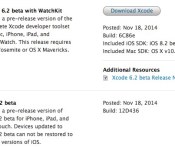
Apple Seeds iOS 8.2 With WatchKit SDK for Apple Watch Apps to Developers
Apple today announced that its set of WatchKit development tools are now available for developers, allowing them to begin creating apps and software for the company’s upcoming Apple Watch.
“Apple Watch is our most personal device ever, and WatchKit provides the incredible iOS developer community with the tools they need to create exciting new experiences right on your wrist,” said Philip Schiller, Apple’s senior vice president of Worldwide Marketing. “With the iOS 8.2 beta SDK, developers can now start using WatchKit to create breakthrough new apps, Glances and actionable notifications designed for the innovative Apple Watch interface and work with new technologies such as Force Touch, Digital Crown and Taptic Engine.”
WatchKit is being released as part of the iOS 8.2 and Xcode 6.2 beta, both of which have been made available to developers today.

Both the iOS 8.2 Beta with WatchKit and the Xcode 6.2 beta can be downloaded from Apple’s developer site, which also has Apple Watch development resources for developers. WatchKit can currently be used to create Glances, actionable notifications, and Apple Watch apps that are powered by the iPhone. Many Apple Watch apps will be driven by code that runs on the iPhone, with a UI that displays content on the watch itself. According to Apple, “fully native” Apple Watch apps can be created “later next year.”
As described by Apple, actionable notifications are notifications that allow users to take an action or respond directly from their wrists with the Apple Watch, turning off the lights when they’ve left the house, for example, or accessing flight information at an airport. Glances are somewhat simpler, aiming to give users quick information at a glance like news, weather, sports scores, and more.

In its press release, Apple highlights several developers who have already begun working with WatchKit, giving some additional insight into how the WatchKit tools can be used. The ESPN app for Apple Watch delivers live scores and information on teams, according to ESPN VP John Kosner, and it offers snapshots of live games through Glances and alerts on score changes through actionable notifications.
Instagram has used WatchKit to develop actionable notifications that let users instantly like a photo or respond with an emoji, plus there’s an Instagram news and watch list to let users see their friends favorite photos and get an overview of likes and comments. American Airlines has used Apple Watch to create pre-trip notifications, updates for gate changes, gate connection information, and alerts when a flight begins boarding, all of which can be accessed directly from the wrist.
In addition to sharing these use cases for the Apple Watch, Apple has also created a dedicated Apple Watch site for developers, outlining the difference between full apps, Glances, and actionable notifications, offering download links to the iOS 8.2 beta with WatchKit SDK, and providing design guidelines and templates.

Apple has said that its Apple Watch will be released in “early 2015,” but an exact launch date remains unclear. At the lower end, the device will retail for $349, with estimates placing pricing for the higher-end solid gold version at thousands of dollars.

LittleBits Introduces Do-It-Yourself Smart Home Kit for $249 [iOS Blog]
LittleBits today introduced a new Smart Home Kit, which is designed to turn any household item into an Internet-connected smart device. Rather than buying various smart products, the Smart Home Kit encourages users to “reinvent” the things that they already own.
Using the tools in the kit, users might build curtains that open at sunrise, a remote controlled pet feeder, a doorbell that sends a notification when it’s pressed, or a toilet paper roll that alerts users when it’s empty. The LittleBits website has several different video examples of how the kit can be used, along with tutorials.
“Our mission is to put the power of electronics in the hands of everyone, and to break down complex technologies so that anyone can build, prototype, and invent. Democratizing the smart home industry is one more step in delivering on that promise,” said Ayah Bdeir, founder and CEO of littleBits. “The Smart Home Kit is giving people the power and opportunity to take the Internet of Things movement into their own hands, and bring their home to the 21st century, on their own terms  recreate a popular smart device, retrofit an old appliance, or invent something entirely new that may be the next big thing.”
The Smart Home Kit comes with 14 “Bits,” including the cloudBit for connecting things to the Internet, an MP3 player, a temperature sensor, a light sensor, a speaker, an IR transmitter, and more. It also comes equipped with project ideas and 11 accessories, like an AC switch, which can interface with wall outlets for connected fans, lights, and more.
The Smart Home Kit can be pre-ordered from the LittleBits site for $249. Kits will begin shipping in early December, and LittleBits also plans to sell its Smart Home Kit in RadioShack stores next month.

Chrome for Mac Gains 64-Bit Support in Latest Chrome 39 Update [Mac Blog]
 Back in August, Google launched a beta build of 64-bit Chrome for Mac, following the public release of 64-bit Chrome for Windows. After several months of testing, Google today launched Chrome 39, its first stable-release 64-bit browser for OS X.
As Google said when it launched a beta version of 64-bit Chrome for Mac, 64-bit support will bring several speed and security improvements to the browser, in addition to decreasing the amount of memory that it uses.
Chrome 64-bit Chrome has become faster as a result of having access to a superior instruction set, more registers, and a more efficient function calling convention. Improved opportunities for ASLR enhance this version’s security. Another major benefit of this change comes from the fact that most programs on a modern Mac are already 64-bit apps.
In cases where Chrome was the last remaining 32-bit app, there were launch-time and memory-footprint penalties as 32-bit copies of all of the system libraries needed to be loaded to support Chrome. Now that Chrome’s a 64-bit app too, we expect you’ll find that it launches more quickly and that overall system memory use decreases.
With the release of Chrome 39, the 32-bit version of Chrome will be retired, left on Chrome 38, which means that some users of older Macs will not be able to use the new Chrome 39.
Along with 64-bit support, the new Chrome update includes new apps and extension APIs, plus improvements to stability and performance. There are also 42 security fixes for various vulnerabilities, which resulted in $41,500 in bounties that Google paid out to the individuals that reported the issues.
Chrome 39 can be downloaded from Google’s Chrome website or installed using the Chrome browser’s built-in update functionality.

Apple Plans to Repurpose Mesa, Arizona Sapphire Plant to Preserve Jobs
Apple is not planning to abandon its now-defunct Mesa, Arizona sapphire facility, reports Bloomberg. The company has told city officials that it remains committed to bringing jobs and manufacturing to Mesa, Arizona, following the bankruptcy that caused hundreds of GT Advanced employees to be laid off.
“They’ve indicated their commitment to us: They want to repurpose that building and use it again,” Mesa City Manager Christopher Brady said in a recent interview. Apple has said it’s focused “on preserving jobs in Arizona” and promised to “work with state and local officials as we consider our next steps.”
Back in October, Apple confirmed in a statement that it would look for other ways to utilize its Mesa, Arizona facility, stating that it “remained committed to the city” and planned to help GT Advanced employees who had been impacted by the bankruptcy to find new jobs.
Apple initially chose Mesa, Arizona as the site for its sapphire facility after city officials agreed to expedite permitting approvals, build out power infrastructure, and cut property taxes. Apple insisted on 100 percent renewable energy for the facility, which required the city to construct a new power substation.
 GT Advanced sapphire facility image via Cult of Mac
Mesa also planned to leverage Apple’s presence in the city with the creation of a new technology corridor in the area, with several other companies having already expressed interest in being located near Apple.
“Apple could’ve invested in a facility literally anywhere in the world,” said Mesa Mayor John Giles, who is planning to visit Apple’s headquarters in Cupertino, California, to show the city’s support. “There’s a reason they came here, and none of those reasons have changed.”
Apple and GT Advanced reached an agreement to end their partnership back in October, and under the terms of the deal, GT Advanced will wind down operations at the sapphire plant in Arizona before officially closing up shop in December. At the current time, most of the company’s employees have already been laid off, while remaining staff cleans and decommissions sapphire furnaces to be sold.
It is unclear how Apple will repurpose the facility, but the company has been working hard to bring more Mac production to the United States. Apple’s Mac Pro, released in late 2013, was the first Apple product line to be assembled in the United States as a result of the company’s efforts to bring manufacturing jobs back to the country.
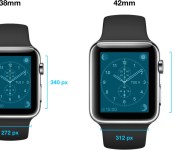
Apple Watch Screen Resolutions: 312 x 390 for 42mm Version, 272 x 340 for 38mm Version
With the WatchKit SDK now in the hands of developers, some new information about Apple’s wearable device is coming out, including its display resolution, which was not previously disclosed by Apple.
According to Apple’s human interface guidelines, the two separate Apple Watch models have different screen resolutions. The smaller 38mm Apple Watch has a resolution of 272 x 340, while the larger 42mm Apple Watch has a resolution of 312 x 390. In the WatchKit documentation, Apple refers to the Apple Watch display as “Retina,” and instructs developers to use 2x image assets.

Apple directs developers to provide image assets for different screen sizes “as needed.” Developers can use the same image resources as long as they “look good on both screen sizes,” but if not, developers will need to provide separate image resources for both devices. Content displayed on Apple Watch “should be the same regardless of the device’s screen size,” and Apple says developers should “let items expand or contract naturally” to fill available space.
Icons on the Apple Watch will have variable sizes based on screen size and type. For example, the Notification Center icon should be 29 pixels for the 38mm Apple Watch, and 36 pixels for the 42mm Apple Watch. A home screen icon on the smaller device should be 172 pixels, while a home screen icon for the larger Apple Watch should be 196 pixels.

In addition to unveiling information on the device’s resolution, Apple’s WatchKit guidelines give some insight into how Apple views the device. Apple asks developers to be mindful of certain concepts when creating content for the Apple Watch, including its deep personalization and connection to people via heart rate and activity monitoring.
According to Apple, the Apple Watch aims to “blur the boundaries between physical object and software” through the Digital Crown navigation tool, the Taptic Engine for subtle alerts, and Force Touch, a new touch control system. Thoughtful design, says Apple, “should contribute to this experience of hardware and software feeling indistinguishable.”
Apple suggests that all content created for the Apple Watch should be “lightweight,” as the device is designed for simple interactions that are “accessible and dismissible quickly and easily, for both privacy and usability.” Apps must “respect the context” in which the user accesses them, “briefly, frequently, and on a small display.”
Apple’s WatchKit development software became available earlier today, as part of the iOS 8.2 beta. The beta can be downloaded from Apple’s developer site, and developers are able to immediately begin creating actionable notifications, Glances, and iPhone-driven apps for the Apple Watch. Apple says that developers will be able to create “fully native” apps “later next year.”

Apple May Introduce ‘Biggest Camera Jump Ever’ in Next-Generation iPhone
Apple may introduce its “biggest camera jump ever” in the next-generation iPhone, according to Daring Fireball‘s John Gruber (via The Tech Block). In a recent episode of his podcast The Talk Show, Gruber said that he heard “from a birdie of a birdie” that Apple is working on major camera improvements.
The specific thing I heard is that next years camera might be the biggest camera jump ever. I don’t even know what sense this makes, but I’ve heard that it’s some kind of weird two-lens system where the back camera uses two lenses and it somehow takes it up into DSLR quality imagery.
Gruber says that he’s heard that Apple’s rear camera could incorporate a two-lens system, which sounds somewhat similar to the Duo Lens camera that was introduced with the HTC One M8. In the One M8, a standard sensor is combined with an “Ultrapixel” sensor that lets in much more light to improve image quality. The secondary lens in the M8 is used to provide additional image information to the first lens, which also lets the focus be shifted.
Another two lens system that hints at what a two-lens setup in the iPhone might be capable of is being developed by Corephotonics. Corephotonics’ system takes advantage of two lenses with separate focal lengths, switching between lenses to magnify distant subjects without the need for a traditional zoom.
With two lenses, the Corephotonics system compares images taken from both, choosing the clearest pixels for the best overall photo. It also utilizes a lens that only snaps black and white images, improving fidelity and allowing in additional light.
Given the fact that there’s little information on what Apple’s actually working on for its next-generation iPhone, it’s hard to say whether a potential two-lens system would work in the same way as the above examples, but two-lens cameras are a new frontier that manufacturers are exploring in order to improve image quality while keeping devices slim.
Apple’s iPhone has long been the most popular camera choice on image sharing site Flickr, and over the years, Apple has embraced iPhone photography. Each new iPhone iteration includes significant camera improvements, with its “S” upgrades often bringing the biggest improvements. With the iPhone 4s, for example, Apple introduced an improved 8-megapixel camera that marked a large jump in quality over the iPhone 4 camera, and with the iPhone 5s, an improved sensor, an aperture of f/2.2, a True-Tone flash feature, better autofocus, and a new “Slo-Mo” mode.
Apple introduced some impressive camera improvements with the iPhone 6 and 6 Plus, including a new Apple-designed image signal processor with Focus Pixels, but it’s possible even better camera improvements are being saved for the introduction of the iPhone 6s and 6s Plus in 2015.
Just yesterday longtime Apple supplier Sony unveiled a new 21-megapixel “stacked” sensor with ultra fast autofocus and 4K HDR video. While the 21-megapixel version is unlikely to make its way into iOS devices, it’s possible that Apple’s next iPhone could incorporate an upcoming Sony 16-megapixel sensor that includes the same impressive features.

PayPal Launches Mobile Payments App for Pebble Smartwatch [iOS Blog]
PayPal today announced that its popular iOS and Android mobile payments app will be available for the Pebble Smartwatch (via VentureBeat).
The PayPal app has let users pay for purchases in certain locations for a while now, and integration with Android Wear has allowed users of Android-powered smart watches such as Samsung’s Gear 2, Gear S, and Gear Fit to make payments via their watches since earlier this year. With the new Pebble app, iOS users can now get a taste of the functionality, which allows them to check into stores and pay for their purchases at locations where PayPal is readily accepted, all without need of using a phone.
Customers can pay for purchases one of two ways: with an auto-generated payment code used when checking out or, with certain PayPal accepted retailers, by checking into a store inside of the PayPal app. If using the latter payment method, the app will automatically communicate with the merchant’s point of sale during the check-out process.

PayPal’s integration with these smart devices in some ways mirrors Apple’s own burgeoning payment system Apple Pay, which is slowly rolling out just now, although the two systems have some significant differences. Despite early rumors of a possible partnership between the online payment giant and Apple earlier this year, the talks reportedly came to a halt when PayPal inked a deal with Samsung to allow users to make PayPal payments with the Galaxy S5’s fingerprint sensor.
PayPal was subsequently excluded from any integration into Apple Pay. PayPal, in response, launched an ad targeting the public release of certain private celebrity iCloud photos and simultaneously promoting its own intense security.
The PayPal app for the Pebble Smartwatch can be downloaded now for free. Its features can also be taken advantage of in the PayPaliOS app [Direct Link].

OWC Opens Pre-Orders for New 12-Port Thunderbolt 2 Dock [Mac Blog]
Other World Computing (OWC) today announced the upcoming availability of its new Thunderbolt 2 dock. The OWC Thunderbolt 2 dock includes twelve ports, allowing for the connectivity of up to 78 direct and daisy-chained devices through a single Thunderbolt connection.

Designed with Apple hardware aesthetics, the dock is compatible with Thunderbolt-equipped Macs in both form and function. Available expansion connections include two Thunderbolt 2 ports, five USB 3.0 ports, 3.5mm audio in/out and one port each for Firewire 800 devices, Gigabit Ethernet, and HDMI 1.4b with support for 4K displays.

The OWC Thunderbolt 2 dock compares favorably with Belkin’s Thunderbolt 2 Express Dock HD, which debuted earlier this year. Similar to OWC’s latest offering, Belkin’s $299 expansion dock includes two Thunderbolt 2 ports, one HDMI port and one Gigabit Ethernet connection. It also offers two audio out ports and three USB 3.0 ports as compared to five for OWC.
The OWC Thunderbolt 2 dock is available now for pre-order with a price tag of $249 and an expected ship date of early December.

Nokia Unveils Android-Powered N1 Tablet With iPad Mini-Inspired Design
During today’s opening of the Slush 2014 conference, Nokia announced its new N1 tablet, the first device from the Finnish company following the sale of its mobile division to Microsoft. With its aluminum casing, curved styling and 7.9-inch screen, the N1 is a dead ringer for Apple’s iPad mini.

Powered by Android 5.0 Lollipop and Nokia’s Z launcher, the Nokia N1 ships with a 2.3GHz Intel Atom processor, PowerVR GPU, 2GB of RAM and a 7.9-inch Retina-resolution display. Other hardware specs include an 8-megapixel rear camera, a 5-megapixel front camera and connectivity options that include 802.11a/b/g/n/ac and Bluetooth 4.0.

Similar to Apple’s Lightning connector, the N1 includes a reversible USB Type-C connector for charging and syncing. The port is located on the bottom edge of the tablet and is nestled between the tablet’s two speaker openings. When it launches next year, the N1 will be available in Lava Grey and Natural Aluminum colors with one storage capacity option of 32GB.
The N1 will ship with Nokia’s flavor of Android and the company’s branding, but it will be manufactured and distributed by Nokia partner Foxconn. Foxconn will handle support and most other product responsibilities. The N1 will launch first in China in Q1 2015 for $249USD with plans for expansion to other regions.
Nokia is just the latest manufacturer to announce a tablet device that looks remarkably similar to Apple’s iOS device lineup. Just weeks ago, Lenovo introduced its S90 tablet that shares a number of design elements with Apple’s iPhone 6 and 6 Plus, with Lenovo even using marketing images reminiscent of Apple’s advertising.

