



Apple Supplier Sony Debuts 21-Megapixel Image Sensor With Ultra Fast Autofocus, 4K HDR Video
Sony today announced a new advanced image sensor designed for use in smartphones, which uses a new “stacked” design to cut down on size while introducing improved image quality and faster speeds. Apple uses Sony sensors in its iPhones and iPads, so it is likely that Sony’s stacked sensor technology will make it into future iOS devices at some point.
The new 21-megapixel Exmor RS IMX230 sensor is built with a chip that stacks a pixel section and a circuit section on top of one another, which allows Sony to build improvements into each aspect of the sensor individually, leading to dramatic improvements. Sony’s been using stacked sensor technology since 2012, but its newest sensor introduces new autofocus and HDR technology.
According to Sony, the IMX230 sensor is the first CMOS sensor for smartphones that includes plane phase detection autofocus signal processing with 192 autofocus points, resulting in much faster tracking of moving subjects that happens almost instantaneously.
 Image plane phase detection AF function using 192 AF points
The sensor also includes support for full 21-megapixel HDR pictures and 4K HDR video, resulting in better lighting in high-contrast scenes. HDR or High Dynamic Range imaging captures separate images with different exposures, combining them into one image that improves detail and color.
The new IMX230 is a type 1/2.4 stacked CMOS image sensor with a significantly improved 21 effective megapixels, and it is also equipped with a newly developed signal processing function. These features fulfill the growing needs in smartphone photography for high-speed autofocus (image plane phase detection AF) and clear, high-quality capture of bright and dark areas even in backlit scenes (HDR imaging). Image plane phase detection AF is a technology used in mirrorless interchangeable-lens cameras, and HDR imaging now supports not only 4K (4096 x 2160) high-resolution videos but also still images.
 HDR video from existing IMX135 sensor with 3.2 effective megapixels on left, IMX230 21-megapixel HDR image using IMX230
Sony is known for making some of the best image sensors available, and Apple has long used Sony sensors in its iOS devices. Sony’s new image sensor will begin shipping in April of 2015, and while it is likely the new sensor technology will make its way into Apple’s iPhones and iPads, it is unknown when that might occur.
Apple does not typically use high-megapixel sensors in its iPhone or iPad, but Sony is planning on producing a 16-megapixel version of the IMX230 in 2015, which would be appropriate for iOS devices. It’s possible Apple could use the 16-megapixel version of the IMX230 in the 2015 iPhone 6s and 6s Plus, but it’s also possible that the sensor won’t be utilized until 2016 or later as Apple often uses slightly older sensors in its devices.
Tom’s Hardware believes that the next-generation iPhone 6 and 6 Plus may incorporate either the upcoming 16-megapixel IMX240 sensor from Sony or the 13-megapixel IMX135, which Sony first introduced in January of 2013.
It’s not known exactly which sensor is used in the current iPhone and iPad, but camera experts have speculated that the iPhone 6 and 6 Plus use the Sony ISX014 sensor, an 8-megapixel sensor that Sony first introduced in October of 2012.
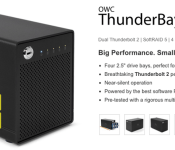
OWC Introduces New ThunderBay 4 Mini Portable Storage With RAID 5 Option [Mac Blog]
OWC today expanded its ThunderBay lineup of storage devices with the new ThunderBay 4 mini and ThunderBay 4 mini RAID 5 Edition. These new portable RAID devices are designed for 2K and 4K video editing with fast Thunderbolt 2 performance and SSD support.
“Our new ThunderBay 4 mini is perfect for mobile workflows involving demanding applications and large mission-critical files,” said Jen Soulé, OWC President. “The combination of RAID-ready capabilities and Thunderbolt 2 technology makes working with large 2K and 4K files easier, faster, and more flexible and affordable than ever before. Now users can get big performance in a small footprint – all in a portable, production-grade 4-Bay enclosure.”
The ThunderBay 4 mini and mini RAID 5 Edition both include four 2.5-inch drive bays that are compatible with either HDDs or SSDs, allowing owners to build a storage solution suitable for their needs. The new ThunderBay minis also include Thunderbolt 2 transfer speeds of 1,284MB/s, the ability to connect multiple ThunderBays into a RAID array and OWC’s signature drive “burn-in” reliability.

Similar to earlier ThunderBay models, the ThunderBay 4 mini is available in a base bring-your-own-drives model for $379 with configurations from 2 TB to 8 TB available at additional cost.
While the ThunderBay 4 mini and the mini 4 RAID 5 Edition share the same internals, the RAID version ships preconfigured for RAID 5 with support for RAID 0, 1, 4, 5, and 1+0. Pricing on the RAID model starts at $479 when you supply the necessary drives and climbs to $2,499 for the 4 TB SSD model.
Both the ThunderBay 4 mini and ThunderBay 4 mini RAID 5 Edition are available now at OWC’s website. The larger desktop ThunderBay 4, introduced last year with support for 3.5-inch drives, is still available starting at $449 for the bring-your-own-drives configuration.
Apple Releases iOS 8.1.1 With Bug Fixes, Performance Improvements for iPad 2 and iPhone 4s
 After two weeks of testing, Apple has released iOS 8.1.1, a minor update that includes several bug fixes. Apple first seeded the iOS 8.1.1 beta to developers on November 3.
iOS 8.1.1 is available immediately as an over-the-air download. Apple has also released new Apple TV software.
According to Apple’s release notes, iOS 8.1.1 includes bug fixes and increased stability and performance improvements for both the iPad 2 and the iPhone 4s, two of the older devices that support the operating system.
iOS 8.1.1 may offer several bug fixes, but as a minor update, it does not bundle in any of the major new features that are rumored for iOS 8, like improvements to Maps and split-screen multitasking for the iPad. These updates may come in iOS 8.2 or iOS 8.3, both of which Apple is rumored to be working on.

Apple Retail Making Gift Card and Uniform Changes for Holiday Shopping Season
As is typical for this time of year, Apple is planning to spruce up its retail operations ahead of the end-of-the-year holiday shopping season. This year’s changes in the company’s retail offering include new colors for store gift cards and holiday-colored shirts for Apple employees, with retail head Angela Ahrendts reportedly introducing these holiday updates in an internal company video.

Anonymous sources claim Apple’s new gift cards will move to solid silver, gold and space gray designs to match the current styling of the iPad and iPhone. Similar to previous gift cards, these new gift cards can be used in store or online with a value up to $2000. They will debut starting today, November 17.
Other retail changes include the rollout of red holiday t-shirts to replace the traditional blue shirts for employees and the removal of the neck lanyard from the employees’ standard retail uniform. The lanyard badge holders are distinctive to Apple and issued to current employees, but without the lanyard there will be more emphasis on employees introducing themselves to customers.
Apple retail stores will also begin servicing Beats Electronics products starting tomorrow, as shown in an internal memo leaked by TechnoBuffalo late last week. Retail sources have confirmed to MacRumors that the leak is genuine and that most service will not take place at stores themselves, but instead be handled through mail-in depot channels. Issues with minor items such as cables, chargers, and cables will be handled in-store.
These small modifications are part of a larger plan by Angela Ahrendts to revamp Apple’s retail operations. Apple’s recently appointed retail chief reportedly is focusing her efforts on mobile payments, expansion into China, and the customer’s Apple Store sales experience.

Microsoft Launches New Holiday Ad Comparing Surface Pro 3 to MacBook Air
Microsoft yesterday launched the latest in its series of ads comparing the Surface Pro 3 to Apple’s MacBook Air. The new ad, entitled “Winter Wonderland”, compares and contrasts the two machines to the jingle of the Christmas melody.
The ad’s predominant assessment of the Surface Pro 3 is how powerful the device is in comparison to the MacBook Air, offering similar performance while also supporting pen input. Microsoft also highlights the use of the Surface Pro 3’s kickstand and touch screen as major advantages over the MacBook line, as the Microsoft user in the ad goes about using the Surface to design a Christmas-themed coffee mug. Finally, the ad highlights the Surface Pro 3’s ability to detach from its magnetic keyboard for easy travel and its robust array of ancillary ports, such as its USB port. “I think I like your Surface Pro 3,” the MacBook Air user states at the ad’s end. “No seriously, where can I get one?”
Since the Surface Pro 3 was announced this past May, Microsoft has released several ads comparing the device to Apple’s line of MacBooks. Back in August, the company released a series of ads sizing up the MacBook Air with the Surface Pro 3 for the first time, most likely for the then-impending back-to-school rush. Microsoft has also pitted the MacBook Air against Lenovo’s Yoga 3 Pro in another ad released earlier this month.
All of the ads unsurprisingly position the Microsoft product as offering more versatility and a wider array of functionality compared to the MacBook Air. None of this is new, of course, as Apple and its products have long been popular targets in ads from a number of competitors including Microsoft, which has in the past compared its Cortana virtual assistant to Siri and the Surface RT to the iPad.

Samsung Chosen to Supply 80 Percent of Apple’s Future A-Series Chips for iOS Devices
Apple has reportedly chosen Samsung over Taiwan Semiconductor Manufacturing Company (TSMC) as the primary supplier for its future application processors in a deal worth billions, claims The Korea Times (Via G for Games) citing sources familiar with the deal.

Starting in 2016, Samsung reportedly will supply 80 percent of Apple’s supply of 14 nm application processors with TSMC supplying the remaining 20 percent. The key factor that boosted Samsung was its recent partnership with GlobalFoundries, a relationship which will enable Samsung to produce sufficient supply of processors to meet Apple’s demand.
“Apple has designated Samsung as the primary supplier of its next A-series chips powering iOS devices from 2016 as the alliance with GlobalFoundries (GF) enabled Samsung to cut off capacity risk,” a source familiar with the deal said.
During its recent conference call, Samsung confirmed that it is producing sample 14 nm chips for an unidentified customer with plans to mass produce the chips in 2015 and 2016. This latest Korean Times report claims Samsung will begin building the processors early next year in its South Korean plant with plans to expand production to the company’s Austin, Texas facility and GlobalFoundries’ New York factory in the coming year.

Apple Now Accepting UnionPay as Payment Option for App Store Customers in China
 Apple today announced that it is now accepting UnionPay as a payment option for App Store customers in China. Established in 2002, UnionPay is the most popular payment card company in China with over 4.5 billion cards issued. With today’s announcement, users can simply link their UnionPay debit or credit card for easy purchases.
“The ability to buy apps and make purchases using UnionPay cards has been one of the most requested features from our customers in China,” said Eddy Cue, Apple’s senior vice president of Internet Software and Services. “China is already our second largest market for app downloads, and now we’re providing users with an incredibly convenient way to purchase their favorite apps with just one-tap.”
The acceptance of UnionPay in the App Store is the latest move by Apple to expand its presence in China. The company is also in talks with major Chinese e-commerce company Alibaba over a China-focused payments partnership, which could see the Alipay electronics payment service integrate with Apple Pay. Discussions between the two companies were acknowledged by Alibaba Executive Vice Chairman Joseph Tsai and Alibaba founder Jack Ma.
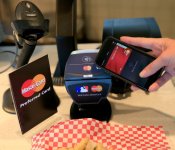
Early Apple Pay stats point to a modest but promising start

Sure, Apple was quick to tout a surge of Apple Pay registrations, but how often are people actually using the iPhone-focused payment service? A fair amount, apparently. Whole Foods tells the New York Times that it racked up 150,000 transactions in the three weeks after Apple Pay became available. That’s not a lot in the grander scheme of things (just 7,143 payments per day), but it’s significant for a single store and a brand new service with limited device support. Other shops aren’t quite so forthcoming with stats, although they suggest that there has also been an uptick. Walgreens says its mobile payments have doubled, while McDonald’s says that Apple Pay now makes up half of its tap-to-pay purchases.
It’s not clear that Apple Pay will be successful in the long run; that depends on additional hardware support and cooperative retailers. Toys “R” Us notes that its boost in mobile payments doesn’t amount to much when cash and credit are still far more popular. Even if Apple Pay doesn’t pan out, though, there are hints that it’s helping others. Both Google and Softcard say they’ve seen increased usage in the past few weeks due to increased awareness of tap-to-pay services — that’s good news for mobile payments as a whole, no matter which smartphone you’re using.
[Image credit: Getty Images for Mastercard]
Filed under: Cellphones, Mobile, Apple
Source: New York Times

Aaron Sorkin on Jobs Biopic: Casting Announcement Imminent, ‘Heroine’ Will Be Daughter Lisa
 In a new interview with The Independent, screenwriter Aaron Sorkin shares a few more details regarding his upcoming movie about Steve Jobs, noting that while there is no word on who will play the leading role yet, an announcement is imminent.
Leonardo DiCaprio and, more recently, Christian Bale, pulled out, the latter because of the sheer demands of the role: “It’s a 181-page script, about 100 of it is that one character,” says Sorkin. The frontrunner is now believed to be Michael Fassbender. Sorkin, today, can confirm only that an announcement is imminent.
As previously shared by Sorkin, the film will focus on three 30-minute scenes showing Jobs backstage before the announcement of the Mac, NeXT, and the iPod.
Sorkin also reveals in the new interview that the character of Jobs’ daughter Lisa will play a major role as the “heroine” of the film. Lisa Brennan-Jobs had declined to contribute to Walter Isaacson’s authorized biography of her father while he was alive, but has worked with Sorkin on the screenplay for the film.
“[I]in the case of Steve Jobs, it’s the relationships he had – particularly with his daughter, Lisa – that drew me to it,” he says. Jobs initially denied paternity of his daughter, now 36, though they later reconnected and she lived with him in her teens. “She didn’t participate in Walter Isaacson’s book, because her father was alive at the time, and she didn’t want to alienate either of her parents, so I was very grateful that she was willing to spend time with me,” says Sorkin. “She is the heroine of the movie.”
Sorkin’s Jobs film does not yet have a release date, but with Slumdog Millionaire director Danny Boyle on board and casting starting to firm up, things are clearly moving forward.

Staples Begins Accepting Apple Pay in Retail Stores
 As of today, popular office supply store Staples has begun accepting Apple’s Apple Pay payments service in its retail stores across the United States, according to information shared with MacRumors.
Staples now offers its customers access to Apple Pay, a new service that will transform mobile payments with an easy, secure and private way to pay. In Staples over 1,400 stores in the United States, Apple Pay works with iPhone 6, iPhone 6 Plus and Apple Watch, upon availability.
When Apple Pay was first announced, Staples was listed as one of the retailers implementing in-store support for the payments service “later this year” along with Anthropologie, Free People, Sephora, Urban Outfitters, and Walt Disney World.
Staples has been an eager Apple Pay partner, initially promising support for the service back in September. The Staples iOS app has included Apple Pay support since it first launched on October 20, and when Staples announced Apple Pay integration, it said that in-store availability would be rolling out “within a few weeks.”
Apple first teamed up with Staples last year, with the two striking a deal that saw Staples selling Apple products in its U.S. stores for the first time beginning in September. Since then, Staples has gone on to heavily promote Apple products both online and in stores, offering frequent deals.
With the addition of Staples, Apple Pay now has 34 retail partners, including competing office supply store Office Depot and other major retailers like Macy’s, Disney, Foot Locker, Petco, Walgreens, and Toys R Us. Apple Pay is also accepted in any store that supports NFC contactless payments.
Retailers have largely been silent on the popularity of Apple Pay during its first month of availability, but Whole Foods’ chief information officer told The Wall Street Journal that the company had processed 150,000 Apple Pay transactions in the 17 days following its October 20 debut. That equates to an estimated one percent of all Whole Foods transactions.

