


Huawei’s big Ascend Mate 2 4G can charge up your iPhone, coming to the US

Given the recent leak, Huawei’s announcement of the Ascend Mate 2 4G should be no surprise to anyone. The device is essentially an LTE Cat 4 (read: 150Mbps!) refresh of its predecessor, packing a similar 6.1-inch 720p IPS panel that seems to be of better display quality, and Gorilla Glass is here to stay. Of course, such screen resolution also means the fixed 4,050mAh battery should keep the Mate 2 going for a lot longer than its 1080p competitors. Furthermore, you can also use the Mate 2 to charge up other devices! Huawei’s rather confident of its own power-management technology, promising 60 hours of “normal use” and 12 hours of web surfing. At the launch event today, Huawei’s Richard Yu confirmed that the Mate 2 4G will have two options for its quad-core 1.6GHz SoC: one is Qualcomm’s MSM8928, and the other is Huawei’s own HiSilicon Cortex-A9 chip.
The Mate 2 also features 2GB of RAM, 16GB of internal storage, microSD expansion of up to 32GB, plus a pair of cameras — 5 megapixels f/2.4 on the front and 13 megapixels, f/2.0 on the back. This is all tucked inside a familiar 202g, 9.5mm-thick body, which feels rather nice given the solid frame and slightly slimmer screen bezel, though we’re not too fond of the glossiness on the white Mate 2′s removable back cover (for access to the SIM slot and microSD slot). On the software side, there’s Huawei’s Emotion UI 2.0 running on top of Android 4.3, so users will benefit from features optimized for single-hand usage — especially the telephone keypad that squashes itself to one side, depending on your tilt. You also get handy floating widgets like calculator, calendar, notes and messages to go on top of other apps.
Huawei has yet to provide details on pricing and availability, but you’ll hear from us as soon as we find out.
Update: Richard Yu also confirmed that the Mate 2 4G will be coming to the US, with AT&T name-dropped as a compatible carrier.
Filed under: Cellphones, Mobile

Engadget for Android 2.0 is here!

You’ve been asking for a new version of our Android app, and we’ve been listening. And after months of development and testing, Engadget for Android 2.0 is finally here, just in time for you to use it stay on top of all of the latest news from CES! We’ve totally rebuilt the app from the ground up, with a ton of new features and enhancements, including:
- An all new card UI layout: Each card highlights the media within the article, highlighting comment count and share tools
- Most Popular articles lets you get a quick view of what’s trending on Engadget
- Easy content sharing via any app on your device that supports sharing
- Podcasts now play in the background
- Send tips to Engadget directly from the app
- Quick access to sections like Reviews, Videos and Galleries from the side drawer
- Comment counts turn orange as the conversation goes deeper, letting you know where to join in
- Articles now have related content and tags support to find more of the content you love
- Articles also have a “back to top” icon to quickly return to the top of any article from anywhere
- Greatly improved performance
The app is available right now from Google Play, and supports both phones and tablets. Download it today, and let us know what you think!
Filed under: Announcements

Qualcomm drops Toq smartwatch price $50 during CES
Qualcomm has announced a $50 price drop on their Toq smartwatch from January 6-11, 2014 to $300.
This price discount is due to CES which is currently ongoing in Las Vegas, NV. Qualcomm might be trying to grab headlines from other companies debuting smartwatches such as LG’s Life Band Touch.
We are expecting to see some new wearable tech from Qualcomm this week, but in the mean time enjoy the price drop and a new Qualcomm Toq – Smartwatch for Android

The post Qualcomm drops Toq smartwatch price $50 during CES appeared first on AndroidGuys.
HP serves up 21.5 inch Android-powered All-in-One
Android hybrid tablet/laptops are so 2013 according to HP, which just announced its new Android-powered HP Slate21 Pro AiO.
Unlike the AiO desktop PCs that dual-boot Windows and Android, this one strictly runs our little green friend, Android 4.3 Jelly Bean.
Said to be designed for productivity in office, education and kiosk environments, the AiO features a 21.5-inch 1920 x 1080 resolution IPS touchscreen display with wide 178-degree viewing angles, plus Its stand design allows it to decline up to 70 degrees. There is also optional “VESA mounting,” that makes it flexible enough for a variety of work environments.
Other specs of the HP Slate21 Pro are an NVIDIA Tegra 4 quad-core T40S Processor (1.66 GHz – Dual-Core/Single-Core mode up to 1.8 GHz), 2 GB of RAM, 16 GB of flash storage, SD card slot, 8.11 a/b/g/n dual band wireless, Bluetooth 4.0, a USB 2.0 port on the side and two on the back, HDMI input, a USB 2.0 upstream port, RJ45 network connection, integrated Ethernet, DTS Sound and integrated audio, two, integrated stereo speakers, a 720p HD webcam and access to the Google Play store.
The AiO can use apps such as Kingsoft Office Suite, Google Docs, Google Drive, it’s certified Citrix ready and HDX verified and can deliver a virtual workspace with secure data and Windows application support via Citrix Receiver, so users also can easily switch between the Android environment and content displayed from a Windows PC.
With business users in mind, it comes pre-installed with Citrix XenMobile, which allows companies to manage apps and secure the HP Slate21 within a corporate environment.
When available, you get all of this this, plus 50 GB of Box cloud storage, starting at $399. If you’re not getting this for business, it should be able to handle games such as Dead Trigger 2 beautifully.
via HP
The post HP serves up 21.5 inch Android-powered All-in-One appeared first on AndroidGuys.
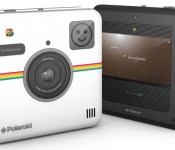
Polaroid’s Socialmatic camera to fuse retro style, instant prints and Android this fall

Last we heard of Polaroid’s Socialmatic camera, which promises to bring back instant prints with a modern flair, it was bound for store shelves in the first quarter of 2014. Here at CES, the firm’s announced that the hardware is cruising for a fall release now that it’s finalized the necessary legal agreements to make it a reality. For those in need of a refresher, the device runs Android to make sharing images a snap and packs a 14-megapixel cam on its front, a 2-megapixel rear-facing sensor, 4GB of storage with expansion via microSD, a 4.5-inch touchscreen and built-in WiFi. Zink’s ink-free paper will do the heavy lifting when it comes to printing photos, so any vintage film can stay stowed in your closet. Polaroid’s Socialmatic shooter is out in the wilds of the CES floor, so stay tuned for a hands-on.
Filed under: Cameras
Source: Polaroid
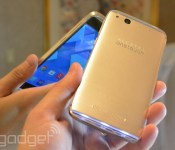
Alcatel OneTouch Idol Alpha gets a champagne gold option, headed to Europe this quarter

You may recall that back at IFA, Alcatel surprised us with a prototype of its shiny OneTouch Idol Alpha. This time at CES, the company brought along a champagne gold version to tease its European launch this quarter. Like before, both the top and bottom transparent parts are lined up with LEDs, with the top ones acting as notification, and the bottom ones shining a light on the three Android soft keys. It’s rather pretty when you see it up close. Spec-wise, the 3D aluminum frame envelopes a 4.7-inch 720p IPS display with Dragontrail Glass, a 1.2GHz quad-core SoC with 1GB RAM, 16GB of built-in storage and a 2,000mAh battery. There’s no info on pricing just yet, but given Alcatel’s target market, we have a good feeling about this one, and we’ll let you know once we hear more.
Filed under: Cellphones, Mobile
Android comes to the open road with Open Automotive Alliance
Android connected cars coming from a variety of industry players
Android is coming to your cars, and in a big way. Today sees the official announcement of Google’s latest initiative, the Open Automotive Alliance.
Partnering other players in the space such as Audi, GM, Honda, Hyundai and Nvidia, the goal is to accelerate “auto innovation with an approach that offers openness, customization and scale”. Just like Google did with the Open Handset Alliance and smartphones, the Open Automotive Alliance should do for vehicles.
While we’ve seen some companies take a crack at integrating smartphones or tablets in the automobile, there are no standards yet. What’s more, it’s a wonky experience when it’s done. To say there’s room for improvement would be an understatement.
…Your favorite apps and music…safely with your car’s built-in controls and in-dash display…Working to enable new forms of integration with Android devices, and adapting Android for the car to make driving safer, easier and more enjoyable for everyone. …Enabling automakers to more easily deliver cutting-edge technology to their customers.
Let’s hope that other industry names join the fray and that innovation accelerates for the auto space as quickly as it has for smartphones. According to the OAA, we can expect to see the first cars with Android integration by the end of this year.
To learn more check out the official website of the Open Automotive Alliance.
The post Android comes to the open road with Open Automotive Alliance appeared first on AndroidGuys.

ZTE’s 5.5-inch Grand S II lets your friends unlock the phone with their voice

After a brief tease last week, ZTE has at last revealed the Grand S II. The Android 4.3 smartphone has all the necessary ingredients of an early 2014 flagship, including a 5.5-inch 1080p screen, a 2.3GHz Snapdragon 800, a 13-megapixel rear camera and a 2-megapixel sensor up front. However, its real centerpiece is its voice recognition, which is more elaborate than ZTE hinted at a few days ago. The Grand S II will recognize multiple users’ voices; unlike the Moto X, you can let friends and family unlock the phone solely through speech. Other voice features are familiar, but welcome. You can take photos with spoken commands, and a My-drive mode tweaks the voice recognition for quicker hands-free control while in the car. We’re not big on the 16GB of built-in storage, but the hefty 3,000mAh battery should last longer than the 1,780mAh pack in the original Grand S. About the only mystery left is the Grand S II’s launch schedule, but we hope to learn more about that in the near future.
Filed under: Cellphones, Mobile
Source: ZTE
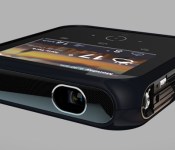
ZTE’s Android-powered Projector Hotspot dishes out 1080p video and US-native LTE

We’ve seen some pretty clever hotspots in our day, but ZTE is determined to trump them all with its new Projector Hotspot. As the name implies, it’s both a 1080p DLP projector (with HDMI and WiFi Display support) as well as an 8-device LTE hotspot, giving your mobile devices a big screen and internet access at the same time. However, it’s smart enough that you sometimes won’t need another device at all. This hotspot runs Android 4.2, folks — you can hop online through its 4-inch touchscreen and project content from any app or website. ZTE plans to bring the Projector Hotspot to the US sometime in 2014, although it isn’t yet saying which carriers (if any) are involved with the launch.
Filed under: Peripherals, Wireless, Networking, Mobile
Source: ZTE
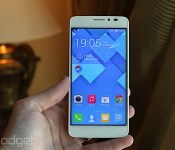
Alcatel to bring world’s fastest octa-core phone to Europe in Feburary

TCL’s already jumped the gun by launching its Idol X+ in China last month, but the same flagship device will be heading to Europe this February under the Alcatel brand. For those who missed the news first time round, this dual-Micro SIM, 7.9mm-thick Android phone packs MediaTek’s 2GHz MT6592, which is currently the world’s fastest true octa-core chipset. You’ll find the usual top-spec components around the Idol X+ as well, including a 5-inch 1080p IPS display, a 13-megapixel main camera (which supports 40-megapixel panorama and digital stabilization for video capture), a 2-megapixel front-facing imager, a 2,500mAh battery and dedicated audio amplifier chips by ESS. Internal storage starts from 16GB (with 12.3GB available to the user), along with microSD expansion of up to 32GB. The phone also comes with a pair of JBL earbuds, but there’s no word on whether the China versions’ Bluetooth activity tracker will be included as well — at least it won’t be called Boom Band, as it will apparently be a more refined version when it goes global.
We were left rather impressed by the Idol X+’s design and build quality. The solid plastic bezel features a brushed metallic effect, accompanied by a spin finish (achieved by in-mould labelling) on the back of the phone. Like the screen, the backside will also have a nano-coating treatment to minimise fingerprint smudges. Shoppers will be given a color option of either black or white when this 3G phone lands in Europe some time in February, and it’ll likely be sold for around the attractive $300 price point unsubsidized.
Brad Molen contributed to this report.
Filed under: Cellphones, Mobile

