


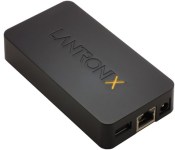
Lantronix xPrintServer Cloud Print Edition offers Chrome wireless printing, arrives next month for $150

Back in 2011, Lantronix served up its first gadget for making wireless printing from an iOS device quite easy. With a Home Edition and Office Edition under its belt as well, the outfit has taken aim at the Chrome faithful with the xPrintServer Cloud Print Edition. Taking on a similar stature as its predecessors, this smartphone-sized black box also allows for printing via any networked or USB printer and carries the same simplified setup as its elder siblings, too. Once tethered to a network, the accessory automatically discovers printers and links all the hardware together without the need for a driver install. The add-on is certified by the folks in Mountain View to support Cloud Print tech and can be used by any device running Android, Chrome OS (2.2 or later) or the Chrome browser. As you might expect, compatibility includes Google’s suite of apps — such as Drive. If your stable of tech meets those requirements, the Cloud Print Edition will ship in February for $150.
Filed under: Misc, Peripherals

Hands-on with Acer’s 2014 Iconia Android tablets

Acer’s been quick to make its immediate plans for the new year known, including the impending release of its refreshed Iconia Android tablets. Today the company’s been kind enough to show the new slates to us, both of which will ship with 4.2 Jelly Bean. The A1-830 is the more premium of the pair, and to give you a quick reminder of the specs, it sports a 1.6GHz dual-core Intel Atom processor, 1GB of RAM, 16GB of internal storage (don’t worry, there’s a microSD slot if you need more), and 5-/2-megapixel cameras. With its 4:3 aspect ratio and 1,024 x 768 display, you’d be forgiven for mistaking it for a iPad mini from afar — the form factor is deceptively similar. It sits at the top of Acer’s tablet range, and fittingly, has an aluminum back to prove it. It doesn’t look half bad, either, although the plastic which encroaches the top edge, framing the camera, kind of ruins the upper-end look. The screen appears to be relatively good quality and it feels solidly built. With a noticeably thin profile, it gives a good first impression. Its specs might be of a mediocre standard, but the price makes up for it. When the tablet hits the North American market in late Q1 2014, it’ll set you back $149, which we wouldn’t say is an unfair ask after out brief flirtation with the hardware.
Acer’s refreshed Iconia B1 tablet (aka the B1-720), which falls in behind the A1, didn’t score nearly as high in our estimation, however. There’s a lot of bezel surrounding its 7-inch, 1,024 x 600 display, making the screen look smaller than it really is. Spec-wise, it’s not all that different from the A1. You’re looking at a 1.3GHz dual-core Mediatek CPU, 1GB of RAM, 16GB of storage (microSD-expandable), and only a 0.3 megapixel front-facing camera. It’s significantly thicker than the A1 and swaps the aluminum backing for textured plastic. You can squeeze a fair few creaks out of it; in general, it feels leagues behind the build quality of the A1. The screen, too, is of noticeably lower quality, but then again, it’ll only be $130 when launched in black and red hues later this month. If you want 3G connectivity on top of WiFi, a SIM-friendly model (B1-721) will be available soon after, but it’ll arrive for at least a $50 mark-up.

Acer made a last-minute pricing adjustment to the A1, bringing the cost down from $180 to $149. While that’s great for enticing eyes to the A1, it has a completely different impact B1. Given there’s been no price adjustment for the lower-end slate, we’d highly recommend chucking the extra 20 bones down for the altogether better tablet.
Alexis Santos contributed to this report.

Acer’s new Liquid Z5 smartphone is more expensive than it should be (hands-on)

Acer didn’t just bring a couple of new tablets to Vegas this year, but something to make calls with, too. The latest addition to its Liquid range after the top-spec S2, the Z5 is very much a “value” proposition, as the raw numbers show. We’re looking at a 5-inch, 854 x 480 display, 1.3GHz dual-core Mediatek processor, 512MB of RAM, 4GB of internal storage (expandable via microSD), and a 2,000mAh non-removable battery. For cameras, the Z5 has a modest VGA shooter up front, and a 5-megapixel main affair with a 5-lens array and IR sensor that Acer promises will improve focus and low-light performance, respectively.
The Liquid Z5 isn’t revolutionary in design, but at 8.8mm thick with a plastic unibody, it’s not horribly unattractive. Debuting on the Z5, however, is Acer’s new “Rapid” button, which the firm expects to bring to other devices in the future. It sits conveniently under the camera on the back of the device (just where your forefinger would rest), undoubtedly taking inspiration from LG’s G2 array of rear buttons. Pressing it once unlocks the device, and second prod will send you straight into whatever app or menu you assign it to. A long press boots the camera app. To further differentiate itself from phones of similar specs or price point, Acer has added a couple of software features to the Z5′s Android 4.2 build. These include the company’s answer to multitasking, called “float apps,” and various custom skins, including one that simplifies the whole Android experience for newcomers or dumbphone nostalgics. As is the fashion these days, there are white and grey peek covers to match the handset’s two color options, should you want to accessorize.

Its sub-par internals certainly show, as even unlocking the phone generated a little lag. We wouldn’t consider this a massive issue if the Z5 was priced accordingly, but it’ll retail for around 170 euros ($230) when it launches later this month. It’s not destined for North America, mind, and will initially land in select European markets before heading to Asia, the Middle East and Africa in due course. It’s hard to come away feeling positive about this device. When Motorola’s offering the much more capable Moto G at a lower price point — and we expect direct competition in this ultra-affordable space soon — the Liquid Z5 already feels dead in the water.
Alexis Santos contributed to this report.
Filed under: Cellphones, Mobile, Acer
Acer’s affordable Liquid Z5 debuts for Europe
Acer will have numerous devices on display at CES 2014 and one of their newest is a smartphone for those on a budget or buying a smartphone for the first time, the Liquid Z5.
Being a budget phone, the device is no game changer, but what you’ll get for your Euros is a device with a 5-inch display with a 16:9 aspect ratio, dual-core 1.3 GHz processor, 4 GB of storage, Wi-Fi, GPS, a 5 MP camera rear-facing camera, front speaker boosted by DTS Sound™ technology and it’s running Android 4.2.2 Jelly Bean under the hood.
The device is also 8.8 mm thin, weights only 147 grams and has a rounded edge.
Some of the other features Acer mentions about this phone is “AcerRAPID™ design” that acts as a personal control key, bringing even more one-hand control to the user by allowing users to unlock the phone, wake-up the screen, launch the camera, take a picture, launch apps from home screen and pick up phone calls, and “Acer Float™ User Interface” that allows app windows to stay open, so users can multitask without having to back out of one app to work on another. Acer said that with the press of a key, users can brings up the Float Apps shortcut where apps on a translucent screen float over the function being used and it allows access to apps such as the camera, maps, calculator and notes and can be customized with up to 8 app shortcuts.
The camera may also be only 5 MP, but it supports “BSI technology” that enables more light on the sensor than traditional FSI, is said to deliver better low-light sensitivity, and comes with a 5 elements f2.4 lens, instead of traditional 4 elements for sharper images.
Acer’s new Liquid Z5 be available in France, Benelux, Germany, Spain, Portugal, Ukraine and UK around mid-January in two colors, “Essential White and Gentle Grey,” for €169.
via Acer
The post Acer’s affordable Liquid Z5 debuts for Europe appeared first on AndroidGuys.

Pandora’s Android app gets an alarm clock function, right on time

There’s no denying it — many people will need extra motivation to get up at a reasonable hour after sleeping in during the holidays. It’s a good thing, then, that Pandora has just given its Android app the alarm clock and sleep functions that reached iOS nearly a month ago. Most of the functions are the same. You can still tell Pandora to wake you up to your favorite streaming station, and you can hit the snooze button if you’re not quite ready to greet the new day. Android users do get a few OS-specific perks, including support for recurring alarms and the luxury of switching apps once the alarm has been set. If you need some tunes to make the early morning a little more bearable, you’ll want to swing by Google Play to grab Pandora’s update.
Filed under: Cellphones, Mobile
Via: The Next Web
Source: Google Play, Pandora

Wikipad breaks off controls into mobile Gamevice gamepad

In its ongoing effort to announce products people may not want long before said products are available to buy, Wikipad today unveiled its Gamevice tablet game controller. The mockup above is an example of what the Gamevice might look like when we get our hands on it sometime later in 2014 — it won’t be at CES next week and it doesn’t have a projected price or release window (other than this calendar year). Rather than focus on the larger tablet form factor, the Gamevice adapts the 7-inch Wikipad’s controls for — the company’s hoping — a variety of Android and Windows 8 devices. It sounds like iOS support is also in the works, but there’s nothing officially confirmed just yet.
Whether there’s a market for Wikipad’s Gamevice is another question altogether. There’s no shortage of mobile gamepads out there, and it’s not clear that Gamevice is any better than the competition. If anything, based on previous experience with the Wikipad’s controls, we’re a bit skeptical.
The company also announced an OTA update for the 7-inch Wikipad that adds Jelly Bean 4.2 and mappable controls. It should be available today.
Filed under: Gaming, Handhelds, Peripherals, Software, Mobile

BBM beta for Android gets Channels and voice chat

Android users who’ve enjoyed their first taste of BBM will want to visit the BlackBerry Beta Zone today. BlackBerry has just released a private beta of the messaging client that introduces promised Channels and Voice support, giving Android users the same social feeds and free WiFi calling as their BB10 bretheren. There’s no mention of when the feature will reach either the public BBM build or its iOS equivalent, but it’s clear that wider availability is close at hand.
Filed under: Cellphones, Mobile, Blackberry
Via: NerdBerry
Source: BlackBerry Beta Zone
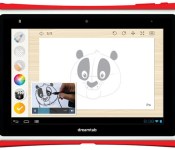
DreamWorks to launch Android ‘DreamTab’ with original content this spring

DreamWorks certainly knows what kids want to watch, and Android tablet maker Fuhu knows a thing or two about children’s tablets — having produced the Nabi 2 Disney edition model, for instance. It looks like the two are putting that youth savvy together to create a new slate called the DreamTab that’ll come with its own stylus and a raft of kids’ apps. The studio told the New York Times that it’d launch an eight-inch model this spring for under $300 with content that can interact with other DreamWorks toys or show kids how to draw, for instance. It’ll also include other educational apps to further entice parents and could even have animated characters like Shrek tell kids when it’s time to shut it down. A 12-inch model will arrive later, and though there’s no word on specs yet, DreamWorks said the new models will provide around the same power as an iPad. “If you give a kid less… they won’t like it.”
Filed under: Tablets
Via: The Verge
Source: The New York Times
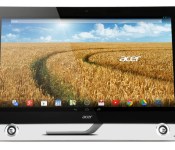
Acer’s latest all-in-one doubles as a 27-inch touch monitor and Android PC

Perhaps the best way to regard Acer’s growing range of Android “all-in-ones” is not as PC replacements, or even as giant tablets, but rather as touch-sensitive monitors that have the added benefit of being able to run their own OS. That certainly applies to the latest model, the TA272 HUL, whose 27-inch, 2,560 x 1,440, 10-point touch panel makes it particularly well equipped as a monitor for a Windows 8 PC. Alternatively, an “NVIDIA Tegra quad-core processor,” which we suspect might be an old Tegra 3, will allow the unit to run basic tasks and media playback in Jelly Bean even when the source PC is switched off. The TA272 HUL comes with 16GB of onboard storage, a USB 3.0 port, HDMI and DisplayPort inputs and a 2-megapixel webcam, all for an RRP of $1,099. For reference, that’s at least $100 more expensive than a similarly specced Acer monitor without Android (the T272 HUL), so you’d need to be pretty certain that you’ll put that built-in OS to good use.
Filed under: Desktops, Displays, Acer
Source: Market Wired

Droplr’s rapid file sharing service goes pay-only

Droplr makes it easy to share files with friends, but that simplicity doesn’t come cheap, it seems. The company has revealed that it will discontinue its longstanding free tier next week; after that, customers will have 30 days before they must subscribe to a Lite or Pro plan. There are a couple of incentives for veterans to fork out some cash, though. Any existing Droplr members can get a 30 percent lifetime discount, and a referral program will let users earn free Pro access. The shift in strategy won’t please those who’ve been thriving on free sharing for years, but there are plenty of alternatives for thrifty types.
Filed under: Cellphones, Storage, Internet, Software, Mobile
Source: Droplr (Tumblr)

