


Intel announces 64-bit CPU’s for Android devices
Mobile World Congress has something else up its sleeve for the Android world; not only have we seen Android powered Nokia devices, new Sony products, and more, but Intel have also just officially announced their new 64-bit processors.
Intel have shown off two different chips named Merrifield and Moorefield which will be hitting in the first and second half of 2014 respectively.
The Merrifield chip is dual-core whilst the Moorefield is a quad-core, both of which support LTE. The two chips have been designed to focus on energy efficiency and long battery life, with graphics being a major priority when designing the 64-bit chips, Intel said.
Intel clarified that these chips are aimed at powering the next generation of high-end Android devices, and was quite clear to state that Moorefield outperforms other CPU’s currently on the market.
Spec sheets and claims are one thing, how they perform powering a 64-bit Android device is another. We’ll reserve judgement until we see them powering some devices.
The post Intel announces 64-bit CPU’s for Android devices appeared first on AndroidGuys.
Sony unwraps smartphones, tablet, and wearable device for MWC
Sony has just finished their slot on stage and have shown off a fair few announcements at Mobile World Congress.
Sony have taken a step into the smartwatch market with the SmartBand SWR10 and provided some further information about their SmartWear experience. This focuses on what Sony are calling Lifelogging which coupled with the Android application provides a new user experience which Sony says is built around three key pillars – “Lifelogging”, “Wearing Smart” and “Life tools”.
Sony’s innovative new Lifelog application binds the SmartWear Experience together, enabling you to discover your past, enjoy your present and helping inspire your future. Together with SmartBand, the Android app enables you to effortlessly capture life and entertainment – places visited, music listened to, games played, books read – and presents it a beautifully visual interface.
Sony also took the opportunity to reveal the next generation of Xperia devices.
First up is the Xperia Z2 which feautres a 20.7-Megapixel, which Sony are saying is the best camera in a waterproof smartphone. The device features a 5.2″ Full HD display and is powered by The latest Qualcomm Snapdragon 801 processor with 2.3 GHz quad-core Krait CPUs and 4G LTE, 3GB RAM and high capacity 3200mAh battery.
Inline with the new device, the Xperia Z2 tablet has been announced, which Sony are calling “the thinnest, lightest waterproof 10″ tablet in the world and our best tablet yet”.
Finally, Sony have announced the Xperia M2 – a 4G compatible qHD device with a 8-Megapixel camera which is the more affordable of the devices but does not compromise on speed, or at least the company claims.
Sony have shown off their next generation devices, and are claiming they are all the fastest in the world. Whilst they are certainly impressive, we are still yet to see what Samsung have to offer.
The post Sony unwraps smartphones, tablet, and wearable device for MWC appeared first on AndroidGuys.
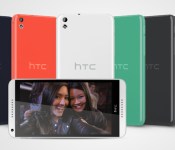
HTC’s ‘flagship mid-range’ Desire 816 packs a large display, decent cameras and LTE

That HTC “Desire 8” you’ve been seeing lately? It’s finally unveiled as the Desire 816, a “flagship mid-range” phone that promises to be competitively priced, while also offering LTE (for EMEA and Asia) and HSPA+ (up to 42 Mbps). This pretty phablet comes with a large 5.5-inch 720p display, a 1.6GHz quad-core Snapdragon 400 SoC, 1.5GB of RAM, 8GB of internal storage (capacity may vary), microSD expansion of up to a staggering 128GB and a fixed 2,600mAh battery. You’ll get a decent multimedia experience courtesy of the BoomSound frontal stereo speakers (with dedicated amplifiers), along with the 13-megapixel f/2.2 main camera (with Zoe mode in HTC Sense 5.5 UI) plus the 5-megapixel f/2.8 selfie camera. These are all tucked inside a 7.99mm-thick and 165g-heavy body, which is pretty good for the size.
Interestingly, this will be the first HTC phone to take a nano-SIM, which may be able to lure a few iPhone 5c users. Ultimately, it’s all about the price, and we should know very soon given the China launch next month (likely March 18th), followed by a global launch in April.
Update: We now have some hands-on photos. Enjoy!
Fortunately, we were able to have a few brief moments with the device. The more we play with it, the more we’re impressed with the overall design. It’s constructed with unibody polycarbonate, and it’s quite comfortable to hold, even at its 5.5-inch size. Interestingly, HTC opted for a shiny backside while its sides have a matte finish. Another nice touch to the phone’s design is, interestingly enough, in the side buttons; the power and volume buttons are located on the left side of the device, and the side of each button has a shiny beveled finish that adds a little extra bit of elegance.
Brad Molen contributed to this post.
Filed under: Cellphones, Mobile, HTC
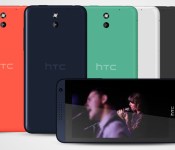
HTC’s Desire 610 joins the affordable LTE smartphone party

Joining HTC’s “flagship mid-range” Desire 816 at MWC is this smaller, but similar-looking Desire 610. As the cheaper model of these two LTE phones, many things have been downsized a little here: There’s a 4.7-inch 960 x 540 display, a 1.2GHz quad-core Snapdragon 400 chip, 1GB of RAM and a fixed 2,040mAh battery. The cameras are also more modest, with the main one sporting an 8-megapixel sensor with f/2.4 aperture, and the front imager featuring a 1.3-megapixel sensor. Both can only handle 720p video recording. On the flip side, the Desire 610 has preserved some of the goodies from its bigger sibling: microSD expansion (but up to 64GB instead of 128GB) on top of the built-in 8GB of space, BoomSound stereo frontal speakers, nano-SIM support and LTE radio for either EMEA or Asia.
There’s no pricing info at the moment, but knowing that the Desire 816 will be priced extremely competitively, here’s hoping that the Desire 610 will cost a tad less than Huawei’s counterpart, the €249 (about $340) Ascend G6 4G. Expect this device to arrive in Europe sometime in May.
Filed under: Cellphones, Mobile, HTC
Google and LG Working on Android Smart Watch Set for June Reveal
Google and LG are working on a smart watch that will likely be unveiled at the Google I/O developer conference in June, reports CNET. Google will reveal details on the device’s operating system in advance of the hardware announcement, giving developers time to create apps for the device’s retail launch.

Google’s smart watch endeavor will mirror its Nexus line of mobile devices, with Google providing the software and a manufacturer partner designing the hardware. Google is said to be working with LG on the smart watch, continuing a partnership established with the development of the Nexus 4 and Nexus 5. Similar to their work on the Nexus devices, Google will lead the marketing and sale of the smart watch, while LG will focus on developing the hardware.
Google’s smart watch will be powered by a version of Android that will integrate the company’s Google Now voice assistant and search feature. The Wall Street Journal also adds that Google’s smart watch will be compatible with a variety of Android devices, setting it apart from other smart watches such as the Samsung Galaxy Gear and Gear 2.
Apple is rumored to be working on its own iWatch smart watch that could debut later this year. Recent reports suggest the device may include advanced sensors to track several health-related functions, such as blood glucose and hydration levels. Other rumors also suggest that Apple is developing Healthbook, an iOS 8 app that would utilize both the iPhone and iWatch for monitoring health statistics like weight, heart rate, calories and step counts.
     |
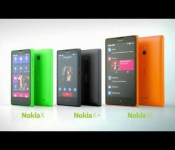
Nokia debuts Android-powered X, X+, and XL
All eyes were pointed at Nokia during Mobile World Congress for a glimpse at the long awaited “secret” Android powered devices the company was said to be working on. These were considered a last gasp effort at exploring Android before being absorbed by Microsoft. However, it seems that the tactics extend far greater than just an experiment with Android.
Nokia has just announced the Nokia XL which has a huge 5-inch IPS display, available in early Q2 of 2014 to over 109 growing markets in Europe.
With CEO Stephen Elop reinforcing that the flagship products are still their Lumia lineup and therefore Windows Phone (obviously), it seems Android is part of a strategy to offer lower-end devices to extend the reach of Microsoft’s services, as the Nokia X lineup will be priced below the Lumia offerings. Nokia XL is running an AOSP build of Android and you can expect it to be preloaded with all of Microsoft’s cloud services.
Rather than introducing just one model at Mobile World Congress, Nokia has delivered no less than three devices: Nokia X, X+, and XL. Save for very minor details, the first two are nearly identical to each other.
The basic specifications for the three breaks down as so:
Nokia X
- 4-inch (800 x 480) display
- 3-megapixel rear camera with fixed focus
- 1GHz dual-core Snapdragon S4 processor
- 512MB RAM
- 4GB internal storage (microSD expansion)
- Bluetooth 3.0
- Also available in dual-SIM
Nokia XL
- 5-inch (800 x 480) display
- 5-megapixel rear camera with fixed focus
- 1GHz dual-core Snapdragon S4 processor
- 768 MB RAM
- 4GB internal storage (microSD expansion)
- Bluetooth 3.0
- Also available in dual-SIM
It is worth pointing out that Nokia makes no references to the particulars of Android and that the devices do not feature any Google Play services or Google apps. Nokia has opted, as their wont, to include their own services and app selection.
The Nokia X will go on sale immediately, starting at EUR 89*** and rolling-out in Asia-Pacific, Europe, India, Latin America, the Middle East and Africa. The Nokia X+ and Nokia XL are expected to roll out in these markets starting early second quarter, priced at EUR 99 and EUR 109, respectively.
The post Nokia debuts Android-powered X, X+, and XL appeared first on AndroidGuys.
Fujitsu’s working on another senior-friendly smartphone for Europe

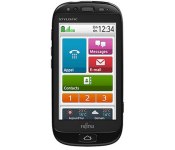
Fujitsu’s evidently so impressed with how its luddite-friendly Stylistic S01 smartphone has performed in France, thanks to a deal with local carrier Orange, that it’s ready to start plugging a follow-up handset. Only, the company doesn’t have a clue on specifics just yet, but we’ll award a few points for enthusiasm, we guess. All we know of the Stylistic S02, assuming that’ll be the device’s name, is that it’s “expected” to wield NFC and LTE chips, an “energy-saving display” and a processor of the quad-core variety. Plans are to launch the smartphone aimed at “mature users” in a number of European locations this autumn. Not a lot to talk about, we know, but Fujitsu had to announce something phone-related at MWC. Otherwise, people’ll just think it makes tablet concepts with scaly touchscreens.
Filed under: Cellphones, Mobile
Source: Fujitsu

The first available Tegra 4i smartphone will cost around €200 (hands-on)

Sorry LG: you may have trotted out the G2 mini yesterday, but yours won’t be the first Tegra 4i device to hit store shelves. NVIDIA says that distinction belongs to the Wax, a newly-revealed handset from French phone maker Wiko that should launch in Europe “within weeks” for around €200. We just spent a few frenzied moments with the Wax at MWC, read on for our first impressions.
Like the G2 mini, the Wax packs a 1.7GHz Tegra 4i chipset with 1GB of RAM and integrated LTE support. That’s about where the similarities end. The Wax’s plastic frame feels incredibly light without dipping into chintziness, a balance that even huge OEMs have trouble nailing. Meanwhile, an 8-megapixel shooter sits high on its back… though picture quality wasn’t anything to write home about. Thankfully, the Wax pulls ahead of LG with its 4.7-inch 720p display. Colors were a bit anemic compared to other screens we’ve seen on mid-range devices, but squeezing those extra pixels in there makes a world of difference.
While LG was deadset on replicating the G2′s features on a modestly-specced phone, Wiko ran with a stock version of Android 4.3 that seems happy to let the hardware shine through. It’s always a little tricky to get a feel for how well a device works in situations like these, but the Wax tackled most of the tasks we threw at it (think opening up apps, swiping through photos, and loading websites). NVIDIA claims it’s capable of delivering “2X the performance” of the more mainstream Snapdragon 400, but don’t let the label fool you. The company ran with less powerful Cortex A9 CPU cores in the 4i, so it won’t be quite as snappy as the full-blown Tegra 4 devices you may have come across in your travels.
Filed under: Mobile
Hands-on with Nokia’s X family of Android smartphones (video)

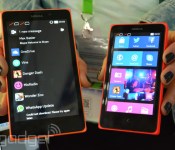
A couple of years ago, we would’ve said that the day Nokia announced an Android device was the day Hades froze over. The hour has come, however, and it’s only slightly chilly this morning. The Nokia X is the company’s inaugural Android-based devices — three of them, in fact — although it’s been tweaked a little bit to fit Microsoft’s and Nokia’s preferences. The devices are known as the X, X+ (pictured above) and XL (pictured after the break), each of which differed by only a small number of factors; and at a cost of 89 euros ($122) for the X, 99 euros for the X+ and 109 euros for the XL, the family fits roughly in-between the Asha and Lumia series in terms of pricing and functionality. The X will be available immediately in growth markets (sorry, enthusiasts in the US, Korea and Japan, it won’t be heading to your neck of the woods through official channels), while the X+ and XL will come later in the second quarter and will come in white, black, cyan, green, red and yellow.
On the outside, the X and X+ both look a lot like a 4-inch version of the Asha 503, with the same matte polycarbonate chassis but without the transparent crystallic case surrounding it. It’s not too tiny that it disappears in your hands, but it’s also not too big to be overwhelming (unless you love larger devices, that is). At 10.4mm thick, it’s not an incredibly thin device but its smaller size helps ensure that it’s still a comfortable fit. (The XL is 10.8mm thick and offers a 5-inch display with the same resolution and 5MP rear camera along with a 2MP front-facing camera; we’ll have more impressions of the XL shortly.)
The phone itself is certainly a basic device, and it shows on the hardware side: the X sports a 4-inch IPS LCD WVGA (800 x 480) display, 3MP fixed-focus camera, a 1GHz dual-core Snapdragon processor, 1,500mAh removable battery, 4GB of internal storage, a microSD expansion up to 32GB and 512MB of RAM; the X+, we’re told, tacks on another 256MB of RAM and comes preloaded with a 4GB microSD card. For an inexpensive pair of devices destined for emerging markets, however, we doubt anyone will complain about the lack of premium specs. We’ve got a gallery of pics below, along with more of our impressions of the Android interface.
Of course, the most intriguing part of the device is the user interface itself. The X family uses a forked version of Android 4.1.2 that uses the standard AOSP but doesn’t have access to Google’s suite of services (such as the official Play Store, Gmail or other core apps). Nokia wants to ensure that the device is focused on Microsoft Cloud services such as Skype (the X will come with a free month of unlimited international calls), OneDrive and Outlook, and it also throws in features like Here Maps, MixRadio and so on. We imagine that putting the focus on these services was the only reason Microsoft would greenlight the project — since this is destined for developing countries and emerging markets, it makes sense that Microsoft wants to get its foot into as many doors as possible.

So what does a Nokia Android UX actually look like in real life? Not surprisingly, it’s a lot like Windows Phone. The X launcher consists of a series of neatly lined-up tiles, although it’s possible to add folders if you’re overwhelmed by apps. Nokia claims that the X reflects the company’s design heritage, and we have to agree — despite its Android framework, it looks and feels very much like a Nokia device. The X also features a menu off to the side called Fastlane (which will be a familiar term for N9 and Asha users), which is the X’s version of a notification menu and logs your favorite/most-used apps, nearly all of your activities, open apps and background processes on the same page. It sounds like a cluster of madness, but the company fortunately kept it looking pretty clean.
Since Nokia’s running the show for all of the core apps, none of them actually look like the way Google has intended. One of our favorite touches was the clock, which Nokia basically copy-and-pasted from the N9. It also includes a Nokia-designed keyboard which even includes swiping gestures (a la Swype or SwiftKey). Third-party app stores and a file manager are also pre-installed. And although it doesn’t use the official Play Store, the X will come with the Nokia Store preloaded. This Store is supposed to feature plenty of Android apps, but they’re specially curated by the company. When asked how particular they are, reps just told us that it’s made things easy for devs: it’ll be a matter of slapping in a few lines of new code into the same APK as they use for the standard Android build, submitting it to Nokia and then finally getting certified by the company. But if the app you’re looking for is nowhere to be found in the Store, a screen pops up with suggestions for other third-party app stores which should feature that particular title. Or, if that doesn’t work, nobody will be able to stop you from sideloading APKs into the phone for your personal use. Since the Nokia UX is simply built on top of AOSP, reps tell us that anything that’s possible within the AOSP is technically possible to do on the X (think launchers, ROMs, widgets and so on).

Will this version of Android get updated, though? It’s never easy to say even for standard Android phones, much less one forked by Nokia. We’re told that it will indeed be updateable (based on consumer need), and individual services can be updated as well; we’d like to give the company the benefit of the doubt, but the reality is that if it’s not successful, there’s nothing preventing Nokia from pulling the support plug.
Color us completely intrigued by the X. As long as you don’t mind the user experience being kept under Nokia’s control, it’s definitely a fun phone to play with. We’ll have to wait until our official review to offer a final judgment, but Nokia’s new smartphone is fun, modern and colorful. We’re still marveling that this kind of discussion is even taking place right now, but it’s fantastic to see the “adventurous” side of both Microsoft and Nokia.
Filed under: Cellphones, Wireless, Mobile, Microsoft, Nokia, Google
Intel promotes its latest smartphone chips with some carefully chosen benchmarks

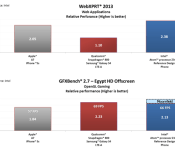
It’s now two years since we first clapped eyes on an Intel-based smartphone, and yet we’re still waiting to see something compelling. If we’re able to trust Intel’s in-house benchmarks, however, then the wait could be over. The publicity slides copied below suggest that the company’s latest dual-core Merrifield Atom smartphone processor (which we last saw at Computex 2013) can match or even beat the current top dogs of the mobile silicon world, namely Apple’s A7 and Qualcomm’s Snapdragon 800. To some degree this isn’t totally implausible: After all, Merrifield (and its newly announced quad-core big brother, Moorefield) have the benefit of the same ultra-efficient 22nm silicon that has benefitted Bay Trail tablets, alongside a cutting-edge Rogue GPU from Imagination Technologies. On the other hand, Intel is comparing Merrifield and Moorefield to rival chips that are already well into their life cycles, and that needs to be taken into account. Moreover, from our own efforts at comparing Android gaming performance across devices, we suspect that raw, benchmark-able performance isn’t everything — Intel also has to contend with a lack of optimization among current Android games and apps. The only reliable test will therefore be a real-world one, and so we’re currently digging around at MWC to find out long it’ll be before we can get hold of a new Atom-based handset that we can actually use.
Filed under: Cellphones, Mobile, Intel

