



Google expands Nexus 5 and Nexus 7 sales to more European countries

Google may have wowed the world yesterday with the introduction of Android Wear, but it turns out it also had some Nexus-related news tucked away too. Already available in 13 countries around the world, the search giant has quietly expanded sales of the Nexus 5 and Nexus 7 across Europe, listing them on the Play Store in eight new markets. These include Austria, Belgium, Denmark, Finland, Ireland, the Netherlands, Portugal and Sweden, giving customers the option to bypass operators and grab themselves an unlocked Nexus device direct from Google. With the Chromecast finally on sale outside of the US and an influx of Android-powered wearables on the way, Google’s finally making it easier for Europeans to start investing in its expanding product family.
Filed under: Cellphones, Tablets, Mobile, Google
Via: Android Police
Source: Google Play Support
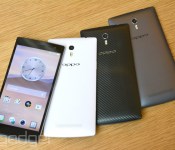
Oppo Find 7 is the world’s first phone that can take 50MP photos (video)

We’ve seen the teasers and we’ve seen the leaks, so it’s about time to see the real thing. Oppo has finally unveiled the Find 7 in Beijing just now, and as promised, this Android 4.3 device really can take 50-megapixel photos! But as with many things in life, there’s a catch here: the sensor is actually a 13-megapixel Sony IMX214 CMOS, so it’s a software trick. Still, the results we saw earlier were surprisingly good, so read on to check out how it’s done and what the rest of the phone is like.
The Find 7 comes with Oppo’s latest image signal processor dubbed Pure Image 2.0, and this is what enables the 50-megapixel “Super Zoom” creation: the camera takes 10 consecutive shots very quickly, and then it automatically picks four best shots to combine them into a 50-megapixel still. Our 8,160 x 6,120 sample shots ended up being around 10MB large each, and as you can see above, there’s a lot of detail preserved even up close, which puts the Xperia Z1′s 20-megapixel camera to shame. While Super Zoom is a software-based feature, the 1/3.06-inch IMX214 sensor also deserves credit for its 480 megapixel-per-second bandwidth, which is 33 percent faster than the 13-megapixel CMOS chip on the Find 5. And of course, the bright f/2.0 aperture helps, too.


Other notable camera features include 4K video recording at 30 fps, slow-motion video at up to 100 fps, long exposure for up to 32 seconds and HDR-capable GIF creation. You’ll also be able to use some of these features with the 5-megapixel f/2.0 front-facing camera.
The 5.5-inch Find 7 will come in two versions. The $499 Find 7a (aka Find 7 Lite in China) packs a 2.3GHz Snapdragon 800, 2GB of RAM, 16GB of internal storage, a 2,800mAh battery and a 1080p display. The more premium $599 Find 7 features a faster 2.5GHz Snapdragon 801, 3GB of RAM, 32GB of storage, a 3,000mAh cell plus a quad HD (2,560 x 1,440) display. This makes Oppo the second manufacturer to offer a quad HD phone, following sister company Vivo’s Xplay 3S.
Apart from the above points plus the different back covers (the Find 7′s has a carbon fiber texture), the two models are otherwise identical. You get Gorilla Glass 3, microSD expansion (up to 128GB), micro-SIM slot, LTE radio (for Chinese, European and US models; 3G only for Indonesian model), a pulsing “skyline” notification light underneath the chin, award-winning MaxxAudio plus Dirac HD audio enhancement and “VOOC” rapid charging (you go from zero to 75 percent in just half an hour). About the last point, you apparently won’t have to worry about potential heat issues while charging, as the Find 7 is built with five layers of thermal protective coating, and the solid titanium-aluminum alloy frame — crafted with nano-injection molding — also helps dissipate heat.

The Find 7 will be shipped with Color OS 1.2 based on Android 4.3, and it’ll come with many familiar features that are already on the N1. These include weather animation on the home screen, gesture shortcuts (including torch and camera activation even when the screen is off) and themes. Do look up our N1 review if you want to know more about Oppo’s custom ROM. At the time of publishing this article, we have yet to hear any news about CyanogenMod development for the Find 7, so stay tuned.
Interested folks outside China can order a Find 7a both online and offline come mid-April (there will be a $50 early bird discount from some retailers), or you can wait for the advanced Find 7 due May or June. If you happen to be in Beijing, CEO Tony Chen will be personally selling some units in one of the local shops tomorrow. Now that’s a hands-on boss.
Filed under: Cellphones, Mobile

Pocket’s read-it-later service adds international flavor with six new languages

Despite how far the internet has come, it hasn’t quite conquered the language barrier. The devs behind Pocket know this and have added new languages to hopefully make the delayed-reading app a bit easier to use if English isn’t your native tongue. To wit, the application is now available in French, German, Italian, Japanese, Russian and Spanish. Those languages account for some 22 percent of what its users speak and, according to the company, this is just the beginning of its expansion to a broader audience. Only time will tell if that’ll include Klingons, though.
Source: Pocket
Grocery King releases free version, no coupon needed
If you’re tired of going to the store three times a week to purchase all the good stuff you forgot on your initial visit, Grocery King aims to end this with a new free version of its existing shopping list app.
Grocery King offers a highly customizable shopping list experience that learns from the user. The more you use it, the better it gets.
This list is also more than your average list, as it lets users create them by picking from hundreds of photos of everyday items in 24 different categories. Grocery King aims for a more visual and fun experience to give a more natural feeling to creating your shopping lists.
Many additional features help differentiate Grocery King from the other shopping list apps available. The app offers cloud-based sharing and syncing of lists to enable real-time coordinated shopping with friends and family, inventory control of current items within the app, price tracking across previous shopping history and price comparison between stores (managed manually) and the ability to store their retailer loyalty cards, coupons and gift cards within the app.
Available on the Google Play store for the past four years, Grocery King was the number one shopping app for two years in a row and still ranks within the top five paid apps in the “Shopping” category even four years later. The free version is ad-supported and has some feature limitations.
The post Grocery King releases free version, no coupon needed appeared first on AndroidGuys.
Skype version 4.7 for Android brings significant battery savings
“Imagine being able to leave Skype running on your phone all day without having to worry about your battery life.”
That’s how Skype are promoting their latest version of the popular app, promising to rid the battery woes that has plagued the app for sometime.
Version 4.7 of Skype sees improvements that aggressively tackle the issue of battery usage, to a point where Skype claim leaving the application running in the background all day will go unnoticed by users when it comes to battery used.
To achieve such drastic improvements, Skype have had to make some fundamental under-the-hood changes including turning off instant notification of messages in group chats. They advise:
- In the near future, you will be able to receive group chat messages instantly without additional battery impact.
- If you can’t wait for that to happen, we’ve added a new setting to let you keep group chat notifications. Go to Settings > Notifications > check the “Sync group messages in the background” box.
In addition, version 4.7 of Skype includes a workaround for a KitKat bug which caused a ‘runaway’ process when the camera was synced in the background (fantastic news), as well as a fix for audio and video calling on tablets that do not have Bluetooth.
The update is live in the Google Play Store right now.
The post Skype version 4.7 for Android brings significant battery savings appeared first on AndroidGuys.

New Skype for Android promises not to drain your battery

If you’re anything like us, then you know how valuable it is to have great battery life on mobile devices. Which is why a number of apps, like Skype, need to be monitored a little closer than others — in particular, ones that are constantly running in the background. Knowing this, Skype’s releasing a fresh version, 4.7, of its Android application that changes the way it handles your smartphone’s or tablet’s battery. “We are introducing aggressive battery life savings that will allow most of our users to leave Skype running without noticeably affecting battery life,” said Skype in a blog post.
In order to make this happen, message notifications in group chats had to be turned off by default, though there is an option to flip the switch for folks who would like to continue using them. According to Skype, we’ve only seen the beginning, as it expects to further improve battery usage in future versions of its mobile app. We’ll have to see it to believe it, but hopefully it turns out to be true — because mo’ juice, mo’ Flappy Bird.
Filed under: Cellphones, Tablets, Internet, Software, Mobile, Microsoft, Google
Source: Google Play
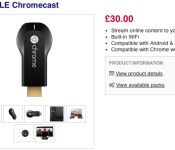
Big UK retailer lists Chromecast ahead of an official launch

Google’s Sundar Pichai said that Chromecast would be available in many more countries this month, and it now appears that this worldwide launch could be close at hand. Engadget reader Martin has noticed that big UK retail chain Currys is already listing the TV media stick, with nary an official announcement in sight. The company says it’s out of stock, but there’s a plausible £30 ($50) price tag in place. While the entry doesn’t give any clues as to when the Chromecast would reach the country, Google has less than two weeks to make good on its word — we’d reckon that the device arrives sooner rather than later.
[Thanks, Martin]
Filed under: Home Entertainment, Peripherals, HD, Google
Source: Currys

Google unveils its vision for smartwatches, launches Android Wear developer preview
Many have hoped to shape the smartwatch revolution, taking their vision to Kickstarter and the like, but today Google finally joined the game announcing Android Wear, a version of the operating system for wearable devices.
Google launched two videos that introduce Android Wear, which extends Android into wearables to provide “useful information when you need it most” and more.
Watches are good at telling time, but imagine having useful, actionable information there precisely when you need it. Automatically.
As with everything Google launches, design is key, and Android Wear also does what everyone has dreamed of, integrating Google Now on your wrist. We even called this about a year ago.
Running Android and using Google Now, you’ll be able to keep time and get weather and news updates, ask questions, track your workouts in real-time, get automatic, passive reminders and notifications from your smartphone apps, just as current players in the market are doing.
As part of the announcement, Google launched a developer preview of the Android Wear SDK that’s coming later this year. Sundar Pichai, Google’s senior vice president of Chrome, Apps, and Android, actually teased this about week ago at SXSW. The Android Wear Developer Preview lets developers create wearable experiences for their existing Android apps and lets them see how they will appear on square and round Android wearables. Once the official SDK launches later this year, developers will be able to enable “even more customized experiences” on wearable devices.
Google is already working with several partners, including Asus, Broadcom, Fossil, HTC, Intel, LG, Mediatek, MIPS, Motorola, Qualcomm Samsung, with Android Wear watches planned to launch later this year.
Surprisingly, there was no mention of other types of wearables, such as Google Glass, but it would make sense if Android Wear is in its future.
via Google+, Android Wear
The post Google unveils its vision for smartwatches, launches Android Wear developer preview appeared first on AndroidGuys.

The new Sonos app makes music discovery simpler with universal search

Here’s the deal: streaming music services are great, but thanks to various content licensing deals with labels, there’s no one-stop shop to cover all of your musical bases. That’s where Sonos comes in with a handy solution by way of its new app. The refreshed Controller app for Android and iOS now includes a universal search feature that indexes your multiple streaming accounts to make finding and listening to Tool, or that haunting Banks track, less of a painful experience. Of course, you’ll need a Sonos player to partake in this game of streaming musical chairs, and some patience — the app won’t be released until sometime this spring. Though, Android users can get in early and preview the pared-down, three-pane UI now by signing up for the beta.
Filed under: Wireless, Internet, Mobile
Via: GigaOm
Source: Sonos

IUNI U2 is palm-friendly Xiaomi competitor, packs an UltraPixel front camera

When Gionee’s spin-off online mobile brand IUNI — taken from “I am unique” — launched back in November, it vowed to go right after Xiaomi with a similar sales strategy, but it’s also differentiating itself by delivering “stunning” hardware design and “elegant” UI at the same time. Earlier today, the Chinese company finally showed off what it’s been working on: the U2. This 2.2GHz Snapdragon 800 device is positioned as the best single-hand metallic phone, featuring a 4.7-inch 1080p LTPS display — similar to that of last year’s HTC One — tucked within a 65mm-wide aluminum body, which is narrower than the Huawei Ascend P6 and even the Moto X. Oh, and it’s cheap, too: the 32GB version with 3GB of RAM is just CN¥1,999 (about $320) unsubsidized, whereas the 16GB version with 2GB RAM is just CN¥1,799 (about $290).
Even though the U2 is a budget phone, a lot of work has been put into its design. The “double curve” design on the back reminds us of the palm-friendly Moto X, but appearance-wise, it’s very much like a distant cousin of the HTC One due to the similar zero-gap aluminum construction. However, IUNI pointed out that due to the 10-degree folds at the top and bottom, along with the shinier “3D polish” on the chamfer, the yield is just 48 percent from the 90-minute process at BYD’s production lines. IUNI admitted that this costly process is rather insane for a budget brand, but this is where they see an opportunity to fight other Chinese online brands — most of which sell plastic devices.

On the software side, the IUNI OS claims to be the cleanest Android ROM you can get (at least in China), as it won’t come with any pre-loaded third-party apps that tend to help generate revenue for manufacturers. The OS itself is also designed in a way to minimize the number of swipes and taps for most common actions, but we’ll only know how effective this is once we have spent some time using it.
Overall, it’s pretty exciting to see a new player injecting fresh energy to the Chinese budget market. While most vendors are offering cheap product by cutting corners, IUNI is really trying to offer a decent phone that makes sense to users, while still able to sell it in the same price range. The U2 has the most efficient 16-megapixel camera, the fastest front-facing camera and it is great for single-hand usage. Sure, it only has HSPA+ instead of LTE, and the battery’s just 2,200mAh, but for just $320 unsubsidized, we’re not complaining at all. If you live in China, you can already head over to IUNI’s website to leave a deposit for the 32GB version of the U2. Sadly, there’s no word on global availability, but we’ll keep an eye out for further news.
Filed under: Cellphones, Mobile
Source: IUNI

