



IFTTT brings its recipe-based app automation to Android

iOS users have been privy to IFTTT’s (If This Then That) formulaic behaviors for automating app tasks on their mobile devices. Well as of today, the Android faithful can get in on the action too. The outfit’s software is now available in Google Play, bringing with it photo, call, notification, SMS, location and device settings channels specific to Google’s OS. What does that mean for you? Well, you can tweak the setup to have your ringtone silenced when you connect to the office WiFi, automatically set your latest Instagram snapshot as your device’s wallpaper and get a push notification if you’ll need an umbrella tomorrow. Selecting all of those “recipes” can take some time, so we’ll let you hop to it via the source link down below.
Source: IFTTT (Google Play)

Now you can play XCOM: Enemy Unknown on Android, too

Android gamers who’ve been yearning for XCOM‘s deep, turn-based tactics just got their wish: 2K has released a version of XCOM: Enemy Unknown for Google’s mobile platform. Much like last year’s iOS edition, you’ll get to fight off invading aliens and build your bases in an interface optimized for touch. This is one of the pricier Android games on the market at $10, but our pals at Joystiq are already fans of the mobile version. It’s likely worth the cash if you’re looking for something engrossing to play on your spring vacation — especially if you can’t get enough of it on your PC or console.
Filed under: Gaming, Software, HD, Mobile, Google
Via: XCOM (Twitter), Joystiq
Source: Google Play

XCOM: Enemy Unknown is coming to soon to Google Play

XCOM just took to their Twitter page to announce that the awesome game that is XCOM: Enemy Unknown will be hitting the Google Play Store and Amazon Appstore very soon.
The Award Winning XCOM: Enemy Unknown is coming to soon to Google Play and the Amazon Appstore! pic.twitter.com/5gFpPvPeCx
— XCOM (@XCOM) April 22, 2014
Whilst the extend of the tweet only mentions that it’s coming and nothing regarding a timeframe, the fact the you will soon be able to enjoy the awesome XCOM: Enemy Unknown experience on an Android device is awesome news in itself.
The post XCOM: Enemy Unknown is coming to soon to Google Play appeared first on AndroidGuys.
Android smartphones ranked by pixels per inch

It used to be a battle of Megapixels between smartphones to showcase their superiority in the market, but now that has moved over to Pixels Per Inch (PPI), manufactures are now looking at ways of packing more pixels into their displays.
PPI contributes to many factors, but most significantly it is how sharp and crisp the display looks. There is a certain amount of pixels per inch that the human eye can distinguish and this varies given the size of the display, and achieving a higher PPI count means users aren’t able to see those individual pixels during normal operating conditions.
We’ve taken the latest smartphones available on the market and ranked them in order of their PPI count to give an idea who is winning the battle of pixels.
Does PPI count of a device play a significant factor when purchasing your Android device? Let us know in the comments below.
The post Android smartphones ranked by pixels per inch appeared first on AndroidGuys.
Facebook buys smartphone fitness-tracking app Moves

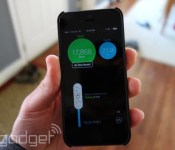
Facebook may already be tracking your usage to serve you ads, but how would you feel if it was able to log your movement? That’s exactly what could be on the cards after the company confirmed it’s bought Moves, the always-on fitness-tracking app that automatically records your daily activities using your smartphone’s sensors. Moves’ mission? It says it’s joining Facebook to “work on building and improving their products and services with a shared mission of supporting simple, efficient tools for more than a billion people.” Zuckerberg and co. intend to keep the iOS and Android apps independent, and the Moves team says there are currently no plans to “commingle data with Facebook.” The social network employs a similar policy with Instagram and Whatsapp, which is no surprise given their huge user numbers and combined $20 billion price tag.
Filed under: Software, Mobile, Facebook
Source: Moves
Snapdragon 801 powered OnePlus One officially unveiled, starts at just $299 unlocked
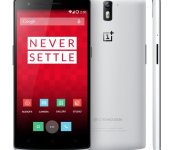
After months of teasing and gathering attention, OnePlus has finally made an official announcement of their first smartphone – the OnePlus One. This device is powered by a 2.5GHz Qualcomm Snapdragon 801 processor, 3GB of RAM and 16GB or 64GB of internal storage. The most impressive thing about the OnePlus One is its aggressive pricing structure. You can get yourself a 16GB version for $299 and 64GB version for $349. It also comes with stylish back cover options known as StyleSwap Covers which are being offered in wood, bamboo, denim and kevlar trims.

OnePlus One White Version
OnePlus One Specifications
- 5.5 inch LTPS IPS LCD display, 1920 x 1080 pixels & Gorilla Glass 3
- 2.5GHz quad-core Qualcomm Snapdragon 801, Adreno 330 & 3GB LP-DDR3 RAM
- 16GB or 64GB of internal storage
- 13MP Sony camera sensor (IMX214), dual-LED flash, 4K video recording, 5MP front-facing camera
- Android v4.4 KitKat based CyanogenMod 11S
- LTE, WCDMA, dual-band Wi-Fi ac/b/g/n, Wi-Fi Direct, Bluetooth v4.1, NFC, A-GPS & microUSB v3.0
- Stereo speakers, tri-microphone noise cancellation microphones
- 152.9×75.9×8.9 mm, 3100 mAh
- Bamboo, Wood, Denim & Kevlar trim for back covers

OnePlus One Battery
It is evident from the hardware and software specifications that the OnePlus One is a ‘no compromise’ smartphone which competes with all the top-end smartphones of 2014 such as Samsung Galaxy S5, Sony Xperia Z2 and HTC One M8 but is being offered at just half the price. The device will be available through an ‘invite only’ basis in Austria, Belgium, Denmark, Finland, France, Germany, Hong Kong, Italy, Netherlands, Portugal, Spain, Sweden, Taiwan, UK and the US to contain the rush. The device availability starts from mid May.
Earlier, only Nexus smartphones were known for their price to performance ratio but if the OnePlus One performs as claimed, it will beat the Nexus line-up of smartphones.
Via: Tom’s Hardware
//<![CDATA[
ord = window.ord || Math.floor(Math.random()*1E16);
document.write('’);
//]]>

Samsung’s Galaxy Tab 4 lineup reaches the US on May 1st

Americans no longer have to splurge on the high-end Galaxy Tab Pro or Note Pro if they want a modern Samsung tablet — the more affordable Galaxy Tab 4 range is headed to the US. WiFi versions of the Tab 4 7.0, 8.0 and 10.1 should hit shelves on May 1st at respective prices of $200, $270 and $350. Travelers craving cellular data can expect LTE variants from AT&T, Sprint, T-Mobile and Verizon sometime this summer. Pricing hasn’t surfaced for these 4G models, but it’s safe to presume that they’ll carry a premium over their WiFi-only counterparts.
The devices don’t carry the biggest bang for the buck. The Nexus 7 offers a sharper display and overall faster performance, for example. However, the two largest Tab 4 WiFi models cost significantly less than their Tab 3 equivalents did when new — they’re potentially good bargains if you’re not concerned about raw performance.
Filed under: Tablets, Samsung, Verizon, Sprint, AT&T, T-Mobile
DoubleTwist’s latest Android tweak brings Google Play Music to Apple TV

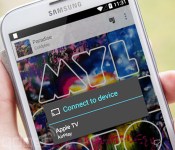
Google’s mobile-streaming tech has a lot going for it, but listening to music stored in Mountain View’s cloud is still limited to a handful of home devices. AirPlay-compatible gadgets, however, are a probably a bit more common than the Nexus Q, Chromecast and Sonos systems are, and developer doubleTwist’s latest project acts as a bridge between the two ecosystems. The outfit recently released “AirPlay for Android,” which is exactly what it sounds like: the tweak open’s the search giant’s media-streaming to AirPlay devices. The rub is that your device running Google’s mobile OS has to be rooted for the hack to work. First, grab and install the aforementioned APK from the dev’s blog, launch Google Play Music (GPM) and hit the Cast button. From there, you need to grant root access to the app, force-stop it and then relaunch. Viola! AirPlay devices on your wireless network should populate the list of compatible targets.
Because this (like so many of doubleTwist’s other projects) is essentially a hack, the dev warns that you may have to force-close GPM now and again to sidestep Google’s restrictive whitelist for approved devices. DoubleTwist doesn’t say if AirPlay for Android will work for apps other than GPM, but given how Casting functions, we wouldn’t rule the possibility out.
Filed under: Home Entertainment, Wireless, Mobile, Google
Source: doubleTwist
Meet the One, OnePlus’ $299 Nexus killer

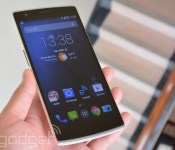
Rarely do we see a tech startup spending five months actively hyping up an unborn product; and when we do, most of them end up being vaporware. Luckily, that’s not the case with OnePlus. Today, the Shenzhen-based company has finally unveiled its first smartphone, the One (not to be confused with the HTC One). While the device’s impressive specs have already been listed in detail beforehand, OnePlus had remained tight-lipped about the actual prices (unsubsidized) until today: $299/€269 for the 16GB model, and $349/€299 for the 64GB flavor; both due mid to late May. This aggressive pricing is obviously going right after the Nexus 5 ($349 for 16GB, $399 for 32GB), but is this too good to be true?

Let’s take a look at the specs again. As promised, the One packs Qualcomm’s latest SoC, the Snapdragon 801 with a quad-core 2.5GHz CPU, Adreno 330 GPU and 3GB of RAM. The display uses JDI’s 5.5-inch 1080p IPS LCD panel, and it’s protected by a layer of Corning Gorilla Glass 3. You’ll also find a built-in 3,100mAh battery, a speedy 13-megapixel f/2.0 camera (Sony Exmor IMX214 sensor with a 6-lens module and dual LED; 4K video; 720p slow-motion at 120 fps), a 5-megapixel wide-angle selfie cam, loud stereo speakers (tuned by JBL) and tri-microphone with noise cancellation. These are all flagship-level features, though we would’ve liked to see microSD expansion, USB 3.0 and Quick Charge 2.0 here.
On top of the usual NFC, dual-band WiFi, Bluetooth 4.1 plus GPS radios, the One’s international version also supports LTE bands 1/3/4/7/17/38/40, as well as WCDMA bands 1/2/4/5/8. Yep, that’s pretty much the whole world covered.
The external design of the phone is just as nice. In fact, the One is built by CEO Pete Lau’s former company, Oppo, so you’ll spot some similarities in terms of build quality, appearance (the back reminds us of the Find 5) and ergonomics. We totally dig the subtle curves on the back that contribute to a comfortable grip, plus these shave the phone’s 8.9mm thickness down to just 4.6mm on the tapered edges, making the phone appear slimmer.

What’s more, OnePlus took one step further and applied corresponding textures onto the back of the “silk white” and “sandstone black” versions. The white one is our favorite, as its special coating — apparently made out of powdered cashew nuts — gives a “baby skin” feel, which is most noticeable when you gently stroke it with your cheek. If you do get bored of the default covers, you’ll be able to swap them out. You do so by first pin-ejecting the micro-SIM tray, followed by somehow prying open the back cover — which we found to be quite tricky with our early production unit. As you can see, there will be a few nice genuine wooden covers, along with a denim version and a Kevlar version not shown here; though the company has yet to announce their availability.
On the software side, the One’s international version is powered by CyanogenMod 11S — the “S” indicating customization for the One — based on Android 4.4; whereas its Chinese counterpart runs on a customized Color OS from Oppo, with the main difference being the icons and some settings. For those who aren’t familiar, CyanogenMod is essentially a plain, slick Android ROM with some nice enhancements and handy customization options. While the Oppo N1 had a CyanogenMod limited edition, the OnePlus One is truly the first phone that is shipped with this popular ROM and its branding on the back.
CyanogenMod alone comes with goodies like SMS encryption, themes, app privacy guard, audio equalizer, file manager, enhanced camera app and more. With CM11S for the OnePlus One, you also get screen-off gesture controls (circle for camera, “V” for flashlight and gestures for music playback; as featured on the Oppo N1), option to toggle between capacitive Android buttons and on-screen buttons, voice wakeup (activates Google Now by default) and a card-style lock screen. These all sound pretty nice, but we’ll have to see how well they fare in the final firmware.
For the record, Lau said OnePlus is open to working with other ROM makers in China, including MIUI (by Xiaomi) and Smartisan OS, in order to offer more options for his users. The international version, however, will only receive official support for CyanogenMod initially.

With the likes of Xiaomi, Meizu, Huawei, Nubia and IUNI all participating in the fierce price war in China, it may seem like there’s barely any space left for a newcomer. But OnePlus’ Lau disagrees, claiming that while the competitors offer attractive prices, they aren’t serious enough about their products in terms of design, battery life, build quality, software and camera performance.
Having seen how successful Oppo did in the overseas market via the e-commerce channels, Lau decided to give it a shot both locally and internationally by forming OnePlus, which is totally separate from his former company (with the exception of the current OEM relationship and a few common investors up top). His company’s mantra is “never settle,” in the sense that consumers shouldn’t have to settle with lesser quality and limited options for the sake of cheaper prices.
“We want to be the MUJI of the tech industry.”
“We want to be the MUJI of the tech industry, this is our direction,” Lau said, while praising the Japanese lifestyle brand’s simple yet well-made products. He added that in China, MUJI is a bit expensive for the local young consumers, so he aims to deliver MUJI quality at a lower price. While Xiaomi and similar Chinese e-commerce brands are targeting the same market, the OnePlus CEO said he’s doing it with style, as consumers are now longing for higher standards.
Lau is well known in the industry for his attention to detail. The exec confessed that his team spent almost four months just to fine tune the USB cable for the One — he wanted to perfect its texture, plug design and other small details. The same goes for the anodized bezel that surrounds and protects the screen — the former is carefully recessed by a fraction of a millimeter, which apparently took the team a few goes to get it just right. Even the camera is carefully optimized on the One: when Lau spotted this author’s HTC One (M8), he quickly grabbed it to compare camera focus and capture speeds, which turned out to be just as fast or even slightly faster on his phone — the spec sheet claims it has a 0.3-second autofocus. We’ll save the image analysis for our review later.
On the software side, Lau realized two personal requests: one is hardware-accelerated scrolling in WeChat, which is apparently missing in most other phones; and the other is a pop-out window feature in AutoNavi’s navigation app, which offers you basic navigation instructions while you switch to other apps during slow traffic. Of course, the exec didn’t forget to pimp the ability to toggle between capacitive buttons and on-screen buttons, which will no doubt please both camps. He mentioned several other sensible software tweaks, but you’ll have to stay tuned for those.

Even before his mobile days, Lau was already famous for one incident back at Oppo’s AV division, where he smashed a Blu-ray player’s logic board to, well, express his disappointment in a seemingly minor issue. This was pretty surprising to us, given how humble the man actually is.
“The circuitry wasn’t laid out neatly, and I didn’t feel good about it no matter how I looked at it,” Lau explained to this author. “We compared ours with Denon’s — theirs was laid out beautifully, but ours wasn’t. When I had a word with my team, they gave me a bunch of excuses: this would affect the performance, that would be difficult to lay out. Eventually, I went to the head of R&D and smashed the logic board on the floor, stamped on it twice.
“They then tweaked the design right away,” the exec chuckled.
As for the smartphone spec war, Lau is concerned that many competitors only care about numbers and are neglecting other important factors — most notably, software smoothness. The exec added that right now the One has the fastest processor (2.5GHz) in the market, but if his next product doesn’t, he will still ensure that it will at least have the slickest user experience, which is what users ultimately want in a smartphone. He likened this to a saying in the marketing world: if you’re selling electric drills, you should know that the consumers are actually “buying” nicely-drilled holes instead of buying just the drill.
“You can use all sorts of marketing tactics, but when you’re back to making a product, you must take users’ actual needs into consideration,” Lau said. “They are the ones who will actually use it, so they know best. You can exaggerate when you’re selling a product, but when the buyers use it and are left disappointed, they’ll still complain, right?
“Therefore products should go back to basics: the users must feel good when using our products. If the users want something, we’ll do it.”
Filed under: Cellphones, Mobile
Leaked Screenshots Show Off New UI of the LG G3

Expected to get an official reveal soon, the LG G3 has garnered a lot of attention. With the most notable rumors suggesting an ultra-high resolution screen, it seems only fair to know what interface will grace that rumored 2560 x 1440 pixel display.
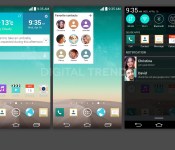
The fine folks over at Digital Trends have gotten their hands on pictures of what seems to be the new user interface that will be on the LG G3 at launch.

The new UI sports a flatter, more modern look that’s clean and lacks the “busy” feel of the UI found on the G2/G Pro 2.
It seems that everything about the UI is getting a revamp. The notification shade seems to be transparent, the quick toggles are now round instead of square, and the QSlide app icons seem to be slightly larger.
Also of note, LG is rumored to have developed a type of “concierge-style” service within the UI that will learn from your use of the phone and give you valuable information that will aid you throughout the day. If you take a look at the weather widget, you can see the service in action suggesting that an umbrella may be in order.

If the rumors are correct, the new UI is a much needed change and LG should benefit from modernizing their outdated user interface.
Source (Digital Trends)
The post Leaked Screenshots Show Off New UI of the LG G3 appeared first on AndroidGuys.
 AIVAnet