



Spotify lets you take all of your tracks offline with just one button

While Spotify’s allowed you to save music for offline playback for some time, downloading playlists can be a laborious process. Today, it’s making things a whole lot easier. As part of its latest iOS app update, the company enabled a new “Available Offline” toggle inside the Songs tab, allowing you to instantly download and then listen to your entire catalog of curated beats (tracks that you’ve saved) without the need for a connection. Android users should already see the option as part of a forced security upgrade. Once updated, you can host as many as 3,333 songs per device and keep them offline for up to 30 days — definitely enough to get you through a tedious long-distance flight.
Filed under: Internet, Software, Mobile
Source: Spotify (App Store), (Google Play)
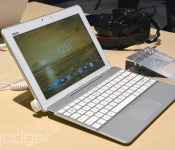
ASUS Transformer Pad refreshed with front speakers, lighter keyboard

It’s been a while since we last heard about ASUS’ Transformer Pad series, so today’s announcement of two new 10.1-inch models was a nice surprise. Starting from the higher end we have the TF303CL, which not only features Intel’s 64-bit, 1.86GHz quad-core Atom chip (Z3745), but it also supports LTE for Europe and Asia-Pacific. Otherwise, the plastic tablet packs the usual set of goodies for a decent Android tablet: a 1,920 x 1,200 IPS display, 2GB of RAM, 16 or 32GB of storage with microSD expansion, 5MP/1.2MP cameras (a downgrade from the old 8MP main imager) and a 25Wh battery. The TF303CL is also enhanced with stereo front-facing speakers, as opposed to the old single-channel speaker (but with two drivers) on the back.
A less obvious change is the removed battery in the new keyboard dock, which is for both reducing its weight — from 546g to 505g, so just 1.1kg when docked — and also for keeping the price competitive; though there’s no pricing info at the launch event. As with most ASUS tablets, this one seems to have a solid build quality, and we dig its textured shell that deters fingerprints. ASUS’ Zen UI is also a nice touch on Android 4.4 — elegant and not too heavy. Expect this device to arrive in Q3 with blue and gold color options.

ASUS also announced the WiFi-only TF103C as the entry-level refresh of the Transformer Pad line. Apart from the processor and the microSD expansion, pretty much everything else have taken the cost-down route: 1,280 x 800 IPS display, 1GB of RAM, 8 or 16GB storage options, 2MP/0.3MP cameras and a 19Wh battery. This will arrive in the coming weeks with white and black options, followed by a 3G version (TF103CG) due July. Again, no prices for now, but they will no doubt be very attractive.

ASUS Transformer Book V is a Windows hybrid laptop with a detachable Android phone

Wow, just wow. ASUS has just announced the Transformer Book V, a Windows 2-in-1 laptop with a detachable Android phone. No, this isn’t the Windows Phone-powered PadFone that we’ve been waiting for, but the package is still pretty mind-blowing. Let’s break it down. First of all, the 12.5-inch tablet/laptop hybrid part has its own Windows 8.1 brain running on Intel Core architecture. Then you have the 5-inch, ZenFone 5-like Android 4.4 phone, which is the first to run on Intel’s 64-bit quad-core Atom (Moorefield) chip with LTE radio. When docked, the phone’s Android interface is displayed within Windows 8, and you can also switch to the full Android tablet interface. In other words, you get five modes in total (hence the name): a Windows tablet, a Windows laptop, an Android phone, an Android tablet and an Android laptop.
The 0.8kg tablet part comes with a 12.5-inch HD IPS display, 4GB of RAM and a 28Wh battery that claims to offer up to 10 hours of web browsing time. In terms of storage space, the tablet packs up to 1TB for the Windows part and up to 128GB dedicated to Android as external space. As for the phone itself, we’re looking at 140g, 11mm-thick package featuring a 2,500mAh battery plus 2GB of RAM, up to 64GB of storage and 8MP/2MP cameras.
Judging by the fact that the product was kept underneath a glass case at Computex, it might be a while before we can actually buy it. We’ll keep poking ASUS until we hear more, so stay tuned.
Filed under: Cellphones, Laptops, Tablets, Mobile, ASUS
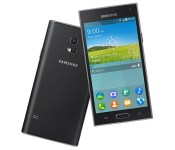
Samsung breaks from Android with its first Tizen phone

Filed under: Cellphones, Mobile, Samsung
Source: Samsung
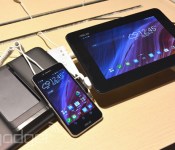
ASUS’ PadFone X goes global: still a 5-inch to 8.9-inch transformer

The ASUS PadFone X due June 6th can be considered as a slightly rugged version of the regular PadFone Infinity flagship line, but it’s only limited to AT&T customers. Luckily, for those outside the US, there will soon be a global variant dubbed the PadFone S. These two models are pretty much identical: you get the same 5-inch phone to 8.9-inch tablet transformation, and the guts include the 2.3GHz quad-core Snapdragon 800, 2GB of RAM, full HD displays, microSD slot, 13MP plus 2MP cameras on the phone (1MP front camera on the tablet) and 2,300mAh plus 4,990mAh batteries. The only differences are the 3G and 4G bands for obvious reasons, plus the wireless charging here follows the more popular Qi specifications, as opposed to PMA’s. There’s no info on pricing yet here at Computex; all we know is that it’ll arrive in select markets as early as late Q3 this year.

Also announced alongside the PadFone S are an LTE-enabled ZenFone 5 (A500KL, with a 1.2GHz quad-core Snapdragon 400) and a ZenFone 4 with a slightly newer Intel chip. Both are due some time between late Q3 and early Q4 in select markets. We’ll have more info closer to the time.
Filed under: Cellphones, Tablets, Mobile, ASUS

Samsung’s 7-inch Galaxy W blurs the line between phones and tablets

If you thought that big devices like the Galaxy Mega 6.3 were already blurring the distinctions between phones and tablets, hold on to your hat — Samsung has just erased those distinctions altogether. Its new Galaxy W (not to be confused with the 2011-era W) blends the 7-inch screen of a small tablet with a relatively compact design that lets you hold it one-handed for phone calls. This isn’t the first crossover we’ve seen by any means, but it promises to be more comfortable than truly finger-straining rivals like ASUS’ Fonepad 7 or HP’s 7-inch VoiceTab.
As with the Mega, this isn’t the flagship you might expect given the gigantic dimensions. You’ll be making do with a 720p display, a 1.2GHz quad-core processor, 16GB of expandable storage, a 8-megapixel rear camera and a 2-megapixel front cam. The W is even stuck on Android 4.3 rather than 4.4. It won’t be the cheapest device, either, as it’s selling for 499,400 won ($489) off-contract in its native Korea — Samsung is no doubt expecting customers to treat this as a two-in-one purchase. There’s no mention of an American launch, but you shouldn’t count on one when US carriers have so far been skittish about offering category-defying hardware.
[Thanks, Phil]
Filed under: Cellphones, Tablets, Mobile, Samsung
Source: Samsung (translated)

Funding push would put Reading Rainbow on phones and game consoles

LeVar Burton had no trouble crowdfunding Reading Rainbow for the web; now, he’d like your help bringing it to living rooms and pockets everywhere. His team has announced a $5 million stretch goal that, if reached, will port his literary initiative to mobile devices, game consoles and set-top boxes. Yes, that would return the program to TV (if not quite in the traditional sense) after an eight-year hiatus. The goal would also expand free student access to from 1,500 classrooms to 7,500. Burton already has over $3 million as we write this, but there’s still some distance to go — if you’re interested in putting Reading Rainbow on your kid’s Android tablet or Xbox, you’ll want to make a pledge at the source link.
Filed under: Cellphones, Gaming, Internet, HD, Mobile
Via: Polygon
Source: Kickstarter

Google wants you to (safely) search the web while driving

While phones like the Moto X let you issue voice commands without touching the device, they’re still not ideal for driving; if you search for something on the web, you’ll still have to take your eyes off the road to see the results. That could change in the near future, Android Police claims. Google is reportedly testing a new Android feature, nicknamed KITT, that would help you focus on your driving even as you scour the internet. When you’re in a situation where you can’t pay much attention to your phone, an always-on voice command system would walk you through every step of performing common tasks, whether you’re searching the web or sending a text message. It would also read back more information than you get today — a weather result would speak back the entire Google search card, rather than just the basic forecast.
The apparent scoop also shows more of how previously rumored voice elements would work. For the most part, you’d need to stay plugged in (to a car’s 12-volt socket, for instance) to use touch-free commands; you’d also have to use a Bluetooth headset or speakerphone when the handset is locked. However, you could wave your hand over the device to wake it up, and you’d only have to go to Google Now to get started. Provided the leak is accurate in the first place, there’s no certainty that Google will launch KITT at its I/O conference this month — or any time soon, for that matter. Still, it raises the possibility that you’ll get to use more of your phone’s features in the car without putting people at risk.
[Image credit: Robert Couse-Baker, Flickr]
Filed under: Cellphones, Transportation, Mobile, Google
Source: Android Police

HP hedges its bets, unveils a 14-inch laptop running Android

If you thought this year’s Computex show would be dominated entirely by Windows machines, you’re in for a little twist. HP has just revealed the SlateBook, that 14-inch Android laptop we saw in a leaked video earlier this year. In addition, HP refreshed its 11-inch Chromebook with a slightly better batter, and dropped the price from $279 to $249. And that’s not even counting all the Windows systems the company just launched. Some might call this strategy “throwing spaghetti at the wall and seeing what sticks”; HP would probably just say it’s hedging its bets. Either way, we’ve got the skinny — but we’ll leave it to you to decide which operating system makes the most sense.
The SlateBook isn’t the first Android clamshell we’ve seen. Normally, though, once we get this far up in screen size, we expect a machine to be running Windows or OS X. You know, a “real” desktop OS. Heck, we’ve even seen Android running on various all-in-ones. But Android on a laptop? Especially one this large? That’s a horse of a different color.
What’s interesting is that with these specs (an NVIDIA Tegra 4 processor, a 1080p touchscreen and a nine-hour battery), the 3.7-pound SlateBook is poised to compete against Chrome OS devices, including HP’s own Chromebook 14, which costs a hundred dollars less. In particular, it matches up well against Samsung’s new Chromebook 2, which also has a full HD screen and long battery life, and which costs the same as the SlateBook.
The difference, of course, comes down to which operating system functions better on a laptop. At first blush, it would seem Chrome OS is more mouse-and-keyboard friendly, but that Android has a much wider selection of apps, meaning you might be able to do more with it. The SlateBook will be available August 6th, starting at $399, at which point we’d love to get one in to review so that we can live with an Android laptop and see what it’s like. Until, then, though, it would appear this is your shopping dilemma, if you choose to go with either OS at all.
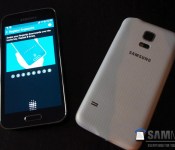
Leak hints the Galaxy S5 Mini will keep its bigger sibling’s sensors

While many have been expecting Samsung to launch a mini version of the Galaxy S5 given the company’s past habits, there have been questions about just what the smartphone would include. Would it be as hobbled as last year’s S4 Mini? Maybe not. SamMobile has received photos of a purported Galaxy S5 Mini which hint that this smaller device could include the fingerprint and heart rate sensors of its full-size sibling, as well as the water-resistant shell. Not surprisingly, it would also share the Ultra Power Saving mode and other software tricks.
The snapshots don’t reveal what’s inside, but their source claims that the hardware won’t be quite as much of a downgrade as in previous years. You could see a 4.5-inch, 720p AMOLED display along with a budget-minded 1.4GHz quad-core processor; there should also be a decent 1.5GB of RAM, an 8-megapixel rear camera, a 2-megapixel front shooter and 16GB of expandable storage. The tip doesn’t include a release date, but it’s coming hot on the heels of the Galaxy S5 Active launch — it’s easy to see the Mini arriving relatively soon.
Filed under: Cellphones, Mobile, Samsung
Source: SamMobile
 AIVAnet