


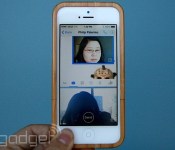
Facebook Messenger now lets you instantly send video clips

Facebook Messenger used to lag behind other messaging apps like Line or Viber when it came to sending media files. The key phrase here is “used to,” because its developers just gave it an instant video-sending feature on top of the voice- and photo-sharing functions they added in April. Now, when you tap the camera icon and hold the Send button, you can automatically record and send short video clips to friends. If you change your mind while recording (because you realized you haven’t even combed yet… among other things), simply swipe your finger off the Send button or quickly press X in the middle of the video clip while it loads on the chat window. Facebook’s slowly rolling out this Messenger update to both iOS and Android devices, so don’t worry if it’s not showing up on your updates list yet. But when it does, it’ll also come with the capability to send bigger thumbs up icons, because, hey, why not?
Filed under: Misc, Mobile, Facebook
Source: iTunes, Google Play
Google tweet has Android fanboys thinking 5.0 for Google I/O

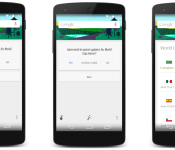
Get out your tinfoil hat, kids. The latest round of chatter says that Google will debut Android 5.0 at Google I/O this month. Why, you ask? Because a tweet from Google’s official account yesterday says so.
If you happened to catch the tweet on June 11 about getting ready for The World Cup then you might have overlooked the clue that allegedly smacks us in the face. See the time on the clock up there in the top right? It’s 5:00… 5.0…Android 5.0 confirmed. Well, not really.
Would we like to see Android 5.0 announced? Sure… maybe? It depends on what’s in it, really. We’re totally content with the KitKat stuff we’ve been using the last few months and don’t feel like there’s anything missing from the experience.
It is worth pointing out, however, that there is actual consideration that goes into these press render images. After all, the clock does have to have some time on it, right? Check out some of the previously released images from Google that show times that kinda sorta do match up with a version of Android.

If interested, you can get in on the conspiracy theory over at Reddit.
The post Google tweet has Android fanboys thinking 5.0 for Google I/O appeared first on AndroidGuys.

World Cup 2014 starts today, ready your Android and Chromecast devices

With the World Cup starting today, you may want to tune in, but may not be close to a TV with a cable or satellite connection. Don’t fret, as this year you can tune in with your Android device with the WatchESPN app.
The WatchESPN app can even stream to your Chromecast, so that’s even better. All you have to do is sign-in with your service provider – if you don’t have cable or satellite TV, ask a friend or family member for some help.
According to my app and at the time of writing this, the opening ceremony is just about to start at noon MST (I live in Boulder, CO), then you can tune into the Brazil vs. Croatia match.
Enjoy soccer (or football) fans!
The post World Cup 2014 starts today, ready your Android and Chromecast devices appeared first on AndroidGuys.
Three sources to consider for buying unbranded Android phones

Since day one, Google has made its wondrous Android OS to be open-source. This means that any company or person can manufacture a smartphone or device and install the platform at virtually no cost. As a result of this, many upstart companies and entrepreneurs have made their own Android products. Just about anyone who has access to smartphone components can (or has) design unbranded phones powered by Android.
Although unbranded Android phones are typically the ones that most consumers try hard to avoid they are a still an inexpensive and somewhat decent way to enter the Android world. Even though buying branded, low-price phones like the Nexus 5 or the OnePlus One is quite popular, some may want to enter the Android world with an unbranded phones.
The unbranded Android phone market has countless manufacturers and sites but we’ve trimmed it down to just three. If you’re the type who prefers to buy based on hardware specs alone you may find some of the phones listed in the sites are actually better than those made by much bigger companies. Oh, and for obvious reasons, we excluded re-seller sites like eBay and Amazon.
GearBest

GearBest is known for selling an unbranded version of almost everything tech related. From watches, to PCs, laptops, tablets, phones and even toys. This site is quite popular and it feature a community that rates, comments and reviews products. This is important because you’ll have a group of people helping to get you the device best suited one for your needs. GearBest Android cell phones vary on price but we found some from as low as $30 all the way up to $350 (same price and Nexus 5). Although the site is pretty great overall, there is something lacking in the search and filtration area. For example check smartphone and 3G smartphone and you get two completely different lists of devices.
DX

This site is very similar to GearBest in the sense that it’s popular and has a large selection of phones,. Unlike GearBest, it doesn’t have an active community and the price range is much higher. Although the site does focus on unbranded technology it doesn’t have a clear focus toward Android phones. Ironically, the site actually sells a couple of genuine Samsung phones. Android-powered phones range from $40 to $700 but much of the higher priced models come from branded devices..
Alibaba

This is probably the most popular site of the three; this may be due to the fact that it’s a re-seller site like eBay. Unlike Amazon and eBay it has a focus on unbranded items – which is why included it. Also, unlike the sites listed above, it doesn’t have a tech-only focus. Products range from jewelry, tech, toys, office supplies and much more. Due to the fact that almost anyone can list their unbranded Android phone on this site it has a very large selection. And, because of this, prices have a much larger price range, anywhere from the ones to the thousands.
The post Three sources to consider for buying unbranded Android phones appeared first on AndroidGuys.
Console OS will let you run Android on a Windows PC or tablet

Toggling between Windows and Android on a single device? That sounds desirable enough maybe, especially the way Intel describes it, but the quest for a practical mixture of green and blue has had its hiccups. (And that’s putting it mildly.) A new project has just arrived on Kickstarter, however, which takes a slightly different tack. It’s called Console OS, and it’s based on the premise that easy-to-use dual OS’s don’t need to be baked in at the factory. Currently under development by the same people who brought us the similarly-themed iConsole.tv, this fork of Android 4.4 is designed to run as either a secondary or standalone OS. It claims to be equally at home in touch-based or mouse n’ keyboard environments, with compatibility promised for a bunch of recent devices (including Dell’s Venue 8 Pro, Lenovo’s Miix 2 and Intel’s NUC). What’s more, since Console OS runs natively on Intel’s x86 architecture, it also promises better performance than any virtualized or emulated solution.
None of this is especially easy to swallow without hard evidence, of course. Mainstream Android devs barely pay much attention to Intel’s chips, let alone to niche Android forks, so the performance and stability of Android apps and games remains to be seen. A significant time delay in switching between OS’s could also be an issue, even though Console OS is supposed to keep the wait down to just 10 seconds. In any case, the risks of investing in this project aren’t huge: a $10 contribution will get you a copy of the Pro version of the software, which allows unlimited windowed Android apps (running inside the Console OS interface, not Windows), faster OS switching and free upgrades for life. Paying more will buy you a greater say over which devices will be supported when the finished article arrives in December. Check out the Kickstarter page for more.
Filed under: Desktops, Laptops, Tablets, Software, Intel
Source: Kickstarter

Charge your Android faster with Bench 2X

Have you ever felt that charging your Android device when attached to a computer or in the car is slow? If yes, the new Bench 2X Faster Charger Cable available from Pyramid Distribution may be just you’re looking for.
The New York-based company said that this unique faster recharge cable improves the electric current of a USB power unit, PC or automobile, up to 2,000 mAh.
Pyramid also makes a good point for its cable, saying that it’s almost impossible to actually increase your phone’s battery power if you’re using it as a GPS even while your phone is plugged in into your car’s USB port since it’s using more power than the power your USB port can supply, which is true.
The way that the Bench 2X allows you to charge your smartphone battery faster is with a switch that changes it from the normal mode, which sends data, to DouBBleTime mode that makes the it act as an its plugged into an AC charger and not only offers faster charging, but also is secure, so no data can be sent from the device.
The Bench 2X Faster Charger Cable is available in both black and white for $14.99 from Pyramid Distribution.
We’ll have a full review of the device soon.
VIA: Pyramid Distribution
The post Charge your Android faster with Bench 2X appeared first on AndroidGuys.
Outlook Web App finally debuts on Android, but only for ‘small’ devices

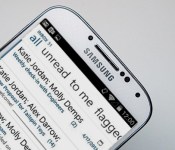
Been looking forward to a native Outlook Web App for your Android device? You just might have to wait a little longer: the freshly launched OWA Android app is only available on ‘select devices.’ Microsoft says this pre-release version can do everything its iOS counterpart can and automatically update its address book whenever the user makes a chance to their device contacts, but it’s not ready for a full roll-out. Still, if you’re sporting a device with Android 4.4 KitKat and Google’s OS standards categorize your phone as “small” or “normal,” the app’s inaugural releases is yours for the taking. Have something else? Check out OWA’s support page: Microsoft is taking suggestions on what devices to support next.
Filed under: Cellphones, Mobile, Microsoft
Source: Google Play, Office 365
HP’s Machine technology rethinks the basics of computing

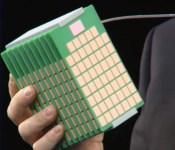
We’ve seen bits and pieces of technology that hint at the future of computing, but HP has just taken a big, big step toward bringing them all together. The company has unveiled The Machine (yes, that’s the name), a processing architecture designed to cope with the flood of data from an internet of things. It uses clusters of special-purpose cores, rather than a few generalized cores; photonics link everything instead of slow, energy-hungry copper wires; memristors give it unified memory that’s as fast as RAM yet stores data permanently, like a flash drive.
The result is a computer that can handle dramatically larger amounts of data, all the while using much less power. A Machine server could address 160 petabytes of data in 250 nanoseconds; HP says its hardware should be about six times more powerful than an existing server, even as it consume 80 times less energy. Ditching older technology like copper also encourages non-traditional, three-dimensional computing shapes (you’re looking at a concept here), since you’re not bound by the usual distance limits. The Machine shouldn’t just be for data centers and supercomputers, either — it can shrink down to laptops and phones.
To HP, the platform opens the door to large-scale computing concepts that aren’t even possible today, since devices can talk to entire networks to get things done. A doctor could compare your symptoms with that of every other patient on Earth, even while keeping everything private; smart cell towers would be aware of what’s going on across other towers and react accordingly. The shift in thinking is significant enough that HP is writing its own operating system from scratch to handle what’s possible with The Machine. It’s also creating an optimized version of Android, so there is a chance you’ll see Machine-based gadgets in your pocket.
The big obstacle at this point is simply timing. HP won’t even have samples of the necessary memory until 2015, while the first devices using The Machine are expected to ship in 2018. However, the tech firm is also attempting the kind of fundamental shift that the industry hasn’t seen in decades — this is going to take a while as a matter of course.
Filed under: Desktops, Misc, Laptops, HP
Source: HP Next
HTC One (E8) hands-on

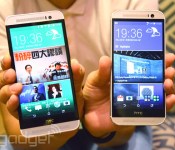
HTC’s betting big on its recently unveiled E8 by pricing it almost half as much as the similarly-specced M8 in China, so naturally, we had to check it out for the sake of curiosity. To our surprise, the plastic body was quite solid — more so than the Desire 816 — and felt good thanks to the ergonomic curves on the back. The design also looked better in real life than in the official renders, though only time will tell how scratch-proof that glossy body is. Slower camera and lack of TV remote feature aside, the E8 is easily a steal given the near-identical guts as the M8 (Snapdragon 801, 5-inch 1080p screen, microSD expansion and more) plus the reassuring build quality; and there’s even a hilariously large limited edition packaging that doubles as a mood light — check it out in our video after the break.
OnePlus One gets delayed over ‘security issues’

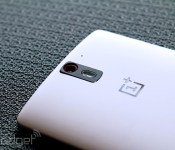
OnePlus One equals more than the number of units of this $300 smartphone that have so far been shipped to paying customers. The high-spec, low-cost Android handset was meant to launch back in May, but the manufacturer has now admitted that it’s “perfecting some final issues,” which means it can no longer be certain when the phone will be ready. In terms of what these problems are, some helpful clarification has been posted to Reddit by OnePlus’s software partner, Cyanogen.
Abhisek Devkota (aka Ciwrl) says that it’s all to do with the security vulnerabilities that were recently discovered lurking in the OpenSSL software tool (yes, that’s the very same OpenSSL package that was also at the center of the Heartbleed scare). These flaws were only made public on June 5th, and they led to a decision to pause shipping of the OnePlus One in order to create and re-certify a new, hopefully better-protected software build. If that’s really all it is, then it sounds like it could be resolved soon — which would be a good, because pretty much the only thing we could find wrong with this phone in our full review was its limited availability.
Filed under: Cellphones, Mobile
Via: AndroidCommunity
Source: Reddit

