


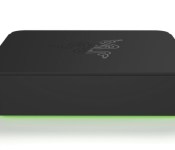
Razer’s making a gaming ‘micro-console’ with Android TV, available this fall

The company behind crazy devices like the Razer Edge and Project Christine is getting into game console creation as well. Razer’s employing Google’s Android TV initiative to create a game-focused “micro-console” and it’s arriving this fall. So, what does it do? Razer’s only offering a teensy bit of details, but what we know thus far sounds impressive. The micro-console can “stream movies, music and other apps for large-screen entertainment,” says Razer, “with an emphasis on gaming.” Sounds a lot like Amazon’s Fire TV, no? The difference here is that Razer’s also promising “hardcore” gaming, though we’re not hearing exactly how it will pull that off just yet (we asked!).
The same goes for what’s inside the Razer micro-console in terms of horsepower and connectivity — we’ve got no idea just yet. Internal storage? No idea. Price? Same situation. Actually, what Razer’s saying is, “In keeping with the spirit of Google I/O, we will not be discussing specific product details at this time.” Pretty funny you guys!
Anyway, in terms of gaming-specific applications, we also don’t know how you’ll control games on the device. Bluetooth game controllers? A custom controller? While we expect it’ll support Bluetooth, Razer’s not saying just yet. As for interface navigation, that’ll be handled by the Android TV app you heard about earlier today. There’s also some form of voice control, which we expect depends on your phone’s mic (though it’s always possible one’s built into a custom gamepad — we’ve got a lot of questions!).
Razer’s not offering hands-on opps today, and the image you see above is actually a render. As a result, it’ll be a few before we can offer more details on Razer’s first console experiment. For now…well, it sounds neat, right? Razer makes nice hardware and knows how to cater to gamers. Consider us cautiously excited.

Android TV will be in Sony, Sharp and Philips TVs next year

Google isn’t giving up on TVs yet. While its new Android TV flavor of Android L will hit the streets in set-top boxes aimed at game consoles and media streamers, it announced that next year smart TVs from Sony (all of its 4K and smart TVs), Sharp and TP Vision / Philips will ship with the OS. It’s also working with some familiar TV providers overseas like LG U+ in Korea (not LG Electronics TVs, which are moving to webOS) and SFR in France, as well as the chipmakers that build the components for smart TVs and boxes as seen in the slide above. The difference from the original Google TV approach is that the company isn’t treating Android TV as an entirely separate platform from mobile, and everything needed to handle video from HDMI,TV tuners or IPTV receivers is now natively included in Android L. We’ll probably have to wait until CES 2015 to find out if it’s having any success convincing more TV manufacturers to join in (again), but these are a start.
Android TV: Google Cast, voice search and tailored content. Visit http://t.co/H3lQNHUvcn for a preview and look for devices this fall.
– Android (@Android) June 25, 2014
Filed under: Home Entertainment, HD, Sony
Source: Android TV
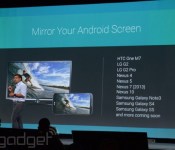
Chromecast can finally mirror your Android device’s screen

Which is better, huddling around a 5-inch screen or a 50-inch TV? Google is making that answer a lot easier with a few upgrades to its HDMI dongle. Chromecast can mirror your device’s screen to the flat-panel in your living room. The stage demo included using Google Earth and even Android’s video camera app. Even more than that, the HDMI dongle is getting a little more personalized too. What’s more, you know those pretty-looking images that populate your TV screen when you’re using the device? They’re about to get a little more tailored to you. You can customize the images of that ambient feed (seen when idle) with your own personal Google+ photo albums.
Not happy with your own pics or just don’t use G+ for photo storage? You can enable geographically filtered pictures from Google’s vast image catalog, too. These albums are curated by Google, so they’re ensured (in theory) to be safe and high quality. The feature is dubbed Backdrop, and it’s rolling out to all users this summer. If you’re still not happy with those choices, the search giant says it’s working to open this up to third-party developers, too — the likes of Flickr and 500px images are about to go prime time.
Mountain View’s HDMI dongle add-ons aren’t stopping there, either. Google announced today that other users can cast to your TV without being on the same WiFi network now, too. This is pretty neat if you don’t want to give out your password or go through the arduous process of getting a long, mixed-character sequence right. All your pals will need to do is enter the PIN on the screen; Google determines that they’re in the same room by location. Seems pretty simple.
Filed under: Gaming, Home Entertainment, HD, Mobile, Google
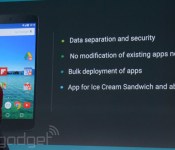
Android for Work lets your personal and business data coexist on one device

If you’ve bemoaned the inability to use your personal Android phone for company business, Google has some heartening news. It just unveiled Android for Work, a code platform that lets your business and personal info coexist on a single device. The technology (derived from Samsung’s Knox) keeps the data types separate without requiring any changes to existing apps. Every major Android manufacturer should have Android for Work certification in the fall, with promises of both guaranteed updates and full security. The office-friendly feature is baked into the Android ‘L’ release from the start, but don’t despair if you’re toting an older device — Google is promising an app that works on Android gadgets running Ice Cream Sandwich or later.
Filed under: Cellphones, Mobile, Samsung, Google
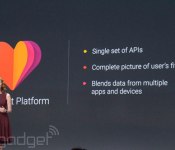
Google Fit is Android’s answer to exercise and health tracking

Google Fit is Google’s new health initiative. It’s a service that’ll track all your health metrics — sleep, steps, etc. — and it’s built into the next version of Android. But what does that mean? Well, it means that Google’s Android platform is getting the same kind of life metric tracking that Apple’s iOS users are getting in iOS 8 with HealthKit. More importantly, it means that the health devices you’re already using will play nice with the myriad Android devices out there. It also means that all your health data ends up in one place, in one app, rather than spread across a variety of software applications.

Adidas, Nike, Withings, Intel, RunKeeper and a variety of other fitness companies are involved with Android Fit. Nike’s FuelBand wearables were specifically given a shoutout on-stage at Google’s I/O event this afternoon, where the initiative was announced.
What we didn’t see from Google today is a dedicated app that collects all your data, like Apple’s Health app. Rather, the Fit initiative sounds like a platform for health device manufacturers trying to make their devices interface with Android. Google product manager Ellie Powers described it as using a single set of APIs for all health products, meaning all devices could technically work with all health/fitness software. While it isn’t the whole cloth approach that Apple’s taking in creating its own app, it’s the kind of open-source approach that we expect from Google.
By the numbers: Google boasts Android explosive growth

Not that this is exactly new to many of you but Android is big and it’s getting bigger by the moment. Google today announced that there are now 1 billion active (within last 30 days) Android users. And, with the upcoming Android One, Android TV, Android Wear, and Android Fit stuff we should expect that figure to shoot even higher.
- 30-day active users grown to more than 1 billion
- 20 billion texts every day
- 93 million selfies every day
- 1.5 trillion steps per day
- 100 billion times per day to check our phones
- Android tablets account for 64 percent of global market share – does not count Kindle and other branded experiences
- App installs are up 236% year over year
The post By the numbers: Google boasts Android explosive growth appeared first on AndroidGuys.
Android still the dominant mobile OS with 1 billion active users

Free-falling product demos and Rube Goldberg multimedia installations aside, there’s always a level of predictability to an opening day keynote. And Google I/O 2014 is no exception. Like clockwork, SVP Sundar Pichai took to the stage in San Francisco this morning to tick off the company’s latest accomplishments. He started off by touting one of the company’s biggest strengths: Android. According to Pichai, Google now has over 1 billion active users (that’s as of the last 30 days) on the OS.
Developing …
Google’s apparently opted to track 30-day usage as opposed to year-over-year numbers as in the past. That said, last year, the company boasted 900 million Android activations, up from 400 million the year before. We likely won’t get a direct comparison due to the change in tracking, but even with the numbers we have, it’s clear Android is still the dominant mobile platform. During its WWDC 2014 keynote earlier this month, Apple’s Tim Cook announced the company had reached 800 million iOS devices to date, fewer than Google’s Android activation numbers from the year prior.
Continuing the theme of unconventional stat tracking, Pichai championed the strength of the platform saying Android users send 20 billion text messages each day and 93 million selfies. What’s more, those self-absorbed phone holders apparently take 1.5 trillion steps each day, and check their handsets a total of 100 billion times every 24 hours.
Filed under: Cellphones, Tablets, Wearables, Internet, Software, Mobile, Google
Google’s next version of Android ‘L-release’ has a new look, deeper ties to the web

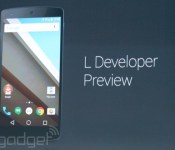
KitKat may have only found its way on to roughly 15 percent of phones at this point, but that won’t stop Google from looking to the future. The new version, teased by Sundar Pichai is simply being referred to as the “L-release” right now. As previous leaks have indicated, this will be the most dramatic UI overhaul the OS has enjoyed since Ice Cream Sandwich debuted back in 2011. The heart of this overhaul is called Material Design — a flatter look, with rounder elements and softer edges that will extend beyond tablets and phones to Chrome OS and Google’s various web services. You can see some of the new design philosophy at work already in the latest version of the Google+ app on Android. But it goes beyond that. Shapes are simplified and there are smooth transition animations across the UI. Developers can also add the illusion of depth by adding “elevation” which automatically stacks visual elements appropriately and adds drop shadows.
Developing…
Of course, if all that was new with Android was a facelift, it wouldn’t be all that exciting. But there are also plenty of new features. Not that there was anything wrong with notifications in KitKat, but there’s always room for improvement. In L you’ll be able to interact with notifications right from your lock screen. That can include quickly swiping them away or you can double tap on the notification to head straight into the relevant app. The notifications aren’t ordered simply chronologically anymore either, they’re sorted by relevance and importance, which is determined by a number of details, like the source app, etc… For truly important events, Google has introduced heads-up notifications, which pop interactive notifications over your current task. In a demo an incoming call showed up at the top of the screen while Dave Burke, director of engineering for Android, was playing a game. He could simply ignore the pop up completely, or he could tap the options to accept or dismiss the call.
One of the more intriguing changes is the deeper ties to the web and Chrome. The new recents interface will pull in not just apps you’ve launched but tabs you’ve opened on your desktop. And, developers can make links go to apps instead a webpage. So, if you search for a restaurant on your laptop, the recent menu won’t just open up a web page, but could launch directly into the Yelp reviews.
Then there’s the ART runtime, the software library that actually makes all your pretty little apps work. ART brings a whole bunch of advantages. For one, apps should run significantly quicker, and in particular they should launch much faster. But, it should also increase battery life because Android will be wasting less processing power decompressing apps.
Filed under: Cellphones, Software, Mobile, Google
Google’s Android One program will set minimum standards for bargain-basement smartphones

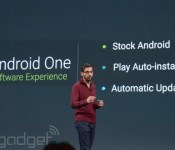
For every HTC and Samsung, there’s tens of Android hardware makers who have to redesign their smartphones to hit a certain low price. This is especially true in the developing world, where keeping the cost down means a lot of effort is spent tweaking devices — something that Google feels is a waste of time. That’s why it’s launching Android One, a program where Mountain View’s engineers will design cost-conscious hardware, and other companies will simply manufacture it. There’s plenty of fringe benefits, but the biggest one is that Google will be able to dictate a minimum set of standards for forthcoming Android handsets.
Since the company is targeting the developing world, Google is initially teaming up with Indian smartphone makers like Karbonn, Cromax and Spice. In an example presented on stage, Sundar Pichai talked about a Micromax Android One device with dual-SIM and SD card slots, a 4.5-inch display and FM radio priced at just $100. As well as that, these phones will get the same preferential treatment as the Nexus and Google Play ranges when it comes to automatic software updates. Is this, then, the much-rumored Android Silver program? Possibly, but given that it’s going to be aimed toward the bottom end of the Android world, it seems like the notion that Silver would kill-off the Nexus line won’t come true today.
Filed under: Cellphones, Software, Mobile, Google

Google’s new ‘Material Design’ UI coming to Android, Chrome OS and the web

Google’s annual I/O developer keynote has only just begun, but already we’re being treated to some of its announcements. In a bid to create a new “visual language” for users, Google is taking the design of Android, Chrome OS, and web properties back to basics with its new “Material Design.” According to Google, Material Design organizes interactions and makes better use of space, serving different views of the same content when viewed on a smartphone, tablet or desktop. Google’s Android apps will be updated to reflect this change, and you may have seen it in early Gmail and Calendar app leaks.
The new design language is more than just a visual refresh, though. In its on-stage demo, Google showed new animations that are designed to present the maximum amount of content while ensuring that scrolling remains smooth. It’s inviting developers to make use of improved typography, grids and more color to improve the layout of apps and services, making user interaction more seamless.
Developing…
Filed under: Cellphones, Mobile, Google
Source: Material Design Guidelines (PDF)
 AIVAnet