


Are you getting the Pixel 3 or Pixel 3 XL?
The regular Pixel 3 appears to have the popular vote so far.
Google’s new Pixel 3 and Pixel 3 XL are both available for pre-order right now, and considering the many similarities between the two phones, it’s shaping up to be a difficult decision to decide which one is worth buying over the other.

On one hand, the regular Pixel 3 doesn’t have an unsightly notch but does have a smaller display and battery. The Pixel 3 XL increases the screen size and battery capacity, but you’re then left looking at that huge display cutout.
Our form users are already going back and forth debating which is the better phone, and this is what they’ve said so far.
EMGSM
10-10-2018 08:52 PM“
P3 has enough improvements for me to stick with the smaller one. Last years P2 had a 2700 mAh battery and a 5 in. Display. The P3 has 2900+ battery and a 5.5 in. display (w/o notch). For me 5.5 could work
Reply
DMP89145
10-10-2018 09:31 PM“
This will be my 3rd regular sized Pixel. I prefer that size because they are more pocketable. The way my tech is set up, I only use phones for “on the move” information and communication. More than that and I’m on a tablet or laptop.
Reply
spiff_p239
10-11-2018 12:20 AM“
For me, I’ve always preferred phones that I can use one handed. With the XLs, I can’t do that. The Pixel 3 has quite a bit more screen real estate than the Pixel 2 and stays that same size so that’s a win for me.
Reply
supabeans
10-11-2018 09:18 AM“
I preferred the bigger screen and would rather have the end to sorta end display; notch and all.
Reply
What say you? Are you getting the Pixel 3 or Pixel 3 XL?
Join the conversation in the forums!
Google Pixel 3 and Pixel 3 XL
- Google Pixel 3 and 3 XL hands-on preview
- Google Pixel 3 and 3 XL: Everything you need to know!
- Google Pixel 3 vs. Pixel 3 XL: Which should you buy?
- Google Pixel 3 and 3 XL specifications
- Join our Pixel 3 forums
Best Buy
Verizon
Project Fi
Samsung Galaxy Note 9 vs. iPhone XS Max: Which should you buy?
We’re a virtual company made up of tech experts from across the globe. We live and breathe Android phones, and use nearly every one of them. We also use iPhones — so we can offer you the best buying advice possible.
Samsung Galaxy Note 9
Our pick

$980 at Amazon
Pros
- Big, beautiful screen.
- Samsung’s software is nicely optimized for both two- and one-handed use.
- Great dual camera.
- Awesome battery life.
- S Pen improvements are meaningful and practical.
- Headphone jack and other useful amenities.
Cons
- Expensive.
- Bixby and its button are industrial bloatware.
- Camera struggles in low light.
Right now, the Galaxy Note 9 is probably the best Android phone in the world. It’s got everything you need to get work done, play games for hours, and do a bit of creative writing or drawing with the S Pen. The camera is awesome, battery life is insanely good, and there’s a headphone jack.
iPhone XS Max
The biggest iPhone

$1,099 at Apple
Pros
- Huge, awesome OLED display.
- Face ID is fantastic and secure.
- iOS is just plain fast.
- App quality still better on iPhones.
- Battery life is fantastic.
- Enormous variety of cases and accessories.
- Software updates are fast af.
Cons
- The extra width (and lack of software optimization) make this a two-handed phone.
- Camera isn’t great in low light.
- Siri is still just bad most of the time.
- Really expensive.
The iPhone XS Max has the biggest screen on an iPhone yet, and while that may please people looking for a big iPhone, iOS 12 doesn’t take advantage of that extra real estate.
Both of these phones are at the top of their categories — they’re arguably after the same customers — but the Note 9 seems better optimized for its larger size, whereas the iPhone XS Max just feels like a bigger iPhone XS. Without rewarding its customers with any meaningful new features, buyers of the Note 9 get a bigger screen and an S Pen, a huge battery, and proper OS optimizations that allow for split-screen apps, picture-in-picture video, and more.
What’s the big deal between the Note 9 and the iPhone XS Max?

Apple vs. Samsung. iOS vs. Android. The debate is older than time itself — if time began around 10 years ago. The reality is that you’re likely already entrenched in one camp or another.
Comparing iPhones to Galaxy phones, from a spec perspective, is also a bit of an apples to oranges spec battle — excuse the pun — because Apple optimizes its software to work with hardware it develops largely on its own, negating the need for lots of RAM, or for oversized batteries.
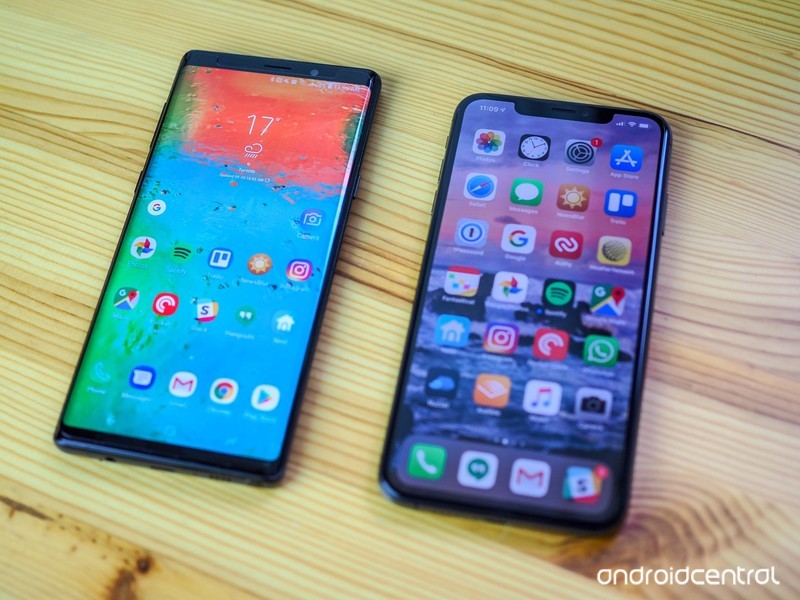
At the same time, the iPhone XS Max does push the spec boundaries a little bit, at least by iPhone standards, bringing the phone to a 6.5-inch 2688×1242 pixel OLED display, 4GB of RAM and a 3174mAh battery. Compare that to the Note 9’s 2960×1440 pixel OLED display, 6GB of RAM, and 4000mAh battery.
Of course, the specs don’t mean much unless they also come with a great experience, and both phones deliver that. Exceptional touch responsiveness, great color reproduction and viewing angles, awesome dual speakers, and basically every amenity you could imagine — wireless charging, IP68 water and dust resistance, and great build quality.


What’s left are the cameras which, again, on paper looks quite similar: a main 12MP wide-angle sensor and a secondary telephoto lens, both equipped with optical image stabilization. Apple claims that the iPhone’s camera is significantly improved this year, but its physical size is now identical to the Note 9’s — 1.4 micron pixels.
The Note’s f/1.5 lens is a bit wider, but that only kicks in under low-light situations — daytime photos are shot at f/2.4 with a dynamic aperture. Both phones support portrait mode and a wealth of other photo and video features like super slow motion (though the Note takes the edge with 960fps slo-mo) and 4K video capture (both can do 4K@60, too).
| Operating system | iOS 12 | Android 8.1 OreoSamsung Experience 9.5 |
| Display | 6.5-inch OLED2688x1242 (19.5:9) | 6.4-inch AMOLED2960x1440 (18.5:9)Gorilla Glass 5 |
| Processor | Apple A12 Bionic | Qualcomm Snapdragon 845 |
| RAM | 4GB | 6GB |
| Storage | 64/256GB/512GB | 64/128/256GB |
| Expandable | No | microSD |
| Rear camera 1 | 12MP, 1.4-micron, PDAFf/1.8, OIS | 12MP Dual Pixel f/1.5 or f/2.4, OIS |
| Rear camera 2 | 12MP, 1-micron, telephoto, OIS | 12MPf/2.4, OIS |
| Front camera 1 | 7MP, auto focusf/2.2 | 8MP, auto focusf/1.7 |
| Connectivity | Wi-Fi 802.11ac 2×2 MIMO, Bluetooth 5.0 LE, NFC, GPS | Wi-Fi 802.11ac 2×2 MIMO, Bluetooth 5.0 LENFC, GPS |
| Audio | Stereo speakersUSB-C | Stereo speakers3.5mm headphone jack |
| Battery | 3174mAhNon-removable | 4000mAhNon-removable |
| Charging | 18W Lightning Fast ChargeQi wireless | Quick Charge 2.0Qi wireless |
| Water resistance | IP68 | IP68 |
| Security | Face ID | Fingerprint sensorIris scanner |
| Dimensions | 157.5 x 77.4 x 7.7 mm208 g | 161.9 x 76.4 x 8.8 mm201 g |
| Colors | Space Gray, Silver, Gold | Midnight Black, Lavender Purple, Ocean Blue, Cloud Silver |
When you look at these two phones side by side, you can tell that the industrial design differs in so many ways — Apple has embraced the edge-to-edge display with the notch in order to faciliate its Face ID biometrics, eschewing fingerprint unlocking entirely.
Samsung, instead of going edge-to-edge vertically, decided to differentiate itself by curvinig the horizontal edge of its phones, keepinig the front relatively symmetrical. I think it looks better, but the iPhone XS Max does offer ever-so-slightly more usable screen real estate. Well, technicially, sinice Apple doesn’t make use of the space with additional content.
What about the cameras?

Here’s where thinigs get tricky. Both phones have pretty much the same camera hardware on paper, though Apple makes more of its use of “computational photography” than Samsung does — at least right now.
In practice, photos taken during the day are basically a wash — while they have slightly different color profiiles, and tend to expose the same scene in different ways, both the iPhone XS Max and Galaxy Note 9 take amazing shots in good lighting. I did find that the iPhone tended to favor faster shutter speeds (there’s good science about why it does that) darkening some scenes that don’t really need to be (like the leaf below) but overall it’s difficult to complain about either one.
The Galaxy Note 9 camera samples
In low light, it’s a different story. I far prefer the slightly more colorful, detailed, and ultimately more noisy photos taken by the Note 9 than the muted, smoother images captured by the iPhone XS Max.
One could argue that the iPhone’s photos are more true to life, and were you to take RAW photos from either one the iPhone would be in a more neutral starting point for editing, but the vast majority of photos I take on my phone are only lightly edited and shared straight to social media or with family members. In those situations, I’d much rather see my subject with a bit of noise than have a cleaner, darker shot. Your mileage may vary, though.
The iPhone XS Max camera samples
On the other hand, Apple’s portrait mode features are much more mature than Samsung’s Live Focus. Not only does the iPhone offer better edge detection, but the finished product almost always looks more pleasing and better framed. Samsung’s Live Focus is often so bad that it’s almost not worth using — which is usually fine because the f/1.5 aperture of the standard lens captures some great depth of field without resorting to any trickery.
Which one should you buy?

My goal isn’t to convince you to buy one of these phones over the other. In fact, you probably don’t need anyone to tell you which to consider — you likely made up your mind a lot time ago. The point of this comparison is to prove that the differences between the best iPhones and Androids, at least from a hardware perspective, are dwindling year over year, and the software is largely what separates them.
To that end, if you are wondering which one wins, the Samsung Galaxy Note 9 is a better phone. Its software is highly optimized for the enormous 6.4-inch OLED display, and the oversized form factor gives it an S Pen, a bigger battery, and a headphone jack.
Samsung Galaxy Note 9
Our pick
$980 at Amazon
The $1000 phone that justifies its price
The Galaxy Note 9 is probably the best phone you can buy. Awesome hardware, reliable software, and so many features. It’s just a fantastic product.
iPhone XS Max
The big, bad iPhone
More expensive without more features
$1,099 at Apple
The iPhone XS Max is a bigger iPhone XS, which happens to be the best iPhone ever. But the Max is ungainly and doesn’t offer any features to justify its higher price, size, and weight.
Samsung Chromebook Plus V2 is getting an LTE model
The new version goes on sale November 2 for $599.
This past June, Samsung released an upgraded version of its excellent Chromebook Plus in the form of the Chromebook Plus V2. On November 2, you’ll be able to purchase a version of the V2 that’s outfitted with LTE.
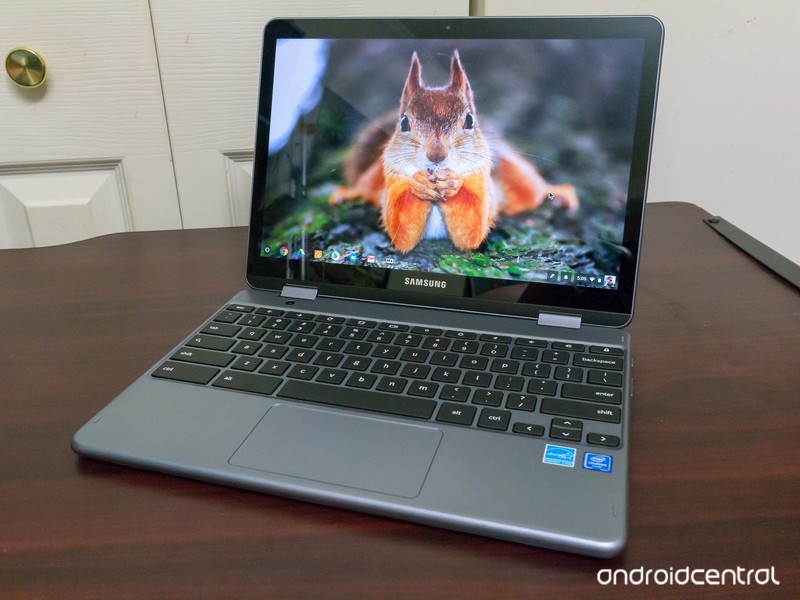
With that LTE connectivity, you can send emails, access Twitter, play online games and more without having to worry about whether or not you’re near a Wi-Fi network. You’ll need to pay an additional monthly fee with your carrier for that privilege, but if you’re constantly on the go, this is a welcome upgrade.
Everything else about the Chromebook V2 remains the same, including its Intel Celeron processor, 4GB RAM, Intel HD Graphics, and 32GB of internal storage that can be expanded up to 400GB.
If you’re interested, the Samsung Chromebook Plus V2 (LTE) will be available for purchase starting November 2 at Samsung.com, Best Buy, and Verizon for a starting price of $599.99 ($100 more than the Wi-Fi only model).
Samsung Chromebook Plus (V2) review: Everything you need
How to make a GIF from a PlayStation 4 video

Here we will show you a very simple way to make your gameplay video clips from your PlayStation 4 into awesome GIFs to share on your social media. The process is pretty painless and takes less than 5 minutes to do and you can create multiple GIFs from one video as easily as making one.
Products used in this guide
- Amazon: PlayStation 4 Pro ($510)
- Amazon: 16GB Memory Stick ($8)
How to make a GIF on PlayStation 4
Choose the capture gallery app from the PlayStation 4 menu.
Press the options button on your controller to open the menu.
Select copy to USB storage to save the selected video clip.

Remove the USB memory stick from the PlayStation 4 and plug into your PC.
Go to the imgflip website and select Create GIF in the drop-down menu.

Click on the Upload Video button to select your video from the USB memory stick.
Use the slider below the video preview to set the position in the video you want to make into a GIF.

Check the Private box if you want to stop imgflip adding your GIF to its library.
Click the generate GIF Button to open the save screen.
Click the download GIF button or share to the social media sit of your choice.

And there you have it, you have made your first GIF using imgflip and your PS4 gameplay footage. There are other ways to get your gameplay footage as well, you don’t have to get it from your console.
If you live stream, you can take the video from Twitch or YouTube and copy and paste the URL into the imgflip website. This will buffer the video into the GIF editing software for you to clip down and make into GIFs. You may have trouble making GIFs from Twitch if your stream is too long, so make highlights of your videos before to shorten the length.
There are of course many other websites you can use to convert GIFs, but I have found imgflip to have the best free tools, as well as an excellent Pro version if you are going to be making a lot of GIFs as I do. The imgflip watermark does appear on the GIFs you make unless you go Pro, but it is much smaller than most watermarks I have seen.
What you will need to make this work
The Big Stuff
PlayStation 4 Pro

$510 at Amazon
The most powerful PlayStation yet
The PlayStation 4 Pro is the pinnacle of Sony’s PlayStation line and is worth every penny to play high-quality games with
While it is not fully mandatory to have the PlayStation Pro, you will need to have a PlayStation 4 to make this guide work. As the PS4 Pro is the current best PlayStation console, it seems silly to recommend anything else.
The small stuff
SanDisk Ultra Flair Memory Stick

$8 at Amazon
This 16GB memory stick is large enough to store all the gameplay videos you will need.
As mentioned above, there are other ways to get gameplay footage off of your PlayStation 4 and made into a GIF, but having a memory stick is by far the easiest.
Aukey’s $15 PowerHub Mini replaces a single outlet with six charging slots
Power multiple devices at once!

Using coupon code YPFQIC8Y during checkout, you can grab Aukey’s Powerhub Mini for just $15, a savings of $5. It has two AC outlets and four USB ports built-in, meaning that your single outlet becomes far more valuable to you. The USB ports have a max output of 2.4A each, totaling 6A. The AiPower Adaptive Charging Technology allows the charger to automatically adapt to give your devices the fastest charge possible.
This desktop charging hub is a great addition to any desk, and if you’re just worried about data transfer, this Aukey 10-port USB hub is a must-have for $22.
See at Amazon
Android 9 Pie rolling out to Sony Xperia XZ2 and XZ2 Compact

A new version of Android means it’s once again time to peer into my crystal ball.
Latest Updates
October 12, 2018 — Android 9 Pie rolling out to Sony Xperia XZ2 and XZ2 Compact
On October 12, reports started coming in to show that Pie is making its way to Xperia XZ2 and XZ2 Compact handsets. The update changes the build number from 51.1.A.11.51 to 52.0.A.3.27 on both phones and weighs in at around 1.059 GB. In addition to the usual Pie goodies, there’s also a new camera app and the October 2018 security patch.
The full roundup
Did you hear? Android Pie is a thing now. And we know that everyone will want it and want it as soon as possible. That’s how it works and that’s how we are wired. We want updates, we want them to be spectacular and we want them right now.
The reality of the situation is a bit different. Most phones made in the last 18 months will see Android Pie, but some of them will only get updated when we see the first developer preview for Android Q (Quince Jelly or gtfo, Google!) come along. It’s a lot easier for manufacturers to update their phones to a newer version, but it’s still not any better. That’s another article for another time, though. This one is where I guess which phones will get updated sometime in the next 12 months.
Predicting anything Android-related is 10% science and 90% interpretation.
It’s not as easy as you think and many sudsy cold beverages worth of thought goes into my guesses each and every year. About one-third of them are no-brainers, but some of the others are basically the same odds as a coin flip. It seems like manufacturers only care about a few models that get a lot of press time. But I do have to toot my own hat (or something) and say I have a pretty good track record. Luck or skill? You decide. (It’s totally skill.)
Let’s break it down by the major manufacturers of the phones we love and make a few predictions. Remeber, these are just predictions and not any official word on anything from any company unless otherwise noted.
- Android Beta Program Partners
- Samsung
- LG
- Huawei
- Motorola
- OnePlus
- Nokia
- HTC
- Sony
Still waiting for Oreo? Check to see whether your phone will be upgraded!

I always start with Google because it’s easy and I’ll get it right every time. That’s what I want at the top of the page. I say it’s easy because Google has already told us which phones get updated and which won’t.
- The Pixel 2 and Pixel 2 XL have already been updated to Pie.
- The Pixel and Pixel XL have already been updated to Android Pie.
- While not actually from Google, any Android One phones manufactured since October 2017 will also be updated to Pie “later this fall.”
And that’s it. Prior to the Pixel, Google promised two years of full support and three years of security updates for phones they sell under their own brand. The Nexus 6P and Nexus 5X are just about three years old. Auf Wiedersehen, Adieu, Adios, Good Bye. They were great phones.
More: It’s time to say goodbye to the Nexus program for good
Android Beta Program Partners

For the first time ever other companies have joined Google in supporting the Android Beta Program. When it was started for Android Pie (then known simply as P) the following phones joined Google’s Pixel and Pixel 2 family in supporting it:
- Sony Xperia XZ2
- Xiaomi Mi Mix 2S
- Nokia 7 Plus
- Oppo R15 Pro
- Vivo X21
- OnePlus 6
- Essential PH‑1
That means that every one of these phones should see a full-on update to Android Pie in the very near future. In fact, the Essential PH-1 is saw its update at the same time the Pixel and Pixel 2 did.
We’re proud to bring Android 9 Pie to Essential Phone the same day it’s released! Check your phone now for the update. 🥧 pic.twitter.com/pniUDl9yr8
— Essential (@essential) August 6, 2018
Samsung

Samsung makes more models of a single flagship line like the Galaxy S each year than Google has made in total, but it’s also pretty easy to know which phones Samsung will update because they’re predictable. Samsung offers four “premium” models each year. like 2018’s Galaxy S9, Galaxy S9+, the Galaxy S9 Active that we all know is coming, and the Galaxy Note 9. Even when Samsung sold 15 different models of the Galaxy S6, they were all treated the same when it came to expecting an update.
When to expect it is just as predictable, and it will happen about a year from the date this was first published (March 2018). Some models in Europe will see it first, about a month later it will show up somewhere else, and once Samsung is satisfied it’s not going to totally wreck about a gazillion phones they will give it the green light. Add in whatever time your carrier needs and the final result is just about a year from its initial release.
- The Galaxy S9 and S9+ (and any S9 Active that comes in the future) will be updated to Android Pie.
- The Galaxy Note 9 will be updated to Android Pie.
- The Galaxy S8 and S8+, and the Galaxy S8 Active, will be updated to Android Pie.
- The Galaxy Note 8 will be updated to Android Pie.
Here’s where it gets interesting. there are a handful of other Galaxy phones that have a huge regional fanbase. In India, for example, the Galaxy J models are huge hits because they offer most of the same experience you find in a Galaxy S at a lower price. Samsung will give them the same treatment the Galaxy S and Note lines receive. That’s not the most interesting part, though. That would be the seemingly random phones that Samsung decides to update. We don’t know why we see this every year (Carrier requests? Developer favorites? Aliens?) we just like seeing it. And we all wish we saw more of it.
LG

LG has always been a wildcard when I write this post every year. Like Samsung, there are a few “important” models that get all the press coverage and plenty of other more inexpensive models that most of us aren’t talking about.
LG also mentioned some streamlining in the release cycle, which hopefully gives the development teams time to get an update out the door and have it be a good update.
- The LG G7 ThinQ will be updated to Android Pie.
- The LG V30 (including the V30S or whatever models we have seen or will see) will be updated to Android Pie.
- The LG V20 will be updated to Android Pie.
- The LG G6 will see Android Pie.
Older models like the G5 and V10 are done seeing any attention and won’t see any updates. LG makes a handful of phones that aren’t quite flagship material, and we know it is willing to spend the time and money on updating some of them even if your carrier isn’t and you never see it. That means nothing is a given.
I also think LG consolidating things and releasing phones when they think it’s time for a new model rather than by looking at a calendar will make a difference here and lead to longer support.
Huawei

Huawei is tough to read. It hasn’t abandoned the Asian way of doing smartphones like LG and Samsung have for their U.S. divisions and sometimes that means the things the company does can be puzzling to those of us used to the Western way of thinking. Just when I think I have figured out exactly which phones are the company’s flagship models that will get the lion’s share of time and money spent, they change it all up. That’s a good thing.
Something made Huawei change the way it redistributes and maintains phones running the EMUI operating system (Huawei’s version of Android) in 2017 and I think that’s going to be reflected when it comes to Android P updates.
- The Huawei Mate 10 will be updated to Android Pie.
- The Huawei Mate 10 Pro is being updated to Android Pie while this article was being revised on October first.
- The Honor 9 and Honor View 10 series will be updated to Android Pie. I’m hoping, but less confident, about the Honor 8 Pro and 7X.
- The Huawei Mate 9 will probably be updated to Android Pie, but we’ll see.
This includes the various Plus, Pro, and Porsche models (I want a Porsche phone) as well, and because EMUI is so different than every other smartphone software available users will have no idea which version of Android they are running unless they look.
Besides, if the things a handful of little birds are saying happen to be true, EMUI 9 isn’t going to be able to run on any hardware older than what comes in these phones.
Motorola

Motorola had a weird 2017. That’s putting it mildly. They released like 100 phones in the Americas and Western Europe (Editor’s note: it was actually 9) and they ranged from the surprisingly great $100 Moto E4 to the Moto X4, the first of hopefully many non-Google phones you can use on Project Fi, and all the Z and Force you can handle in between.. And they did it without compromising the G series which has been a company staple for years from the smartphone division.
Moto phones under Lenovo are slowly becoming like the Thinkpad — quietly chugging along in the background doing their thing. And doing it well.
On August 15, Motorola published a blog post outlining the handsets that’ll receive the official Pie update starting this fall. They include:
- Moto Z3
- Moto Z3 Play
- Moto Z2 Force
- Moto Z2 Play
- Moto X4
- Moto G6 Plus
- Moto G6
- Moto G6 Play
While that’s a strong list, the notable omissions include the Moto E5, E5 Plus, and E5 Play.
OnePlus

OnePlus is on the verge of becoming more than just a niche brand. But it won’t forget where its early success came from — providing fast updates because its customers wanted them. And just because it is never as fast as we wanted doesn’t mean it wasn’t as fast as possible. Sometimes, too fast even …
Here’s the list of phones OnePlus is going to update to Android P.
- OnePlus 3
- OnePlus 3T
- OnePlus 5
- OnePlus 5T
- OnePlus 6
Nokia
Hi, Android Pie will be available for the Nokia 3, 5, 6 and 8. Roll-out will be phased as usual to secure quality delivery. Nokia 7 Plus is part of the Android One program, which guarantees two years of software updates, including Pie.
— Nokia Mobile (@NokiaMobile) August 8, 2018
Nokia seems to understand that a substantial portion of its own customer base wants fast updates. Like OnePlus, they should listen to their current customers while trying to find new ones if they are to be successful. Here’s a list of phones expected to see Android Pie from Nokia.
- Nokia 3
- Nokia 5
- Nokia 6
- Nokia 6.1
- Nokia 7 Plus
- Nokia 8
- Nokia 8 Sirocco
HTC
Disappointing sales have left the future of HTC’s smartphone business in uncertainty, but assuming the company doesn’t go under in the next few months, it’s announced that it’ll be updating four of its smartphones to Android 9 Pie. The list is as follows:
- HTC U12+
- HTC U11
- HTC U11+
- HTC U11 Life (Android One version)
We’re pleased as pie to confirm updates to Android Pie for the HTC U12+, U11+, U11, and U11 life (Android One). Timeframes for roll-out will be announced in due course. We can’t wait to know what you think of Google’s freshest slice of Android! pic.twitter.com/mPJePFegne
— HTC (@htc) August 10, 2018
Annnnddd…that’s it.
HTC says that it’ll release timeframes for its Pie updates “in due course”, and as those announcements are made, we’ll update this article accordingly.
Sony

Sony announced its Pie update plans on August 16, 2018, and as expected, the phones that’ll be the first to get the new software treatment are the company’s high-end flagships. Starting this November, the following phones will get Android 9 Pie:
- Sony Xperia XZ2
- Sony Xperia XZ2 Premium
- Sony Xperia XZ2 Compact
- Sony Xperia XZ Premium
- Sony Xperia XZ1
- Sony Xperia XZ1 Compact
On October 12, reports started coming in to show that Pie is making its way to Xperia XZ2 and XZ2 Compact handsets. The update changes the build number from 51.1.A.11.51 to 52.0.A.3.27 on both phones and weighs in at around 1.059 GB. In addition to the usual Pie goodies, there’s also a new camera app and the October 2018 security patch.
But wait, there’s more!
If you own a Sony Xperia XA2, XA2 Ultra, or XA2 Plus, you can expect Pie to land on your phone by “early 2019.”
Must mentions
These may be the companies we’re most familiar with in the west that sell Android phones, but they aren’t the only companies doing it. Out of the literally hundreds of models available, a few stand out and need mentioning.
- Any phone running the Android Go version will probably see an update once Google gets Pie optimized for the meager specs these devices have.
- The BlackBerry KEYone probably won’t be upgraded to Android Pie, but we know the KEY2 will be.
- Someone at XDA will update their Nexus One to Android Pie and I am going to do my best to get Google to send that person a brand new Pixel 3 NotchXL.
Like mentioned earlier, these are just educated guesses at this point. but one thing I know for certain is that no matter what the phone, any updates will feel like they took too long to make it into our hands. That’s just how we’re wired.
Android 9 Pie
- Android 9 Pie review: Greater than the sum of its slices
- Everything you need to know about Android 9 Pie!
- Will my phone get Android Pie?
- How to get Android 9 Pie on your Pixel right now
- Join the Discussion
Updated October 12, 2018: Added details about Pie rolling out to the Xperia XZ2 and XZ2 Compact.
UK Daily Deals: Xbox Live Gold membership, Fire HD 10, Anker speakers, more
Whether you’re looking for new tech gear or household items, we’ve got you covered.
We found plenty of great deals today Xbox Live Gold membership, Hive Smart Thermostats + free Echo Dots, refurb Amazon Fire HD 10 tablets, Anker speakers, Philips 4K TVs, and much more!
View the rest of the deals
Each day, the Thrifter UK team scouts out and shares amazing deals on products you know and love, helping you find the best prices on the ‘net.
For more UK deals coverage, be sure to keep an eye on Thrifter UK and follow the team on Twitter for the most up-to-the-minute coverage.
Game of the Week: Assemble your clone army for PvP battle in Badland Brawl!

Update October 12, 2018: This week, we’re playing Badland Brawl, a new take on the PvP tower defense genre!
Most mobile gamers should fondly recall Badland, the highly-stylized adventure game that raked in many awards and much accolades when it was first released five years ago. After a fairly successful sequel, the team at Frogmind Studios has returned to the Badland brand with a new PvP multiplayer experience that’s worth checking out.
The premise is pretty familiar if you’ve played other PvP mobile games such as Clash Royale — your goal is to destroy your enemies towers before they destroy yours by strategically deploying the right clones at the right time. What makes Badland Brawl stand out from the rest of the crowd is it’s physics-based combat that borrows the slingshot mechanic from another iconic mobile title, Angry Birds, and the way you can literally bump your enemy’s clones off course and completely derail your opponent’s attacks.
As you’d expect, upgrading your troops is a bit part of this game and relies on collecting and unlocking crates — in this instance, eggs — that give you upgrade points and coins for your different clones. As your collection of clones grow, you’ll get more variety to choose from for selecting your battle party. There are currently 37 different clone types to find and battle with, and there are in-app purchases available for purchasing gems which you can spend on eggs or coins.
If you love PvP arena games, Badland Brawl offers a fresh take on the tried and tested formula that’s made all the better by the gorgeous graphics that the Badland franchise is known for. The backgrounds are colorful and vibrant, and the character animations are butter smooth. It’s a free download so check it out if it seems like something you’d enjoy!
Download: Badland Brawl (Free w/IAPs, Ads)
Android Gaming

- Best Android games
- Best free Android games
- Best games with no in-app purchases
- Best action games for Android
- Best RPGs for Android
- All the Android gaming news!
Echo Dot (3rd Gen) Review: Bigger, better, and much louder
Amazon’s heavy hitter has been overhauled with a focus on quality and volume.

When people say they have an Amazon Echo, they almost always mean they have an Echo Dot. The cheapest of the Echo family regularly drops into stocking-stuffer price points, which allowed for these speakers to quickly rise in popularity over the last two years. But popularity doesn’t necessarily mean quality, and the competition quickly moved to make mini speakers with better speakers and a more visually pleasing design.
Amazon, now on the third generation of its Echo product line, has responded with a new Dot. And at first glance, it looks an awful lot like Amazon is reacting to the competition. After a few days of using it, and seeing how much better this new speaker is over its predecessor, I think the only company Amazon is competing with is itself.
Crank up the volume
Amazon Echo Dot (3rd Gen)

$49 at Amazon
A worthy upgrade in almost every way.
Amazon’s Echo Dot has grown up quite a bit, bringing with it improved audio and noticeably better microphones.
The Good
- MUCH louder
- Nice tactile buttons
- Improved design
- Easy set up
The Bad
- No more USB port
- Audio gets muddy at top volumes
- Light animations aren’t as smooth

Amazon Echo Dot (3rd Gen) What I like
I thought I knew exactly what I was getting myself into as I opened the box to the new Echo Dot. It’s an Echo, after all. Alexa is a ubiquitous platform, and the Echo Dot is supposed to be the low end of what this experience offers. I wasn’t expecting a lot of surprises here, as I already have multiple 2nd Gen Echo Dots in the house.
Wow, was I wrong.
Every part of this experience exceeded my expectations, starting with the initial set up. On multiple occasions, I have had to go in through the Alexa app and manually pair to an Echo product because the auto detection had failed. This time it immediately connected and, because my Wi-Fi network was stored in my Amazon account, was available on my network almost instantly.
This new Echo Dot is loud, especially when compared to its predecessor. Sitting the two side by side, a 2nd Gen Echo Dot at max volume is right around as loud as a 3rd Gen Echo Dot is at 30%.
It’s not just louder, too; there’s a lot more character to the audio. You get some bass with your little speaker, which absolutely could not be said of the last Echo Dot. If you were planning on listening to music with the last Echo Dot, you really needed to connect a speaker to the 3.5mm jack at the back. With this new Echo Dot you can certainly do the same, but in smaller rooms, you probably won’t need to. In fact, there’s a reasonable argument to be made for having two of these Echo Dots paired and playing audio together from different sides of the room instead.
This increase in volume meant a change in how the microphones on the Echo Dot are set up. The previous generation could barely handle picking up the Alexa passphrase when playing music at a reasonable volume, and the little animation for where the microphone thought the request was coming from is frequently wrong. This new Echo Dot has multiple microphones and does a noticeably better job picking up your voice even when the volume is up high. You can see the four microphone holes on the top of the speaker clearly, and the results are obvious from the moment you set it up.
This thing sounds better than its size suggests. A lot better.
Finally, I realize this is a small thing most people won’t notice, but the buttons on the top of the Echo Dot feel really nice. This speaker has the same four buttons its predecessor has, but they all have a more tactile and satisfying click when you press down on them. No more spongey buttons is a great thing, even if these buttons don’t get a lot of use.

Amazon Echo Dot (3rd Gen) What I don’t like
Amazon gets lots of credit for making the speakers on the Echo Dot louder and adding some character to the sound these speakers produce, but louder does not mean better. At higher volumes, the audio quality on this speaker suffers. Everything becomes a little muddy at the 70% mark, and gets noticeably worse as it gets louder. At 100%, none of the songs I played on it were things I wanted to listen to. It’s cool to be able to say this speaker is louder and noticeably better than the one in the Google Home Mini, but kind of hard to see how it matters much if you don’t ever want to use it at those louder volumes.
This new Echo Dot is an improvement in nearly every way.
This new, louder speaker requires more power to drive it, which makes sense. The small 9W power adapter included in the previous Echo Dot has been replaced with a larger 15W power adapter, and at the other end the miniUSB has been replaces with a barrel connector. This isn’t a big deal to many, but I really liked being able to grab a random cable and use it to power an Echo Dot. I liked being able to connect to things that weren’t a standard wall outlet, but those features are gone now. And, honestly, I doubt many others will notice.
Amazon’s new design makes the light ring around the outside of the Echo Dot more visible from more angles, which is fantastic. Lots of people rely on this light animation to confirm Alexa is listening before giving a command. This new design doesn’t contain an LED array that is quite as densely packed as some other Echo products, though, so the animations look a little segmented at times and not quite as smooth as I’ve come to expect from this line of products. Also not a huge deal, just worth noting if you’re already a fan of these speakers.

Amazon Echo Dot (3rd Gen) Should you buy it?
Amazon didn’t make a speaker to compete with Google or Apple. It made a speaker for people who already own an Echo Dot. This speaker isn’t going to convince anyone to switch platforms, and until we get to the holidays and Amazon drops it down to those crazy $30 prices there won’t be a mad rush to buy these from people who don’t already own them.
But if you own an Echo Dot right now and aren’t totally thrilled with it, this new upgrade is an improvement in nearly every way. If you are already a fan of the Alexa ecosystem, you’re going to love this speaker.
4.5
out of 5
Personally, I’m excited to see which company makes a big battery enclosure for this so it can be portable. That worked really well for the last generation.
See at Amazon
Samsung’s foldable phone will basically be a pocketable tablet

This will be the next big thing … at some point.
The mobile industry has been tracking this rumored Samsung “Galaxy X” prototype phone for several months, gradually pushing back the supposed launch timeline for what’s apparently to be a successor to the general “Galaxy S” line. But even so, we’re still struggling for details on what this supposed Galaxy X with a foldable display will be. Here’s the latest information.
The latest Galaxy X news
October 12, 2018 — Samsung’s foldable phone will basically be a pocketable tablet
The folks at CNET recently had a chance to speak with DJ Koh (Samsung’s head of mobile) about the upcoming Galaxy X, and during their conversation, Koh offered some further details about what we can expect from the upcoming foldable phone.
Per CNET’s article:
DJ Koh, CEO of Samsung’s mobile business, said you’ll be able to use the device as a tablet with multitasking capability before being able to fold it up into a more portable phone.
We’ve been expecting that the Galaxy X will offer more screen real estate compared to traditional phones, so it’ll be interesting to see how close of a tablet experience it really is able to offer.
The Galaxy X is still scheduled to arrive at some point before 2018 is over, so stay tuned.
September 4, 2018 — Samsung confirms a folding phone will be launched this year
While there’s been no doubt that Samsung’s working on a foldable smartphone, one detail we haven’t had a definite answer on is when the thing will be released. That’s now changing, however, as the company’s CEO of its mobile division — DJ Kohn — confirmed to CNBC that a folding phone will launch at some point this year.
Koh told CNBC that “it’s time to deliver” and that Samsung has “nearly concluded” its development of the phone. We’re still uncertain how exactly the foldable nature will be implemented, but during IFA in Berlin, Kohn went on record saying:
You can use most of the uses … on foldable status. But when you need to browse or see something, then you may need to unfold it. But even unfolded, what kind of benefit does that give compared to the tablet? If the unfolded experience is the same as the tablet, why would they (consumers) buy it? So every device, every feature, every innovation should have a meaningful message to our end customer. So when the end customer uses it, they think ‘wow, this is the reason Samsung made it’.
July 18, 2018 — Galaxy X reported to fold in the shape of a wallet, might cost over $1,500
A report from The Wall Street Journal surfaced this morning outlining a few key details we can expect from the Galaxy X. When describing the design of the phone, part of the report notes that:
The screen can be folded in half, like a wallet, these people said. When folded, the exterior of the phone boasts a small display bar on the front and cameras in the back, they added.
Furthermore, it’s said that the Galaxy X has a screen that measures in at 7-inches diagonally.
As for pricing and availability, WSJ notes that the Galaxy X has “taken on a greater sense of urgency in recent months” and that its price tag could reach well beyond $1,500. The phone’s expected to be released at some point in early 2019.
All the big details
Some background on Galaxy X rumors
No, you didn’t miss an announcement — Samsung didn’t have anything public to say about the Galaxy X (if that is its real name) at CES 2018. But as many companies do, Samsung took the opportunity of having so many high-up industry people together to show off what it’s working on to partners. According to The Investor, this year that included the Galaxy X. The device in question has a 7.3-inch display that can fold in the middle — multiple versions were shown, with different capabilities such as folding both inwards and outwards.
The inward-folding model (protecting the screen when closed) is reportedly the design with the most traction at the moment. The outward-folding one, on the other hand, includes “more advanced next-generation technology,” whatever that entails. The rest of the specs of the phone aren’t yet known, and considering how far out we are from a potential release — reportedly as late as early 2019 — those can and will change between now and then.
How will a ‘foldable’ phone actually work?
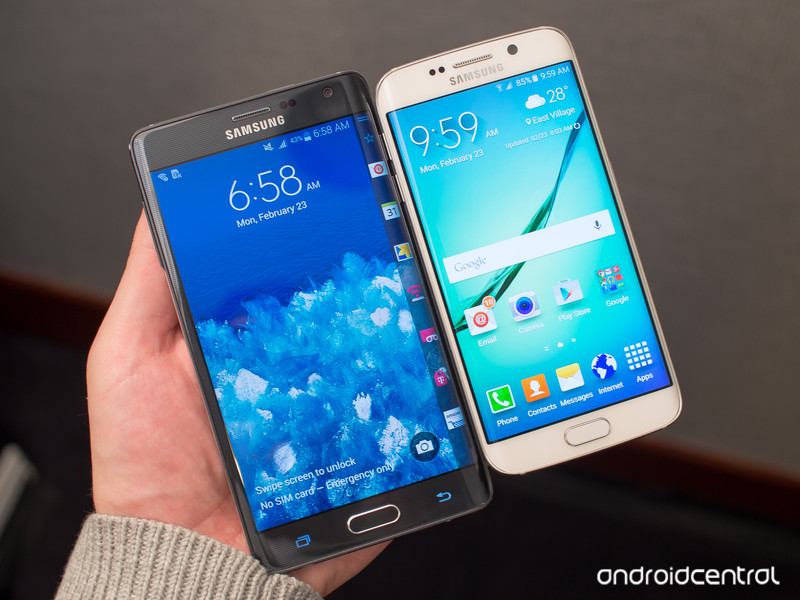
Samsung has of course been putting curved panels in production phones since the Galaxy Note Edge that eventually spawned into a phenomenon that has become a hallmark of Samsung’s high-end devices. The company has been experimenting with bendable OLED panels for years, going so far as to show them off publicly as technology demonstrations. But the question is whether it could make devices with displays that could be actively bent or folded thousands of times as a regular part of use. The display would have to be very robust, but then you also have the issue of what covers the display panel — typical Gorilla Glass wouldn’t do the trick.

LetsGoDigital has worked up renderings based on reports and patent filings that show the Galaxy X as a vertical-orientation phone, but with a hinge mechanism built into the sides of the phone. The phone would be rigid (and what looks to be extremely tall as well) when the display is extended and flat, but you could pull the top and bottom apart to expose the hinge to then bend while the screen follows suit.
Further renders show the phone while closed, which leaves a gap around the hinge portion not unlike a Microsoft Surface Book laptop. Large internal components would of course split between the top and bottom halves of the phone by the hinge.
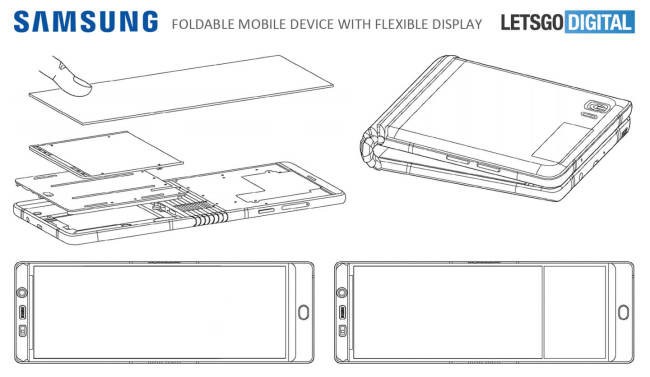
Early rumors pointed to a Galaxy X with a hinge and two displays, but now we’re talking about just one panel.
Early rumors of the Galaxy X pointed to some sort of announcement or teaser as early as late 2017, which obviously didn’t happen. But those same rumors questioned whether the Galaxy X was truly a “bendable” phone with a single screen, or simply a hinged device with two distinct panels — like the ZTE Axon M, for example. It seems now that Samsung’s going to attempt a full-on single bendable display. Other rumors also had indicated Samsung had a more tablet-shaped device with this bendable display technology in place, and that may still be on the table in different future devices, but in terms of the “Galaxy X” it looks to be a traditional vertical phone orientation.
When it will be announced
During IFA 2018 over in Berlin, Samsung’s mobile division CEO — DJ Koh — confirmed that a foldable smartphone will be launched before the year is over.
Koh teased that we may learn more information during the Samsung Developer Conference in November, but it’s still unclear when this year the phone will actually go up for purchase.
Update August 2018: Updated with a new statement from Samsung about the Galaxy X’s launch.
 AIVAnet