


Fallout 76 for PS4: 5 main factions revealed
Fallout 76 is about to take nuclear survival to an entirely new level.

Post-apocalyptic nuclear wastelands are supposed to be terrifying, but we’re always excited to experience those conditions whenever we take a visit back to the world of Fallout. With Fallout 4 having kicked this generation off, Bethesda is ready to turn in yet another new title – and all of this is before we’ve had another proper Elder Scrolls game!
It’s called Fallout 76. And no, that doesn’t mean it’s the 76th Fallout game made. To find out the significance of that number and everything else you need to know about Fallout 76, read on.
What’s new with Fallout 76?
Excited about rebuilding a civilization devastated by nuclear fallout? Keep it locked here for the latest details on Fallout 76. We’ll be updating this post periodically as new information surfaces.
October 22, 2018 — New factions revealed
Bethesda took the weekend to trickle out new information about Fallout 76, namely the different factions you’ll encounter in the game. There will be 5 major factions, each with their own motives and goals.
Those factions are the Brotherhood of Steel, the Enclave, the Raiders, the Free States, and the Responders. The former three are returning from previous Fallout games, with the others being brand new.
Here’s a bit about each of those groups of folks and what they’ll be up to once you step into the nuclear wasteland later this year:
Brotherhood of Steel: Formed by Captain Roger Maxson, this Brotherhood typically had more capitalistic aspirations. The group holed up in the Californian Bunker of Lost Hills. It was there they found a working satellite, and used that technology to extend their reach from one coast of the United States to the other.

Raiders: Raiders want everything, and they’ll do anything to get it. The group is headed up by Rose, whose ruthless leadership makes this group one to take note of, if not outright fear.

Enclave: US leadership retreated to a remote oil rig right before the bombs fell. They’ve lost control of America for now, but their goal is to make it back to the US mainland and reestablish government from a secret bunker hidden somewhere in Appalachia.

Free States: A heady group of doomsday preppers knew this day was coming, and their preparations have helped them survive the worst of it. Or, at least they thought the bombs were the worst of it.

Responders: They have one goal: save everyone they can, no matter what it takes. Comprised of firefighters, doctors, police, and other brave souls, the Responders’ sole interest is to get aid to the people in need.

Fallout 76 launches November 14, 2018 for PlayStation 4, Xbox One, and PC.
September 28, 2018
Bethesda has revealed that Fallout 76’s B.E.T.A. will begin on October 30 on PlayStation 4.
August 7, 2018
Bethesda has released new details regarding Fallout 76’s B.E.T.A. (Break It Early Test Application). Over on its FAQ page, the company noted that the beta will contain the full game, and all progress made within it will be saved and carry over once the game launches in November. If you’re playing on PC, you’ll need to access the beta through Bethesda.net as it won’t be available through Steam’s storefront.
July 23, 2018
Just like Fallout 4 received, Fallout 76 is getting a strong marketing campaign in the months leading up to its launch. Bethesda has new videos showcasing a few of the new mechanics you’ll encounter within the game.
Intro to multiplayer and griefing
Fallout 76 won’t feature any human NPCs, so when you see another person out in the Wasteland, it’s someone from the real world. Whether they turn out to be hostile or friendly, this constant knowledge should always keep you on your toes.
In order to avoid griefing, you cannot be killed by another player until you reach level 5, giving you some time to accustom yourself to the gameplay. Those deemed overly aggressive will also be given a wanted level, further discouraging players from ruining the fun of others. Bethesda is still tweaking the systems in place to deter griefing, but there will be systems so players cannot be abusive.
“So you can’t be harassed by somebody who just keeps chasing you around the world and keeps killing you over and over again,” said Bethesda’s Pete Hines. “The game literally doesn’t allow that to happen to you.”
Intro to C.A.M.P.
Bethesda expanded upon Fallout 76’s base building. Dubbed the C.A.M.P. (Construction and Assembly Mobile Platform) system, this differs from Fallout 4’s settlement system in that you can move your base around. It wouldn’t seem fair to settle down in one area only to find yourself plagued by enemies day and night. If you do find your little base under attack too often for your liking, you can move it around between pre-determined areas of the map. The building process, menus, and UI are similar to that found in Fallout 4.
Intro to nukes
When Todd Howard revealed that players could nuke sections of the map, there were some reservations about this mechanic. How would this affect gameplay? Could this be abused? Thankfully, Bethesda is implementing nukes in such a way that sounds more like a fun challenge and less a constant annoyance.
The ability to use nukes is gated behind randomly finding every piece of the code to launch one. You can’t just go up to a silo and instantly nuke the world. When you’re out fighting the various threats in West Virginia, you may find that one of the fallen enemies has a nuclear Silo Alpha Code when you go to loot them. This is just the beginning of your journey to unleash hell. Once you collect several pieces to get the full code, you can then find the appropriate nuclear silo and choose a target to wipe out in one of the six distinct regions; Ash Heap, Toxic Valley, Savage Divide, The Forest, The Mire, and Cranberry Bog.
Nuking an area turns it into an end-game location of sorts. The resulting destruction changes the land for a period of time (not forever), welcoming more powerful enemies, rare loot, and new environmental hazards. Great rewards come with great risk. Think of areas similar to the Glowing Sea in Fallout 4.
B.E.T.A.
As announced at E3, Fallout 76 will indeed be getting a B.E.T.A. (Break-it Early Test Application) before arriving this fall. Bethesda recently revealed that the beta will be taking place in October, though specific dates were not announced. The company has stated that Xbox One users will get access to the beta first before PlayStation 4 and PC. Currently you can get a code to participate in the beta by pre-ordering Fallout 76 at participating retailers.
July 1st, 2018
Speaking on the issue of cross-play. Bethesda’s Todd Howard confirmed that Fallout 76 won’t have the feature. He mentions that they would love to add it, but it isn’t currently possible due to Sony’s policy on not allowing cross-platform play with competing platforms.
A loosely translated report from German outlet Gamestar suggests Howard specifically called out Sony, noting that they are “not as helpful as everyone would like it.” This comes as no surprise, as Sony has been under fire lately for the cross-play issue that keeps Fortnite players from being able to use their accounts on multiple platforms.
Howard’s tone would suggest that cross-play could eventually be added if Sony ever lifts restrictions, but for now, you can expect the online communities of Fallout 76 to remain isolated.
June 10th, 2018
At E3 2018, Bethesda premiered a new trailer for Fallout 76. It’s a direct extension of the launch teaser, with the company showing us life outside the vault. We’ve learned that the wastelands are still just as ravaged as you’d expect after a nuclear bomb hits.
The trailer doubled down on expectations that Fallout 76 will be focused on the act of rebuilding a society in the rural plains of West Virginia. Players will not only build up houses but also help grow and nurture entire communities. It even tasks you with educating young ones, a sign that we may see some sort of hereditary system. And you might also get to rebuild an entire government.
We also saw the same power armor suits we’ve seen in previous games, some sort of dragon-esque creature flying about, and a handful of rural towns and cities. Bethesda noted that the overall game world would be four times larger than Fallout 4, some of which was on display in the trailer.
Bethesda also confirmed some gameplay details in their own E3 showcase. We got confirmation that Fallout 76 is entirely online, with folks entering the vast wasteland with at least a dozen other players.
You and your friends can build a survival settlement together, help other players, or even get into some sort of conflict with other players you come across. That conflict can escalate quite heavily with the ability to find nuclear keys and use them at active nuclear launch sites.
Despite the heavy online focus, players will be able to play the game entirely solo if they so wish. Bethesda didn’t specifically say they could play offline, however, so there may be some sort of passive gameplay option available to players. And if you do decide to jump into a friend’s game every now and then, you will be able to take all the progress you’ve made (and, presumably, items found) back to your own game.
Fallout 76 will launch November 14th, 2018, and there will be a beta test ahead of the game’s launch for players who want to ensure Bethesda catches as many bugs and fixes as many issues as possible.
If you’re going to pre-order Fallout 76, you’ll want to consider this awesome collector’s edition. Called Poer Armor Edition, those willing to drop the money on it will get an actual Power Armor helmet, complete with a working light and voice modulator. The helmet is even designed to be worn if your head will fit inside.

There’s also a West Tek duffle bag, a glow-in-the-dark world map, collectible figurines, an exclusive steel case, and bonus digital in-game items. There’s no pricing for all of this just yet, but we’d suggest saving at least $150 if you plan on getting it.
What’s Fallout 76?
The Fallout series has traditionally placed players within a post-nuclear world. It’s a survival game at heart, they’re typically open world affairs ever since the third mainline title, and they feature Bethesda’s signature RPG touch, but with a combat twist that’ll make each encounter equally interesting and intense.
You’re typically in control of a character who has spent most of their life within a “vault,” built for sheltering survivors from the effects of nuclear radiation. In previous Fallout titles, these vaults were typically evacuated due to emergency circumstances, with the events forcing you out into the world to fend for yourself. Some of these vaults are moderate in size, but there are a number of bigger ones called “controlled vaults” which house as much as 500 survivors.
The original purpose of these vaults was to have them open exactly 20 years after the nuclear bombs dropped, with the creators looking to compare the survival rate of those who were let out versus those who remained inside. Vault 76 was one such vault, and it serves as the starting point for Fallout 76.
What’s the story so far?

While the trailer nor Bethesda managed to reveal any hard facts, several things within the announcement trailer help us begin to paint a picture. For starters, the game is set in the year 2102, as spotted by the date entered on one of the Pip-Boy units lying around. We’re not sure if the entirety of the game moves on chronologically from that point, but it’s significant for a couple of different reasons.
The first reason is that this will have been the earliest time in a Fallout game we’ve ever seen. The original Fallout took place in 2161. Fallout 2 was 2241. Fallout 3 and New Vegas were 2277 and 2281, respectively. The most recent entry – Fallout 4 – took us to the year 2287.
While the bombs have already dropped by the time 2102 arrived (doomsday was October 23rd, 2077), Fallout 76 should be the purest a Fallout world has ever been, meaning buildings won’t be as worn down, vegetation won’t be as scarce, wildlife won’t be as mutated, and things might not be quite as depressing overall. That’s not to say you should expect an oasis, but it could be the perfect excuse for Bethesda to give us more of a living, breathing world when previous games gave them every excuse not to.
The second reason the year 2102 is significant is because Vault 76 was supposed to have opened precisely 20 years after the first bombs dropped — the inhabitants even seem to be celebrating their “Reclamation Day” at some point — but that date would mark 25 years. That means one of two things happened: the vault did open five years ago and we’re just seeing the abandonment in all its glory, or something terrible has happened that delayed the grand opening. And if you know the history of Fallout games, you know you’ll almost never leave the vault due to some regular occurrence.
Beyond that, Bethesda dropped hints as to the game’s setting. The song playing on the radio throughout the trailer is Country Roads, a country song about West Virginia, and sure enough that’s where the game will take place.
We now know that the player will be among the first inhabitants to leave the vault, and that it’ll be up to them to help begin the slow rebuild of society.
Base building, rodent killing, and online play

The first Fallout 76 trailer didn’t give us any expectations of gameplay mechanics, but some early rumors have given us an idea of what to expect. We’ve heard that the base building aspect introduced in Fallout 4 will return in Fallout 76, presumably with more polish and a greater level of detail. In fact, it may serve as the entirety of the game’s premise (whereas Fallout 4’s felt like more of an afterthought feature). We can see a situation where you’re one of Vault 76’s inhabitants and you’re tasked with building up a settlement to help you and your family survive.
And we’re sure all this base building would necessitate supply and food runs, meaning there’ll be plenty of reasons and opportunities to venture off into the wildlands. Expect a huge bundle of quests along the way that’ll help you gain new companions, gather the supplies you need, and indulge in Fallout’s unique combat system that mixes real-time action and turn-based strategy.
Fallout 76 will not be your typical Fallout game.
Another big detail is that Fallout 76 will be the first ever online Fallout game. Fallout 76 originally began as an experimental project to see if an online component would be right for Fallout 4. While that development never came to fruition for the existing title, Fallout 76 gives them a nice opportunity to take a chance.
It’s suggested that it will be akin to games like Rust or ARK: Survival Evolved, where dozens of players can exist on the same server. In those games, you start off with absolutely nothing in your possession, and it’s up to you to start building the shelter, sowing the seeds, crafting your tools, and marking your territory. There will be both cooperative and PVP elements in play.
But those who are fans of single-player experiences shouldn’t fret, apparently. It’s said there will still be a massive quest line for you to enjoy solo should you shy away from interconnected conflict. That’s sure to be good news for folks who enjoy Bethesda games for their strong single-player stories.
When can you play it?
Bethesda has confirmed that Fallout 76 will launch November 14th, 2018, and you’ll be able to play the game on PS4, Xbox One, and PC whenever it launches. Be sure to check back often for more news and updates about Fallout 76 as we begin the long wait for an eventual release!
Updated September 2018: Added information regarding its B.E.T.A.
PlayStation 4

- PS4 vs. PS4 Slim vs. PS4 Pro: Which should you buy?
- PlayStation VR Review
- Playing PS4 games through your phone is awesome
Amazon
Canada Daily Deals: iTunes gift cards, TCL TVs, Nest Hello doorbells, more
Whether you’re looking for new tech gear or household items, we’ve got you covered.
We found plenty of great deals today that include big discounts on ILIFE Robotic Vacuum Cleaners, TCL 4K HDR Roku TVs, Nest Hello bundles, AMD Ryzen processors, and much more!
View the rest of the deals
Each day, the Thrifter Canada team scouts out and shares amazing deals on products you know and love, helping you find the best prices on the ‘net.
For more Canadian deals coverage, be sure to keep an eye on Thrifter CA, sign up for the Canadian newsletter and follow the team on Twitter.
Tim Cook Visits Europe Ahead of Brussels Privacy Conference
Later this week, Apple CEO Tim Cook is set to speak at the European Data Protection Conference in Brussels during the “Debating Ethics: Dignity and Respect in Data Driven Life” session.
Ahead of the event on Wednesday, Cook is in Europe visiting app developers and filmmakers who work with the iPhone. Cook has been sharing his European adventures on Twitter.
Cook visiting the developers behind Asana Rebel, a yoga app
Cook started off the week in Berlin, where he met with developer Peter Kolski and took a look at mauAR, an upcoming augmented reality app that will display the Berlin Wall as it was prior to its demolition in the 1990s.
Schön, wieder einmal in Berlin zu sein! Thank you @peterkolski and the mauAR team for bringing the Berlin Wall’s history to life through augmented reality — a new way to learn from the past. We are looking forward to seeing your app on the App Store! pic.twitter.com/NhwGUUgG2O
— Tim Cook (@tim_cook) October 21, 2018
Cook went on to visit the Asana Rebel team, who have created an augmented reality yoga app available on the iOS App Store .
Here’s to the rebels! Thanks for the visit, @AsanaRebel, and for sharing your enthusiasm for yoga and wellbeing. 🧘♂️ We’re thrilled when entrepreneurs like you use the App Store to turn their passion into a thriving global business. pic.twitter.com/G4FOR3HtNK
— Tim Cook (@tim_cook) October 21, 2018
After that, he stopped off in Paris where he met with French filmmaker Claude Lelouch, who shot his upcoming movie on the iPhone.
Bonjour Paris! 🇫🇷 Honored to meet legendary director Claude Lelouch and hear about his upcoming film, which will be #shotoniphone. In 50 years of filmmaking, he says he’s “never been happier” than when shooting with iPhone! pic.twitter.com/t5q8J8jOW6
— Tim Cook (@tim_cook) October 22, 2018
Cook then stopped by the offices of Foodvisor in Paris. Foodvisor is an app that is designed to analyze the nutrients in food through a photograph.
Now here’s a good reason to snap that photo of your lunch! Had a blast at @foodvisor_app’s office in Paris, seeing how their artificial intelligence makes food tracking easy. 🍣 pic.twitter.com/i1NoM1OLM3
— Tim Cook (@tim_cook) October 22, 2018
After visiting Foodvisor, Cook stopped by L’Atelier des Artistes en Exil in Paris, which showcases the artwork of artist refugees around the world.
A profoundly moving visit to @aartistesenexil in Paris. Through their works of creativity and courage, these artists are shining a light on the hardships that so many face as refugees. “On ne voit bien qu’avec le cœur. L’essentiel est invisible pour les yeux.” pic.twitter.com/rKGz2rlFAX
— Tim Cook (@tim_cook) October 22, 2018
Cook has one more day in Europe ahead of the Brussels conference, and he is planning to meet with French president Emmanuel Macron at the Élysée Palace tomorrow, where taxes and developer relationships may be topics of conversation.
Cook will be in Belgium on Wednesday, and following the conference, he may spend some more time in Europe before flying back to the United States to prepare for Apple’s October 30th event in New York City.
Tag: Tim Cook
Discuss this article in our forums
Google Home Hub review

First there was the Google Home. Then, the Google Home Mini and Home Max. For 2018 it’s the Google Home Hub.
Unlike its predecessors, the Home Hub is the first product in the smart home line to offer up a full display. It’s the same smarts underneath, and features a a decent speaker, and sounds pretty much like the same experience. It’s not. The Google Home Hub changes the game for Google.
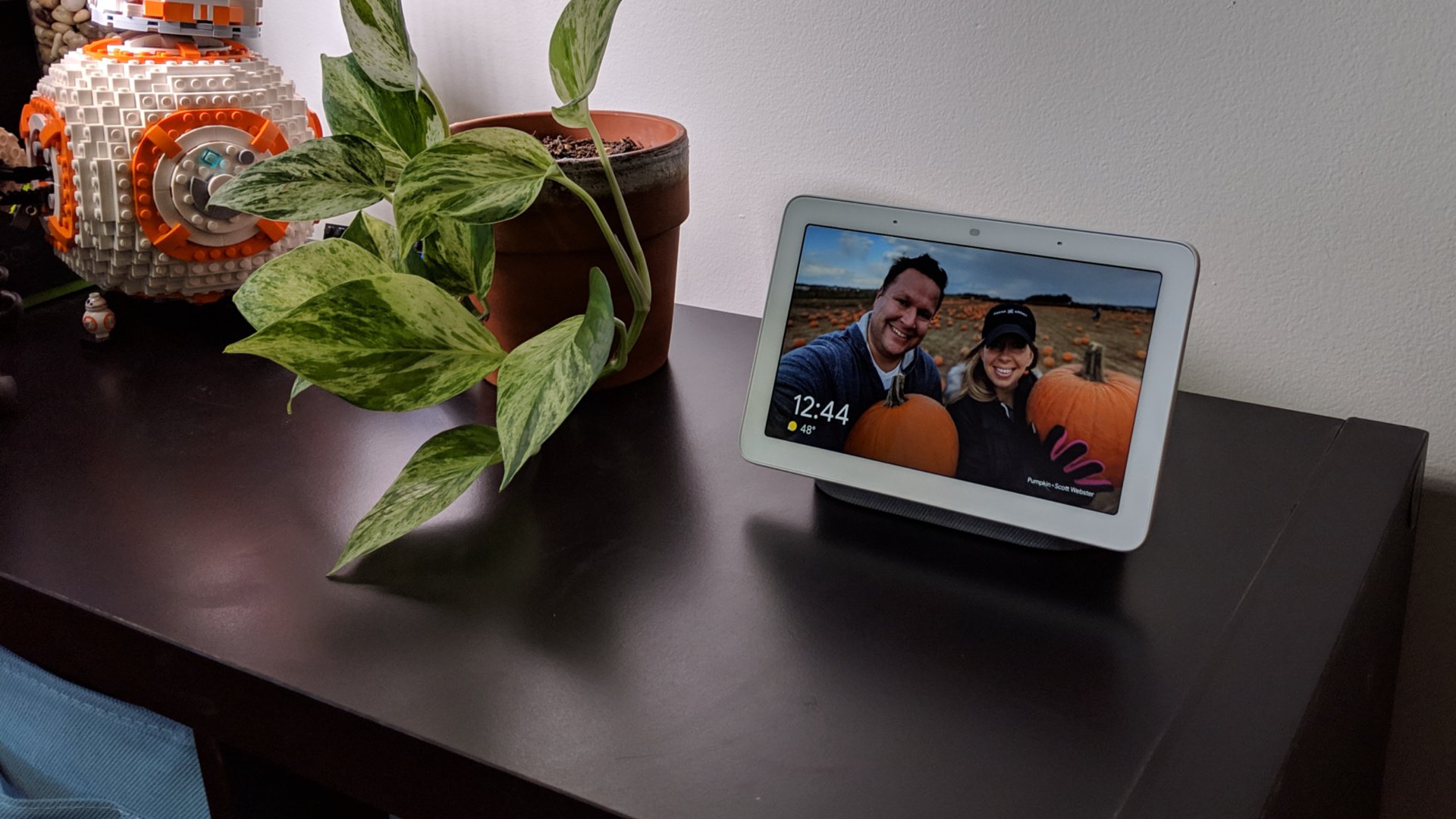
Think back over the last decade or so and chances are good that you’ve either owned or known someone who purchased a digital picture frame. Google Home Hub is that, but so much more.
Almost all of us have at least one Bluetooth or Wi-Fi connected speaker that we like to listen to music, podcasts, or audiobooks on. Nothing fancy, just a favorite unit that travels either throughout the house or stays in a convenient location. The Google Home Hub is that, too, but so much more.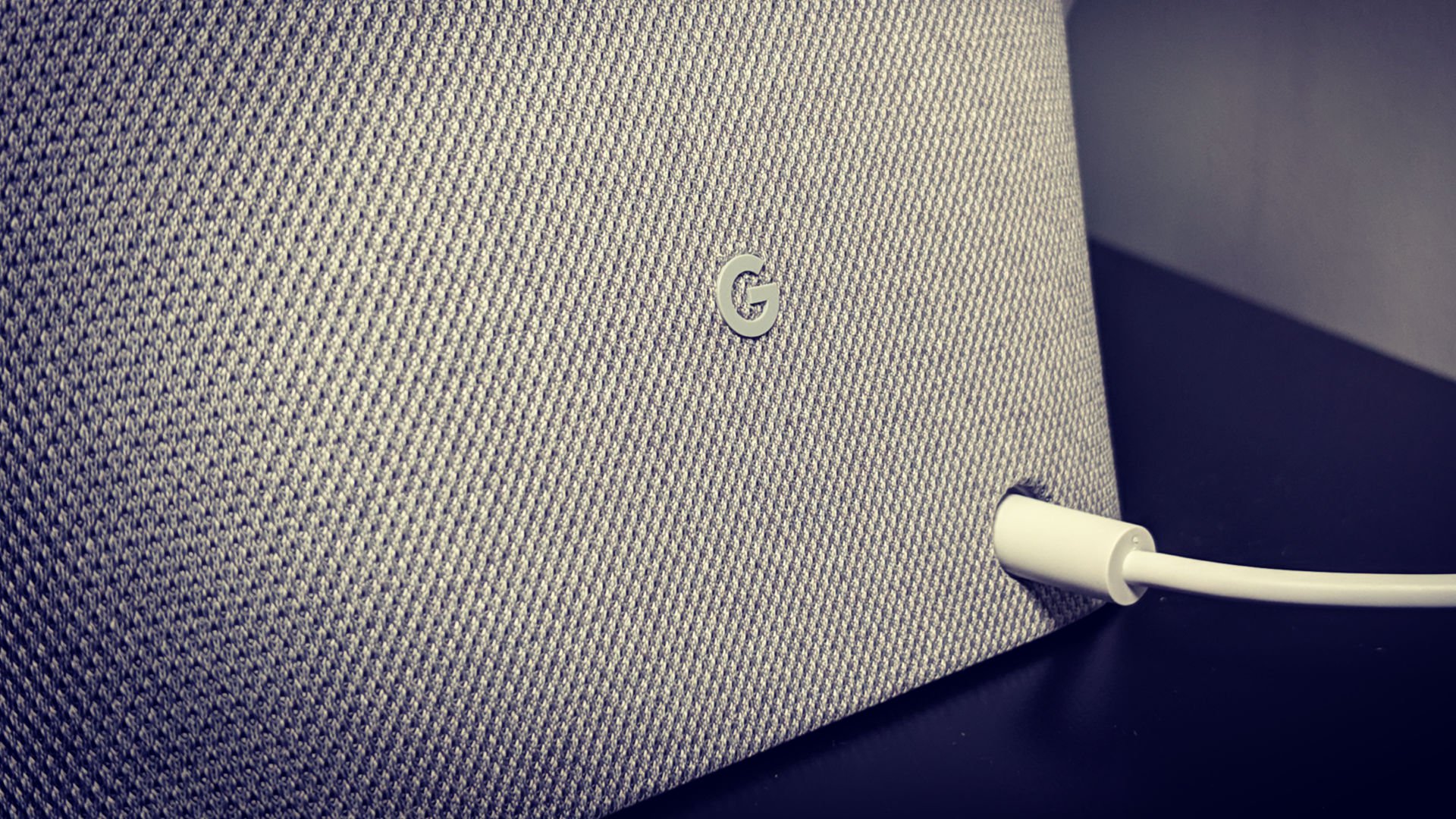
Many of us own a smart speaker that we can tap into for reminders, grocery lists, help with cooking or homework, or general search. Google Home Hub is… well, you already know.
Falling Fast in Love
After just a few days with the Home Hub we’ve already come to appreciate it for so many reasons. From the simple, intuitive design to the technical prowess under the hood, it’s one of those devices we can see in each room of the home.
The Home Hub is more compact than you’d imagine, but it doesn’t feel small. It’s comprised of a 7-inch display with a white bezel and a speaker. The former sits in landscape mode at a reclined angle while the latter is your base. The speaker is wrapped in a fabric not unlike what Google has on the Home Mini.
The front side features two far-field microphones, and “Ambient EQ” light sensor. Around back is the volume rocker and the microphone toggle. There’s no camera to be found, but you won’t really need, or miss that option.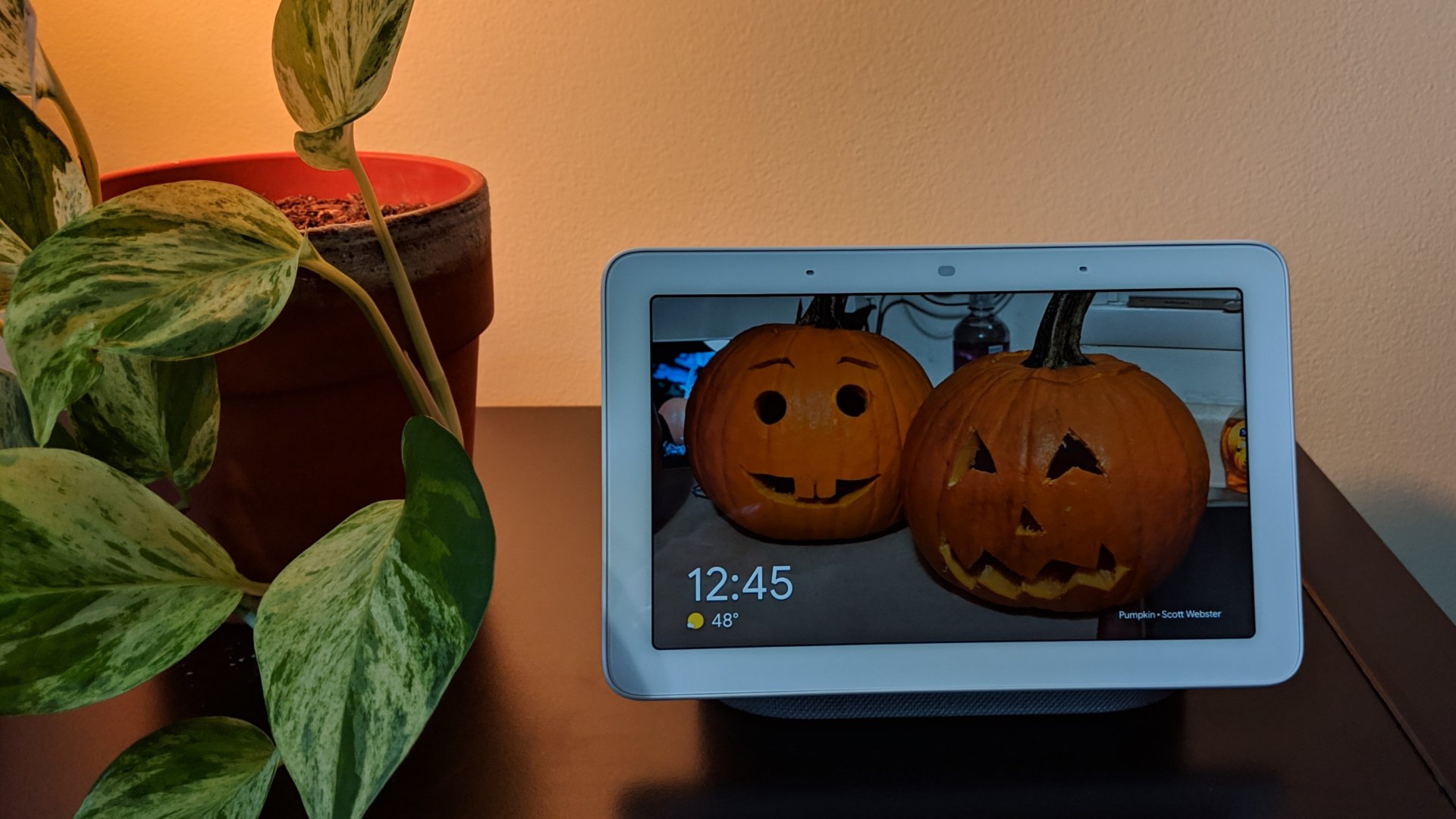
The light sensor automatically adjusts brightness and color temperature based on the ambient lighting in environment. Place it in a well-lit kitchen or living room area and it pushes out a brighter image. Dim the lights, or keep it on the nightstand, and it dials things down so they’re not jarring or harsh.
Display
Surprisingly, the display resolution is relatively low at 1024 x 600, which is far less than what you’re getting in today’s smartphones. What’s more, the pictures you’re capturing tend to have exponentially higher pixels. That’s hardly noticeable here as pictures still pop right off and look every bit as sharp as you’d like.
Color balance and saturation are tuned to our liking and we never really felt like we needed to dial something up or back. Brightness, thanks to the sensor, is always what the room calls for and doesn’t distract.
Tips and tricks every Google Home user should know
If for no other reason than to provide a connected digital picture frame, the Google Home Hub is worth the price. Moreover, it’s incredibly simple to set up and work with; it’s a perfect gift idea for grandparents or long-distance family.
Setup
Setting up the Home Hub is incredibly simple, particularly if you’ve already got a device or two in the home. Our process consisted of plugging and following the prompts in the Google Home apps on our phone. All told, we probably spent 3-4 minutes in setup with some of that coming from an update.
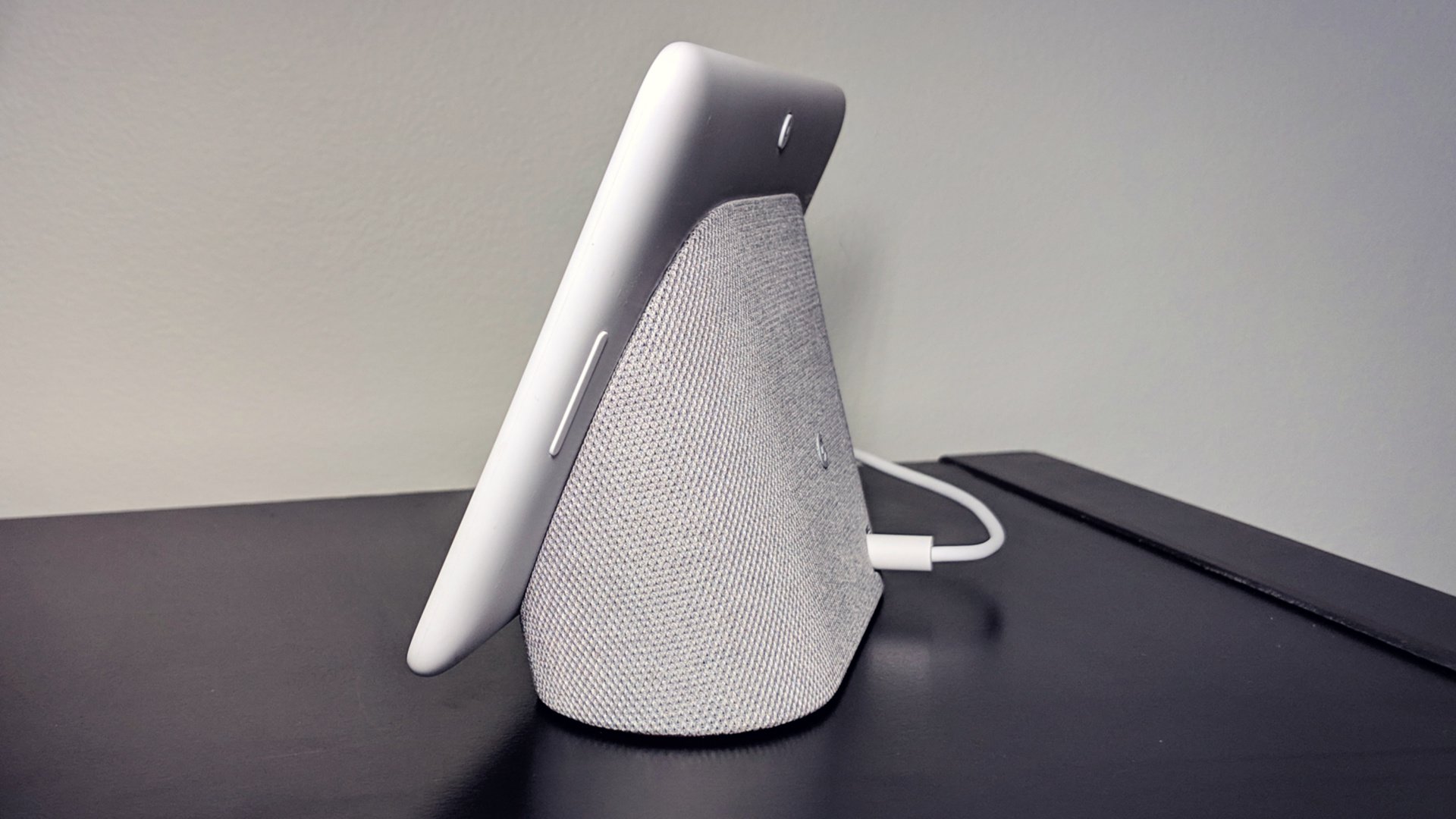
The connected device is designed to work as a passive, always-ready, speaker and display. You can leave it alone for days on end and let it cycle through your Google Photos or a collection of curated pictures. Alternatively, you can opt to show one of a few clock options.
Choosing your pictures to showcase can be a lot of fun as all of your shared albums are ready to go. Additionally, you can just let Google do its magic and pick highlights of your gallery, randomly pulling up your best stuff.
Users have control over how often pictures change with a range of five seconds to ten minutes. Changing the album(s) and speed is a breeze; you’re never stuck with anything.
The Google Home app has really improved over the last few releases, adding in options and a more friendly interface. It’s insanely easy to configure your connected speaker or display.
If anything, the Google Home Hub is the easiest device we’ve added to a network. Why? Maybe it’s the visuals that help us see where we are in the process.
What Else?
The Google Home Hub is ready for you to Cast to it. That’s an awesome feature and one we’ve found ourselves using quite a bit. Depending on where you’ve placed the unit you might want to send YouTube TV or Hulu over to it to act as a second or third screen in the room.
You can cast pretty much anything you want to the Home Hub save for Netflix. This isn’t a limitation on the side of Google so much as an Netflix decision. Nevertheless, as much as we’ve enjoyed watching small bursts of news or sports as we go about chores, we don’t see ourselves binge-watching our way through Ozark on it.
Sound is good, but it’s not great. If you’re primarily concerned with pumping out music, you’ll want to pair a separate Bluetooth speaker to it. Generally speaking, we’re okay with the somewhat flat audio experience as it’s right in line with the Google Home or Google Home Mini.
The more we’ve used Google Assistant over the last few years, the more we’ve come to appreciate it. We’ve evolved from having it on our phones as a Google Search/Google Now on steroids to something we often rely for small things.

Today we’re routinely asking Google Assistant about our day, the weather, our appointments, or commute. Getting that information is helpful not only on a phone, but anywhere we happen to be. Having visuals makes that better.
It cannot be overstated how nice it is to see a graphic representation of the weather, or calendar events. Ask how your day looks and you get a map of the route with any slow downs or accidents to accompany the commute details.
We’re going to have a difficult time getting the Home Hub outside of the kitchen. Not only are we enjoying the manner in which recipes look and work, but we’ve asked it to be our oven timer and conversion tool, too.
Although the Home Hub doesn’t have a camera on it, you can use it for Google Duo calls over voice. By contrast, the Lenovo Smart Display does allow for this, and it’s pretty nice to have. We don’t necessarily need it, though, as it’s not a primary means of communication.
As the name implies, the Home Hub does give you control over the various connected items in your home or office. You can’t set everything up directly from within the app, but it’s a solid way of managing things once they are up and running.
Controls can include things such as dimming lights or switches throughout the house, adjusting the thermostat, or viewing Nest doorbells and cameras. Google has done an excellent job of adding in new controls and hardware partners over the last couple of years. Looking ahead we fully expect that to ramp up, particularly now that we have visuals.
Conclusion
The Google Home Hub is a must-have device for those who rely on Google Assistant. For about $20 more than the Google Home you end up with a 7-inch digital display that compliments search and routines.
We like creating groups of speakers and devices so we can play music, podcasts, and other media throughout the home. As we move from room to room in the morning, as part of readying for bed, we appreciate that we can keep up with the news or a book.
Given how easy it is to install and configure, we’re really itching to add devices like these to other rooms. In fact, we’re already looking ahead to the holidays and outfitting the homes of friends and family.
If you’re considering a connected or smart speaker, you absolutely should put the Google Home Hub on your list. Whether it’s your first foray into the world of Google Assistant or if you’re complimenting your current setup with something visual, it’s the stepping off point.
Samsung’s HMD Odyssey Plus gives you a clearer view into the virtual world
Samsung is giving its Odyssey Windows Mixed Reality headset a nice refresh. With the HMD Odyssey+, Samsung is focusing on a better and more comfortable visual experience. Though Samsung’s refreshed efforts didn’t result in a wireless mixed reality headset that has been rumored in recent months, the biggest improvement that the Odyssey+ delivers is a new exclusive anti-screen door effect, or anti-SDE, in the display.
The headset ships with dual 3.5-inch AMOLED displays, delivering a combined resolution of 2,880 x 1,660 pixels, and the new anti-SDE feature should give wearers a cleaner and crisper view into mixed and virtual reality experiences. And by eliminating the screen door effect, Microsoft claims that this not only leads a more enjoyable experience, as it could help reduce the feeling of dizziness or nausea.
“Samsung anti-SDE AMOLED Display solves SDE by applying a grid that diffuses light coming from each pixel and replicating the picture to areas around each pixel,” Microsoft explained in a blog post. “This makes the spaces between pixels near impossible to see. In result, your eyes perceive the diffused light as part of the visual content, with a perceived PPI of 1,233PPI, double that of the already high 616PPI of the previous generation Samsung HMD Odyssey+.”
With the anti-SDE feature, the headset and its motion controllers will ship for the same $500 that its predecessor debuted at starting Monday, October 22. Microsoft also reduced the price of the original HMD Odyssey down to $349 on its online store, but at at the time of this article’s publication, a listing for the Odyssey+ has not appeared on Microsoft’s online store.
Although the overall design of the Odyssey+ is reminiscent of the original Odyssey, Samsung also made a few tweaks to make the headset more comfortable this year. The Odyssey+ is a few ounces lighter, weighing 1.3 pounds, and comes with improved ergonomics, like a wider eye box. The headset is also more adjustable this year, allowing you to adjust the display position and control the Inter-Pupillary Distance with a wheel.
Like recent Samsung consumer products, the headset leans on AKG to deliver a premium audio experience. Samsung claims that the headset will deliver 360-degree Spatial Sound that can simulate 3D sounds. This will help you feel more immersive in mixed reality environments, especially since the Odyssey+ also supports six degrees of freedom (6 DoF).
“The 6DOF controller can detect your every move and distance traveled inside your MR world, responding quickly to the slightest motion, ensuring your gameplay movements are more natural, and significantly reducing any dizziness from in-game motion,” Microsoft said.
Editors’ Recommendations
- Acer OJO 500 Windows Mixed Reality headset lets you straddle real, virtual worlds
- Oculus Quest vs. Oculus Rift
- Oculus Rift review
- Oculus Quest vs. Oculus Go
- The Samsung Galaxy Tab S4 is a tablet and computer rolled into one
Intel denies rumors that 10nm Cannon Lake CPUs have been canned
Intel
If you were holding off on upgrading your PC to see what Intel’s truly next-gen 10nm CPUs are capable of, you might want to rethink that decision. A new report claims that the notoriously troublesome architecture has been scrapped entirely and will no longer be coming to market in 2019, or ever. However, Intel has since denied the rumors, claiming that production is on track with previously announced timelines.
Intel’s 10nm Cannon Lake CPUs have been troublesome throughout their developmental life cycle. Originally slated to debut in 2016, they were pushed back again and again due to manufacturing difficulties that lead to their yield being far lower than expected and needed. The last report we heard was that they were only likely to appear in serious numbers at the tail end of 2019, but now it’s uncertain whether we’ll see them at all.
Intel has since rejected such claims, stating in a tweet on Monday, October 22, that its yields were improving and that the development of the 10nm standard was ongoing:
Media reports published today that Intel is ending work on the 10nm process are untrue. We are making good progress on 10nm. Yields are improving consistent with the timeline we shared during our last earnings report.
— Intel News (@intelnews) October 22, 2018
The initial rumor came from Semi-Accurate’s Charlie Demerjian, who claimed that Intel has now axed 10nm production entirely. If true, this would be a major step by Intel, suggesting we may have an even longer wait than next holiday season before Intel can offer something beyond its newly launched 9-series range.
Though Intel’s new 9900K, 9700K, and 9600K CPUs are impressive, they aren’t exactly revolutionary. That could be problematic with AMD slated to debut its first 7nm Zen 2 Ryzen CPUs at CES 2019, with a general release estimated to take place later in the year.
With suggestions of big performance gains to be had with AMD’s die shrink to 7nm from existing 12nm Zen+ CPUs, Intel will need to do something special to remain competitive. Cannon Lake CPUs were expected to do just that, but now its future has been brought into question. Intel’s language didn’t name Cannon Lake specifically, so it could be that that architecture has been canceled and Intel is shifting work to its planned “10nm+” successor for Cannon Lake, known as Ice Lake — that is pure speculation on the part of this writer, however.
Editors’ Recommendations
- Intel’s 10nm ‘Cannon Lake’ processors won’t arrive until the 2019 holiday season
- New Intel CPUs bake in gigabit wireless and Alexa support
- Intel’s ninth-generation CPUs could launch on October 1
- New Apple MacBook may appear in September at $1,200
- Google may launch two Pixelbook 2 laptops in October
Not to be outdone, Samsung says it’s making a laptop with a foldable display
Ryan Smalley | Behance
Samsung’s ambitions with foldable displays in consumer electronics won’t stop at building and launching one of the first smartphones with a foldable screen. Not to be outdone by PC rival Lenovo, which was reported to be working with LG Display on plans to launch a laptop with a foldable screen, Samsung announced that it is also working on a notebook with a large foldable screen that will leverage technologies found in flexible displays.
“Like foldable smartphones, Samsung is collaborating with display makers to develop laptops with foldable displays that will not just simply fold in and out but create new value and user experience, amid the changing market trends for laptops,” Samsung vice president of PC marketing Lee Min-cheol said, according to Patently Apple.
Creating new value for the novel user experience isn’t something that hardware companies like Samsung are grappling with. Microsoft, which has its own hardware business under the Surface branding, was also widely believed to be working on a compact PC with a dual-screen display known as Project Andromeda. However, it’s been reported that Microsoft shelved its plans for the dual-screen device because it did not find a compelling use case for the device. And lacking a clear use, it would be hard for marketing teams to ask consumers to justify what will likely be a premium for the new technology.
A recent Microsoft patent filing revealed that Microsoft may be reconsidering its dual-display strategy for Project Andromeda by going with a new hinge design and a single flexible display that can fold. If Microsoft does release such a product, the idea may be similar to Samsung’s strategy with its foldable smartphone and laptop. Microsoft may also be exploring concepts for a laptop with a flexible display, according to earlier patent filings.
Earlier this year, Intel worked with a PC partners Asus and Lenovo to show off prototypes of dual-screen laptops. Though these devices, referred to as Tiger Rapids, replace the keyboard portion of a traditional clamshell notebook with a second screen, they don’t come with a single, large foldable display that Samsung’s Min-cheol referenced. In a separate report on Patently Apple, Samsung said that it “will continue developing innovative PCs with partners like Intel and Microsoft.”
A foldable display will offer the convenience of a smaller footprint for travel when folded, but can expand to a larger, more immersive display to consume content when it’s opened. In the past, Samsung Mobile CEO DJ Koh stressed that a folding smartphone would be “really meaningful to our customers.” In addition to Samsung, Huawei is also working on a folding phone that can open up to a tablet-size screen.
Pick up Amazon’s 1st gen Fire TV Stick for $30 right now
Watch all your favorite shows.
The Fire TV Stick streaming media player is down to $29.99 on Amazon. That’s $10 off its regular price and a match for a deal we haven’t seen since September.

Amazon does have a newer generation of the Fire TV Stick, but it is currently $50. That version includes 4K video support and an upgraded Alexa-enabled voice remote.
The Fire TV Stick is Amazon’s most affordable streaming hardware that provides quick and easy access to popular services like Amazon Prime Video, Hulu, Netflix, and more. It has an Alexa-enabled voice remote, which means that you can speak to it and get your favorite shows played without having to search for them manually. The device supports a picture quality up to 1080p and Dolby Audio.
See on Amazon
Time to try the Instant Pot Ultra pressure cooker on sale for $120 today
Look like a cooking genius.
The Instant Pot Ultra 8-quart 10-in-1 programmable pressure cooker is on sale for $119.95 as part of Amazon’s daily deals. This pressure cooker normally sells for around $180 and has never sold for less than $140 before. The drop to $120 marks a new low, even if it is temporary. Today’s deal makes it cost the same as the 3-quart version.

An eight-quart pressure cooker makes a lot of food. If you regularly cook for six or more people, then go for it. With 10 different uses, this pot can be a pressure cooker, slow cooker, rice cooker, yogurt maker, cake maker, egg cooker, saute, steamer, warmer, and sterilizer. Some of the features include an altitude adjustment, cooking indicator, and steam release. The pot’s embedded microprocessor monitors pressure, temperature, time, and more. Users give it 4.4 stars based on 1,561 reviews.
If you need some ideas on what to do with it, this Instant Pot cookbook we’ve shared before is free right now on Amazon.
See on Amazon
Never get stranded in an emergency with the $80 Anker Roav Jump Starter Pro
Stay prepared.
The Anker Roav 800A 8000mAh Jump Starter Pro is down to $79.99 with code ROAVR312 on Amazon. The Roav normally sells for $100 and we haven’t seen a discount on it before. This deal puts it at the same price as the much smaller Anker PowerCore mini jump starter.

Anker’s device combines an emergency jump starter with an emergency battery charger. If your car dies on you, you won’t have to worry about being stranded in the middle of nowhere. You can get up to 15 jump starts from a single charge of this device. Hopefully you won’t need to use them all. If it happens at night, the device has a built-in high-intensity LED lamp. Plus, there are two USB ports for charging your mobile devices in a pinch with the 8000mAh battery. Anker backs it up with an 18-month warranty, and the 52 users who have reviewed it give it 4.6 stars out of 5.
See on Amazon
 AIVAnet