


Razer Phone 2 vs. Razer Phone: Time to level up?
Julian Chokkattu/Digital Trends
The Razer Phone was something of a surprise last year, but it looks as though gaming phones are a new category that’s here to stay. This year, Razer is looking to level up with an improved smartphone that offers the best mobile gaming experience around and improves on some of its predecessor’s shortcomings.
On top of the inevitable adoption of a newer processor, the Razer Phone 2 has a better camera, water resistance, and wireless charging support. We decided to compare it to the original Razer Phone to see precisely what has changed. Game on.
Specs
Razer Phone 2
Razer Phone
Size
158.5 x 78.9 x 8.5 mm (6.24 x 3.1 x 0.33 inches)
158.5 x 77.7 x 8 mm (6.24 x 3.06 x 0.31 inches)
Weight
220 grams (7.76 oz)
197 grams (6.95 oz)
Screen Size
5.7-inch IPS LCD
5.7-inch IPS LCD
Screen Resolution
2,560 x 1,440 pixels (515 pixels per inch)
2,560 x 1,440 pixels (515 pixels per inch)
Operating System
Android 8.1 Oreo
Android 7.1.1 Nougat
Storage Space
64GB
64GB
MicroSD Card Slot
Yes
Yes
Tap-to-pay services
Google Pay
Google Pay
Processor
Qualcomm Snapdragon 845
Qualcomm Snapdragon 835
RAM
8GB
8GB
Camera
Dual 12MP + 12MP rear, 8MP front
Dual 12MP + 12MP rear, 8MP front
Video
4K at 30 frames per second
4K at 30 frames per second
Bluetooth Version
Bluetooth 5.0
Bluetooth 4.2
Ports
USB-C 1.0
USB-C 1.0
Fingerprint sensor
Yes (side)
Yes (side)
Water resistance
IP67
No
Battery
4,000 mAh
Fast charging (Quick Charge 4.0+)
Qi wireless charging
4,000 mAh
Fast charging (Quick Charge 4.0+)
App Marketplace
Google Play Store
Google Play Store
Network support
T-Mobile, AT&T
T-Mobile, AT&T
Colors
Black
Black
Price
$800
$700
Buy From
Razer
Razer
Review Score
Hands-on review
3.5 out of 5 stars
Performance, battery life, and charging
Julian Chokkattu/Digital Trends
The Razer Phone 2 is packing a Qualcomm Snapdragon 845 processor backed by 8GB of RAM. This year’s “flagchip” is in all the top Android phones and it’s significantly faster and more power efficient than last year’s Snapdragon 835, which you’ll find in the original Razer Phone. Both have 64GB of storage with room for expansion via a MicroSD card.
The battery capacity hasn’t shifted, still weighing in at 4,000 mAh, and you’ll find support for the incredibly fast Qualcomm Quick Charge 4.0+ standard in both Razer phones, but only the Razer Phone 2 offers Qi wireless charging.
Winner: Razer Phone 2
Design and durability
Julian Chokkattu/Digital Trends
Quite honestly we wouldn’t award Razer’s design any plaudits. The chunky, squared-off look of the original, itself inherited from the ill-fated Nextbit Robin returns in the Razer Phone 2, but this time around the rear of the phone is black glass and the triple-headed snake logo glows with customizable lighting effects that can serve as app notifications. It’s a bold, unique look that definitely grabs your attention. The camera module has also been centered, giving the Razer Phone 2 a much more stylish look from the back than the original. You’ll still find the fingerprint sensor in the power button on the side of the frame. The front of these phones looks very similar with the 5.7-inch screen flanked by stereo speakers.
The first Razer Phone felt like a tank that could survive a drop or two. The glass-clad Razer Phone 2 doesn’t feel as durable, but it does add water resistance into the mix with an IP67 rating that means it can be submerged in shallow water for up to half an hour without sustaining damage.
Winner: Razer Phone 2
Display
Julian Chokkattu/Digital Trends
The displays in these phones are identical on paper. They are both 5.7-inch IPS LCD screens with resolutions of 2,560 x 1,440 pixels. They also both offer 120 Hz screen refresh and 120 Hz touch sampling, which ensures that you never miss a frame of the gaming action. It still doesn’t match the quality of an OLED screen, but Razer has managed to make the screen 50 percent brighter this year and it really makes a difference.
Winner: Razer Phone 2
Camera
Julian Chokkattu/Digital Trends
We highlighted the camera as one of the weak spots of the Razer Phone. Despite pairing two 12-megapixel lenses it disappointed with most shots and we felt the experience was severely hampered by slow software that was lacking in features. Razer went back to the drawing board with the Razer Phone 2 camera to pair an all-new 12-megapixel wide-angle lens with optical image stabilization (OIS) and a 12-megapixel telephoto lens with 2x zoom. Based on first impressions, it seems to be a big step up on last year’s camera.
Both phones can record video at up to 4K at 30 frames-per-second and also have an 8-megapixel front-facing camera.
Winner: Razer Phone 2
Software and updates
Julian Chokkattu/Digital Trends
The original Razer Phone launched with Android 7.1.1 Nougat, but has since been updated to Android 8.1 Oreo. The Razer Phone 2 is being released with Android 8.1 Oreo installed, which is a bit disappointing since Android 9.0 Pie is now available. There is a customizable launcher and a special Game Booster app, but the experience is fairly close to stock Android. We expect the Razer Phone 2 to get updates for a bit longer than the Razer Phone, so it scores the win here.
Winner: Razer Phone 2
Special features
Julian Chokkattu/Digital Trends
Both Razer phones have the fast refreshing, super responsive screen, though the brightness is improved in the Razer Phone 2. They also both offer plenty of customization options in the Game Booster app. However, only the newer phone boasts a Vapor Chamber cooling system which, paired with the more powerful processor, allows you to run demanding games for longer before the phone overheats. The Razer Phone 2 also has that versatile, eye-catching light-up logo on the back which can be fully customized with the pre-installed Chroma app.
Winner: Razer Phone 2
Price
The original Razer Phone costs $700, but the Razer Phone 2 will cost you $800. You can buy either one unlocked directly from Razer, but they won’t work with Verizon or Sprint.
Overall winner: Razer Phone 2
It’s refreshing when a manufacturer listens to feedback and works to improve as Razer has done here. A lot of the things we didn’t like about the original have been improved or fixed in the Razer Phone 2. The camera and design are much better, it’s faster, it’s water resistant now, and it supports wireless charging. Even at $100 more, the Razer Phone 2 is a much more attractive prospect and the obvious choice if you’re considering these two phones. If you already have the Razer Phone, we’re not sure you’ll want to upgrade so soon.
Editors’ Recommendations
- Razer Phone 2 hands-on review
- The Razer Phone 2: Everything you need to know
- Razer Blade 15 (2018) review
- Nokia 7.1 vs. Honor 8X vs. Moto G6: Budget phone battle royale
- LG V40 ThinQ vs. V35 ThinQ vs. V30: Which of LG’s big phones is best for you?
Razer Phone 2 vs. Galaxy Note 9: Closer than you think
Julian Chokkattu/Digital Trends
The Razer Phone was a great gaming-focused phone from 2017, but it fell short of being a great smartphone because of a weak camera and a lack of water-resistance. Razer has taken the criticism to heart with the Razer Phone 2, enhancing the weaker points to deliver a phone that hopes to be a great gaming device and smartphone. But the Razer Phone 2 has a lot of competition, and it’s eventually going to find itself up against one of the biggest and best smartphones around — the Galaxy Note 9.
Which phone comes out on top when these two titans clash and which should you buy? We found out.
Specs
Razer Phone 2
Samsung Galaxy Note 9
Size
158.5 x 78.9 x 8.5 mm (6.24 x 3.11 x 0.33 inches)
161.9 x 76.4 x 8.8 mm (6.37 x 3 x 0.34 inches)
Weight
220 grams (7.76 ounces)
201 grams (7.09 ounces)
Screen size
5.7-inch UltraMotion IPS LCD
6.4-inch Super AMOLED display
Screen resolution
2,560 x 1,440 pixels (515 pixels per inch)
2,960 x 1,440 pixels (516 pixels per inch)
Operating system
Android 8.1 Oreo
Samsung Experience 9 (over Android 8.0 Oreo)
Storage space
64GB
128GB, 512GB
MicroSD card slot
Yes, up to 1TB
Yes, up to 512GB
Tap-to-pay services
Google Pay
Google Pay, Samsung Pay
Processor
Qualcomm Snapdragon 845
Qualcomm Snapdragon 845
RAM
8GB
6GB, 8GB
Camera
Dual 12MP (with OIS) and 12MP telephoto rear, 8MP front
Dual 12MP (with dual OIS) rear, variable aperture, 8MP front
Video
2,160p at 30 frames per second
2,160p at 60 frames per second, 1080p at 240 fps, 720p at 960 fps
Bluetooth version
Bluetooth 5.0
Bluetooth 5.0
Ports
USB-C
3.5mm headphone jack, USB-C
Fingerprint sensor
Yes (side)
Yes (back)
Water resistance
IP67
IP68
Battery
4,000mAh
QuickCharge 4.0+
Qi wireless charging
4,000mAh
QuickCharge 2.0
Qi wireless charging
App marketplace
Google Play Store
Google Play Store
Network support
T-Mobile, AT&T
T-Mobile, AT&T, Verizon, Sprint
Colors
Black
Ocean Blue, Lavender Purple
Price
$799
$1,000
Buy from
Razer
Samsung, Amazon
Review score
Hands-on review
4 out of 5 stars
Performance, battery life, and charging
Julian Chokkattu/Digital Trends
Both of these phones put a heavy emphasis on gaming performance, and so it’s unsurprising that we see some exceptionally powerful hardware here. Both the Razer Phone 2 and the Note 9 are equipped with this year’s “flagchip,” the Snapdragon 845. Thanks to that chip, you get smooth performance whether you’re playing the latest mobile game or just checking your emails. Both have innovative cooling systems too — the Note 9 comes with water-cooling, while the Razer Phone 2 comes with the Vapor Chamber cooling system, which spreads heat around the phone.
There is lots of RAM here with 8GB in the Razer and 6GB or 8GB in the Note 9. While the Razer Phone 2 has just 64GB of onboard storage compared to the Note 9’s 128GB, both have a MicroSD card slot to boost that, so the lower capacity shouldn’t matter too much. Both phones come with whopping 4,000 mAh battery capacities that should easily last the day. Both also come with Qi wireless charging but the Razer Phone 2 comes with much faster charging, thanks to the rare inclusion of QuickCharge 4.0+.
It’s an exceptionally tough category to judge since both phones rock similar specs. We’re calling this section a tie.
Winner: Tie
Design and durability
Call 2018 the year of repeated designs because both of these phones (and many others) are calling upon their predecessors for style tips. Most people would be hard-pressed to tell the Note 9 apart from the Note 8, while the Razer Phone 2’s front is a doppelganger for the Razer Phone, and it’s only when you see the glass back that the differences become obvious.
But that’s where similarities end. The Razer Phone 2’s design has angular corners and hard edges, as well as sizable top and bottom bezels that house the front-facing speakers. It’s definitely a gaming phone though, and it sports RGB lighting on the Razer logo. By contrast, the Note 9 is a culmination of modern design, with an all-glass design and soft curves that glide into each other. These phones have different styles, but the Note 9 is definitely the better looking.
Water resistance has been added to the Razer Phone 2, with an IP67 rating, but it doesn’t quite match the Note 9’s IP68 rating. However, the aluminum front of the Razer Phone 2 probably gives it better drop-resistance than the all-glass Note 9. On the other hand, the Note 9 is one of the few flagship phones to still come with a headphone jack — worth keeping in mind if you can’t lack the jack.
While the Razer Phone 2’s design will have its fans, the Note 9 is far prettier and has better water resistance.
Winner: Galaxy Note 9
Display
Julian Chokkattu/Digital Trends
Here’s where both phones get to be a little bit special. The Note 9’s 6.4-inch Super AMOLED display is utterly gorgeous and showcases some of the deepest blacks and most vibrant colors we’ve seen on a smartphone. It’s so good that it was awarded DisplayMate’s highest ever score, making this an exceptional piece of technology.
The Razer Phone 2’s 5.7-inch UltraMotion IPS LCD display isn’t able to match the Note 9’s amazing color reproduction, but it’s still special in its own way — it supports a super-smooth 120Hz refresh rate. This means the Razer Phone 2’s display updates twice as often as most other phone displays, making performance smoother than normal — and significantly improving how good games feel on the device.
It’s another tough matchup — but we think the Note 9’s higher quality screen will be coveted, but gamers will want the smoother 120hz display. We’re giving the Note 9 the win for being technically superior.
Winner: Galaxy Note 9
Camera
Julian Chokkattu/Digital Trends
The Razer Phone’s camera was one of its major weaknesses and it was primarily the software that let it down. That seems to have been fixed in the Razer Phone 2, which sports a much-improved camera app to complement the dual 12-megapixel lens set-up. But it’s up against a photography monster here. You’ll find a similar pair of 12-megapixel lenses on the Note 9, but the variable aperture borrowed from the Galaxy S9 ensures photography is solid in a variety of lighting conditions, and Samsung’s artificial intelligence optimization is top-notch.
The Note 9 also comes with a portrait-taking mode called Live Focus too, and though both phones have an 8-megapixel selfie shooter, Live Focus really gives Samsung the edge in selfies. Video capabilities are similar, with both being able to take video in 4K resolution — but the Note 9 can record at 60 frames-per-second, and in super-slow motion.
The Razer Phone 2’s camera is much improved, but it’s a mismatch — like throwing a new boxer against a world champion. The Note 9 wins.
Winner: Galaxy Note 9
Software and updates
Julian Chokkattu/Digital Trends
The Note 9 comes with Samsung’s custom user interface — the Samsung Experience — laid over the top of Android 8.0 Oreo. It looks good and it offers some good customization options and additional features but there is a good deal of apps that repeat Android’s own base apps. That’s not an issue with the Razer Phone 2, which runs almost stock Android 8.1 Oreo, but with Nova Launcher pre-installed. Nova Launcher offers a huge amount of customization, and you can tweak to your heart’s content. You won’t find many pre-installed apps either, except for Razer’s Chroma and Cortex apps.
While neither has Android 9.0 Pie yet, you can expect it to come to both phones eventually. However, we expect Razer to have the update out well before Samsung, since Razer doesn’t need to adapt its own custom UI in the same way Samsung does.
Both phones have great software, but we’re suckers for purer versions of Android. Add Razer’s better update history to that and the Razer Phone 2 comes out on top.
Winner: Razer Phone 2
Special features
Julian Chokkattu/Digital Trends
The Razer Phone’s special features are mostly entertainment-based. The front-facing stereo speakers hidden in the chunky top and bottom bezels are exceptionally loud, and there’s a THX-certified 24-bit Digital-to-Analog Converter (DAC) included, which you can use with wired headphones. Outside of that you’ll find Razer’s special game-boosting apps that serve to help keep your games together and optimize your experience — and the awesome RGB lighting on the back. Make no mistake, this is a gaming and entertainment-focused phone.
The Note 9’s features cater for a wider audience. Bixby is pre-loaded, and though it’s still not great, it’s improving. Samsung’s DeX mode has improved too, enabling your Note 9 to serve as a makeshift desktop and you can now use it with just a single cable. But the real headline feature here is the S Pen, which can be used to write on the screen, access quick features, or — most excitingly — be used as a camera trigger or clicker thanks to a low power Bluetooth connection. It’s a big change in the Note’s stylus, and it’s now something you might use.
While the Razer Phone 2’s features are more tempting if you love your games or movies, we feel the Note 9’s are better suited to most people.
Winner: Galaxy Note 9
Price
The Galaxy Note 9 is currently available, and prices start from $1,000 for 128GB of storage and 6GB of RAM. As a Samsung flagship, it’s usable on every major U.S. network.
The Razer Phone 2 will be available for pre-orders from October 11 and will start from $799. Unfortunately, it will only work on T-Mobile and AT&T.
Overall winner: Galaxy Note 9
We all knew it would end up this way but the Note 9 really had to fight to keep its crown this time. The Razer Phone 2 looks to be a real contender, with tons of power, an improved camera, and an amazing 120Hz display. If you love your mobile gaming, your music, or your movies, then the Razer Phone’s super-smooth display, loud speakers, and flashy RGB lights will likely make you very happy. But for everyone else, the Note 9 is the phone to get — even at $200 more.
Editors’ Recommendations
- The Razer Phone 2: Everything you need to know
- Razer Phone 2 vs. Razer Phone: Time to level up?
- Razer Phone 2 hands-on review
- Samsung Galaxy Note 9 vs. OnePlus 6: Does more expensive mean better?
- LG V40 ThinQ vs. Samsung Galaxy Note 9: Can the V40 unseat the king?
Singapore reclaims longest flight but could you sit on a plane for that long?
It’s probably just as well there are no economy seats on Singapore Airlines’ newest international service.
Why? Because at almost 19 hours, the flight between Singapore and New York will be the longest in the world.
Such a lengthy flight would surely leave your body pleading for mercy if you had to endure it in a cattle-class seat, so the airline has opted to fit the plane with luxurious business seats as well as a number of still-not-that-comfortable-sounding premium economy seats.
Taking 18 hours and 45 minutes between Singapore’s Changi Airport and Newark Liberty Airport just a short drive from New York City, the service, which starts on October 11, is actually a relaunch after the Asian carrier scrapped the route in 2013 due to running costs.
Having deemed it viable again, the carrier is using Airbus A350-900 ULR (ultra-long range) aircraft with 67 business class seats and 94 premium economy seats for the colossal 10,377-mile (16,700 km) flight. The airline’s other A350-900 aircraft are configured to carry a total 253 passengers instead of the 161 we see here.
In a bid to increase comfort for what sounds like a grueling journey — it does, after all, last just five hours short of an entire day — the aircraft has been designed with special lighting to reduce jet lag (there’s a 12-hour time difference), larger windows, and higher ceilings.
Perhaps wisely, Singapore Airlines also teamed up with health spa resort Canyon Ranch, which has knocked together a wellness plan to ease passengers through a flight that spans half the globe. It includes specially designed menus that focus on hydration, nutrition, and bold flavors; “subtle sleep strategies” to improve rest quality; and guided stretching exercises to ensure that your body doesn’t completely seize up halfway across the Pacific.
For in-flight entertainment, the airline has added 200 hours worth of movies and TV shows to the 1,000 already available as part of its regular services, and for anyone who needs to stay connected even at 38,000 feet, there’s Wi-Fi, though it’s not free.
Seat prices vary according to demand and date, but some passengers have been paying around $4,000 for a premium economy return ticket.
“Singapore Airlines has always taken pride in pushing the boundaries to provide the best possible travel convenience for our customers, and we are pleased to be leading the way with these new non-stop flights using the latest-technology, ultra-long-range [aircraft],” Singapore Airlines CEO Goh Choon Phong said in a release.
Singapore Airlines’ new service takes the place of Qatar Airways Doha-to-Auckland, New Zealand route as the world’s longest flight. That one launched in February 2017 and takes 17 hours and 30 minutes to reach its destination.
Editors’ Recommendations
- In ‘Crazy Rich Asians’ Singapore’s tech and opulence get starring roles
- Delta tech issue grounds planes, could affect Wednesday flights
- Airbus Zephyr solar aircraft breaks record for longest flight
- Flying could feel more like going to the movies with VR headsets and headphones
- The best earbuds of 2018
This high-tech shopping cart from Walmart could save your life
Today’s businesses want to find out as much as they can about the people who use their services so they can improve their offering with a view to building an even more lucrative operation.
Store cards and apps already help retail businesses collect customer data, but Walmart would like to know feeling when you’re inside its store, and has come up with an idea for a way to find out.
The retail giant recently submitted a patent application detailing a design for a sensor-laden shopping cart that can track a customer’s heart rate, temperature, how tightly they’re gripping the cart’s handle, and other data like the speed at which the cart is being pushed.
According to the filing, the high-tech shopping cart would transmit the information to a server for speedy analysis and, if necessary, initiate a response.
Walmart told the BBC it would not collect any personally identifiable data, using it merely to learn about how shoppers respond to certain store conditions, while also allowing staff to offer speedy assistance if it detected that someone was experiencing a sudden health issue.
Life-saving potential
So if the sensors on the handle of the cart detected that a shopper’s heart rate and temperature were both increasing rapidly, the system could automatically alert a worker on the store floor to check that the customer is OK. While it’s rare to see shoppers keeling over at Walmart, or inside any store for that matter, if it did happen then Walmart’s smart shopping cart could turn out to be a life saver.
The patent also explains how the real-time data could be used to improve the overall shopping experience, explaining: “The server may identify that the heart rate of most customers increases when they enter certain aisles … or when certain music is playing across the intercom.”
So, for example, if a store’s ’80s mixtape started playing Joe Dolce’s Shaddap You Face, Walmart would likely detect a store-wide spike in shoppers’ stress levels and know never again to subject its customers to such an upsetting track.
Data from the carts could also help to quickly pinpoint potentially dangerous customer behavior. If, say, the system suddenly detects a cart hurtling along aisle 7, a store worker could be despatched to determine the cause of the behavior and stop it from continuing.
For now, Walmart’s proposal for a data-gathering shopping cart is just a patent application, so it may never come to fruition. Other notable Walmart patents from the last couple of years have included self-driving shopping carts and product-carrying drones for inside its stores. No, we haven’t seen either of those yet, either.
Editors’ Recommendations
- Apple considers making its own health-monitoring processors
- 7 of the most unusual wearable wellness devices
- Autonomous cars: Waymo and Walmart partner on a grocery pickup service
- The best Black Friday stores compared: Amazon, Walmart, and more
- Engineers build new camera capable of taking pictures in five dimensions
Nokia 3.1 Plus preview: Covering all the bases
With the Nokia 3.1 Plus, HMD is making sure it leaves no corner of the budget segment left untouched.

HMD Global is on a roll. The company unveiled the Nokia 7.1 earlier this month in London, and is now following it up with the Nokia 3.1 Plus. With the Nokia 6.1 Plus and the Nokia 5.1 Plus also making their debut over the last two months, it’s clear that HMD is looking to offer a range of options in the budget segment.
The Nokia 3.1 Plus shares the same moniker as the Nokia 3.1, but the two phones are nothing alike. HMD introduced a new design language with the Nokia 6.1 Plus, and we’re seeing a continuation of that in the Nokia 3.1 Plus. The phone has a similar design with an oblong camera housing that contains the two rear cameras as well as the flash module, but there are a few key differences.
First up, the Nokia 3.1 Plus has a polycarbonate back instead of glass, and the matte texture makes it great to hold the device. There are plastic inserts at the top and bottom for the antennae, and the chassis is reinforced with an internal die cast metal midframe.
The phone features a 6-inch HD+ display, and unlike the Nokia 6.1 Plus and the 5.1 Plus, there’s no notch here. The 18:9 screen has a resolution of 1440 x 720, and while the phone would have benefited from a Full HD panel, doing so would have had an adverse effect on battery life and performance.
Talking about performance, the Nokia 3.1 suffered in this area on account of the MediaTek MT6750, but HMD is making amends by switching to a Helio P22. The P22 is manufactured on a much more energy-efficient 12nm node, and has eight Cortex A53 cores that go up to 2.0GHz. The result is a drastic uptick in performance, and in the three days I used the phone I didn’t face a lot of lag or stutter.
| Screen | 6.0-inch 18:9 HD+ (1440×720) IPS LCD |
| Chipset | MediaTek Helio P22 |
| RAM | 2/3GB LPDDR3X |
| Storage | 16/32GB, MicroSD slot |
| Software | Android 8.1 Oreo |
| Rear Camera 1 | 13MP, ƒ/2.0 |
| Rear Camera 2 | 5MP, ƒ/2.4 |
| Front Camera | 8MP, ƒ/2.2 |
| Security | Rear fingerprint |
| Battery | 3500mAh |
| Connectivity | Wi-Fi 802.11 b/g/n, BT4.1, FM radio |
| Colors | Blue, White, Baltic |
| Dimensions | 156.6 x 76.4 x 8.1mm |
| Weight | 180g |
The unit I’m using has 3GB of RAM and 32GB of storage, but the base model of the Nokia 3.1 Plus comes with just 2GB/16GB. With even entry-level devices coming with 3GB of RAM, it would’ve made more sense had HMD offered the 3GB variant as standard.
There are a few features missing from the device, including the ability to connect to 5GHz Wi-Fi networks. VoLTE is thankfully enabled out of the box, and you also get a 3.5mm jack, FM radio, and a dual SIM slot along with a dedicated MicroSD slot.
One of the key highlights on the Nokia 3.1 Plus is the 3500mAh battery, with HMD touting two-day usage from a full charge. That claim definitely holds up in real world usage, and while I haven’t used the phone for enough time to deliver an accurate assessment on the battery life, you’ll easily get more than a day’s worth of use even under heavy load.
As for the software side of things, the Nokia 3.1 Plus comes with Android 8.1 Oreo out of the box, with an update to Pie in the works. The software experience itself is identical to what you’d find on any HMD device today, and like all Android One devices, the Nokia 3.1 Plus will receive platform updates for two years and three years’ worth of security updates.

The Nokia 3.1 Plus will be available in three color options — Blue, White, and Baltic — and the phone will be going up for sale in India starting October 19 for ₹11,999 ($160).
Unlike the Nokia 6.1 Plus and 5.1 Plus — which are targeted online — the 3.1 Plus will be sold in the offline market. It will be hitting global markets for €159, with availability kicking off later this year.
The Nokia 3.1 Plus joins the rest of HMD’s recent launches in offering great value for money, and it’s easy to see that the Finnish manufacturer is setting its sights on the likes of Xiaomi and Samsung with its aggressive launch cycle. The only difference here is that HMD’s phones come with an uncluttered software experience with the promise of quick updates, unlike a majority of devices in this category.
What are your thoughts on the Nokia 3.1 Plus?
Nokia 7.1, 6.1 and 6.1 Plus to get stable Android 9.0 Pie update this month
Nokia is set to deliver the stable Pie update to three phones this month.

HMD Global delivered the stable Android 9.0 Pie update to the Nokia 7 Plus at the end of last month, and the company has detailed the update schedule for other devices in its portfolio.
The Nokia 7.1, Nokia 6.1 Plus, and Nokia 6.1 are now in the beta labs program, and HMD says it will deliver the stable Pie build to all three devices before the end of October.
The Nokia 8 and Nokia 8 Sirocco will be picking up the stable Pie update in November. Committing to Android One for all of its devices gives HMD a leg up when it comes to updates, and that’s exactly what we’re seeing here.
By the end of November, the company will have six devices running the stable version of Android 9.0 Pie. There’s no mention as to when the other devices in the HMD portfolio will get the update, but it shouldn’t be too long after the current set of devices are updated.
Razer Phone 2 heeft helderder scherm en lichtgevend RGB-logo
Razer heeft een opvolger aangekondigd voor haar gamingtelefoon de Razer Phone. De nieuwe Razer Phone 2 krijgt een 50% helderder IGZO-scherm met snelle refresh rate van 120 hertz en een achterkant met lichtgevende logo dankzij Razer Chroma. Spectaculair anders is de Razer Phone 2 daarmee niet, meer een verfijning.
Game-hardware-fabrikant Razer begeeft zich sinds 2017 in de mobiele telefonie en gooide met de allereerste Razer Phone meteen al hoge ogen dankzij z’n scherm. Deze kent met een refresh rate van 120Hz extra soepele beeldovergangen. Ideaal voor het spelen van games. Voor 2018 doet Razer er een stapje bovenop want het scherm op de Razer Phone 2 is 50% helderder en kent een betere kleurweergave. Het gaat nog altijd om een IGZO-paneel met resolutie van 2560 bij 1440 pixels.
De Razer Phone 2 in Black
Om ideaal te zijn voor gaming is de Razer 2 voorzien van de nieuwe Snapdragon 845-processor van Qualcomm voorzien van ‘Vapor Chamber Cooling’. Koeling gebeurt dus niet via een heatpipe maar via een vloeistof dat omgezet wordt naar stoom. De Razer Phone 2 kan draadloos opgeladen worden en is IP67 water- en stofbestendig. Allemaal dingen die de eerste Razer Phone niet had.
Ontvang een e-mail wanneer de Phone 2 verkrijgbaar is
Razer Chrome-verlichting
Qua ontwerp is er nauwelijks iets gewijzigd. Zo zit er nog altijd een dubbele speaker voorop voor stereo-geluid waarover Dolby Atmos-geluid afgespeeld kan worden. Ook HDR en 5.1 geluid worden ondersteund. Een 3,5 mm koptelefoonuitgang ontbreekt maar Razer levert een hoogwaardige 24-bits DAC mee. Deze steek je in de USB-C uitgang waarna je je eigen 3,5 mm koptelefoon kunt inpluggen. De achterkant is ditmaal van glas en het logo voorzien van Razer’s eigen Chroma-techniek. Met andere woorden; er zit RGB-verlichting in waarmee je uit 16,8 miljoen verschillende kleuren kunt kiezen. Het logo kan dienst doen als notificatie-lamp.
 Razer Chroma RGB-verlichting
Razer Phone 2 in Nederland
De Razer Phone 2 kost 849,99 euro en komt uit in de kleuren Mirror Black en Satin Black. Verwacht het toestel vanaf 9 november in de winkel. Dat model komt met 64 GB aan geheugenopslag. Heb je toch echt meer nodig dan zul je even moeten wachten op de uitvoering met 128 GB aan opslag. Die volgt later en krijgt een meer robuuste behuizing.
How to Take Burst Photos on iPhone and iPad
Burst Mode refers to when the camera on your iOS device captures a series of photos in rapid succession, at a rate of ten frames per second. It’s a great way to shoot an action scene or an unexpected event, since you’re always more likely to end up with the picture you were aiming for.
For instance, the picture below was taken when the sun came out momentarily from behind the clouds to throw light on the beautiful yellow ocher leaves of a tree. Burst Mode made it possible to shoot the whole event and then save out the one shot that captured the tree at its most vivid during its brief illumination.
To take a photo in Burst Mode, launch the Camera app from the Lock Screen – if your device is unlocked, select the Camera app from the Home screen or slide the Control Center into view and launch it from there. Once you have a shot in frame, tap and hold the shutter button at the bottom of the Camera interface for the duration of the scene that you’re trying to capture.

Notice the counter increase at the bottom of the frame for as long as you hold down the shutter. This indicates how many shots are being captured in the current burst. Simply take your finger off the shutter when you want to end the burst of shots.
When you take a series of burst photos, they automatically appear in the Photo app under the Album name Bursts. You’ll also find them in your main Photo Library as well as the Moments section found in the Photos tab. Here’s how to view your burst photos and pick out the best images from them for safe keeping.
How to View Burst Photos
Launch the Photos app.
Tap a collection of burst photos – they appear in the Photos Library as a single picture, but if you look closely, you’ll see more images stacked underneath the top thumbnail image.
Tap Select at the bottom of the screen.
Swipe the film strip-like ribbon of images below the photo to view the other shots in the burst.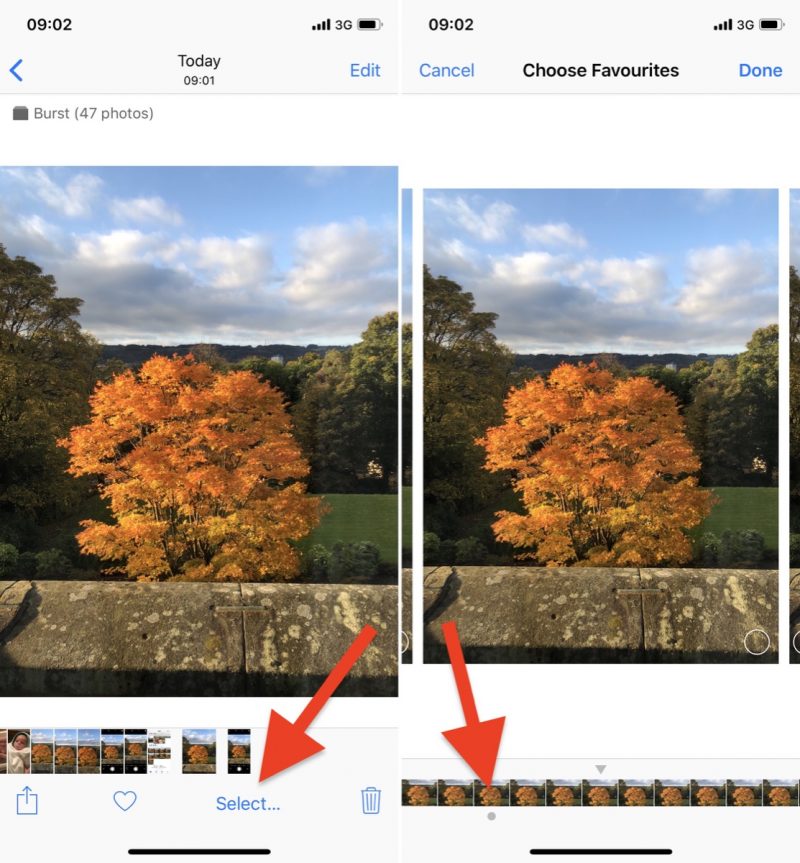
Any dots you see below images in a burst indicate that Apple’s algorithms think they have the best focus and detail in the set, but of course you may think differently.
How to Save Individual Images in Burst Photos
Tap a stack of burst photos in your Photo Library.
Tap Select in the top-right corner of the screen.
Tap each image in the series that you want to keep.
Tap Done in the top-right corner of the screen.
To keep only the images that you ticked in the burst series, tap Keep Only Favorites. Otherwise, tap Keep everything.
Related Roundup: iOS 12Tag: photography
Discuss this article in our forums
Flir’s stealthy drones will help Army vehicles spot enemies in the distance
FLIR Systems
For as long as there has been warfare, there have been reconnaissance scouts, sent out to survey the scene and report back to their commanders about enemy troops, prevailing conditions, and more. That same information is as useful today as it’s ever been, although the technology has changed a whole lot along the way. Case in point? The Black Hornet Vehicle Reconnaissance System, a new unmanned nano drone which can be deployed — either solo or in a group — to find and identify threats along a planned military route. It can then feedback 360-degree elevated information in real time from a radius of up to two kilometers.
“A typical scenario is when an armored or non-armored mobilized combat patrol moves into an hostile urban environment, where they have little or no information on where the threat would come from, where the potential enemy would be hiding, and where they could be expecting an ambush,” Ole Aguirre, senior director of Unmanned Systems and Integrated Solutions at manufacturer Flir Systems, told Digital Trends. “By launching the Black Hornets from a safe distance before moving the patrol into an exposed street or alley, the NUAVs provide live video feeds in day or night conditions to observe rooftops, crossroads, dark alleys or even go inside buildings to seek out enemy snipers or assault teams.”
FLIR Systems
The Black Hornet can be launched from a special external mount, which can be attached to any military vehicle. This includes armored personnel carriers, infantry fighting vehicles, and light utility vehicles. The mount holds three of the UAVs, which can be easily deployed with the touch of a button. Unlike other drones, the Black Hornet is designed to be silent, thereby not giving away its position while collecting intel on enemies or subjects of interest.
“The Flir Black Hornet VRS is designed to be integrated onto any vehicle, ideal for mounted Army, Marine, or special operations forces combat or reconnaissance teams,” Aguirre continued. “Key markets are the United States or NATO vehicle modernization programs, like the Joint Light Tactical Vehicle (JLTV) Program or Stryker Modernization Program. It is also designed to meet key ISR capability gaps for small special operations units operating detached from larger combat support elements.”
Editors’ Recommendations
- Wavesense ground-penetrating radar aids navigation with road data
- Honda is giving cars the ability to see around corners to avoid accidents
- The best used cars you can buy for under $15,000
- 2018 Land Rover Range Rover Sport HSE Td6 Review
- Riding along in Audi’s e-tron, the electric SUV born to slay Teslas
Tesla’s referral program lets owners send laser-etched photos into space
Being a Tesla owner certainly has its perks. There’s the fact that your car isn’t reliant on fossil fuels to get around, the fact that you get to drive an incredibly cool car that can go 0 to 60 mph in a matter of seconds, and then there’s the latest one: The option to fire a laser-etched photograph deep into outer space.
The ability to send any image into orbit is an honor being bestowed on Tesla owners who refer one other person to the company’s cars before December 10 through the company’s referral program. Tesla owners just have to provide a referral code to their friends and family, which can earn them a variety of rewards when those folks go on to purchase a Model S, Model X, Model 3 or solar products.
The reward in question, titled “Launch Your Photo into Deep Space Orbit,” is, well, exactly as it sounds. Tesla owners with one qualifying referral can claim the perk, which allows them to select a photo of their choice to be laser-etched and fired off into deep space orbit. Photos can be uploaded via the Tesla mobile app, and the company will take care of the rest, including launching it into the great unknown — a task that presumably will be handled by Tesla CEO Elon Musk’s other company, SpaceX. They just have to pick a photo before the December deadline.
Also included in the latest round of referral rewards for Tesla owners is a $100 Supercharging Credit (a replacement for the Free Unlimited Supercharging perk, which has been retired and was only available for the Model 3 with the Performance trim package, per Teslarati). The more limited charging credit now applies to all Model S, X, and 3 vehicles.
Tesla loyalists with four qualifying referrals can also score a perk that gives them priority for software updates. Once they have reached that perk level, their car will automatically be first in line to get over-the-air updates as they become available. If they own more than one Tesla, all of their vehicles will be given the priority position when it comes to software upgrades.
Editors’ Recommendations
- Tesla warns owners to protect against car thieves using key fobs
- Tesla extends battery capacity to help owners of the older Model S flee Florence
- Here’s the latest news on the Tesla Model 3, including specs and performance
- Elon Musk says a $25K Tesla is possible in ‘maybe 3 years’
 AIVAnet