


Hubble provides the cosmic background to a dark French opera
Grandiose space images from NASA’s Hubble telescope might be the last thing you’d expect see in an early 20th century French opera. However, Marco Brambilla, the artist behind epic video art installations and Kanye West’s “moving painting” music video for Power, has done just that. He created the video backdrop for a new production of Claude Debussy’s Pelléas et Mélisande, currently running at the Opera Ballet Vlaanderen in Antwerp, Belgium.
Pelléas et Mélisande, based on the “libretto” play by Maurice Maeterlinck, is Debussy’s only opera and regarded as one of the greatest ever. The story depicts Prince Golaud, who discovers the mysterious Melisandé lost in forest, setting up a love triangle with Golaud’s half-brother. The set design by Marina Abramović features a giant, crystal-covered convex mirror that merges into the floor and act like an eye with Brambilla’s video backdrop as the “iris” at the center.
Brambilla used collages of Hubble and NASA images to create the backdrop. “Both the libretto and the music have always screamed of the cosmos to me,” Brambilla said. “Since the text deals with the recurring theme of the eyes and sight, Marina Abramovic’s set design uses seven monolithic crystals and an onstage projection disc as the pupil of a symbolic eye. This becomes a portal into the subconscious where my videos unfold and heighten the tension and drama unfolding onstage.”
The play, with its themes on the creation and destruction of relationships, is perfectly suited to other aspects of Hubble, too. Many of the telescope’s most famous images, like Pillars of Creation and the Carina Nebula, depict the births and deaths of stars and galaxies.
Pelléas et Mélisande was already ahead of its time when it debuted in 1902, so naturally it was misunderstood by critics and cast alike. It has seen avant-garde interpretations before, perhaps most famously by French artist Jean Cocteau in the 1960s. By incorporating and reinterpreting modern space imagery, however, the latest version may be the most visually spectacular version yet.
Via: Wallpaper
Source: Opera Ballet Vlaanderen
Air Force general behind government 5G memo leaves White House
That scrapped proposal for a goverment-run 5G network is triggering a political fallout. A senor official has confirmed to the Washington Post that the author of the memo pushing for the 5G network, Brigadier General Robert Spalding, has left his position as the National Security Council’s senior director for strategic planning and returned to the Air Force. He wasn’t fired, the insider claimed, and this wasn’t prompted by the leak — rather, the Council decided against renewing his position in part because his push for government 5G had “gone beyond his role.”
Brig. Gen. Spalding’s last day in the White House was January 31st, or 3 days after the memo surfaced at Axios. He wasn’t officially punished, according to the tipster, so he’s free to take whatever job he’s qualified to handle.
The general isn’t known to be responsible for the leak, but that apparently didn’t matter. Reportedly, officials had already been worried that he was “too aggressive” in promoting the idea, distributing it widely and effectively circumventing the deliberative process. Supposedly, some officials indirectly blame him for the leak because of that circulation.
This is water under the bridge when the White House has shelved the idea, and the FCC’s chairman has rejected the concept. You could argue that it was a bad idea from the outset, for that matter — private carriers already have a head start and would likely sue the FCC to either block the plan or insist on playing a part. Even so, the departure sends a strong signal to anyone who would bring up a similar plan in the future.
Via: Military.com
Source: Washington Post
Tweak Spotify’s recommendation tech to create custom playlists
If you’re looking for a way to fine-tune your Spotify experience, you might want to check out Nelson, a web-based playback jukebox of sorts on app-maker website Glitch. You choose as many genres as you like before tweaking some of the Spotify API’s various parameters, and Nelson will compile a custom set of songs. You can even have it create a playlist right on Spotify for you.

Originally tweeted out by Arielle Vaniderstine, a “developer advocate engineer” at Spotify, Nelson is very much a version one release on Glitch. It’s an internal project that feels more like a toy than an exact tool or proper feature. Still, it’s a blast to goof around with, and the playlists it creates appear right in your Spotify app, if you choose to do so. I clicked “Ambient,” “Disco,” “Electronic” and “Happy” and got a playlist that started with Wild Cherry’s “Play That Funky Music.” It’s a happy disco song, for sure, but sometimes the results are a bit puzzling.

The different variables you can tweak are explained at the Spotify developer blog. There are things like “acousticness,” “danceability,” “instrumentalness, “loudness” and “speechiness.” There’s even a measure for the amount of happiness conveyed by a track, called “valence.” You can change these values in Nelson with a slider and the resulting playlist (which will play in your browser by default) should match your selections.

Via: The Verge
Source: Arielle Vaniderstine
Sondors’ three-wheeled EV is affordable and stylish
Starting a new car company is tough. In fact, it’s nearly impossible. Then Tesla pulled it off. As we transition from the internal combustion engine to electrification, startups and even a few established players are taking a chance on EVs. Building a three-wheeled autocycle isn’t revolutionary, exactly. But making an EV starting at $10,000, with all the usual amenities, makes it a car worth watching. Plus, it looks spectacular.
I got a chance to drive the $1 million prototype of this Italian-designed car in Malibu last week. The one-off vehicle isn’t street legal or ready for actual roads. It didn’t have working seat belts and couldn’t reach the speeds the company says the final production model will be capable of. But once I put it in gear and depressed the accelerator, it seemed like, with some fine tuning (not to mention passenger restraints), the car would be at home cruising through a residential neighborhood.
Behind the wheel, steering and braking worked as advertised, even if the car was poky off the line and I wasn’t able to do anything resembling freeway speeds. I got it up to a whopping 28 miles per hour in a beach parking lot, where I yanked the wheel left and right to test stability. Three-wheeled cars have had a bad rap since the Reliant Robin episode of Top Gear where they rolled a three-wheeled car every time it took a turn. Before you get concerned about the safety of future drivers, though, it’s important to remember that the Robin in question was actually set up to roll over when it turned.
So, yeah, the Sondors is stable even if it’s still in the prototype stage.
When the car does go into production — which the company expects to happen in April 2019 — the base model will have a range of 75 miles. Add an additional $3,000 for a range of 150 or $6,000 for a 200-mile reach. The zero-to-60 time will range from eight seconds to about five, which is pretty quick for a car that costs less than most used vehicles.
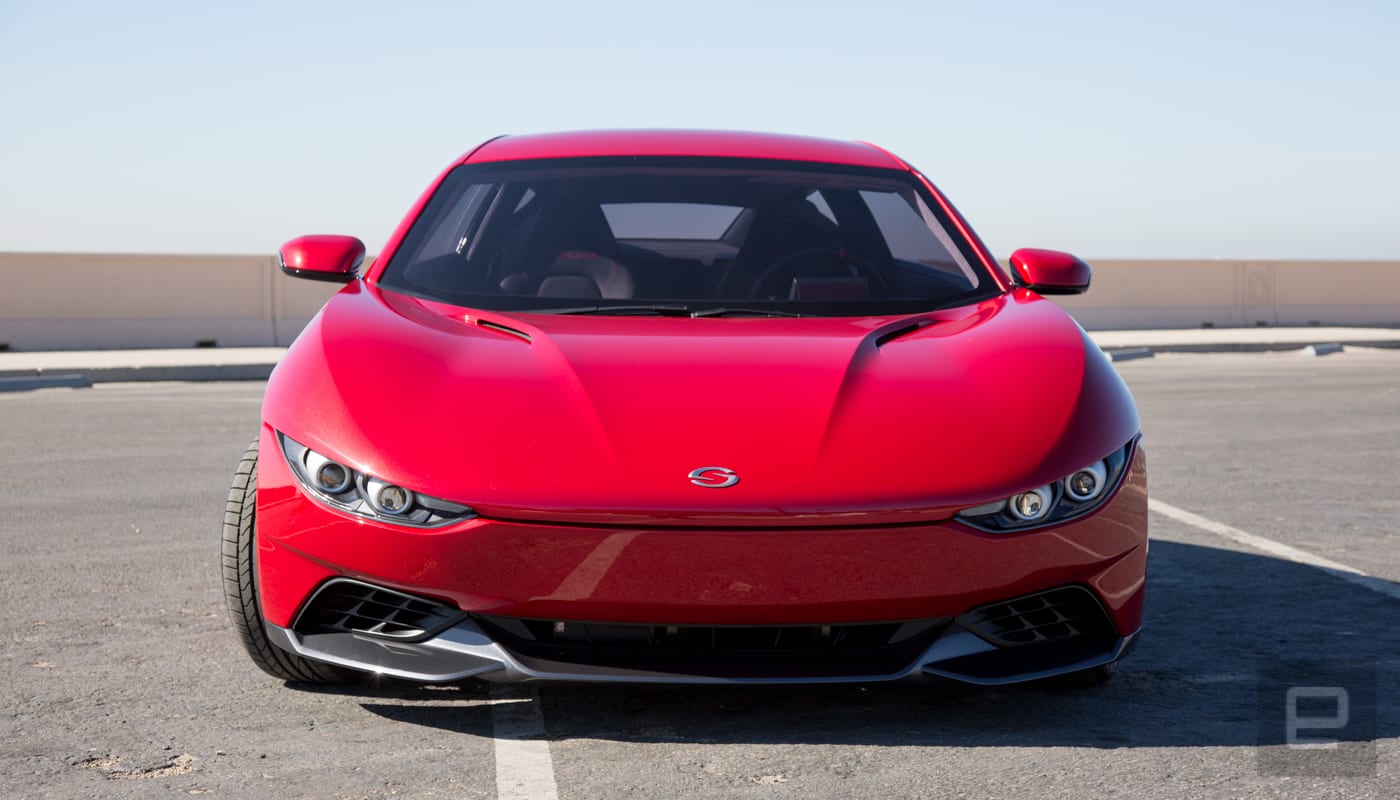
Those speeds are thanks to a rear-mounted motor that will push out 170 horsepower and a whopping 323 pounds of torque to the front wheels. Sadly, none of that power was evident during my drive.
What Sondors did deliver in its prototype was the design of the car, which is exquisite. If the company is able to get its car into production next year, expect a lot of people to buy the vehicle based purely on its looks. Photos of the car don’t quite do it justice. During the four hours I spent with the vehicle, multiple people stopped to remark on how beautiful it was and wondered if it was on sale.
Of course, gawking at a three-wheeled car at the beach is far different from actually buying a niche vehicle.
Sondors CEO Storm Sondors seems fine with that. He says the car comes in response to the needs of Sondors’ bike customers. He adds that the company wants to start slow, producing cars for the needs of its current customers and first adopters. He understands that scale is tough, especially when building a car.
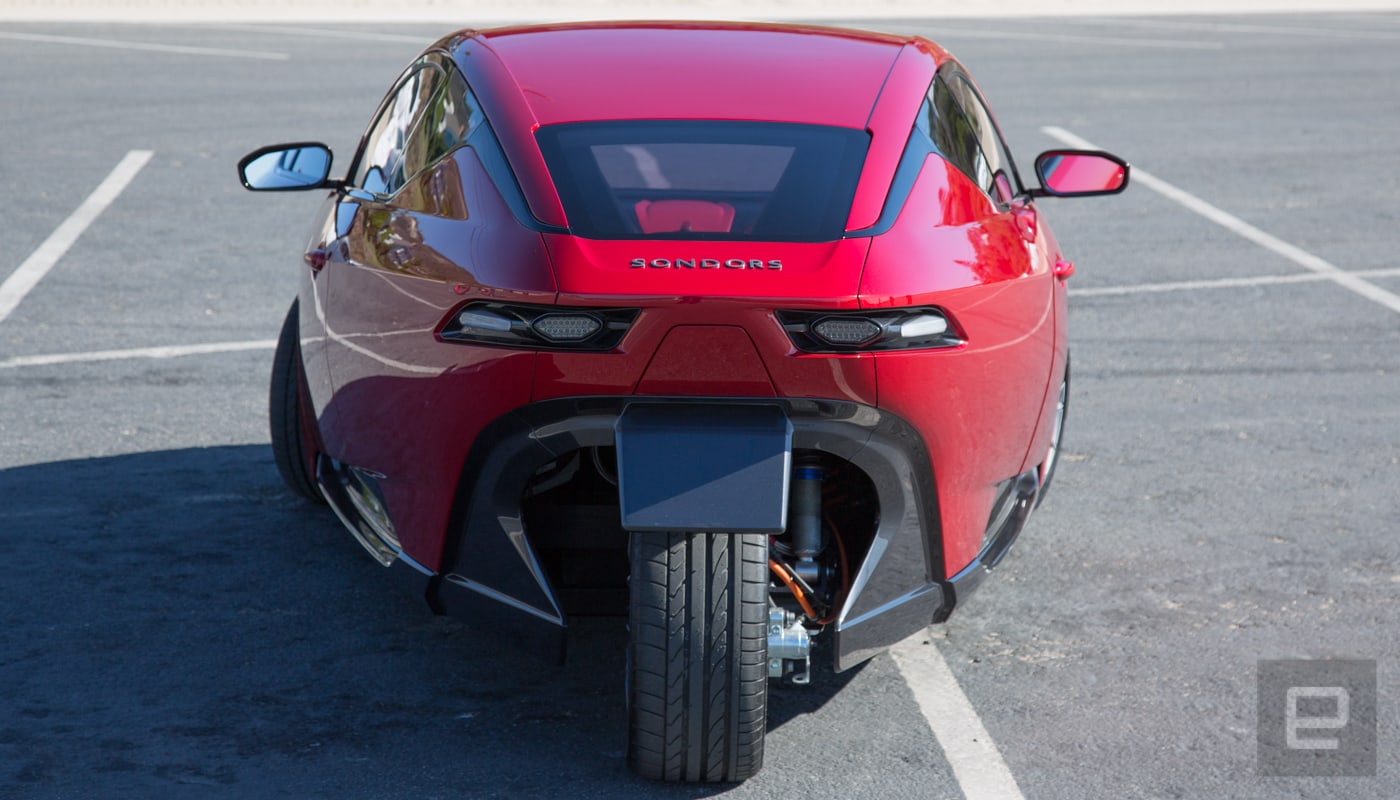
Indeed, even building 1,000 cars is challenging. The company does have experience producing electric bicycles, but cars are a different beast. Plus, there’s that $10,000 asking price — that’s cheaper than most used cars these days. It’s safe to say that delivering something that inexpensive is going to be a monumental feat.
But I hope Sondors can pull it off. The world needs more affordable cars that catch the eye as well as reduce emissions. I just hope the production model is faster than the prototype.
Facebook may share ad money to lure creators from YouTube
Facebook has been gearing up its Watch platform for months, now. Originally launched last August, it already has tons of shows on tap (for US audiences, at least). The company may even spend $1 billion on original video this year in hopes to catch Netflix and Hulu, and it’s been running ads in front of Watch videos for a while. Now, according to a report on CNBC, Facebook is talking to media buyers about expanding the Watch service to more individual creators to rival YouTube’s similar business model.
According to CNBC‘s sources, Facebook wants to create a tiered advertising system that would allow creators to upload their content for free, then earn revenue from ads placed into the videos. That way, says CNBC, Facebook can fill its Watch platform with content it won’t have to pay for up front. CNBC‘s sources say that Facebook pays some creators for rights to their shows in the range of $10,000 to $500,000 per episode, while other shows are uploaded for free as a “partner.” As CNBC notes, It’s getting harder for creators to make money on YouTube, though the Google-owned company is trying to fix that. Facebook may also be looking at video to help keep users on its site for longer periods of time to reverse the current trend. We’ve reached out to Facebook for comment and will update this post when we hear back.
Source: CNBC
Apple briefly pulled Telegram over child pornography distribution
When Apple temporarily pulled Telegram from the App Store over “inappropriate content,” it left many wondering just what that content was. We now know: 9to5Mac has learned that the company removed the app after discovering that people had been distributing child pornography through the app. Apple both contacted Telegram’s team and authorities (including the National Center for Missing and Exploited Children) to both address the specific violation and to ensure that there were “more controls” in place to prevent a repeat.
As a rule, internet services use a range of safeguards to prevent the spread of child porn, such as shared hash lists that prevent a file on one site from being posted elsewhere. It’s not certain what solutions Telegram implemented, but the relatively short turnaround (its software was back within hours) suggests it didn’t require a fundamental change.
The nature of the discovery might provide a clue as to how it was distributed. Telegram’s bread and butter is end-to-end encrypted messaging, which should rule out a non-participant directly intercepting the messages (including Apple itself). The 9to5 team suggests that the material may have been made public through a third-party plugin. Your privacy should remain intact as a result — Apple may have just been fortunate enough to spot the vile content and take action.
Via: The Verge
Source: 9to5Mac
SpaceX animation shows the ideal outcome for the Falcon Heavy launch
SpaceX will attempt to launch its Falcon Heavy rocket for the first time tomorrow. It’s no small feat and a lot could go wrong, but SpaceX has a released a video showing how the launch will work if everything goes according to plan.
The launch window is open from 1:30 to 4:00 PM Eastern and will take place at NASA’s Kennedy Space Center in Florida. You can see in the video that after it’s launched, two of Falcon Heavy’s three boosters will return to Earth, landing back at Kennedy Space Center. The third will keep traveling a ways further but will also eventually detach and land on one of SpaceX’s drone ships. Falcon Heavy’s payload — Elon Musk’s Tesla Roadster carrying a space suit-clad dummy — will then continue on its path to Mars. That is, if everything goes well. Musk has said that there’s plenty of room for error. “There’s a real good chance that it does not make it to orbit,” Musk said at the ISS R&D conference last July. “I hope it gets far enough away from the launch pad that it does not cause pad damage –- I would consider that a win.”
We’ll be watching the launch attempt tomorrow and keeping you up to date on how it goes. We’ll also have a livestream of the event ready for you if you want to follow along. No matter what happens, tomorrow stands to be an incredibly exciting day and one that could push space travel technology further than it has ever been before.
Source: SpaceX
NVIDIA will power Continental’s self-driving car platform
German automotive components producer Continental has partnered with NVIDIA to produce a full-scale self-driving car platform. It will use the GPU maker’s autonomous vehicle hardware and software setup, DRIVE, to make a unified platform that prospective automakers and others can build their own self-driving cars upon.
NVIDIA will provide the Xavier chips, operating system and software from its DRIVE suite, while Continental will contribute its security certification know-how along with its own radar, LiDar and camera products. Both companies intend for their platform to provide clients with level 2 autonomy (smart cruise control like Tesla’s Autopilot feature) to level 5 (full self-driving capability without steering implements).
Continental is far from NVIDIA’s first autonomous driving partner. Despite losing a deal with Tesla, the company announced agreements throughout 2017 with Audi, Toyota, Volvo, Volkswagen and even Chinese tech giant Baidu to collaborate on different self-driving projects. Continental isn’t a newcomer to the field, either: Last year, they planned a test with Canadian autoparts manufacturer Magna to attempt the first autonomous car trip across the US-Canada border.
Source: TechCrunch
Apple Substituting Some 16GB iPhone 5c Models In Need of Replacement With 32GB Models
For the foreseeable future, Apple and Apple Authorized Service Providers will offer some customers who own a 16GB iPhone 5c that’s in need of replacement a 32GB model instead.
Apple shared the new directive with Apple Authorized Service Providers this morning.
“Orders for whole unit service inventory of iPhone 5c (16GB) models may be substituted to iPhone 5c (32GB) models until further notice,” reads the note that was sent out today.
Not all 16GB iPhone 5c replacements will be upgraded to 32GB devices instead, but some customers who take their iPhone 5c models in for repair for a manufacturing issue or other problem may see an upgrade to the larger capacity 32GB model.
Apple did not offer a reason why some 16GB iPhone 5c models are being replaced with 32GB models, but it’s often due to available supply at any given time.
The iPhone 5c was first introduced alongside the iPhone 5s in September of 2013, and it’s the only 4-inch iPhone that Apple has introduced with a colorful plastic exterior.
Apple stopped offering 16 and 32GB iPhone 5c models for sale in most countries in September of 2014, but continued selling an 8GB model until September of 2015. In India, the iPhone 5c was still available through February of 2016, but since that time, the iPhone 5c has been fully discontinued in all countries.
Discuss this article in our forums
Apple Music Gets New Head of Editorial With Hiring of Music Journalist Alex Gale
Music journalist Alex Gale has been named the new head of editorial for Apple Music, reports Variety. Gale has previously written for sites like Billboard, Complex, XXL, and Vibe.
Gale, who will work under Jen Robbins, the director of project management and editorial for Apple, will lead the team that’s responsible for all written content on Apple’s music platforms, including Apple Music, iTunes, Beats 1, and some video projects.
Written Apple Music content appears in interviews, Apple Music features, details on playlists, information on videos, album intros, and more.
News of Gale’s hiring comes just after Apple announced that Apple Music has grown to 36 million total subscribers around the world, a six million increase from the 30 million the company reported in September of 2017.
Tag: Apple Music
Discuss this article in our forums
 AIVAnet