


Elon Musk emphasizes the risks ahead of Falcon Heavy’s first mission
Tomorrow, SpaceX will attempt to launch its massive Falcon Heavy rocket for the very first time. If successful, it will be the most powerful rocket in operation and opens up the possibility of future crewed missions to the Moon or Mars. Today, Elon Musk gave a few more details about the launch attempt during a press call ahead of tomorrow’s main event.
Musk detailed the rocket’s mission: After launch, it will coast for six hours, straight to geosynchronous Earth orbit, which is an orbit that follows the Earth’s rotation so a satellite stays in the same place. This phase of the mission is specifically related to national security missions, to show that the rocket can deliver a payload directly to GEO.
After this, the rocket will begin a trans-Mars injection engine burn. The upper stage of the Falcon Heavy will position itself in an elliptical orbit — one part will be in Earth orbit, and the other will be in Mars. Musk described it as an “Earth-Mars cycler,” but it’s a little tricky to imagine just what this orbit will look like without some visuals. If everything goes well, the rocket will be about 400 million kilometers (about 250 million miles) away from our planet, and will remain in that orbit for up to a billion years. There’s an “extremely tiny” chance it (along with the Tesla roadster that the Falcon Heavy will carry) could even impact the red planet.
But there is a lot of risk associated with tomorrow’s mission, and Musk was frank about it. “It’ll be a real huge downer if it blows up,” he said on the call. If it explodes on the pad, the damage will take 9-12 month to clean up. However, an unsuccessful launch will not impact production.
Even if the rocket takes off, there’s a lot of uncertainty in its risky mission. It will travel through the Van Allen Belts, charged areas of trapped radiation that surround the Earth, which could damage the rocket. There’s also the concern of ice on the upper stage, as well the possibility the fuel could freeze or the oxygen could vaporize. There are many unknowns when it comes to tomorrow’s scheduled launch; but one thing that Musk promises is that it’ll be exciting: “It’s either going to be an exciting success or an exciting failure — one big boom.”
Images of Samsung’s Galaxy S9 Leak Ahead of Rumored February Unveiling
Samsung is planning to unveil its next-generation smartphones, the Galaxy S9 and S9+, at an event that’s set to take place at Mobile World Congress on February 25, but ahead of that date, several images have leaked depicting the South Korean company’s new flagship device.
Noted leaker Evan Blass, aka @evleaks, has shared several renders of the new Samsung Galaxy S9 and S9+ on Twitter, along with details about what to expect from the device that will compete directly with Apple’s own iPhone X.
Galaxy S9
Samsung’s two new smartphones will continue to use the same general design as the Galaxy S8 devices, with slim bezels and a near edge-to-edge Super AMOLED display. Unlike the iPhone X, the S9 and S9+ have black bars at the top and bottom of the device, with the top bar housing components like the camera and the microphone.
 Galaxy S9+
The larger of the two devices, the Galaxy S9+, features a new vertical dual camera design at the back of the phone, similar to the iPhone X. Samsung’s invite for its February 25 event suggested camera improvements will be a main focal point for the two new flagship devices.

Rumors suggest the Galaxy S9 will feature a single 12-megapixel camera with variable aperture from f/1.5 to f/2.4, while the S9+ will feature the same variable aperture 12-megapixel camera paired with a second 12-megapixel camera with a fixed aperture.
Samsung isn’t ready to introduce a robust Face ID-style feature in its smartphones (but it will continue to offer less secure iris scanning and facial recognition as options), so the Galaxy S9 and S9+ will feature fingerprint sensors located at the back of the devices. Samsung has, however, repositioned the fingerprint sensor on both devices to below the camera instead of to the right of it.
These are the Samsung Galaxy S9 and S9+ https://t.co/deXGg39m0d pic.twitter.com/RNGezrF4Bs
— Evan Blass (@evleaks) January 26, 2018
Samsung plans to offer its Galaxy S9 and S9+ in Midnight Black, Lilac Purple, Titanium Gray, and Coral Blue. The Samsung Galaxy S9 will measure in at 5.8 inches like the iPhone X, while the S9+ will measure in at 6.2 inches. Android Central has additional details about Samsung’s upcoming S9 and S9+ for those who are curious about what to expect to see in the devices that will directly compete with the iPhone X.
Tag: Samsung
Discuss this article in our forums
Banks ban Bitcoin credit card buys as cryptocurrency crash continues
As Bitcoin “hodlers” brace against the storm of the biggest cryptocurrency crash in recent memory, banks in the United States and United Kingdom have taken steps to prevent customers from getting in over their heads. A number of financial institutions have now banned the use of credit cards for purchasing Bitcoins, meaning potential investors will need to resort to other means to purchase their cryptocurrency.
Bitcoin and altcoins like Litecoin and Ethereum became vogue investment purchases at the tail end of 2017 when a wave of mainstream attention saw prices increase by tens, if not hundreds, of percent in just a few short weeks. That latest bubble eventually burst towards the end of December, with Bitcoin itself reaching near $20,000 per token before the crash. It then tumbled by thousands of dollars in the weeks that followed, dragging most other cryptocurrencies down with it.
With Bitcoin now having fallen to less than $7,500, its lowest price point since early November last year, Chase, Bank of America, and Citigroup have all banned the use of credit cards for buying Bitcoins. In the U.K., Lloyds group banks have done the same, including Bank of Scotland, Halifax, and MBNA.
Although this may stop some banking customers getting into hot water, the move is more to prevent lenders from being hit by this latest crypto-crunch. As Bloomberg reports, customers overspending in expectation of quick returns could leave banks in the lurch if they can’t repay. Similarly, there is concern over stolen credit cards being used to buy cryptocurrency, which is often hard to twin with its real-life owner.
As much as those banks are taking steps to create some moderate separation between their services and Bitcoin, not all banks are doing the same. As Diar reports on Twitter, two top U.K. banks, HSBC and Barclays, have confirmed that they are not restricting cryptocurrency investments at all.
Indeed it’s important to remember that while the banks that have banned credit card purchases have restricted one avenue of buying cryptocurrencies, bank transfers, currency trading, and even gift-card buys can be used to purchase Bitcoin and other altcoins.
As much as this latest news could exacerbate the current tumble Bitcoin and its contemporaries have taken, as we discussed in a recent piece, regulating Bitcoin is harder than most people think, so the long-term impact may not be too dire.
Editors’ Recommendations
- Bitcoin’s latest boom sends it scorching past $9,000
- What is bitcoin? Here’s what you need to know about it
- Go ahead, pass laws. They can’t kill bitcoin, even if they try
- How to trade bitcoin for other cryptocurrencies
- Amid cryptocurrency frenzy, South Korea bans anonymous accounts
HP’s new 3D printers can print in full color and use multiple materials
HP wants to support the 4th industrial revolution with its latest 3D printers.
The company has launched four new 3D printers capable of printing in full color and with multiple materials within the same print.
The Jet Fusion 300 and 500 3D printers, each of which is available in black and white and color models, are HP’s next step in democratizing 3D printing. Designed with small-to-medium operations in mind, the machines start at approximately $50,000 and can easily top $100,000 depending on the specific configuration. This isn’t exactly consumer-friendly pricing, but it’s a comparatively small investment for teams looking to prototype and develop without outsourcing.
What sets these two printers apart is their ability to work at voxel-level — a voxel essentially being a 3D pixel that’s used by 3D printers to make objects — to create full color objects. Already, HP has worked with Phoenix Children’s Hospital, Yazaki Corp., and Youngstown State University to Find new purposes for full color 3D printing technology.
Seen in the above image, Phoenix Children’s Hospital has used the full-color 3D printing technology to recreate an anatomical model of a patient’s heart that has a complex defect. By doing this, doctors can better visualize the optimal surgical path and also explain to the patient’s family what will be done.
It’s not just color though. HP is also working with partners, such as SolidWorks, to boost its Open Platform. These partnerships are helping to develop different materials that will be used by the Jet Fusion printers at the voxel-level.
What this means is while printing a design, the Jet Fusion printer is able to change the material used to alter the final product. Imagine being able to 3D print a shoe insert that has a fabric-like material for the top, but offers a springy platform for optimal support, all in a single process. That’s what HP’s Jet Fusion printers will be able to do, alongside the addition of color.
HP expects 3D printing to be a vital part of what it deems the fourth industrial revolution. And from the looks of it, they’re on track with the release of these new printers and the ongoing improvements to its partnership program.
You can find out more information by visiting HP’s website.
Editors’ Recommendations
- Ethereal Machines’ Halo takes 3D printing to a new dimension, literally
- Enormous 3D printer is designed for an equally huge job: printing yacht parts
- New 3D printer will combine all your medications in one personalized pill
- Uniz’s new line of 3D printers bring astonishing levels of speed
- Don’t print with crappy plastic. Here’s the best 3D-printing filament you can buy
Tired of broken eggs? Google might have a solution with a new patent design
Have you ever drove over a bump on your way home from the grocery store, then found all your freshly bought eggs cracked? Many of us have been there. Even those who use grocery delivery services may find a few eggs arrive broken from time to time, which can be a pain for customers.
But Google just might have a solution for disgruntled egg consumers. According to recently released patent filings, Google seems to want to solve the problem of broken eggs once and for all, or to ensure its Google Express grocery delivery customers don’t open up their grocery bags to find yolk all over the carton.
So what is the secret to Google’s egg carton patent? It might be an insert made up of interconnected domes that keeps the eggs from moving while they are resting in the carton. Each dome is ideally sized to cup the top portion of an egg and the insert itself can be placed directly into the egg carton, with each dome corresponding to one dimple of the carton. When the insert is placed into a carton full of eggs, the carton should be able to close securely.
In addition to the insert, Google also outlined a special carton packaging that should keep the eggs doubly secure. The cruciform sheet is sized such that it wraps tightly around the outside of the carton, bound by flaps at the top and bottom and secured with tabs on the sides. With the carton resting in this special packaging, the eggs would theoretically move around less while traveling from point A to point B.
Google Express was publicly launched in September 2013. Since then, the search engine giant has found competition in other grocery delivery services such as AmazonFresh, Instacart, and Shipt. But if Google Express can guarantee its eggs arrive at your doorstep without so much as a single crack, that just might put them above the competition.
Interested in giving Google Express a try? Membership is free, and you can shop from all different retailers, including Costco, Target, Overstock, Walgreens, and more. Shipping is free as long as you reach the minimum purchase requirement, which for most stores is between $25 and $35.
Editors’ Recommendations
- What is AmazonFresh? Here’s everything you need to know
- Shopping at Amazon’s Go stores feels like a heist. And we love it
- This swarm of robots can fill your grocery delivery order in no time at all
- Best smart home product of 2017
- Make the most out of Google with this list of ‘OK, Google’ commands
Google adds tablet-friendly features in the latest Chrome OS 64 build
Google’s Chrome OS continues to make noticeable strides as a lightweight operating system that runs primarily on relatively low-cost PCs. As with the Windows 10 market, Chrome OS is seeing an increase of 2-in-1 machines of the 360-degree convertible variety, along with hints at an impending influx of detachable tablets.
Unsurprisingly, we’re now seeing Chrome OS adopt new features that make the OS more suitable for touchscreen devices, and the latest Chrome OS 64 update is a prime example. The latest build, taking Chrome OS to version 64.0.3282.134, adds in two specific features that make the platform more 2-in-1-friendly.
First, there’s a new screenshot method that’s aimed at convertibles. You can now hold down the power and volume buttons simultaneously to capture the screen, which is also how you take screenshots on most Android devices. In addition, there are new touchscreen pairing settings, an obvious boon when a convertible is in tablet mode and, of course, for dedicated tablet devices such as the upcoming Acer Chrome OS tablet.
Here are some other fixes:
- Revamped intent picker for Play applications (same window by default with override)
- Lockscreen performance improvements
- Enable VPN for Google Play apps
- Enhancements to the protected media pipeline for Android
- Android container auto update optimizations
Google also notes that it has implemented additional precautions in the browser against the notorious speculative side-channel attacks dubbed Spectre, which have gained industrywide attention and forced a number of updates on virtually every computer platform. These recent changes are in addition to steps taken in earlier versions to address issues caused by Meltdown and Spectre. If you want to understand how the flaws have been affecting Google’s products, then take a look at this overview.
As usual, you can update your Chromebook manually by clicking on the Setting cog icon, heading to About Chrome OS in the menu, and then clicking “Check for Updates” under “Google Chrome OS.” The update will be downloaded and then you can perform the update. Be prepared to reboot your Chromebook, and when it returns to action, your touchscreen-enabled convertible Chrome OS machine will be that much easier to use.
Editors’ Recommendations
- The best 2-in-1 laptops you can buy
- Google retires Pixel C tablet, wants you to buy the Pixelbook instead
- Like Chrome OS, but miss Windows? Here’s how to install it on your Chromebook
- Asus Chromebook Flip C101PA review
- Google Pixelbook Review
Intel’s ‘Vaunt’ smartglasses could be the iPhone of augmented reality
Google Glass was awful. It never quite took off — and for good reason. It was bulky, unintuitive, and it made you look like a Glasshole. It gave AR glasses a bad name, but Intel aims to change all that with its new Vaunt smartglasses.
Dieter Bohn over at The Verge got an exclusive behind-the-scenes look at the next-generation smartglasses, and it’s hard not to get excited about their potential. These are, first and foremost, glasses. They’re just regular old prescription or non-prescription glasses you would wear during the day and charge at night. There’s not a computer attached to your head or some weird bulky attachment to your existing glasses.
Just look at these things. Without the serial numbers on them, you’d never notice someone wearing a pair and just walking down the street — or attending a meeting in the office.
The computing power comes from your smartphone, which the glasses connect to over bluetooth. The Vaunt glasses use some impressive technology to beam a few limited notifications into your field of view. They’re not designed to constantly ping you with Twitter updates or emails — the display is intended to offer context-sensitive information like directions, an incoming phone call, or even a restaurant’s Yelp rating.
Let’s take a step back for a second, these are pretty limited use-cases and that’s to be expected. Think about the first generation iPhone, what it was — and wasn’t — capable of right out of the box. There were only a handful of Apple-designed applications. In time though, it grew into the massive ecosystem we know today. As Intel’s Itai Vonshak points out, there was no Uber, Lyft, Instagram, or Snapchat when smartphones first hit it big. Those came later, and that’s what Intel is banking on here.
They intend to roll out the first set of real AR glasses for real people, and see what happens. That’s the thing the budding smartglasses market has been missing — an actual product. Not a concept, or expensive headpiece like the Magic Leap, but a pair of AR glasses with some basic functionality — something people would actually wear everyday. Put them out there, see what people end up doing with them, and most importantly, find out what people want to do with them.
Intel will be start up an “early access program” later this year.
Editors’ Recommendations
- Felix Gray’s new anti-glare specs make you look good while protecting your eyes
- Apple AR glasses: News and rumors about ‘Project Mirrorshades’
- Look into the future using the first smart glasses with Alexa control
- ‘Smart’ sunglasses from Vuzix work with Android and iOS, will debut at CES
- Let just the right amount of light in with Halio smart-tinting glass
HP aims to impress VR developers with its new Z4 workstation options
HP might not be the first name you think of when you hear about virtual reality, but it’s looking to change that with the new configurations it has added to its long-standing Z4 desktop workstation.
Trying to wrangle in the professional virtual reality creators, such as game developers and simulation artists, this HP Z4 refresh is specced out with a wildly powerful Intel ‘Skylake-X’ processor in addition to being bundled with some exciting goodies.
More specifically, the new HP Z4 workstation PC is equipped with an 18-core, 36-thread Core i9-7980XE processor whose clock speeds range from 2.6GHz to 4.4GHz, thanks to Intel’s Turbo Boost Max technology. There is no telling how much this exact model will cost, but judging by the $1,999 price tag of the processor alone, it ought to be expensive.
That said, it can be bought with the company’s own Mixed Reality headset included, seeing to it that you don’t have to go out and buy one for a separate $449 cost. That is not a bad deal for an HMD that can display 1,440 x 1,440 pixels per eye at up to a 90Hz refresh rate. Still, here is hoping that the headset is discounted enough to make the bundle worth it.
Fortunately, HP was aware that some Z4 users would prefer a lower price tag to a ridiculous amount of cores, which is why it’s offering cheaper workstation models for as low as $1,499. Of these, there will be a version of the Z4 featuring an eight-core i7-7820X saddled into the CPU socket. None of these options, including the top-end Core i9 variant of the HP Z4, however, will be available until March.
In the meantime, the existing HP Z4 will continue to be sold, assembled with the Intel’s more expensive and industrial-grade Xeon processors. Unless you’re planning on using it as a server, though, your best bet will be to hold off until March.
What’s more, HP plans on continuing its sale of the HTC Vive Business Edition despite having its own Windows Mixed Reality headset which, mind you, has been refined since the last time we saw it.
Now called the “Professional Edition,” this model differs as a result of its double-cushioned padding and a front-hinged display that lets you toggle between the real world and the VR world. The cushions can be removed as well, making for an undeniably cleaner VR experience when you think about it. Otherwise, it’s the same as the $349, non-professional HP Mixed Reality headset of the past.
Editors’ Recommendations
- Windows Mixed Reality news: Here’s everything you need to know
- HP supercharges Spectre x360 15-inch with Intel 8th-Gen Core and AMD Vega graphics
- Apple iMac Pro news: everything you need to know about the professional desktop
- The best VR innovations at CES 2018 so far
- Lenovo’s Mirage Solo, two compact 180-degree video capture cameras coming soon
This $6 electronics screwdriver repair kit belongs in your toolbox
The Intey Magnetical Precision 58-piece Electronics Repair Tool Set falls to just $5.52 when you use code JM7NB3HC at checkout. It includes two specially-designed bits for smartphones, and a wide variety of other bits for commonly-used electronics. This is magnetized so you won’t have to scramble around for teeny-tiny parts. It also comes with a plastic case, and various shafts and a driver for different types of projects.

Pro tip: keep your screws in an ice cube tray when repairing electronics. Just please, whatever you do, don’t knock it over.
See at Amazon
AR stickers and new user interface come to Google’s Motion Stills
The new goodies are part of Motion Stills’ v2.0 update.

Back in July, Google brought its Motion Stills app to Android. Motion Stills was previously an iOS exclusive, and it allows you capture short video clips and turn them into GIFs that you can share on your favorite social media platforms. Motion Stills is now being updated to v2.0, and it comes with a few big changes.

The most notable part of the 2.0 update is the addition of AR stickers. There are currently six different stickers to choose from, including a T-Rex, alien, gingerbread man, chicken, robot, and planet Earth. Only one sticker can be added at a time, but you can place them wherever you’d like and resize them as you see fit.
Motion Stills’ AR stickers aren’t quite as impressive as what you’ll find with the ones in the Google Camera app, but unlike those, Motion Stills doesn’t require you to have the Pixel Visual Core in order to get in on the AR fun.
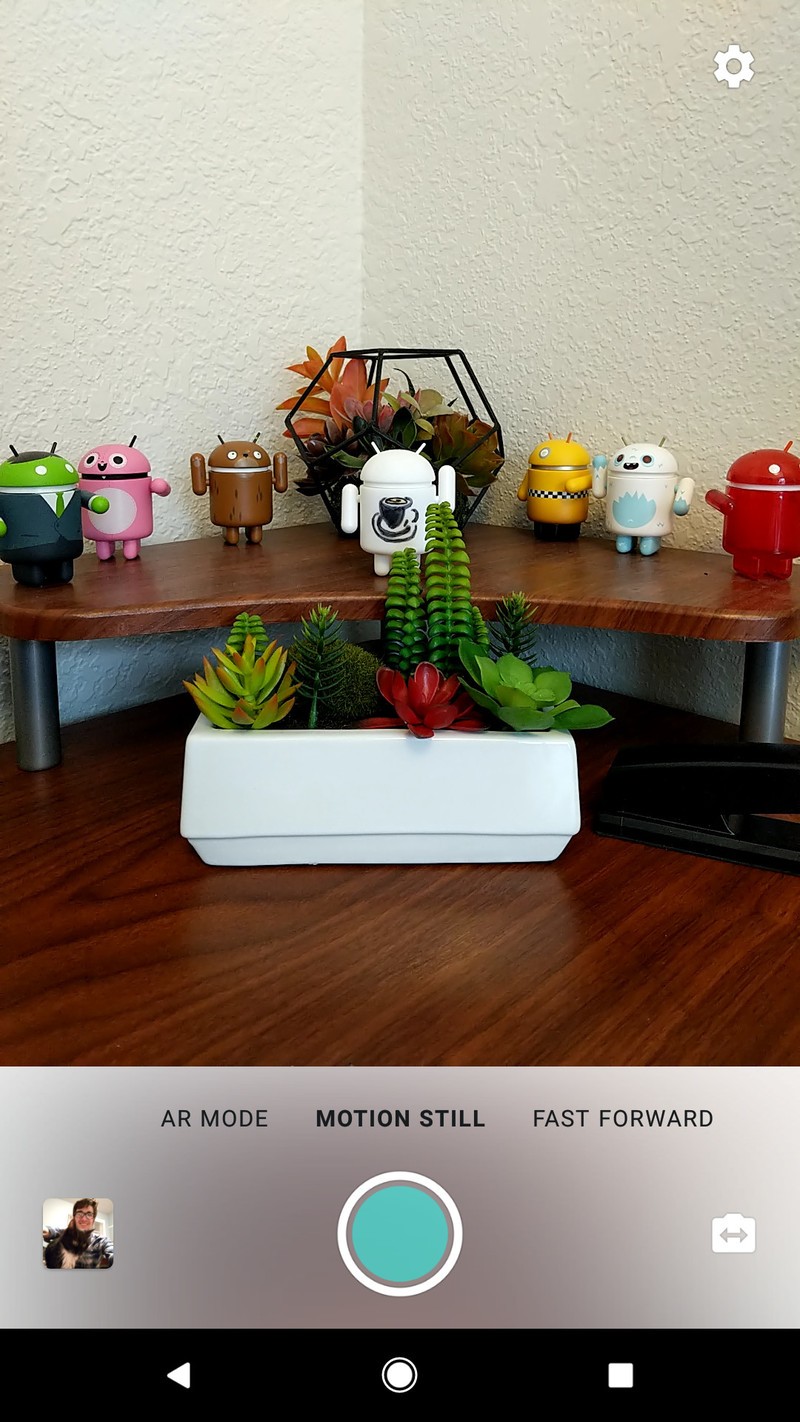

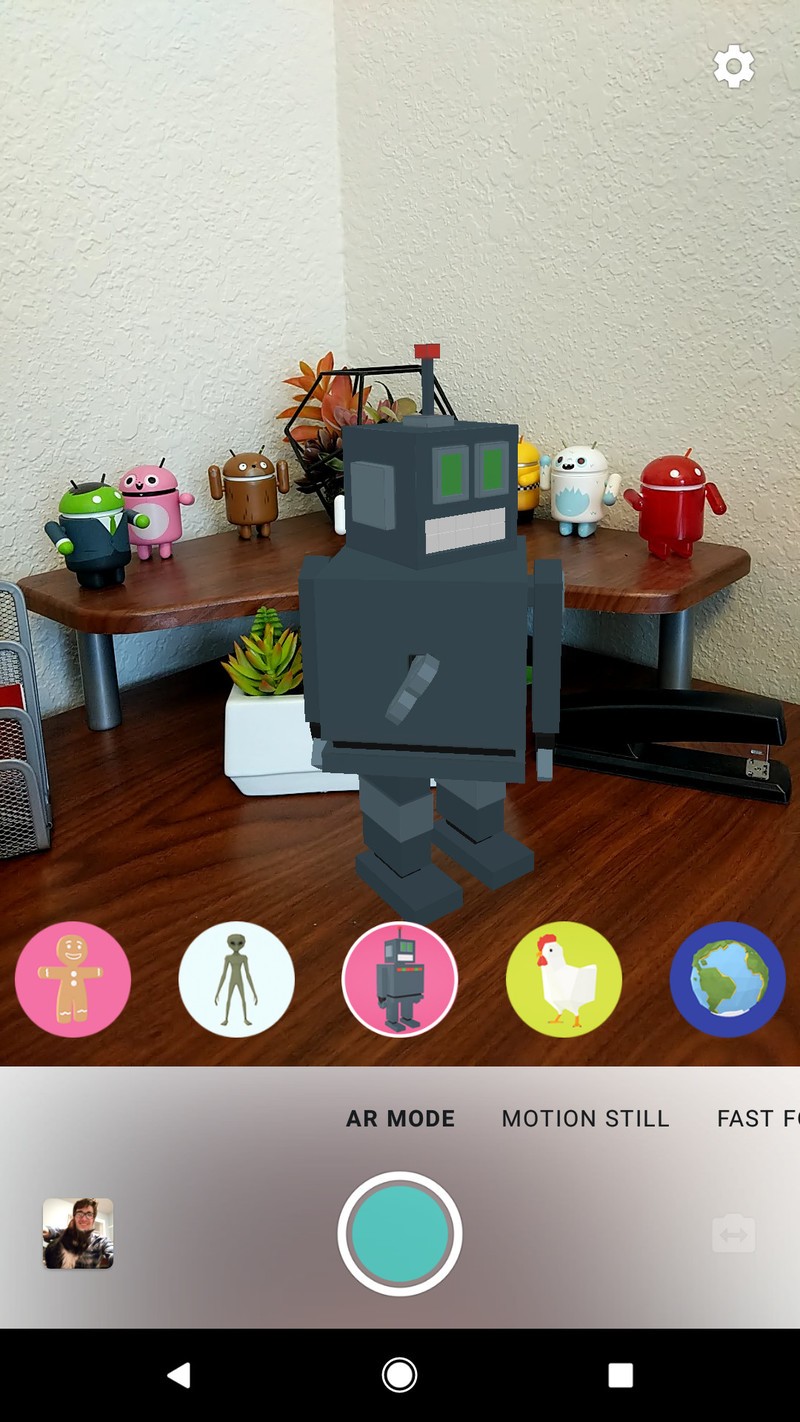
Also new is an updated user interface that should make it a bit easier to navigate through the app. Motion Stills now looks much more like a traditional camera app, with a capture button in the center and different modes above it for switching between Motion Still, Fast Forward, and AR Mode.
Motion Stills 2.0 is rolling out to the Google Play Store now, but if you want to download it ASAP, check out the APK file here.
The Pixel’s AR Stickers are the most fun you can have with a camera

