


Essential Earphones HD review: $99 USB-C headphones that make the best of an awkward situation

USB-C headphones need a guiding light.
Essential is riding a mixed bag of press over the past 6 months, but you can’t argue it’s had a good run of being able to stay in the news cycle one way or another. Between sales, software news, and accessories, it’s the little company that just won’t quit. Its latest announcement is on the accessory front: the “Earphones HD” USB-C headphones, a $99 pair of in-ear buds sold directly on its website.
While my immediate reaction to Essential releasing a pair of $99 earbuds was “why don’t you focus on living up to the initial promises of your phone that you haven’t yet fulfilled,” I was willing to give them a try. After all, there’s an extreme shortage of good USB-C audio accessories out there today, and with the increasingly popular trend of companies (Essential included) not including headphones with their phones this category is becoming important for those who won’t cave and go to Bluetooth.
Here’s what Essential can offer USB-C headphone buyers for $99.
See at Essential
As for the basics, things are very simple considering these are just in-ear headphones. The earbuds, USB-C connector and associated pieces are all a deep grey metal that feels suitably thick, and the cord is a silicone-coated tangle-free style. You get small, medium and large earbud tips along with a zippered hard case to keep it all tidy when you’re not using the headphones. There’s no branding or hallmark design touches on the earbuds, cord or carrying case, which is fine — I care far more about the headphones themselves being well made.
They’re basic, solid headphones — and they sound good for little earbuds.
Along the right earbud cord you get an inline microphone and multi-function button, which is for play/pause with a short press and summoning Google Assistant with a long press, which all works just fine. Unfortunately there aren’t volume control buttons, which is a bit of a bummer — you’ll find a volume rocker on a majority of wired earbuds and all Bluetooth headphones nowadays.
Now, let’s get to audio quality. No matter how much you pay, in-ear headphones are going to be extremely limited in their audio quality by their size. But Essential is doing things right here, with rather large 9.2mm drivers and USB Class 2 audio — that means it supports 24bit/192kHz playback, provided the device you plug them into also supports Class 2.
Yup, the earbuds sound good. To my untrained ears, they were clearly a step ahead of cheap pairs, but didn’t blow away other $50-something pairs I’ve used from the big names. Playing with the equalizer settings in Google Play Music I could crank up the bass without much distortion (and then promptly turned it back down), and I actually felt like the earbuds had a good range. Podcasts were predictably crisp. As ever, the headphone cord rustling on my clothes transferred so much noise when walking around with the earbuds that it really didn’t matter how good the actual earbud sound quality was — such is life.
The earbuds themselves are quite small and comfortable, which was somewhat surprising to me considering they don’t employ any sort of extra support, cushioning or ergonomic design elements. They’re just basic metal barrels with standard silicone tips on the end. My large ears were filled just fine by the default tips that came on the buds, and provide a little bit of passive noise cancellation in the process — though nothing on the same level as other foam-tipped and deeper earbuds I’ve tried.
The most impressive thing to me is that Essential has built USB-C headphones that “just work” in a way I haven’t come to expect from USB-C accessories. The Earbuds HD work the same plugged into my Essential Phone as they do my Google Pixel 2 and HTC U11 (a notoriously finicky phone for this) — my MacBook Pro even recognizes them right away as a USB audio accessory. Finally, a pair of USB-C headphones I can actually rely on.
If you’re determined to go wired without an adapter, these are a great pair of headphones at a reasonable price.
At first I balked at the $99 pricing of the Essential Earphones HD. But after browsing the extremely small number of USB-C headphone options out there, seeing price tags at or above $99, I kind of understand it. Essential has made a pair of earbuds that sound good, are well made, and most importantly follow USB-C standards to work across a variety of devices. In a market that’s months (years?) away from being crowded, it can comfortably charge $99 as it really doesn’t have much competition.
There are inherent shortcomings to USB-C headphones, but taking that as a given, the Essential Earphones HD make the best of an awkwardly bad situation. If you want to stick with wired headphones on your headphone jack-less phone without resorting to adapters, these are a great pair.
The real question is how many people are actually considering USB-C headphones. You can find really solid pairs of traditional 3.5mm earbuds for $20-50 and use them with a USB-C adapter, and just as easily find great Bluetooth headphones for $50-100. Essential itself makes the “Earphones Mini” with very similar design to the HD model for half the price, $49 — and perhaps those are the pair that potential buyers in this segment should be considering most often.
See at Essential
Essential Phone
- Essential Phone review
- Essential Phone specs
- The latest Essential Phone news
- Join our Essential Phone forums!
Amazon
Best Buy
Sprint
Telus
This year’s 157 new emojis include kangaroos, toilet paper, feet, and more
2018 is the year of red-headed emojis.
Although they’re easy to make fun of, emojis have quickly become a standard addition to text-based communication. They’re something I use every single day when talking to both friends and work colleagues, and in 2018, the world will be graced (or cursed) with 157 more of them.
The new emojis for 2018 are part of Emoji 11.0, and they’ll be released with Unicode 11.0 this June. I won’t go through every single one, but some of the highlights include a freezing and party smiley face, superheroes, raccoon, swan, kangaroo, lettuce, toilet paper, cupcake, and plenty more.
However, perhaps the most important addition is that of red-haired emojis.
You can browse the full list of Emoji 11.0 here, and similar to past releases, the new emoji should start arriving on phones in August and September.
What’s your favorite emoji in the 11.0 release? Let me know in the comments below ⬇️😄👩💻🐶🍕🌮💰
Google has fixed the infamous cheeseburger emoji with Android 8.1
These Cameras Work With Amazon Echo Show and Echo Spot

The Amazon Echo Show and Echo Spot are special because they have displays. And that means they have a very special set of skills. The better to see you with, my dear.
So you’ve got an Amazon Echo Show or Echo Spot. Those, as you’ll well know, are the Amazon Echo devices that in addition to being powered by Alexa and able to do all of those Alexa-esque things, also have a display.
The Echo Show is the larger of the two, with a 7-inch touchscreen. The Echo Spot is a baseball-like device with a screen about half that size. And both can show you all sorts of things, including feeds from a number of popular security cameras you might have at home.
(And it’s worth mentioning that the Echo Show and Echo Spot aren’t the only Alexa-powered things that can view your camera feeds. The Amazon Fire TV is hooked into Alexa, of course, and generally has a huge screen — a television set — hooked up to it. The Amazon Fire tablets also have Alexa, and so they also can view the feeds.)
You’ll just need to enable the specific Alexa Skill for your brand of camera, and then you’re on your way. Just be sure that your cameras have distinct names that are easy to remember.
Here’s a quick look at the more popular cameras Amazon that support Alexa.
- Ring doorbells and security lights
- Nest cameras
- Netgear Arlo cameras
- Logitech Circle 2
- Amazon Cloud Cam
Ring doorbells and security lights
 Ring Video Doorbell 2 ($169 at Amazon.)
Ring started out with connected doorbells — it’s got a number of good ones from which to choose — and it’s since expanded to connected security cameras. They all connect to Alexa via a Skill, and you can view any of the feeds on any of your Alexa-enabled devices.
The process is the same whether you’re talking about a Ring doorbell or camera — just tell Alexa to show it to you, and she’ll do it.
The full line includes:
- Ring Video Doorbell ($179)
- Ring Video Doorbell 2 ($199)
- Ring Video Doorbell Pro ($249)
- Ring Video Doorbell Elite ($499)
- Ring Spotlight Cam ($199)
- Ring Floodlight Cam ($249)
See at Amazon
Nest
 Nest Security Camera ($168 on Amazon.)
Nest’s line of cameras remains an excellent option, particularly in conjunction with Nest’s own connected thermostat or the newer Nest Secure security system.
Nest has a basic indoor camera, as well as an outdoor camera. Or for some extra smarts, you’ll want to check out the Nest IQ line, which can learn to identify individual faces. Nest’s upcoming Nest Hello doorbell should also tie into Alexa.
The full line includes:
- Nest Cam Indoor ($199)
- Nest Cam Outdoor ($199)
- Nest Cam IQ ($299)
- Nest Cam Outdoor IQ ($349)
See at Amazon
Arlo
 Arlo Pro ($150 on Amazon.)
Arlo is the full line of security cameras from Netgear (which you probably know better as the maker of all kinds of networking gear). The big deal about Arlo cameras are that they’re great for wireless setups, with mounting options that are as easy as they are flexible.
The full line supported by the Alexa Skill includes:
- Arlo Wire-free ($179, Model VMC3030, VMS3x30)
- Arlo Q & Q Plus ($249, Model VMC3040, VMC3040S)
- Arlo Pro ($189, Model VMC4030, VMS4x30)
- Arlo Pro 2 ($439, Model VMC4030p, VMS4x30p)
- Arlo Go ($417, Model VML4030)
- Arlo Baby ($198, Model ABC1000)
See at Amazon
Logitech Circle 2
 Logitech Circle 2 ($179 on Amazon.)
The Logitech Circle 2 is consistently rated as one of the top DIY camera solutions. It’s got a number of mounting mechanisms (including a very cool one that plugs directly into a 110v outlet. It’s another camera that has numerous options for mounting and powering. The wired camera runs $179, and the wireless option is just $20 more.
And, of course, it’s all tied in with an Alexa Skill.
See at Amazon
Amazon Cloud Cam
 Amazon Cloud Cam ($99 at Amazon.)
Amazon has is own Cloud Cam. It’s the least expensive of the bunch at just $99, and it’s a pretty simple product, with no real frills to speak of. You just figure out where you want to put it, plug it in, and go. It ties into Amazon’s services via its own app (instead of through the Alexa app). And while it does have its own Skill, it’s automatically enabled on all Alexa-capable devices, so you don’t have to do anything separate.
See at Amazon
Amazon Echo
- Tap, Echo or Dot: The ultimate Alexa question
- All about Alexa Skills
- Amazon Echo review
- Echo Dot review
- Echo Spot review
- Top Echo Tips & Tricks
- Amazon Echo vs. Google Home
- Get the latest Alexa news
See at Amazon
Zeiss’ entry-level VR headset is about to get a lot more fun

Normally when people talk about Zeiss, it’s regarding the company’s optics business — which has been around for more than a century. However, Zeiss is making inroads into the VR space as well. Last year, the company introduced its One Plus VR headset. This entry-level device retails for $70 and, like the Google Cardboard or Daydream, leverages your smartphone as both the processor and display unit.
What sets the One Plus apart is its optics. Most headset lenses have a focal point, which is why you have to fiddle with knobs and dials after you put on the VR gear to get to everything in focus. The ones in Zeiss’s headset have a focal plane, meaning that as soon as you put on the headgear, you’re ready to dive into your VR experience — no further adjustments necessary.
Now, that’s all well and good, assuming you don’t mind limiting your VR experiences to only what’s available through the Cardboard/Daydream or Gear VR app platforms (which really isn’t much). And, until now, unless you wanted to throw down a couple hundred bucks on either a Vive or an Oculus Rift — and the hardware to run them — Google’s offering was about the best you could hope for. But, come this May, One Plus owners will have an entirely new library of VR titles to play with.
Zeiss plans to introduce a new accessory for its current headset, dubbed the VR One Connect. It includes a pair of Bluetooth-enabled controllers (each offering three degrees of freedom), a 12-foot USB cord and the necessary software to tether your phone to your laptop and access your Steam account. Setup is straightforward. You install the Zeiss app (either iOS or Android), plug your phone into your gaming laptop so that the Zeiss and Steam apps can communicate, then slot the phone into your headset. Once you calibrate the Bluetooth controllers, you’re good to go.
This offers a significant advantage over similar VR setups. One, since the processing duties are offloaded from the phone to the PC, your phone won’t run hot 15 minutes into the gaming session. And the fact that the phone is tethered to the computer means that will remained charged regardless of how long you play. I spent around 30 minutes with the One Plus strapped to my face as I shot at drones in Space Pirate Trainer and demons in Doom VR. And, while my face did get a bit sweaty from the exertion of ducking and dodging, the iPhone we used stayed cool (and fully charged).
Don’t let the One Plus’ price point fool you, however. I didn’t experience nearly the same degree of the “screen door” effect that one does with the PSVR. What’s more, the latency with using the One Plus was far lower than what you’d get with a Cardboard/Daydream headset running everything from a smartphone. Granted, the quality of the VR experience is going to depend a bit on what handset you’ve got inside it — we had an iPhone X for the purposes of this demo — but the One Plus accommodates a variety of screen sizes. Basically, any iPhone after the 6, most of the Galaxy Notes, and even the Galaxy S 8 will work with the One Plus.
The VR One Connect is slated to hit retailers this May and will go for $130 when it does so. However, Zeiss will also offer both the headset and the Connect bundled for $150 at the same time. So even if you’re not a heavy gamer, or just want to see what all the hubbub about VR is without spending hundreds upon hundreds of dollars, the One Plus and VR Connect make for an attractive entry-level option.
This year’s new emoji include redheads, legs and a salt shaker
There are 157 new emoji coming this year. What made the cut? Ginger-haired people, female superheroes, dark-skinned folks with curly hair, pirate flags and… soap. There are also skin-tone options and genders for superheroes and supervillains, a test tube, salt (finally), a leg, balding people and a male and female option for white hair. Unicode says that the set is finalized and that they should start appearing on your phones and other devices as soon as August. Sure, that’s still six months away, but it gives you time make a request for the next emoji set before March’s deadline. For a quick visual overview of what’s coming, check the video below.
Via: The Verge
Source: Unicode (1), (2)
The Falcon Heavy launch brought me to tears
The buzz over SpaceX’s Falcon Heavy rocket launch might have seemed to erupt out of nowhere, but for space enthusiasts, it was a long time coming. I’ve followed the development of the Falcon Heavy since it was announced in 2011, and I was on the ground at Cape Canaveral to see the launch in person, about three miles away at NASA’s press site.
It had gotten to the point where I didn’t think the rocket launch would ever happen. After all, the Falcon Heavy was supposed to take flight in the spring of 2016. It turns out, though, that the development of the rocket was much more difficult than anticipated, to the point where Elon Musk admitted to the press that the project was almost canceled three separate times.
And yet, I knew that if and when it did take off, I needed to be there to witness it. I’ve spent the last year making tentative plans and warning my friends that I might have to cancel at the last minute if the rocket launch date was scheduled. (I, thankfully, have very understanding friends.) I refused to make Thanksgiving or Christmas travel plans in 2017 because of the Falcon Heavy. I have literally scheduled my life around this rocket launch.
Was it worth it? Absolutely, and I’d do it again in a heartbeat.
The morning of the launch was a bright sunny day, and the always-crucial weather forecast looked favorable. I was optimistic when I arrived at the press site and settled down to work. However, the assembled journalists were soon greeted with unwelcome news: the high-level winds were out of bounds for the launch. Elon Musk had specifically mentioned the wind concern the day before, so we all knew SpaceX was going to be conservative with launch conditions. They quickly delayed the scheduled launch time from 1:30 to 2 PM ET, with a launch window that extended to 4 PM ET.
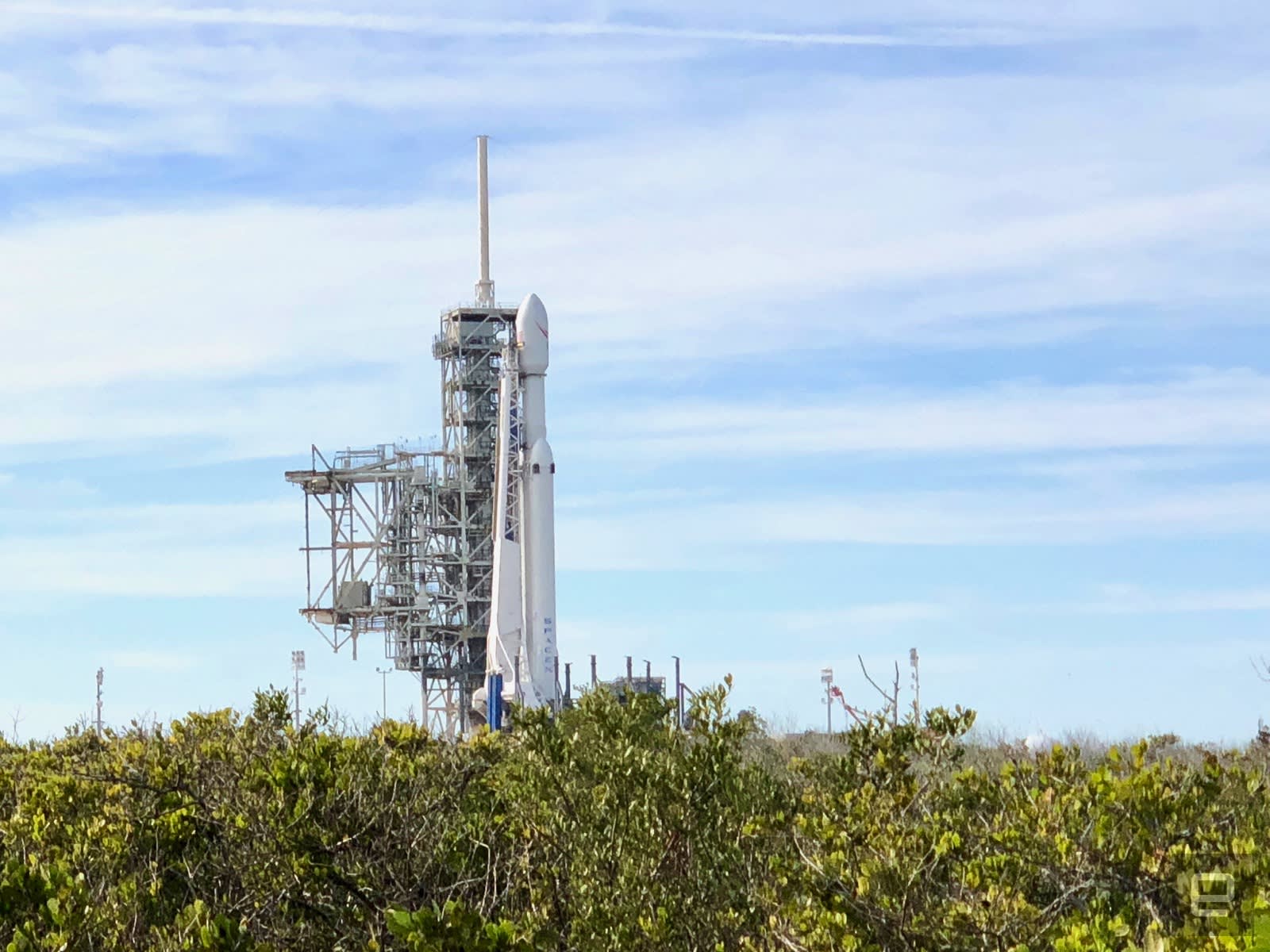
We expected launch delays (it was a test, after all), but that didn’t stop the despair from setting in. We were desperate, and the uncertainty was grueling. To make matters worse, the winds kept up and the time kept getting pushed back further. Everyone was on edge, staring at the countdown clock in the press room, helpless to do anything. Every time the launch clock reset, the entire room would groan in unison.
Like the millennial reporters that we are, we turned to Twitter to express our frustration.
The time left in today’s planned launch window for the Falcon Heavy is now about the length of one episode of Stranger Things
— Marina Koren (@marinakoren) February 6, 2018
We all started resigning to ourselves to the possibility we’d have to return the next day.
Finally, a new launch time was set: 3:45 PM ET — SpaceX was cutting it close to the end of the window. The launch would likely not happen if anything went wrong during the countdown. We were all basically walking bundles of nerves. Even our anxiety had anxiety.
There should be a bar at the NASA press site
— Loren Grush (@lorengrush) February 6, 2018
I honestly don’t think I was this nervous before my wedding. This is ridiculous.
— Miriam Kramer (@mirikramer) February 6, 2018
Our anxiety mixed with confusion as the clock counted down and propellant was loaded. Wait, nothing was going wrong? Suddenly, we were set for launch? The fueling proceeded as scheduled, the weather continued to cooperate and the upper level winds were quiet.
Everything’s going smoothly with the rocket.
I’ve been waiting for this since 2011.
I am not going smoothly.
— Swapna Krishna (@skrishna) February 6, 2018
When we got to about 20 minutes before launch, it started to feel real. “Is it possible this might actually happen today?” I asked myself. I left my computer on its desk on the press room and headed outside, squinting in the bright light, to take a look at the rocket on its pad.
It’s close! pic.twitter.com/VWGQgynWHL
— Swapna Krishna (@skrishna) February 6, 2018
Everyone was excited, but still a little in disbelief. As that clock ticked downward though, it became real. Thirty seconds before launch, I called out the time to reporters who weren’t listening in on the feed from Launch Control; surprise rippled through the ranks that it was so close.
And then, ignition.
Smoke billowed out from the bottom of the rocket as it began to lift off. A few seconds later, it started to move upward. It felt like the rocket was in slow motion, while simultaneously moving blazingly fast. It’s hard to describe the color of the flames shooting out from the bottom of the rocket; It looked like the brightest molten lava.
A few seconds later, the sound hit those of us at the press site. It wasn’t just a noise I could hear; I felt the rumbling deep in my chest. As the rocket ascended, the emotion (and the years I’d been waiting for this launch to happen) hit me, and I started sobbing. I may have been standing in the middle of strangers, but I felt no embarrassment. We were united in our exhilaration.
As we watched the Falcon Heavy ascend into the sky, we whispered under our breath for it to keep moving upward (“please don’t explode”). After it disappeared, we knew it wasn’t over. It was time to search the skies for the first stages returning to land. A few minutes later, we spotted them: two flanking boosters in a perfectly synchronized descent.
The launch of the Falcon Heavy was spectacular. But it was the sheer audacity of the twin booster landing that that transformed my joy into wonder. When I heard the two sets of twin sonic booms (four in all) as the rockets touched down on their respective pads, I couldn’t help but scream, “Holy shit!” They’d done it. And with it, SpaceX had opened a door to a new era in American spaceflight. Watching that launch (and landing) is an experience I will never forget.
Guys my eyes are swollen and my nose is red and it is REALLY obvious I’ve been crying pic.twitter.com/PZnJ7hKzZc
— Swapna Krishna (@skrishna) February 6, 2018
Upcoming Mobile Game ‘Mario Kart Tour’ Will Be Free-to-Start
Nintendo last week announced that its next mobile game will be “Mario Kart Tour,” but with a launch date aimed at any time before the company’s fiscal year ending March 2019, not much information is known about the game. Today, DeNA CEO Isao Moriyasu was reported as saying that Mario Kart Tour will be free-to-start (via TouchArcade and The Wall Street Journal).
The “free-to-start” terminology is somewhat vague, but when compared to Nintendo’s previous use of the phrase it could suggest where Mario Kart Tour is headed. For example, Nintendo currently describes Animal Crossing: Pocket Camp as free-to-start on the game’s website, while Super Mario Run’s website explains that “you can download and enjoy a portion of Super Mario Run for free.”
DeNA CEO said “Mario Kart Tour,” a Nintendo-DeNA smartphone game planned for FY18, will be free-to-start.
— Takashi Mochizuki (@mochi_wsj) February 8, 2018
While far from a definitive answer, this suggests Nintendo might lean towards its recent trend and make Mario Kart Tour a game that’s free to play, with in-app purchases that help with certain tasks. Out of Nintendo’s four mobile games so far, three have followed this model (Miitomo, Fire Emblem Heroes, Animal Crossing: Pocket Camp), while only Super Mario Run has used the pay-once price tier.
Tags: Nintendo, DeNA, Mario Kart Tour
Discuss this article in our forums
Apple News Introduces Coverage Portal of 2018 Winter Olympics in Partnership With NBC
Apple News will be a go-to source for coverage of the 2018 Olympic Winter Games in Pyeongchang, South Korea, which officially begin with Friday’s opening ceremony, although some competition is already underway.
A new section devoted to the Winter Olympics is now available within the “For You” tab of Apple News in the United States, and it will feature articles, videos, and other coverage of the games over the next two weeks.
Apple has partnered with NBC for the new section, but coverage will be provided from a variety of sources, according to Ingrid Lunden at TechCrunch. Live streams and full replays of specific events will link directly to the NBC Sports app, while clips from events will be viewable within Apple News itself.
The portal will also feature a planner for viewers to figure out when specific events are scheduled, and it will allow users to add events they want to watch to their calendars. There will also be a medal tracker and daily roundups given a 14-hour-plus time difference between South Korea and the United States.
Tags: NBC, Apple News
Discuss this article in our forums
Crucial iPhone source code posted in unprecedented leak
Critical, top secret Apple code for the iPhone’s operating system was posted on Github, opening a new, dangerous avenue for hackers and jailbreakers to access the device, Motherboard reported. The code, known as “iBoot,” has since been pulled, but Apple may have confirmed it was the real deal when it issued a DMCA takedown to Github, as Twitter user @supersat noted.
iBoot is the iOS code that ensures a secure boot by loading and checking that kernel is properly signed by Apple before running the OS. The version that was posted to Github, supposedly by a Twitter user named @q3hardcore, was for iOS 9, but much of it likely still exists in the latest version, iOS 11.
Fun thing about the DMCA: it required Apple to state, under penalty of perjury, that the iBoot source code was legit: https://t.co/PKHZqcEe6h
— Karl (@supersat) February 8, 2018
The code can’t be compiled because certain files are missing, but researchers and hackers who know what to look for could probe it for vulnerabilities. “This is the biggest leak in history,” author and security researcher Jonathan Levin told Motherboard. “The leaked sources of iBoot … bring us closer to a truly liberated iOS booted on generic arm boards and/or emulator,” he added on Twitter. Levin and other security researchers believe the code is the real deal.
iPhones used to be relatively easy to jailbreak before Apple introduced the “secure enclave co-processor” with the TouchID of the iPhone 5s. Now, it’s nearly impossible for hackers to even find bugs in iOS code, making iOS exploits relatively rare, unlike in Windows and Android. As such, the iBoot leak is exposing code that hardly anyone has seen before.
The iBoot dump first appeared last year on Reddit, but received little notice from the security community until it hit Github. Apple considers iBoot to be such a critical part of iOS that it offers $200,000 for vulnerabilities, the most in its bug bounty program. That means the release of the source code could amount to a gold rush for many researchers.
Via: Motherboard
Source: Github
Viacom closes its VR studio
VR hasn’t yet become the shot in the arm the entertainment industry was hoping it would be, and so things have to change. Viacom has decided to close down Viacom Next, its emergent technology group which produced VR content like The Melody of Dust and Are Aligned. Variety reports that some staffers will lose their jobs, while others will be given the chance to transfer to other parts of the media conglomerate.
The company issued a statement saying that it remains “deeply committed” to building new technologies through augmented and virtual reality. Viacom Next started out exploring esoteric art projects in VR, and worked with the NYC Media Lab to explore the relationship between music and virtual reality. Its only notable partnership with the wider Viacom family was to produce the Transformers ARKit title Cade’s Junkyard.
Source: Variety
 AIVAnet