


The ugly history of strapping screens to our faces
2017 isn’t the first time that VR, or any face-worn gadget for that matter, has attempted to make it in the mainstream. And yet, the hardware itself, be it a Daydream View or a HTC Vive, is still a pretty intimidating thing to attach to your face. But looking at some of the headsets that didn’t make it over the years, we’re in a much better position than we were two decades ago.
Virtuality (1991)

We’ll start with Virtuality, a massive VR headset aimed at arcades that ran on an Amiga 3000. Each headset packed two LCD displays, each with a resolution of 276 x 372, enough to render the sub-Money For Nothing graphics of multiplayer shooter Dactyl Nightmare. Interestingly enough, though, each headset weighed in at 645 grams, making it only a little bit heavier than the 555 gram HTC Vive.
Forte VFX 1 (1995)

If you think Oculus produced the first VR headset for the home, you’ve probably never heard of the Forte VFX 1. It was designed to operate as a stereoscopic viewer for your PC, although that feature required your desktop to have a Pentium processor. Without built-in head tracking, it needed you to use a handheld mouse, called the Cyberpuck, to move around inside games like Doom and Duke Nukem 3D.
Retailing for the better part of $700 and requiring a dedicated card to be installed on the motherboard, it wasn’t a hit with consumers. Forte was bought out in 1997 after going under. A follow-up device, the VFX 3D, similarly flopped.
Toshiba Bubble Helmet (2006)
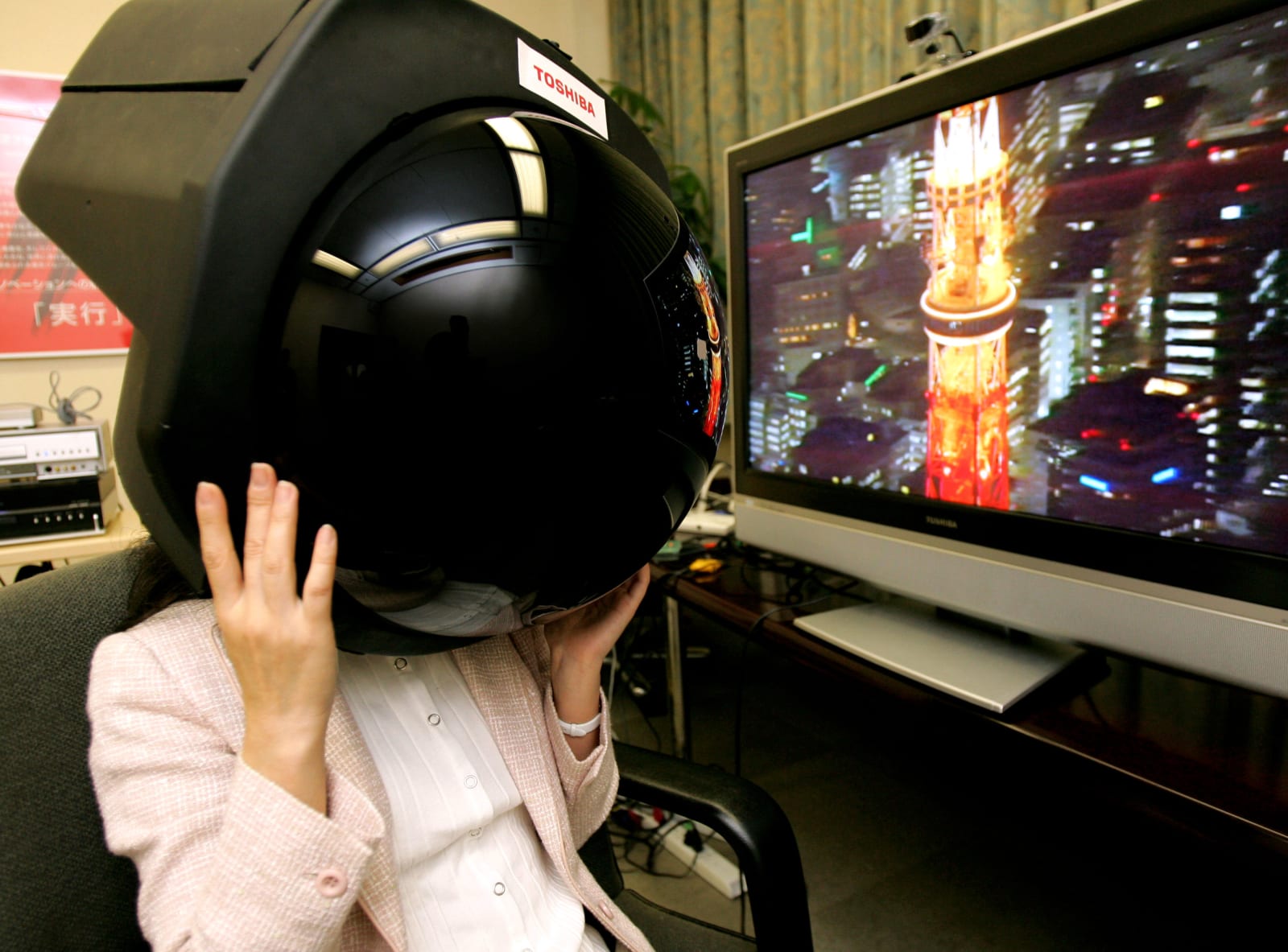
Over ten years ago, Toshiba’s idea of a head-mounted display was a little different from many of the others, to the point where nobody’s sure — even now — that it wasn’t an elaborate prank. The idea was to offer up 360-degree video in a sphere that enabled you to look around without getting eyestrain. Rather than the device showing you a restricted view, you’d simply turn your head to look at the rest of the display. Weighing in at six pounds, the device was only really good as an indoor planetarium, but imagine the view. You can make your own guesses of why it never made it past the concept stage.
Sony HMZ series (2011 – 2015)

In 2011, Sony built the first of what would be three attempts to create a perfect virtual cinema. The HMZ-T1 was equipped with a pair of 0.7-inch OLED displays with a resolution of 1,280 x 720. Priced at $800 and available only at Sony stores, it offered 5.1 channel audio via its built-in headphones. There was also the promise of 3D video and the ability to take it on trips with you so you never, ever lacked a screen to watch.
The company refined the template over the next three years, releasing the T2 and T3 in quick succession. Each one lost a few grams, got better sound and improved connectivity. But no amount of refinements were enough to rouse the affections of an indifferent public. Sony pulled the headset in 2015, pushing the resources toward its VR division.
Google Glass (2013)

Engadget
Who could forget Google Glass? The experimental head-worn computer that promised to revolutionize technology. If only it a) had a purpose, b) had decent battery life c) didn’t cause revulsion wherever it was worn. From privacy concerns surrounding Glass’s built-in camera to the worry that the technology would erode human relations, hostility abounded.
Because Glass didn’t have a single USP, Google was pretty much throwing an idea at the wall and seeing what stuck. And it turned out that very little did, so after a hardware revision, Glass made a muted exit from the public’s consciousness.
At least, until earlier this year, when the company revealed it had placed Glass headsets at various business. Google Glass Enterprise Edition is designed to enable factory workers and other professionals to have a heads-up display while they work. Sure, it won’t be as ubiquitous as the smartphone, but Glass can’t be written off as a total failure.
Avegant Glyph (2016)

In the wake of Sony’s exit from the market, other companies, like Vuzix, have tried to fill the void for personal-cinema fans. Perhaps the most eye catching is Avegant, whose Glyph headset looks like a pair of Beats headphones. But, flip the body down to eye level, and it instantly becomes a screen that claims to substitute a 55-foot movie theater. There’s no indication how many headsets Avegant has sold; although the fact that its price has now fallen to $500 may be a sign of some success.
Royole Moon (2017)

Royole’s Moon, the head-mounted display that inspired this jaunt through time, is the latest personal cinema to make its debut. The hardware comes with plenty of useful features, including a built-in browser, touchpad controls on the right ear cup and active noise cancellation.
Unfortunately, for all of those perks, the unit is still pretty heavy, and eyestrain remains an issue. Not to mention the whole fact that, like most of the devices on this list, it’s pretty spendy. In fact, it’s another $800 slab of plastic and leather that, like so many that preceded it, has to do a lot to convince users to open their wallets.
Daydream View (2016)

Which brings us to Google’s Daydream View headset, updated at yesterday’s event. It’s the most elegant, perhaps the prettiest, headset available for everyone to buy. After all, using a smartphone for a display means you’re untethered from a PC or other equipment, removing the fear that you could crash into something. The new version comes with a wider field of view — around 15 degrees, depending on the size of your smartphone. And at $99, it’s cheap enough to tempt a wide variety of people to embrace the technology and strap gadgets to their face. Or, at least, that’s the plan.
Images: Ullstein Bild via Getty Images (Virtuality); Ajerimez, Wikimedia Commons (VFX 1); Associated Press (Toshiba); Yoshikazu Tsuno via Getty Images (Sony VR headset); Engadget (Google Glass); James Trew / Engadget (Avegant Video Headset); Dan Cooper / Engadget (Royole Moon); Engadget (Daydream View)
Sharp’s smartphone robot gets a more ‘affordable’ WiFi version
If you’ve been waiting for a price drop for Sharp’s super adorable robot phone, your wait is sort of over. As of October 6th, you can get a RoBoHon for 138,000 yen (excluding tax) which is about $1,230. That’s a notable 60,000 yen or $530 drop from the original price, but there’s a catch: this new offering doesn’t come with cellular function. Apart from that, this WiFi-only RoBoHon (SR-02M-W) is otherwise identical to its LTE counterpart (SR-01M-W), packing the same Snapdragon 400 chipset, Android 5.0 OS, 2GB of RAM, 16GB of storage, an 8-megapixel camera (with 720p video recording), a 720p pico projector in the head, a 1,700 mAh battery and a 2-inch QVGA touchscreen on the back.

It’s unclear whether this more affordable RoBoHon will boost sales in the consumer market, but Sharp is certainly interested in pushing this model to businesses, including shops, restaurants, tourist spots and more. After all, this little robot can still sing and dance using just WiFi connectivity. Alas, both RoBoHon models are still only available in Japan, but at least you now have a more valid excuse to make a shopping trip.
What to expect from the Engadget Experience, our immersive art + tech event
New mediums like augmented reality, virtual reality and artificial intelligence are pushing the boundaries of art, entertainment, gaming and performance — but immersive media isn’t always accessible. For one day only, we invite you to experience what happens at the outer limits of creativity.
The first Engadget Experience is set to bring together some of the brightest minds in technology, art and entertainment next month, and we want you to be there. The agenda is nearly complete, and we’re proud to say it’s going to be a killer show.
When we first birthed this brain baby, we didn’t know what it would look like. What we did know is we wanted to create a space for conversation between the people building new technologies like AR, VR and AI and the people leveraging those technologies to reshape the way that we tell stories. The Engadget Experience is that space.
But just talking about the amazing things people are doing with immersive media wasn’t enough. We wanted to do our part to bring those ideas to life. So we put together a $500,000 grant program and funded five immersive experiences spanning AR, VR and AI. The prizewinners had to do two things: address the theme of alternate realities and complete their projects in four months.
Your Hands Are Feet (Amelia Winger-Bearskin and Sarah Rothberg), Untrained Eyes (Glenn Kaino and Jesse Williams), Mapper’s Delight (Tahir Hemphill, David A.M. Goldberg and Nick Fox-Gieg), Dinner Party (Laura Wexler, Angel Soto, Charlotte Stoudt and Saschka Unseld) and Dance With flARmingos (Kristin Lucas, Regine Basha, Tommy Martinez, Thomas Wester and Ben Purdy) will all premiere at the Ace Hotel Theatre in downtown LA on November 14th. The artists will also appear on stage along with a series of short documentaries that follow the prizewinners as they produce their projects.
Attendees will get the chance to experience these projects firsthand and get a glimpse at the unique challenges of working in as-yet-unestablished media. In addition to the exhibition, a series of talks, panels and conversations will shed light on the future of entertainment, art, gaming, even social media. Our special guests include “the godmother of virtual reality,” Nonny de la Peña; co-founder of Oculus Story Studio and CEO of Penrose Studios Eugene Chung; and executive creative director of The Mill, Rama Allen. They’ll join thought leaders from RSA, UCLA, Technicolor and Sundance to discuss topics ranging from identity and representation in virtual worlds to VR’s still-undecided killer application.
You can get your tickets to the Engadget Experience right now at our website for the Early Adopter rate of $125. That gets you one day’s admission to be front and center at the Ace Theatre for in-depth interviews and screenings from today’s creative pioneers and experience immersive AR/VR art installations. During lunch and at our closing cocktail reception, you’ll get to expand your network and meet leading creators and technologists who are making waves in this emerging space. Full-time and recently graduated students can apply for our reduced-rate tickets here.

The Engadget Experience
AGENDA
_____________________
Tuesday November 14
9:00 AM
DOORS OPEN
10:00 – 10:08 AM
Opening Remarks: Christopher Trout, Engadget Editor-in-Chief, and Dana Wollman, Engadget Executive Editor
10:10 – 10:30 AM
Talk: A New Lexicon for Virtual Reality with Eugene Chung (Penrose)
Just as the entertainment industry needed a new lexicon in the early days of film and opera, creators of virtual and augmented reality face the same challenge. Each new medium requires its own specific terminology, and there’s a “new language” coming into place for AR and VR. Penrose Studios founders, Oculus Story Studio co-founder and Pixar alum, Eugene Chung talks about how we talk about virtual worlds.
10:30 – 11:00 AM
Artist Spotlight: Untrained Eyes documentary screener and presentation by Glenn Kaino and Jesse Williams
Untrained Eyes is a conceptual technology project that takes its inspiration from observing the explicit bias that can be found during everyday image searches within Google and other public-image archives. Jesse Williams (Grey’s Anatomy) and long-time collaborator and internationally renowned artists Glenn Kaino use artificial intelligence to hold up a mirror to programming bias.
11:00 – 11:30 AM
Panel: Identity and Representation in the “Empathy Machine” with Gina Kim (UCLA), Nicole McDonald (HELO)
Panelists will discuss the idea of virtual reality as the ultimate “empathy machine,” and how science and storytelling combine to allow viewers to experience the world through the eyes of another.
11:30 AM – 12:00 PM
Artist Spotlight: Mapper’s Delight documentary screener and presentation by Tahir Hemphill
Mapper’s Delight is a cultural tale representing worlds, experiences and gameplay told through the most-listened-to musical genre on the planet. The Datanauts of Mapper’s Delight use sight, sound and touch to investigate the global distances traveled by the lyrics contained in each rap artist’s career while exploring the secret flows of hip-hop’s spacetime through a panoptic interface.
12:00 – 1:00 PM
LUNCH
1:00 – 1:30 PM
Talk: Manufactured Hallucinations: Virtual Dreams & Emotional Machines by Rama Allen
Rama is going to get weird. He’ll discuss translating dreams and hallucinations into shared digital experiences; virtual worlds that respond to feelings; and the bright, odd, shiny future for technologically enabled artists. Mostly just hallucinations, though.
1:30 – 2:00 PM
Artist Spotlight: Dance with flARmingos documentary screener and presentation by Kristin Lucas
Dance with flARmingos is a mixed reality experience that features an interspecies dance between humans and flamingos, and pays homage to the flamingo — a consummate showman and embattled victim of environmental neglect — by staging kinship from an ethical distance. Digital art pioneer Kristin Lucas and her team use augmented reality to transport you to a flamingo dance party.
2:00 – 2:30 PM
Panel: The Big Picture With Marcie Jastrow (Technicolor Experience Center), Jen Dennis (RSA VR), and Ruthie Doyle (Sundance)
With VR and AR still in their infancy, we’ve yet to see what the media killer applications will be. With filmmaking, art, gaming, enterprise and social media pushing to come out ahead, what will the future of AR and VR look like?
2:30 – 3:00 PM
BREAK
3:00 – 3:30 PM
Artist Spotlight: Dinner Party documentary screener and presentation by Laura Wexler, Angel Soto, Saschka Unseld and Charlotte Stoudt
Dinner Party is a virtual-reality thriller based on the true story of the Betty and Barney Hill UFO-abduction incident, the first nationally known UFO abduction in American history. After an inexplicable nighttime encounter, the Hills, an interracial couple living in 1960s America, sought hypnosis to recover memories of what they experienced. Literary journalist Laura Wexler, Angel Soto (RYOT), Saschka Unseld (Pixar, Oculus Story Studio) and Charlotte Stoudt (Homeland) transport you to another world via virtual reality.
3:30 – 4:00 PM
Artist Spotlight: Your Hands Are Feet documentary screener and presentation by Amelia Winger-Bearskin and Sarah Rothberg
Your Hands Are Feet is an interactive room-scale VR experience that places you in surreal realities made up of experiential metaphors. You start out in a kitchen with a carton of six eggs, which can be picked up and thrown or cracked on the countertop. Each egg acts as a portal to a new experience; the room is transformed into a surreal landscape, presenting a reality where your head can be in the clouds, the whole world can crumble around you, you can be all thumbs, or have two left feet (but really, though).
4:00 – 4:30 PM
Panel: The Social Medium by Boo Wong (The Mill), Adam Arrigo (The Wave VR)
Virtual Reality has often been criticized for its predisposition to isolating users. We’ll explore how artists and technologists are working to make VR a social medium in amusement parks, music and sports.
4:30 – 5:00 PM
In Conversation: TBA
5:00 – 5:30 PM
In conversation: Nonny de la Peña
Engadget senior editor Devindra Hardawar will sit down with the “godmother of virtual reality” to talk about the early days of virtual reality, the new VR gold rush and her work as a trailblazer in immersive storytelling.
5:30 – 7:30 PM
Closing Reception
Attendees will mingle with artists, speakers and panelists and explore the Alternate Realities prizewinning projects.
Source: The Engadget Experience
Smart speakers are working their way into every home
Apple, Google and Amazon have all announced smart speakers that are more like gadgets than audio gear. Of course, whenever a tech company attempts to build audio gear, the specter of the iPod HiFi looms large. Apple’s ill-fated attempt to build the perfect speaker was considered a flop thanks to its high price and limited functionality. It was a glorified iPod dock that set you back $349 and couldn’t even connect to the internet or FM radio. A decade later, smart speakers look ready to take over the world. And what happens next is going to be very interesting.
It’s not enough for your speakers to simply pump out good sound from your TV, computer, smartphone or Spotify account. Not in 2017, when three of the world’s biggest consumer technology companies — and that includes Amazon — are pitching products that do so much more. No matter which system you buy, you’re entitled to expect decent audio and the ability to control parts of your smart home. Not to mention the amusing, but less useful, ability to ask voice questions and get the answers spoken back to you in real time.
The fact that these devices all retail for between $50 and $400 means that Silicon Valley is planting its tanks squarely on mainstream audio’s lawn. You can imagine the nervousness coming out of companies like Bose, B&O Play and Philips. If you’re already an Android phone user with a Chromecast, then doesn’t Google Home — which integrates with both — make more sense than a third-party name-brand speaker?
Similarly, if you are already embedded within Apple’s or Amazon’s ecosystem with Apple Music or Prime, then it would make sense to buy a HomePod or Echo. Sure, audiophiles may not be swayed by these devices, but for those folks happy with standard-resolution streaming audio, it’s ideal. Ease of use, utility, a relatively low price and the brand may trump sound quality for a lot of us.

Amazon’s strategy has been to flood the market with a wide variety of Echo devices that come in all shapes, sizes and prices. The revamped, $100 Echo ships with a pleasing cloth finish and Dolby-tuned sound to ensure it becomes your go-to speaker. Meanwhile, the $150 Echo Plus ships with a ZigBee controller, enabling it to control a wide variety of smart home devices, like Hue bulbs, without the need for an additional bridge. Hell, even the $130 Echo Spot will play music and offer voice commands, even if it is intended more as a replacement for your alarm clock.
Then there’s Google, which added to its initial $129 Home smart speaker with the $50 Home Mini and $400 Home Max. The latter is designed as a smart, wireless multi-room speaker that will connect to Google Assistant and control your home. In addition to dual 4.5-inch woofers and custom tweeters, Google claims to have custom-designed even the fabric for better sound on both of its new products. The Home Max will even tune itself, optimizing its own sound settings for the local environment. It will also learn your music tastes and fine-tune the balance of its sound for optimal listening across your living room.
Home Max does have one drawback, which is that it’s going to retail for $50 more than even Apple’s smart speaker. Since it ships with a 3.5mm audio-in jack, however, the device can pull double duty as the primary speaker for plenty of other hi-fi gear. It may not be able to replace your TV’s sound bar, unless you can connect to your set-top box wirelessly. But it’s plausible that, with Chromecast integration, it could become a one-stop shop for your home entertainment needs.
Homepod, meanwhile, is Apple’s own entry into the smart speaker market. It similarly offers positional awareness, high-quality sound and voice control. It’s Siri, rather than Assistant or Alexa, that you’ll use with a variety of Homekit-enabled accessories, with all of the attendant benefits and burdens that entails. Apple has promised that its platform has improved, although time will tell whether that will actually be the case. In addition to voice control and smart tuning, you also get the benefit of Apple’s broad and deep ecosystem, including its music offerings and integration with AppleTV (via AirPlay 2) and your iOS devices.

You would think that the first and most obvious casualty from this shift would be Sonos, which has made its name producing high-quality, reasonably priced audio gear. But it may actually come out a surprising winner against all of these other names, since Google and Amazon both allow third parties to use their platforms. Sonos has already announced that its new Sonos One speaker will ship with Alexa, with Google Assistant integration coming at some point next year.
Having a device that’ll play nice with two of the three major voice platforms (sorry, Cortana) may prove to be an inspired business decision. Users can pick and choose which option they’d prefer, or use both, depending on the circumstances. The One will also have AirPlay 2 integration, giving them adjacent access to iOS. The move will also reduce the worries of buyers, who may stay away for fear of committing to a platform that they may not like. Plus, for $199, it may strike the right balance between quality and affordability for those folks for whom $400 for a speaker borders on the extravagant.
I don’t think that, whatever happens, this is going to be a rerun of the iPod HiFi debacle, and that many companies in the audio space should be nervous. Amazon, Apple and Google have already sucked most of the air out of so many industries that it’s hard not to expect them to have an impact. Look at how many retailers have been crowded out by Jeff Bezos, how many watchmakers have seen profits fall now that the Apple Watch exists. The set-top box market may have ambitions toward diversity, but the only names worth paying attention to are Amazon, Apple, Google and Roku.
Fundamentally, if you’re a company producing speakers around the $300 mark, then you have a problem. Because smart speakers, produced and backed by billion-dollar tech companies, are looking to eat your lunch. These devices have a ready-made position at the heart of the smart home revolution. This is a time to either pounce on a radical new idea, join up with Google or Amazon and hope they leave enough crumbs for you to survive, or face hard times ahead.
Follow all the latest news from Google’s Pixel 2 event here!
SanDisk’s ‘Industrial’ SD cards can withstand extreme temperatures
Western Digital is working on a new line of SanDisk memory cards that can withstand a wide range of temperatures, from the extremely hot to the extremely cold, AnandTech reports. The lineup includes an Automotive SD meant for vehicles like cars and drones and three Industrial cards — Industrial SD, Industrial microSD and Industrial XI — intended for more mainstream industrial applications.
And extreme is no exaggeration here. The Industrial SD and Industrial microSD cards can work for extended periods of time at temperatures ranging from -13°F to 185°F while the Industrial XI and Automotive SD cards can withstand temperatures between -40°F and 185°F. Those are temperatures that most people won’t find themselves in very often, if ever, but if they can work in extreme heat and cold, they should definitely work just fine in the more mild temperatures experienced by most of the population.
The cards’ read and write speeds are also pretty decent (80MB/s and 50MB/s) and they incorporate a Health Status Monitor that will allow manufacturers to check in on card usage and performance levels. They’re also designed with a number of features meant to protect data.
AnandTech reports that SanDisk has distributed samples of the Industrial SD, microSD and Automotive SD cards to manufacturers around the world and samples of the Industrial XI cards will be released sometime this month.
Via: The Verge
Source: SanDisk (1), (2), AnandTech
New macOS High Sierra Vulnerability Exposes Passwords of Encrypted APFS Volumes in Plain Text [Updated]
Brazilian software developer Matheus Mariano appears to have discovered a significant macOS High Sierra vulnerability that exposes the passwords of encrypted Apple File System volumes in plain text in Disk Utility.
MacRumors confirmed our test password “dontdisplaythis” appeared as the hint
Mariano added a new encrypted APFS volume to a container, set a password and hint, and unmounted and remounted the container in order to force a password prompt for demonstration purposes. Then, he clicked the “Show Hint” button, which revealed the full password in plain text rather than the hint.
A second video with English system language is embedded below
MacRumors reproduced this behavior on a 2016 MacBook Pro running macOS High Sierra, including versions 10.13 and 10.13.1 beta. German software developer Felix Schwarz also shared a video of the issue on Twitter today.
Tried myself & it’s true: #HighSierra shows the #APFS volume password as hint. Persists reboots, not stored in keychain. Wow. Just wow. pic.twitter.com/FkcHI9KHl9
— Felix Schwarz (@felix_schwarz) October 5, 2017
The issue currently only affects Macs with SSD storage due to Apple File System compatibility, but APFS will eventually support machines with Fusion Drives as well. Schwarz believes users who haven’t specified a password hint, or haven’t used Disk Utility whatsoever, are probably not affected.
For clarity, this appears to be a bug within Disk Utility itself. When creating an encrypted APFS volume in Terminal with the diskutil command line utility, the actual hint is shown, rather than the password.
Mariano said he has reported the vulnerability to Apple. The company did not immediately respond to our request for a comment on the matter, but we’ll update this article if we hear back.
Update: Apple has addressed this bug by releasing a macOS High Sierra 10.13 Supplemental Update, available from the Updates tab in the Mac App Store. Apple has also shared a support document outlining steps to back up, erase, and restore the encrypted APFS volume upon updating.
Related Roundup: macOS High SierraTag: APFS
Discuss this article in our forums
Sphero Launches New R2-Q5 iPhone-Controlled Star Wars Droid
Following the launch of BB-8 in 2015, and R2-D2 and BB-9E last month, Sphero has introduced an all-new iPhone-controlled droid ahead of New York Comic-Con, which begins today. This one is R2-Q5 and is the Imperial counterpart to R2-D2, with a glossy black finish and matte gold trimmings. R2-Q5 first appeared in Return of the Jedi.
Similar to Sphero’s R2-D2 droid, R2-Q5 has functional lights, a rotating dome, retractable third foot, on-board speakers, and can be piloted manually via the same Sphero app that controls the other Star Wars droids, or patrol on its own. The app has augmented reality features that place R2-Q5 in settings within the Star Wars universe, including the Death Star. You can watch Star Wars movies with the droid and have it react to certain moments within the film as well.
R2-Q5™ is an Imperial astromech droid from a galaxy far, far away…. Control it with your smart device or keep this nefarious Droid in top shape with augmented reality training. R2-Q5’s signature front and rear LED lights are fully functional, and an integrated speaker means all sounds come right from the droid itself. Watch R2-Q5 interact with other Star Wars™ App-enabled Droids by Sphero, and view films from the Star Wars saga with R2-Q5 reacting by your side. This special droid has been brought to life thanks to Sphero technology.
Sphero is planning R2-Q5 as a much more exclusive model than its previous droids, with only 100 on sale at the company’s New York Comic-Con booth today. After that, the droid will debut on Best Buy’s site and in stores on November 5 for $199.99. Pre-orders are available now, and the “limited edition” droid is expected to see limited availability throughout the holidays, so once they disappear from Best Buy they’ll be gone for good.
Tags: Star Wars, Sphero
Discuss this article in our forums
Apple Releases macOS High Sierra 10.13 Supplemental Update With Fix for APFS Disk Utility Bug
Apple today released a supplemental update to macOS Sierra 10.13, the first update to the macOS High Sierra operating system that was released to the public in late September. The macOS High Sierra 10.13 update comes just over one week after the release of macOS High Sierra.
The new version of macOS High Sierra 10.13 is a free update for all customers who have a compatible machine. The update can be downloaded using the Software Update function in the Mac App Store.
The supplemental macOS High Sierra 10.13 update addresses a software vulnerability that could expose the passwords of encrypted Apple File System volumes in plain text in Disk Utility.
Apple has released a support document alongside the Supplemental Update that walks users through the process of protecting their data if macOS High Sierra is showing a password instead of a password hint on an encrypted APFS volume.
Steps include installing the new update, creating an encrypted backup of data for the affected volume, erasing the drive, reformatting to aPFS, then APFS (Encrypted) and finally restoring the data that was backed up.
According to Apple’s release notes, the update also improves installer robustness, fixes a cursor graphic bug in Adobe InDesign, and resolves an issue where messages couldn’t be deleted from Yahoo accounts in Mail.
macOS High Sierra introduces a new more modern file system designed for flash storage (APFS), Metal 2, Safari improvements that protect user privacy and prevent autoplay videos, and improvements to several apps like Photos, Mail, Notes, and more.
Discuss this article in our forums
ZTE makes its Verizon debut with the ultra-budget Blade Vantage smartphone
Why it matters to you
The ZTE Blade Vantage comes at only $50, and may well be the best phone for that price currently on the market.
ZTE is making its big push into the United States, and to do that, it’s finally working with Verizon, the largest mobile carrier in the country. The mobile phone manufacturer has announced that it will be offering its first device on Verizon, called the ZTE Blade Vantage.
The phone is aimed at being an excellent ultra-budget option, and it comes in at only $50. Sure, for that price you won’t get a flagship device, but it’s actually not a bad option for those looking for a super-cheap phone. For that $50, you’ll get a Qualcomm Snapdragon 210 processor, coupled with 2GB of RAM and 16GB of storage. That storage can be expanded upon with the MicroSD card slot, which is helpful for those that want a little more space.
Even the cameras on the device are better than you would expect for the price. The rear-facing camera sits in at 8-megapixels, with the front-facing camera coming in at 2 megapixels. Powering the whole device is a 2,500mAh battery, which may not be as big as some other phones, but considering the display sits in at only 854 x 480 pixels, it should be able to get you through the day.
“The ZTE Blade Vantage is ZTE’s first smartphone to be on Verizon’s network, signifying an expanded partnership that we are excited to see grow over the coming months and years,” ZTE CEO Lixin Cheng said in a press release. “Consumers continue to be attracted to our affordable premium smartphone lineup, and we’re excited that Verizon customers can now purchase a ZTE device with the Blade Vantage.”
The super-budget phone market really seems to be heating up. Gone are the days when not paying a premium meant having to deal with a nonperforming device. These days, phones like the Blade Vantage mean that not only can you get a smartphone for $50, but you can get one that’s more than capable of handling most day-to-day tasks like basic web-browsing, social media, and so on. Sure, as mentioned, it won’t be able to do things like handle virtual reality or serious multitasking — but as is always the case with these things, that tech will eventually trickle down to low-cost phones like this.
Best iOS app deals of the day! 6 paid iPhone apps for free for a limited time
Everyone likes Apple apps, but sometimes the best ones are a bit expensive. Now and then, developers put paid apps on sale for free for a limited time, but you have to snatch them up while you have the chance. Here are the latest and greatest iOS app deals available from the iOS App Store.
These apps normally cost money and this sale lasts for a limited time only. If you go to the App Store and it says the app costs money, that means the deal has expired and you will be charged.
SideGuide
SideGuide is you’re crowdsourcing solution for what to say in any situation. Whether you have a romantic conundrum, professional quandary, or a social dilemma, SideGuide can help you figure out what to say.
Available on:
iOS
Gaitometer
The patented Gaitometer measures the symmetry of steps when walking (or running), and provides real-time audio and visual feedback to assist the user in obtaining a more symmetric and healthier gait.
Available on:
iOS
Aerium
Aerium is a gorgeously crafted weather app that alerts you to when it’s expected to rain in your location the day before. The weather descriptions can help you decide how you need to dress before going out.
Available on:
iOS
Binaural Meditation
The beats in Binaural Meditation have been engineered to help you get into deep states of meditation and mindfulness as quickly and effortlessly as possible.
Available on:
iOS
myPref
Designed by behavioral experts, myPref is a convenient, efficient way to to determine preferences. Up-to-date preferences are vital to the effectiveness of any behaviorally based program and myPref makes performing these assessments easy and accurate.
Available on:
iOS
PaintVideo
PaintVideo is an easy-to-use video drawing application with real-time features with which you can draw, write, fill, blur, and add music within an existing video.
Available on:
iOS
 AIVAnet