


Li-Fi, the internet of light, turns LED fixtures into speedy wireless access
Why it matters to you
As our demands on Wi-Fi grow, Li-Fi offers a smart, efficient, and secure alternative to keep us connected.

Internet access is fast becoming a basic human right, but there are problems with our current delivery systems. As we connect more and more devices to the internet, a spectrum crunch is increasingly inevitable. Li-Fi, which allows us to access the internet via light, instead of the radio frequencies that Wi-Fi relies upon, could open up a lot of bandwidth.
More: We’ve seen the light! Li-Fi is the future of wireless connectivity
You may remember that we talked to Edinburgh-based PureLiFi last year to see a working prototype of its LiFi-X system. This year at MWC in Barcelona, we sat down with PureLi-Fi COO, Harald Burchardt again to find out how far the team has come in the last 12 months. As it turns out, the company has been busy raising significant funding, expanding the engineering team, and securing more partners.
What is Li-Fi?
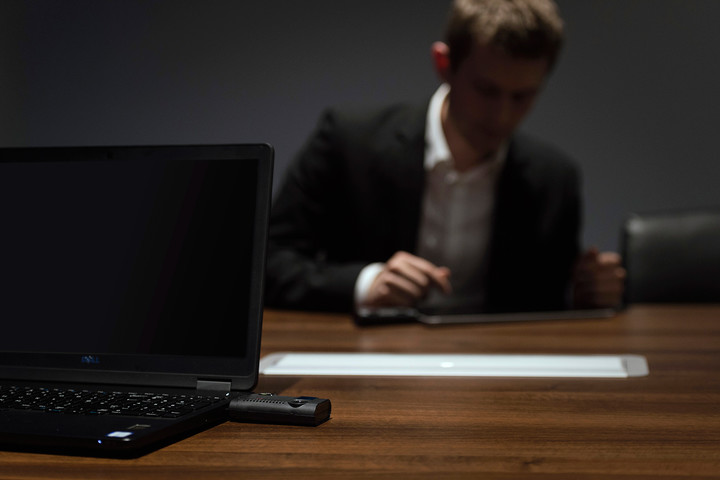
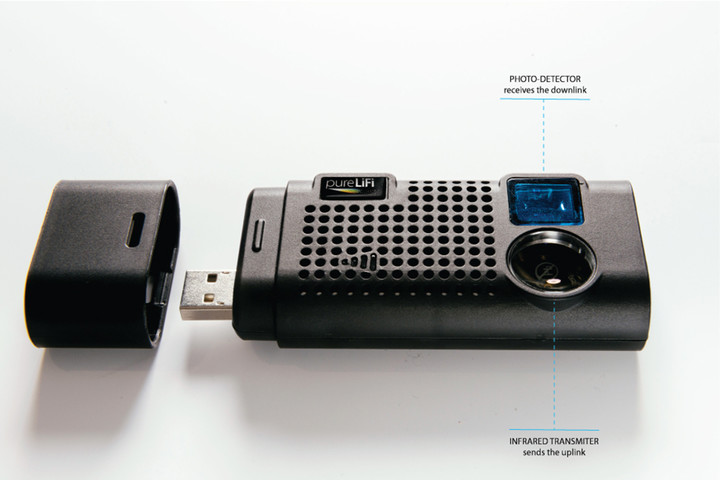
The LiFi-X system consists of a LED light fixture and a dongle that you can plug into a USB port on your laptop. It’s capable of delivering speeds of up to 42Mbps up and down. It’s already available and in use through various business partnerships.
PureLiFi has been working with a number of companies worldwide, including Cisco, British Telecom, and Babcock, to trial the technology and gather feedback for improvements. There are lots of reasons that a company might consider a Li-Fi system.
The LiFi-X dongles and LED light fixtures are capable of sending and receiving data through light.
“We work with a lot of companies where security is high on their agenda, for the enterprise bandwidth is a big thing, but also location for retail and financial services,” Burchardt told Digital Trends.
The LiFi-X dongles and LED light fixtures are capable of sending and receiving data through light. That means you can confine access to the network very easily, offering much greater security than Wi-Fi.
In order to get the light working, you need to hook it up in much the same way as you would a router. This is ideally achieved through Ethernet cabling, though it can also be retrofitted using existing power lines. The weakness of power line communications is that the lights are in a daisy chain, so you’re dividing the bandwidth between them. With Ethernet cabling, each individual light is hooked up directly.


PoE (Power over Ethernet) systems are actually growing in popularity because they offer very high-efficiency power and, since they don’t require a certified electrician to fit them, they’re also faster and cheaper to install. Having IP connectivity in every light fixture also offers benefits in terms of building control and device monitoring, which is growing more important as the IoT expands.
In the short term, PureLiFi is working on establishing a set of performance standards. It expects to hit speeds of 80 to 100 Mbps relatively soon, and will then look to push things further to 1 Gbps within three years.
Li-Fi might be in your phone one day
A lot of effort is also going into miniaturizing the technology. The current LiFi-X dongle is quite big, it’s suitable for a laptop, but probably too bulky for comfortable use with a tablet. We got a sneak peek at the newly redesigned dongle, which is coming in the second half of this year. We weren’t allowed to photograph it, but compared to the existing LiFi –X, it is much smaller. Imagine a sleek, stylish-looking USB thumb drive and you’re close. That’s a significant improvement, but it’s still not going to work for smaller devices, like our phones.
Rumors have already circulated about Li-Fi support in a future model of Apple’s iPhone.
“We are currently working on ways to reduce the size of the optical receiver so that it can fit in a smartphone,” says Burchardt.
It may be part of the screen, under the screen, or something separate about the size of a camera module.
“We are already in discussions with a number of manufacturers of smartphones, tablets, and laptops and the goal is to get to that stage where we’re developing chips that will go into the device,” Burchardt explained. “Our long-term goal is component supply for OEMs.”
PureLiFi remains tight-lipped about who the prospective partners are, but rumors have already circulated about Li-Fi support in a future model of Apple’s iPhone, after a reference to “LiFiCapability” was spotted in iOS code.
More: Why 2017 will be the year of blisteringly fast Wi-Fi
Businesses can talk to PureLiFi now and get to work implementing the technology, but if you’re clamoring for a consumer product, you’ll need to be patient for a while longer.
“Probably within the next three years we’ll have components available that can be technically integrated into a phone,” says Burchardt.
The future is bright for Li-Fi
By that time, the underlying infrastructure of Ethernet cabling, required for peak performance of Li-Fi, is likely to be far more widespread. PureLiFi is also working with a number of partners in the lighting industry, so the ecosystem required for Li-Fi to thrive is already growing. Component costs will also come down, as manufacturing ramps up, making it affordable for OEMs to integrate.
“We plan to provide components that are very low power, very cost effective, and very high performance,” says Burchardt.
The exponential growth in connected devices and data demands is leading to frequency congestion and that could make current wireless technologies unsustainable in the long term. Li-Fi can make much greater volumes of data accessible, and securing access is as simple as pulling the shades. The future looks bright for Li-Fi.
Li-Fi, the internet of light, turns LED fixtures into speedy wireless access
Why it matters to you
As our demands on Wi-Fi grow, Li-Fi offers a smart, efficient, and secure alternative to keep us connected.

Internet access is fast becoming a basic human right, but there are problems with our current delivery systems. As we connect more and more devices to the internet, a spectrum crunch is increasingly inevitable. Li-Fi, which allows us to access the internet via light, instead of the radio frequencies that Wi-Fi relies upon, could open up a lot of bandwidth.
More: We’ve seen the light! Li-Fi is the future of wireless connectivity
You may remember that we talked to Edinburgh-based PureLiFi last year to see a working prototype of its LiFi-X system. This year at MWC in Barcelona, we sat down with PureLi-Fi COO, Harald Burchardt again to find out how far the team has come in the last 12 months. As it turns out, the company has been busy raising significant funding, expanding the engineering team, and securing more partners.
What is Li-Fi?
The LiFi-X system consists of a LED light fixture and a dongle that you can plug into a USB port on your laptop. It’s capable of delivering speeds of up to 42Mbps up and down. It’s already available and in use through various business partnerships.
PureLiFi has been working with a number of companies worldwide, including Cisco, British Telecom, and Babcock, to trial the technology and gather feedback for improvements. There are lots of reasons that a company might consider a Li-Fi system.
The LiFi-X dongles and LED light fixtures are capable of sending and receiving data through light.
“We work with a lot of companies where security is high on their agenda, for the enterprise bandwidth is a big thing, but also location for retail and financial services,” Burchardt told Digital Trends.
The LiFi-X dongles and LED light fixtures are capable of sending and receiving data through light. That means you can confine access to the network very easily, offering much greater security than Wi-Fi.
In order to get the light working, you need to hook it up in much the same way as you would a router. This is ideally achieved through Ethernet cabling, though it can also be retrofitted using existing power lines. The weakness of power line communications is that the lights are in a daisy chain, so you’re dividing the bandwidth between them. With Ethernet cabling, each individual light is hooked up directly.


PoE (Power over Ethernet) systems are actually growing in popularity because they offer very high-efficiency power and, since they don’t require a certified electrician to fit them, they’re also faster and cheaper to install. Having IP connectivity in every light fixture also offers benefits in terms of building control and device monitoring, which is growing more important as the IoT expands.
In the short term, PureLiFi is working on establishing a set of performance standards. It expects to hit speeds of 80 to 100 Mbps relatively soon, and will then look to push things further to 1 Gbps within three years.
Li-Fi might be in your phone one day
A lot of effort is also going into miniaturizing the technology. The current LiFi-X dongle is quite big, it’s suitable for a laptop, but probably too bulky for comfortable use with a tablet. We got a sneak peek at the newly redesigned dongle, which is coming in the second half of this year. We weren’t allowed to photograph it, but compared to the existing LiFi –X, it is much smaller. Imagine a sleek, stylish-looking USB thumb drive and you’re close. That’s a significant improvement, but it’s still not going to work for smaller devices, like our phones.
Rumors have already circulated about Li-Fi support in a future model of Apple’s iPhone.
“We are currently working on ways to reduce the size of the optical receiver so that it can fit in a smartphone,” says Burchardt.
It may be part of the screen, under the screen, or something separate about the size of a camera module.
“We are already in discussions with a number of manufacturers of smartphones, tablets, and laptops and the goal is to get to that stage where we’re developing chips that will go into the device,” Burchardt explained. “Our long-term goal is component supply for OEMs.”
PureLiFi remains tight-lipped about who the prospective partners are, but rumors have already circulated about Li-Fi support in a future model of Apple’s iPhone, after a reference to “LiFiCapability” was spotted in iOS code.
More: Why 2017 will be the year of blisteringly fast Wi-Fi
Businesses can talk to PureLiFi now and get to work implementing the technology, but if you’re clamoring for a consumer product, you’ll need to be patient for a while longer.
“Probably within the next three years we’ll have components available that can be technically integrated into a phone,” says Burchardt.
The future is bright for Li-Fi
By that time, the underlying infrastructure of Ethernet cabling, required for peak performance of Li-Fi, is likely to be far more widespread. PureLiFi is also working with a number of partners in the lighting industry, so the ecosystem required for Li-Fi to thrive is already growing. Component costs will also come down, as manufacturing ramps up, making it affordable for OEMs to integrate.
“We plan to provide components that are very low power, very cost effective, and very high performance,” says Burchardt.
The exponential growth in connected devices and data demands is leading to frequency congestion and that could make current wireless technologies unsustainable in the long term. Li-Fi can make much greater volumes of data accessible, and securing access is as simple as pulling the shades. The future looks bright for Li-Fi.
Serious work was put into the LG G6’s wallpaper design

There’s more to it than you’d think.
Everyone loves to personalize their phone a bit, and that usually starts with a wallpaper. But before you download one of your own, you’re going to start with a pre-installed wallpaper, and LG put some serious work into the default set on the LG G6.
They didn’t explicitly follow Material Design, but they sure got close.
LG’s visual designers spent a few days with the art and color experts at Pantone to create unique, eye-catching artwork for the dozen or so pre-installed wallpapers on the phone. The end result is lots of subtly colorful and graceful looks that don’t overflow with wild combinations like you may see on other phones. The default wallpaper, shown in LG’s marketing and on the box, was a product of this process — look for the subtle lines that make a “6” in the wallpaper.
You wouldn’t be alone if you saw hints of Material Design philosophy throughout the process, with the stacking of physical paper and plastic to create layers of depth. When we asked LG’s interface designers about their Material Design influence, they said that they weren’t directly following Google’s guide but did find in the end that they came up with many of the same ideas.
If you see an LG G6, be sure to take a few moments to appreciate the wallpapers.
LG G6
- LG G6 review!
- LG G6 specs
- These LG G6 features are exclusive to some countries
- LG forums
- Latest LG G6 news
Google has shipped 10 million Cardboard VR headsets since 2014

Mobile VR usage has skyrocketed last year.
Google has announced that it shipped over 10 million Cardboard VR viewers since its launch in 2014. The company also said that over 160 million Cardboard apps have been downloaded, out of which 30 apps have over 1 million downloads. The numbers are a healthy increase from January 2016, when Google touted 5 million sales and 25 million installs for Cardboard apps.
In recent months, Google has turned its attention to the Daydream mobile VR platform, with the company stating that it built a more immersive platform thanks to lessons learned from Cardboard. The Daydream View VR headset currently works with six phones — Axon 7, Pixel, Pixel XL, and the Moto Z series — and there are over 100 apps tailored for the platform. Google says that people using Daydream are spending about 40 minutes per week using the platform, and that YouTube accounts for over half of all content consumption.
At Mobile World Congress, Google’s VP of VR Amit Singh detailed new experiences coming to the Daydream platform. The company has partnered with Sky to bring Sky VR content to Daydream, including a red carpet show for Star Wars, David Beckham specials, clips from Disney’s The Jungle Book, and more. The content was previously limited to Cardboard, but today’s announcement makes it available for those using Daydream as well.
In addition to Sky VR, Google is adding new AR experiences:
Tango technology powers devices that help you bring virtual objects into your world, and now three new augmented reality (AR) experiences are available. The Sims app lets you use your phone with Tango technology to travel around the Sims house; Chelsea Kicker puts a Chelsea football player right in your space, so you can take your picture with him or even try to best him at a few soccer tricks; and WSJ AR lets you visualize stock trends.
The Morning After: Wednesday March 1 2017
Hey, good morning! You look fabulous.
Welcome to Wednesday. This morning we’re digging into Amazon’s big server outage, some new iPhone rumors and, surprise, surprise, Uber’s in trouble again.
AWS unpluggedAn Amazon server outage took vast areas of the internet offline

If your favorite internet service became tough to reach yesterday afternoon, it was probably related to an issue with Amazon Web Services’ S3 cloud storage. A problem in its East region datacenter affected our site, as well as others like Giphy, Slack and even the Securities & Exchange Commission. Everything is back up and running now, but not quite soon enough to keep cloud skeptics from noticing how many of these eggs are in the same basket.
Like PlayStation Now, but not in the cloudMicrosoft tries out a Netflix-for-games approach with Xbox Game Pass

The Xbox One is trailing in sales, major exclusive game releases, and, until Project Scorpio hits the streets, horsepower. So what can Microsoft do to take the fight to Sony? It’s going to try the Xbox Game Pass, a $10 per month subscription (outside of the Xbox Live fee) that opens up access to a rotating catalog of older Xbox One and Xbox 360 games. Unlike Sony’s PlayStation Now, it doesn’t stream the games, so players can download and install them as normal and even purchase the game at a discount if they choose to. Titles like Halo 5: Guardians and NBA 2K16 will be among the 100-game lineup when it launches this spring.
At least it doesn’t look like a potato on wheelsToyota Prius Prime review

According to Roberto Baldwin, Toyota’s Prius Prime has fixed a major plug-in hybrid problem: the looks. Between its gas engine and the 8.8-kWh battery, it can take drivers 640 miles, or up to 25 miles in pure electric mode. The biggest downside he found, however, was inside, where the infotainment system disappointed despite a large 11.6-inch touchscreen interface, lacking Android Auto and Apple CarPlay.
And USB-C?WSJ: 10th Anniversary iPhone will have a curved OLED screen

Apple isn’t at Mobile World Congress, but the rumor mill is still cranking out iPhone news. The Wall Street Journal has apparently confirmed that the so-called 10th Anniversary iPhone will, in fact, feature a curved OLED display, and even went a step further by claiming it might ditch the Lightning connector for USB-C.
Meet the GTX 1080 TiNVIDIA unveils the new world’s fastest gaming GPU

At GDC 2017, NVIDIA announced it’s pushing VR and 4K gaming ahead with the GTX 1080 Ti, which it claims offers 35 percent more performance than the standard GTX 1080, with 11GB of RAM and gobs of bandwidth. It’s even faster than the company’s $1,200 Titan X setup, and it will go on sale March 10th starting at $700. If you’d like something cheaper, last year’s GTX 1080 is getting a price drop to $500.
What’s next?Uber CEO caught on video arguing with a driver, apologizes

The #DeleteUber movement got another boost yesterday when Bloomberg posted a video of CEO Travis Kalanick arguing with a driver. The Uber Black driver was upset with dropping mileage rates that he said drove him into bankruptcy, while the CEO (who was getting a ride along with a couple of friends) told him “Some people don’t like to take responsibility for their own shit.” Now that the in-car video has been released, Kalanick responded with an apology, saying “this is the first time I’ve been willing to admit that I need leadership help and I intend to get it.”
Yet another skinny bundleYouTube launches a live TV service

This spring, Google will launch YouTube TV, a premium TV streaming service both broadcast and cable channels for $35 per month. CBS, Fox, NBC and CBS are aboard, as well as cable networks like USA, FX and ESPN. Included in that price is unlimited cloud DVR storage, which, along with the ability to view it on most of the screens YouTube is already on, could make for a compelling alternative to the cord-cutting favorites like Sling TV, DirecTV Now and PlayStation Vue.
But wait, there’s more…
- FCC chairman Ajit Pai calls net neutrality a ‘mistake’
- Google reveals the latest plans for its futuristic campus
- The Nokia 3310 stole Samsung’s show at MWC 2017
- Google pulls the plug on its Pixel laptops
The Morning After is a new daily newsletter from Engadget designed to help you fight off FOMO. Who knows what you’ll miss if you don’t subscribe.
UK government unveils its post-Brexit Digital Strategy
After a year of delays, the UK government has finally shared its plans for a more prosperous digital Britain. Unveiled by the Department for Culture, Media and Sport (DCMS), the Digital Strategy report outlines steps to plug skills gaps and deliver free training to people who need it, pushing forward important UK technology sectors like AI and allowing UK companies to remain competitive as they come to terms with life after Brexit.
Skills
One thing the report makes clear is that the government can’t do it alone. It’s enlisting the help of some of the UK’s biggest employers and companies, which will offer four million free digital skills training “opportunities” to people who need them. Many are existing initiatives or have been expanded, but Google will offer five hours of free digital skills as part of its Garage initiative (unveiled late last year) and launch a summer programme in coastal towns, BT’s Barefoot Computing Project will give teachers free extra computer science resources and O2 will continue to deliver online safety tips via its partnership with the NSPCC.
Those companies, along with Apple, Sky, Microsoft, Samsung, Lloyd’s, Barclays and Cisco, will contribute to the government’s new Digital Skills Partnership, which collates all of that outside help and matches people with the training they need.
Connectivity
The government has long touted better broadband and mobile infrastructure, but progress has been slow going. In today’s Digital Strategy, Secretary of State for Culture, Media and Sport Karen Bradley outlined plans to force providers to share their infrastructure with competitors, which was something that BT was told to do last year. The Universal Service Obligation is still on course for 2020, which aims to give all residents the right to request at least a 10Mbps internet connection, and there will one day be free WiFi on trains, although the rollout is expected to be completed by the end of 2018, not 2017 as originally planned.
Mobile planning laws could be shaken up, giving carriers the opportunity to build more masts in more places, reducing “notspots” in the process. There will also be tighter regulation on how broadband companies sell their services. The ASA has already made progress in this area by asking providers not to mislead customers over potential speeds but it doesn’t have the regulatory power to enforce legislation, The government will step in and ensure that services are sold without hidden pricing and deliver what is advertised.
As part of the Autumn Statement, the government dedicated £1 billion to new fibre broadband and 5G connectivity. The Digital Strategy report notes that ministers are currently drawing up a dedicated 5G strategy, but we won’t see anything concrete until the Spring Budget next week.
Robotics, VR and AI
In order to understand the importance of robotics, VR and AI, the government is conducting independent reviews into each sector. Professor Dame Wendy Hall, Regius Professor of Computer Science at the University of Southampton, and Jerome Pesenti, CEO of BenevolentTech, will look at the best ways to boost skills, lure talent and provide investment in the artificial intelligence industry.
Another independent review will delve into the world of music and video game development, looking at ways to promote growth and nurture the development of new technology. To that end, it’s allocating £17.3 million in Engineering and Physical Sciences Research Council (EPSRC) grants to support new AI and robotics projects in UK Universities.
The government says it also wants to support the UK’s burgeoning VR and AR sectors, giving companies the ammunition to push their creations to a global audience.
Other notable inclusions
Much of the Digital Strategy report touches on previous commitments that have today been incorporated into a dedicated plan that will serve Britain as it negotiates terms and ultimately leaves the European Union. However, there are some other notable pledges that could make things easier for people living and working in the UK:
- Police officers will be allowed to use biometric tools and apps that can match fingerprint and DNA samples at the scene of a crime, speeding up investigations.
- After school “cyber” clubs will be offered to the most talented students in UK schools, “to ensure that the UK has a pipeline of cyber skills that meets its current and future needs.”
- The government will push ahead with age checks for underage internet users, introducing a “robust regulatory regime” to protect children from harmful content.
- In a bid to improve public services, the government intends to make it easier to renew passports and report crimes online.
“The UK’s world-leading digital sectors are a major driver of growth and productivity, and we are determined to protect and strengthen them,” said Bradley. “This digital strategy sets a path to make Britain the best place to start and grow a digital business, trial a new technology, or undertake advanced research as part of the government’s plan to build a modern, dynamic and global trading nation.”
Source: Gov.uk
NYT: Snapchat built its own drone
Snapchat’s second or third reinvention was to describe itself as a “camera company,” but really it wants to become a hardware maker. At least, that’s the theory coming out of the New York Times, which has spoken to three anonymous employees who claim the startup has been working on a photography drone.
It’s not uncommon for tech companies to try to build an outlandish product and then leave it rotting in a drawer. It’s entirely possible that Evan Spiegel and chums tried building a drone and found that it wasn’t worth the effort.
But then again, it also points to a company that is looking to build products to widen a portfolio that began with Spectacles. Snap will also have to work out a way of turning a better profit on its hardware offerings, since the video-recording glasses don’t make a lot of cash.
There’s also the fact that Snap conceded in its IPO documents that it is a young company without a lot of experience in building hardware. But hardware is probably a safer bet than trying to innovate the Snapchat app itself — especially since Facebook quickly copies its innovations.
Source: NYT
Polk Audio parent company nabs Hi-Fi brands Denon, Marantz
There’s big news for audiophiles: Sound United, the company behind Polk Audio and Definitive Technology, has purchased D+M Group, the owner of Denon, Marantz and Boston Acoustics brands. That will let Sound United, a company mostly known for speakers, sell some of the best-known (and priciest) receivers and home theater systems around.
The combined company will be called Sound United and continue to market each brand separately. Apart from speakers and receivers, there’s a fair amount of product overlap — both Denon (via its HEOS brand) and Polk Audio make Sonos-like wireless multi-room speakers, for instance. Denon and Marantz also sell turntables, and virtually all the brands make headphones and earphones.
None of the company’s products are what you might call cheap, but Denon and Marantz aren’t as expensive as you might remember from their 1970s and ’80s heydays. It’ll be interesting to see, nonetheless, if the consolidation causes the prices to go down. There’s increased interest in old-school Hi-Fi, in part because of the resurgence of vinyl. That said, most new receivers and other audio products need to handle 4K video, Spotify Connect, Bluetooth and other new technology.
Apple Pay Japan ‘New Life’ Promotion Brings Support For Six New Credit Cards
Apple today posted a limited-time promotion on its Japanese site for its “New Life” campaign, which allows customers using certain company-issued credit cards to receive cashback and other benefits on Apple Pay purchases and store rewards.
As noted by Japanese blog Ata Distance, the Apple Pay promotion runs between March 1 and April 30 and takes in app purchases and online services including Japan Taxi, Toho Cinemas, Demae-Can, Jalan, Minne, Base, and Giftee. The available online rewards range from coupons to free shipping on orders, while purchases from brick-and-mortar convenience stores are also touting similar benefits.
As part of its “New Life” campaign, Apple has added more firms to its list of participating card issuers: APLUS, EPOS, JACCS, Cedyna, POCKETCARD and Life all now offer some sort of reward as part of the promotion. UCS integration has also been confirmed but a timeline for activation has not been announced.
Apple Pay debuted in the Japanese market last October following the release of iOS 10.1, making it available for use at all locations that accept the Suica prepaid money card, QuicPay, or iD. Apple Pay in Japan also works with credit and debit cards issued by American Express, JCB, Mastercard, Aeon Financial, Orico, Credit Saison, SoftBank, d Card, View Card, MUFG Card, and more.
Related Roundup: Apple Pay
Tag: Japan
Discuss this article in our forums
‘Google Keep’ iOS Notes Now Integrate With Google Docs on the Web
Google has integrated Google Keep notes into Google Docs, allowing users of the Google Keep iOS app to drag-and-drop their notes directly into online documents.
With Google Keep for iOS, users can input notes, lists, photos, and voice memos, set reminders about notes, and organize their note collections with labels and colors.
While in Docs on the web, users can now access the Keep notepad via the Tools menu. The new integration means users can copy their Keep notes into Docs and create new Keep notes right from inside Docs (accessed via the web, not through the Docs app), after which they will sync back to the Keep iOS app.
Google has offered some tips on making the most of the new feature:
Here are a few ways you can now work better with the integration between Keep and Docs:
- Drag your notes from Keep directly into your work documents
- Easily search your notes in Keep while in Docs to find the information you need to complete your project
- Add a new note in the Keep notepad or select text from inside of your document and easily add it to a new note (just right click and select “Save to Keep notepad”). When you open that note in Keep, we’ll include a link back to the source document so you can always refer back to it.
Google Keep is a free download for iPhone and iPad available from the App Store. [Direct Link]
Tags: Google Keep, Google Drive
Discuss this article in our forums

