


Ripple is a penny-sized safety wearable with a 24/7 support team
Why it matters to you
Using a safety wearable like the Ripple can sometimes be faster than dialing 911 when seconds count.
Safety wearables are becoming a dime a dozen. From a smart ring that lets you push a button to notify your friends, to even the Apple Watch, which lets you dial 911. Ripple is yet another wearable that’s there for you during emergencies, but the company’s approach stands out among its competitors.
Ripple looks like a small padlock, but if you click the center button once you’ll immediately receive a call from the Ripple support team. If there is a legitimate emergency, the support team acts as an intermediary to contact the relevant authorities. But you can also contact them if you’re feeling particularly vulnerable on your walk home.
More: Nimb is a smart ring that lets you secretly notify people when you’re in trouble
When setting up your Ripple, you can choose to enter information such as your picture, physical description, allergies, medical conditions, any current medications you’re taking, and more. The benefit of using Ripple as the intermediary instead of just dialing 911 is that you won’t need to waste time by detailing this sometimes critical information as the support team will already have the information pulled up.
But for moments when you can’t answer the phone, tap the Ripple three or more times. This is for emergency situations — when you build your profile you have to specify what action you want the support team to take when the Ripple is pressed repeatedly. You can either specify them to call your phone, or send an ambulance or police to you. The Ripple team will have your location via your phone’s GPS, allowing them to direct the relevant first-responders to you.
The Ripple is water-resistant, and the size of a penny. It uses Bluetooth to pair with your smartphone, and as the battery lasts up to six months, you never need to charge it. When you’re out of juice, the company will send you a replacement for free.
More: Italian engineers build a safety-first terrain park in just three hours
Ripple is able to provide this 24/7 support team thanks to a partnership with Tunstall, a connected health-care platform — but the support team isn’t free. While the company is offering free subscriptions for Kickstarter backers, 24/7 service will likely require a monthly subscription fee.
You can order a Ripple on Kickstarter now for $49, but that only nets you three months of the Ripple support service. The $129 option gives you a year of 24/7 service. The company is looking to raise $50,000 on Kickstarter, and if it succeeds, the product is expected to ship in April.
Flipagram gains AI-customized feeds after acquisition by China’s Toutiao
Why it matters to you
Flipagram’s social aspect could start to customize users feeds using AI technology from its new parent company.
Flipagram users could soon see content customized to their interests. Today, the Chinese content company Toutiao announced that it had acquired the video-generation app. Financial details behind the acquisition were not released.
Toutiao, which means “headlines” in Chinese, is a platform that uses artificial intelligence to deliver individualized, aggregated news content, continually improving based on the stories users choose to read or watch. For Toutiao, the acquisition is a step forward in the content company’s goal for global reach. Toutiao will recommend Flipagram to it’s users — and vice versa.
More: Video slideshow app Flipagram now has 200 million creators, 4 billion daily video views
For Flipagram users, that acquisition likely means that Toutia’s custom news feed will eventually make its way inside the social aspect of its app, recommending other users’ videos based on the content you’ve watched in the past. Flipagram videos could also see enhanced reach integrating with Toutiao.
Flipagram founder and CEO Farah Mohit says the company will continue to operate independently, remaining in its Los Angeles office, while the main changes will stem from the two apps sharing their technology. With over 10 million Flipagrams produced every month, Toutia’s machine learning platform that delivers individualized content will help get those videos in front of the right viewers, Mohit suggests.
Now with over 200 million users, Flipagram grew in popularity partially because of the global music licensing deals that allows users to legally use many different popular songs in their videos. “Since the launch of our free app in late 2013, Flipagram has been one of the most popular mobile video creation apps in the world. We pioneered the licensed use of music clips in user generated videos, and have enabled hundred of millions of users around the world to create and share amazing video stories, with just their phones,” Mohit said. “Today we are thrilled to take the next step in our journey, with Toutiao, whose expertise in content recommendations can help take the Flipagram mobile video network to the next level.”
Founded in 2012, Toutiao is a news aggregation app with a team of 1,000 engineers working to give users the content that’s most interesting to them. Around 175 million people use the platform — but even more impressively, Toutiao claims the average user spends 76 minutes a day on the app.
Nintendo says it wants to release a new mobile game every few months
Why it matters to you
Be prepared for a frenzy of Nintendo games invading seemingly everyone’s smartphone on a consistent basis.
Nintendo has had massive success with its first official mobile game, Super Mario Run, and to no surprise, it wants to repeat that. With that in mind, it’s announced its intention to release between two and three new mobile games a year from here on out, Reuters reports.
Many big name developers have created apps for the mobile space, often augmenting already existing properties on other platforms. For a long time, Nintendo was hesitant to do that, seemingly over fears that it would eat into its lucrative portable gaming business. In 2016, though, that all changed and following the massive success of Pokémon Go, Super Mario Run became the fastest growing app ever.
While it’s arguable that Nintendo needs to learn a little more about how to market its content in the world of app stores — the $10 charge for Super Mario Run’s full game hasn’t been stomached by more than a few million — the fact that it managed to pull in close to 80 million players already, even without an Android version, shows there is huge potential on the platform.
That Android version is expected to show up in March and could lead to a big resurgence in the app’s growth.
More: ‘Super Mario Run’ on Android coming in March — will the buy rate be higher?
With those kinds of numbers, it makes a lot of sense that Nintendo would look to create more mobile content on a regular basis. If it were able to generate a fraction of the buzz that Super Mario Run received and similar numbers for paying customers, mobile could become one of Nintendo’s largest growth sectors.
This announcement came from Nintendo president Tatsumi Kimishima as part of an earnings call, where he also claimed that there were currently 70 different developers working on over 100 titles for the upcoming Nintendo Switch console.
How does it make you feel? Wearable system predicts wearer’s mood
Why it matters to you
By predicting moods, AI like this can help ease social interactions for people who find them difficult.
Researchers at the Massachusetts Institute of Technology’s Computer Science and Artificial Intelligence Laboratory (CSAIL) and the Institute of Medical Engineering and Science (IMES) have developed a wearable they say can predict the mood of its wearer by analyzing speech patterns and physiological signs. The system may someday serve as a social coach for people with anxiety or Asperger’s syndrome.
“Imagine if, at the end of a conversation, you could rewind it and see the moments when the people around you felt the most anxious,” Tuka Alhanai, a CSAIL graduate student who worked on the project, said in a statement. “Our work is a step in this direction, suggesting that we may not be that far away from a world where people can have an AI social coach right in their pocket.”
Using two AI algorithms and a Samsung Simband, the system measures vitals like heart rate, blood pressure, blood flow, and skin temperature, while recording audio data related to the wearer’s pitch, tone, and vocabulary. It then attempts to identify the speaker’s mood, from positive to neutral to negative, in five-second increments.
More: Keymochi, the smart mobile keyboard, can judge your mood based on how you type
“As far as we know, this is the first experiment that collects both physical data and speech data in a passive but robust way, even while subjects are having natural, unstructured interactions,” Mohammad Ghassemi, a CSAIL doctoral student who worked on the project, said in a statement. “Our results show that it’s possible to classify the emotional tone of conversations in real time.”
The system is imperfect and not yet ready for real-world applications, but it’s better than current methods. Results showed it could identify moods with an accuracy of about 18 percent above chance and 7.5 percent better than existing technologies. Alhanai and Ghassemi will present their findings at Association for the Advancement of Artificial Intelligence (AAAI) conference in San Francisco next week.
How does it make you feel? Wearable system predicts wearer’s mood
Why it matters to you
By predicting moods, AI like this can help ease social interactions for people who find them difficult.
Researchers at the Massachusetts Institute of Technology’s Computer Science and Artificial Intelligence Laboratory (CSAIL) and the Institute of Medical Engineering and Science (IMES) have developed a wearable they say can predict the mood of its wearer by analyzing speech patterns and physiological signs. The system may someday serve as a social coach for people with anxiety or Asperger’s syndrome.
“Imagine if, at the end of a conversation, you could rewind it and see the moments when the people around you felt the most anxious,” Tuka Alhanai, a CSAIL graduate student who worked on the project, said in a statement. “Our work is a step in this direction, suggesting that we may not be that far away from a world where people can have an AI social coach right in their pocket.”
Using two AI algorithms and a Samsung Simband, the system measures vitals like heart rate, blood pressure, blood flow, and skin temperature, while recording audio data related to the wearer’s pitch, tone, and vocabulary. It then attempts to identify the speaker’s mood, from positive to neutral to negative, in five-second increments.
More: Keymochi, the smart mobile keyboard, can judge your mood based on how you type
“As far as we know, this is the first experiment that collects both physical data and speech data in a passive but robust way, even while subjects are having natural, unstructured interactions,” Mohammad Ghassemi, a CSAIL doctoral student who worked on the project, said in a statement. “Our results show that it’s possible to classify the emotional tone of conversations in real time.”
The system is imperfect and not yet ready for real-world applications, but it’s better than current methods. Results showed it could identify moods with an accuracy of about 18 percent above chance and 7.5 percent better than existing technologies. Alhanai and Ghassemi will present their findings at Association for the Advancement of Artificial Intelligence (AAAI) conference in San Francisco next week.
A big solution for small spaces — the Kammerspiel is an all-in-one furniture box
Why it matters to you
Microliving is all the rage these days, and you can bring it to the next level with this large furniture box
The solution for a very small space to live? A very large piece of furniture.
Sure, it might sound counterintuitive, but sometimes when you’re pressed for space, you aggregate all the space you can. That, at least, appears to be the approach taken by designer Nils Holger Moormann, whose latest creation is meant for micro apartment dwellers. Curiously, it’s the largest piece of furniture he’s ever designed, but it’s meant to save space by serving as an all-in-one solution.

“At a time when affordable living space is becoming scarce and the grand opera is not always possible, a Kammerspiel (intimate theatre) can be a fitting alternative,” Moormann wrote on his website. The Kammerspiel is described as a room within a room, “condensing enough features and space to take the airiness of the rest of the apartment into consideration.”
More: To make its furniture stronger and easier to build, Ikea creates wooden wedge dowel
Just about everything you need can be found in this singular unit — sleeping, eating, working, and reading can be done with features built into the exterior of the Kammerspiel, while everyday essentials and a walk-in wardrobe are contained in the interior. There’s even a staircase to be found in this all-in-one contraption (of course, they double as drawers). Have a bike? You can store it in the Kammerspiel, and you can also write yourself messages on the built-in whiteboard.

And don’t worry — just because this piece is all-encompassing doesn’t mean it’s one size fits all. “As personal lifestyle habits differ as much as the occupants themselves, Moormann’s Kammerspiel can always be conceived differently and individually,” the designer added. You can also obtain a range of external module designs that fit your unique needs. There’s also plenty of storage available — you can fit 25 bottles of wine (necessary when you’re living in a small space), a vacuum cleaner, a bracket for a broom (clearly, cleanliness is key, too), shelves for shoes, and more.
So go ahead, city dwellers. Embrace that closet you call home, and fill it up with the only piece of furniture you’ll ever need.
Light up the night! Here are the 10 best headlamps for your outdoor adventures
Think your flashlight does the trick when camping? Try camping with a headlamp just once and the experience will be… illuminating. After all, even simple tasks such as lighting a match and chopping wood require two hands. And while your precious Maglite might moonlight as a weapon against rampant bears, it’s far too cumbersome when you’re trying to cook a backcountry meal under a banner of stars.
More: Do you really want a solar charger? Seasoned hikers share the ins and outs
Alas, not all headlamps are created equal. Like most camping gear, they become more durable and functional with the more money you’re willing to shell out. Never fear, though. We’ve picked out several headlamps that represent the best of what’s available at different price points, whether you’re looking for a low- or high-budget source of light.
However, there are a few things to consider when deciding which is best for you. Depending on what you intend to use your headlamp for, factors such as weight, comfort, durability, beam distance and regularity can all play a major part in your decision. Although manufacturing specs tend to exaggerate when it comes to said categories — ahem, lumen output — the headlamps below rarely disappoint.
The Best
Petzl Ultra Rush Headlamp ($283)

The Petzl Ultra Rush is our favorite headlamp on the market, however, it is also one of the pricier models out there. The powerful beam dishes out 760 lumens up to 560 feet. Unlike most headlamps, the Ultra Rush utilizes a “constant lighting” feature, meaning the beam doesn’t progressively fade towards the end of the battery life.
In fact, as the battery is nearly depleted, the Ultra Rush will automatically switch to reserve lighting to maximize the remaining energy. The mixed beam has four power options to choose from, allowing greater flexibility for an array of tasks. Situationally, the full power 760 beams may be rather unnecessary, therefore switching to a lower setting will use a more ideal beam for the task at hand and also extend the battery life. The rechargeable battery is ergonomically mounted on the back of the headband.
The entire unit is IP67 graded, meaning the Ultra Rush is capable of being submerged in up to one meter of water for 30 minutes without damage. At nearly 300 dollars, the Petzl Ultra Rush is certainly not for everyone, and at 1.6 pounds it is on the bulkier side, however, if you’re in the market for an intuitive, rugged, and versatile headlamp, the Ultra Rush is hard to top.
Buy one now from:
Amazon
The Rest
Petzl NAO ($135+)
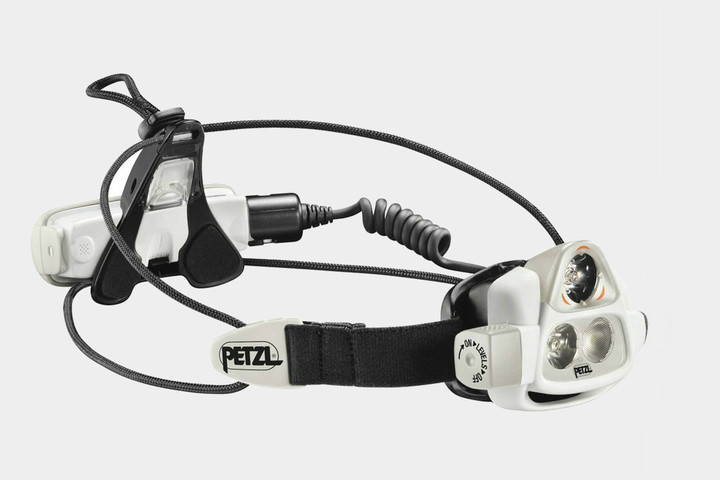
The Petzl NAO is one of the pricier options on our roundup, and for good reason. The headlamp has an array of handy features and a maximum brightness of up to 575 lumens. The company’s reactive technology and the built-in light sensor allow the brightness and beam pattern to automatically adjust based on your environment, thus affording the headlamp longer burn times and reducing your involvement. The Petzl NAO also has a lock function to prevent the headlamp from unintentionally turning on while stowed, along with two power options — Max and Max Autonomy — which result in brighter output and work to extend battery life. When the beam does go out, however, you can recharge it via the integrated USB connector on the back of the device. Now, if only the battery would last more than five hours at time.
Buy one now from:
Amazon Backcountry
Black Diamond ReVolt ($60)

This rechargeable headlamp packs in a good deal of functionality for the price. Its maximum beam distance isn’t as robust as others on our list, but it is bright enough to suit most needs, especially when it comes time to find the trail. The beam is also even — which is less tiring on your eyes — and adjustable, meaning you can easily dim the the light to whatever strength you prefer. The ReVolt supports a whopping nine hours of battery life when left on high-beam mode, too, capitalizing on either AAA batteries or a lithium alternative you can charge in your car or from a solar charger. A convenient red light option even comes standard — rendering it great for hunting, or reading in a tent — along with a strobe setting that allows you to be seen from greater distances.
Buy one now from:
Amazon Backcountry
Petzl Tikka RXP ($80+)
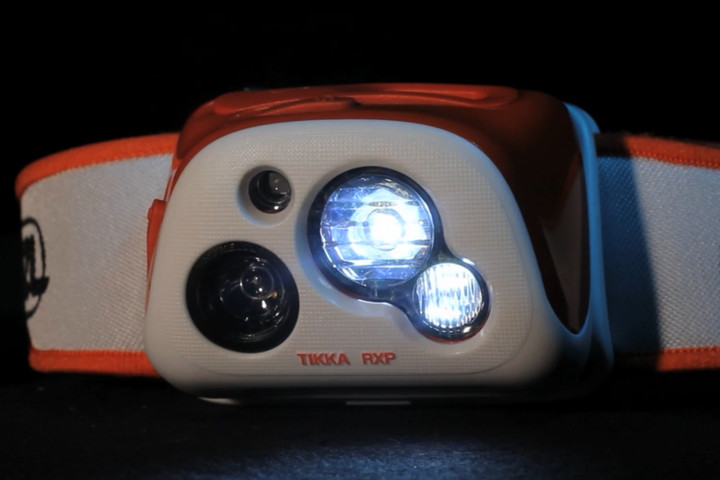
Headlamp tech is on the rise. Petzl, for instance, now outfits some of its high-end headlamps with a responsive technology that auto-adjusts the brightness of your headlamp based on what you’re looking at. This is particularly convenient in when you’d like to leave your headlamp on high for prolonged periods and look at close-range things that may not require as much light, such as a map or nearby sign. The feature help saves your battery life, too, and can be turned off in situations where other sources of light — i.e. a campfire or reflective snow — might hinder its performance.
Buy one now from:
Amazon Backcountry
Black Diamond Icon ($90+)
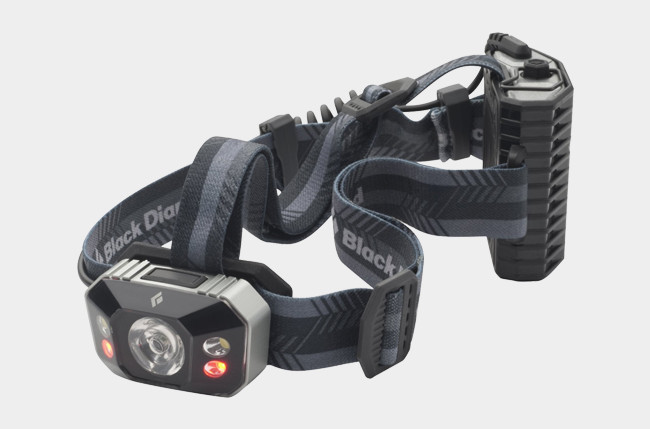
The recently-updated Black Diamond Icon provides 320 lumens of light, which is 200 more than the previous model. That said, if you’re looking for a more versatile headlamp, look no further than the Icon. It represents the perfect combination of form and function, providing you with a long-distance beam, fantastic optics, and excellent battery life. Like the ReVolt, it offers variable dimming and a red light that flashes when in need of a signal. You can also submerge it up to one meter of water for up to 30 minutes. It’s a little heavier and bulkier, so ultralight backpackers might decide to pass, but it’s the headlamp we’d buy if we had just over $50 to spend.
Buy one now from:
Amazon Backcountry
Princeton Tec Sync ($29+)

Of all the low-range options out there for headlamps — and there are a lot — our favorite is the Tec Sync from Princeton. You can always buy a penlight for a mere $15, sure, but if you’re willing to spend a little bit more, you can actually get a very functional headlamp. The lightweight, flexible Tec Sync sports both red and white LEDs, along with mid-range distance and five different brightness levels that are comprised of both spot and flood settings. It should go without saying that few headlamps offer better bang for your buck.
Buy one now from:
Amazon Backcountry
Fenix HP25 ($74)

The HP25 is, by and large, the brightest light on our list. Although the light isn’t the most uniform, it does shed light as far as 157 meters, and touts an aluminum chasis that’s as durable as it is sleek. The brighter light does equate to shorter battery life, however, so you’ll likely drain the headlamp within a couple hours if you leave it on high. The aforementioned, uniform lighting might make it somewhat tricky and tiresome when navigating the trail, but being able to see more than 500 feet ahead when biking is convenient to say the least.
Buy one now from:
Amazon Fenix
Black Diamond Spot ($30+)
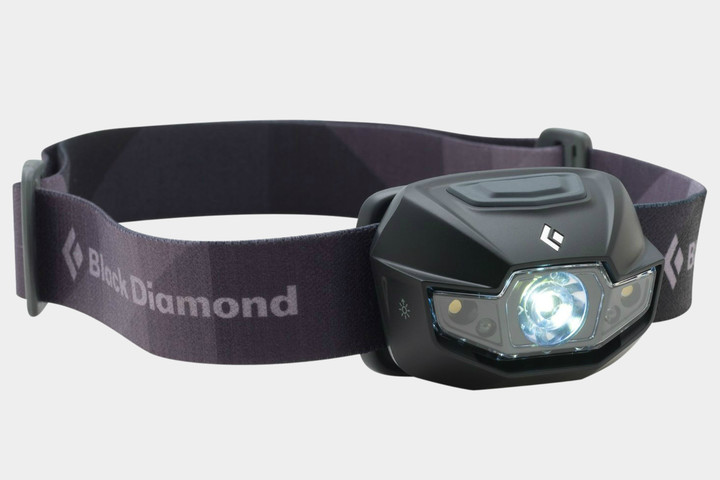
The 130 lumens afforded by the Black Diamond Spot may not hold a candle to other headlamps on our list, sure, but that doesn’t mean it isn’t a worthy alternative for those working on a budget. The headlamp’s unique, Power Tap technology makes switching between full and dimmed brightness quick and convenient. The side of the Black Diamond Spot’s housing is also touch-sensitive, meaning you can adjust the brightness with a single tap of a finger. The headlamp runs on three AAA batteries, and a built-in meter displays the remaining battery life for three seconds once the headlamp has been activated. The headlamp is IPX4-rated, too, so it can withstand the occasional splash even if it can’t be submerged. A pair of red LEDs and various strobe settings help round out the basic set features.
Buy one now from:
Amazon Backcountry
Black Diamond Sprinter ($80)

While the simple single strap headlamp design is fine for many outings, the two band models are ideal for more physical activity. When running, cycling, or mountain-biking, the single band designs can slide out of place and over-tightening them to compensate can make them all the more uncomfortable. The Black Diamond Sprinter is one of the sleeker two band designs on the market.
The TriplePower LED dishes out an ample 200 lumens. This is more than enough for the trailhead or an early morning run. For added safety in urban areas, the unit also has a strobing red taillight, making the Sprinter ideal for runners and cyclists. This taillight can be switched on or off to help maximize battery life. Even when you do eventually drain the battery, the Sprinter is rechargeable via USB with about a five hour total charge time. While some headlamps can weigh well over a pound, at just seven ounces this unit won’t bog you down.
Buy one now from:
Amazon
Coast HL3 60 Lumen LED ($12)

Not all situations call for the most technologically advanced headlamp. If you need a headlamp for basic camping purposes or nighttime tasks around the house, a budget model will do just fine. The Coast HL3 is capable of producing 60 lumens which is more than enough for most low-light/nocturnal tasks. The Max Beam Multi-Reflector system projects light up to 141 feet in ideal conditions.
The model is also impact and water resistant for added durability. Similarly, this headlamp is backed by Coast’s lifetime guarantee. The HL3 runs on three AAA batteries, with an expected battery life of about 12 hours. Rechargeable options are preferential for economic reasons, however, if you’re looking for a headlamp to throw on every now and then without breaking the bank, the Coast HL3 is certainly one to consider.
Buy one now from:
Amazon
T-Mobile begins limited rollout of RCS texing with Google Messenger app
Why it matters to you
RCS messaging is better than SMS/MMS, and the sooner carriers support Google’s open-source platform, the easier it will be for third-party apps to adopt it.
T-Mobile is joining the ranks of carriers like Sprint and Rogers by rolling out support for Rich Communication Services (RCS) messaging, an evolution of SMS and MMS. While the company has offered RCS since 2015, the new rollout utilizes Google’s Universal RCS platform.
RCS is the next-generation of text messaging — you can send messages longer than 160 characters, have improved group chats, read receipts, high-resolution photo sharing, typing indicators, and more. It’s essentially modernizing text-messaging to be on par with Internet Protocol-based messaging, such as apps like iMessage and Facebook Messenger.
More: Google rolls out RCS support for Rogers customers in Canada
Google acquired Jibe in 2015, and promised a standardized RCS text-messaging platform that would work with non-Android devices. Unlike IP-based messaging systems, RCS requires carrier implementation — which explains the slow adoption rate.
The application that will make use of RCS features on Android is Google Messenger — an app that’s preinstalled on many Android smartphones. When Sprint announced support for Google’s RCS platform, the carrier also said it would preinstall Google Messenger onto every Android phone it sells starting in 2017. T-Mobile hasn’t made any announcements yet, but customers are reporting that T-Mobile is starting a limited rollout. It’s unclear when we’ll see a full rollout — we have reached out to T-Mobile and will update this article when we learn more.
Other texting apps, like Textra, have announced plans to also support the platform — so you’ll have more options rather than only having to use Google’s app.
More: From 5G and bezel-free phones to Android 2.0, these mobile trends will define 2017
We don’t know yet what Verizon’s plans are for RCS, even though it is a signatory for the GSMA Universal Profile. AT&T, on the other hand, offers RCS messaging in its own texting app, but it’s not compatible with Google’s Jibe platform.
GoPro begins selling its Karma drone again following simple battery fix
Why it matters to you
A redesigned battery latch will ensure the Karma won’t lose power mid-flight and fall on anyone’s head.
GoPro’s first attempt at a drone is back in the skies. On Wednesday, GoPro announced the Karma drone is now on sale — again.
After the Karma’s initial launch, the drone was well received for its portability and ease of use but then GoPro noticed a problem. Some of the Karmas were losing power mid-flight, causing them to drop out of the air. GoPro initiated a recall of the quadcopter in November — after less than a month on the market — though there wasn’t a legal obligation to start the recall and no injuries were reported from the glitch.
More: GoPro quietly creates a cheaper way to replace crashed Karmas
The problem? The movement from the drone was causing the battery to pop out of place. The newly relaunched Karma has a redesigned battery latch, ensuring that the battery stays in place during the flight.
“Safety is our biggest priority, so this decision came after we learned that a small number of Karma units were experiencing power loss mid-flight. We knew we had to move quickly. Really, it was an easy decision but difficult news to share,” the company said in a blog post.
With the re-release, GoPro is reiterating the drone’s use not just for aerial shots but as a “versatile stabilization solution” thanks to the Karma stabilizer grip included with the drone as well as sold individually.
The Karma drone was already delayed a year before the official launch last fall — industry experts say the recall and delay will likely have a significant effect on the drone’s sales — particularly since the DJI Mavic Pro launched only a week later with a similar compact size but additional features including obstacle avoidance. It’s unclear whether the company’s move to recall the drone without a legal reason to do so will gain the company some much-needed karma (pun intended) after laying off staff shortly after the recall.
Still, even before the recall, early users said the drone was easy to use for aerial videography newbies, with a video game-like controller and four auto-follow modes. GoPro is calling the relaunched Karma “Hollywood in a backpack” because of the drone’s folding design and removable stabilizer.
The Karma, with the redesigned battery latch, will sell for the same $800 (or $1,100 with the Hero5 camera) price as the first launch. GoPro says it is also planning to release a kit without the Karma grip, for users that purchased only the stabilizer during the drone’s recall.
Google makes Chrome for iOS open source
Why it matters to you
Google’s decision to open-source Chrome for iOS is a boon for third-party mobile development.
Google’s Chrome browser on desktop has been open source almost since its inception — in 2008, the Mountain View, California-based company released a large portion of Chrome’s underlying code as an open-source project called Chromium, which it permitted third-party developers to study and use as they saw fit.
But that wasn’t the case for Chrome for iOS, which Google kept separate from the rest of the Chromium project due to “the additional complexity required for the platform.” On Tuesday, though, Google announced that the Chrome for iOS’s underlying code will be rejoining Chromium and will move into the open-source repository.
The challenge, apparently, involved working around the limitations of Apple’s iOS operating system. “Due to constraints of the iOS platform, all browsers must be built on top of the WebKit rendering engine,” Google’s Rohit Rao wrote. “For Chromium, this means supporting both WebKit as well as Blink, Chrome’s rendering engine for other platforms. That created some extra complexities which we wanted to avoid placing in the Chromium code base.”
More: Google’s finally got something to offer iPhone users
Rao didn’t elaborate, but part of the problem likely stemmed from Apple’s restrictive policy regarding third-party browsers. The first iterations of Chrome for iOS were required to use the iOS WebKit framework and WebKit JavaScript — Safari’s rendering engine — instead of the Google’s desktop rendering engine. And they were forced to use a slow JavaScript engine while only Safari could use a faster JavaScript engine — Apple’s new Nitro JavaScript engine.
That policy changed mid-2014, though, when Apple began allowing browsers like Chrome to tap the Nitro JavaScript engine. Google quickly took advantage, adding the ability for iOS users to link directly to other iOS app when search queries yield a specific app as a result.
And earlier this year, it introduced a new version of Chrome for iOS with an improved rendering engine that crashes 70 percent less than the previous version and handles JavaScript code just as fast as Safari.
The open-source move is also the result of multi-year changes Google has made to the Chrome development process. “[Developers] can compile the iOS version of Chromium like they can for other versions of Chromium,” Rao wrote. “Development speed is also faster now that all of the tests for Chrome for iOS are available to the entire Chromium community and automatically run any time that code is checked in.”
More: Chrome for iOS update brings tighter integration with Google Apps and more
The open-source code is available on Google Source, an open-source repository.

