


Oculus to pay $500 million after ZeniMax lawsuit ends
ZeniMax is triumphant in its lawsuit against Oculus over alleged technology theft… well, sort of. A Texas jury has determined that Oculus must pay $500 million to ZeniMax over claims that Palmer Luckey didn’t comply with a non-disclosure agreement he signed with the game publisher. However, what didn’t happen is more telling. The jury found that Oculus didn’t steal trade secrets from ZeniMax when it hired John Carmack. In other words, one of the cornerstones of the case didn’t hold up.
Neither side is going to be all that happy with the results. ZeniMax had been asking for $4 billion in compensation and damages — it’s only getting an eighth of that. Oculus, meanwhile, won’t be pleased at having to pay anything. It maintained its innocence from the start, and has long characterized the lawsuit as both a cash grab (to take advantage of all that Facebook money) and a sign of jealousy after losing a game industry legend like Carmack.
We’ve reached out to both companies and will let you know what (if anything) they intend to do next, although Oculus has already said that it plans to appeal. It’s safe to say that Facebook and Oculus aren’t about to change course on their virtual reality plans any time soon, and that ZeniMax isn’t about to drop its technology theft accusations.
Source: Polygon
Facebook shows no sign of stopping, now has 1.86 billion users
Facebook is under quite a bit of pressure of late. It’s trying to fix the rise of fake news and clickbait on its News Feed and, more recently, it’s had to deal with the Zenimax lawsuit against Oculus. But all of that hasn’t eaten into Facebook’s bottom line. As its Q4 2016 earnings report shows, the company once again raked in cash hand over fist, with $8.8 billion in revenue and $3.56 billion in profit. Its user growth also continues to climb, with 1.86 billion monthly users and 1.74 billion logging in on mobile. Mobile advertising made up 84 percent of its revenue last quarter.
Those numbers are pretty good when you look at daily users too. The company reports that 1.23 billion people use Facebook everyday, with 1.15 billion doing so from mobile devices. Still, the growth is only up 3.91 percent from last quarter, which is slightly slower than the 4.67 percent reported a few months ago. Also, while $8.8 billion is certainly a hefty amount, it’ll lose around $500 million due to the Zenimax lawsuit payout announced earlier today.
For the whole of 2016, Facebook made close to $27 billion, which is an increase of 57 percent from the previous year. Much of the growth can be attributed to expansions of Facebook properties like Instagram, WhatsApp and Facebook Messenger.
We’ll report more from the earnings call later today.
Developing…
Apple Developing ARM-Based Mac Chip to Handle Low-Power Functions Alongside Intel Processors
Apple is developing a new ARM-based chip for its Mac lineup that would “take on more of the functionality” handled by Intel processors, reports Bloomberg.
In development since last year, the chip, codenamed T310, is said to be similar to the chip used to power the Touch Bar in the new 2016 Macbook Pro. It’s built using ARM technology and will work with the standard Intel processor, handling “Power Nap” low-power mode functionality.
Apple engineers are planning to offload the Mac’s low-power mode, a feature marketed as “Power Nap,” to the next-generation ARM-based chip. This function allows Mac laptops to retrieve e-mails, install software updates, and synchronize calendar appointments with the display shut and not in use. The feature currently uses little battery life while run on the Intel chip, but the move to ARM would conserve even more power, according to one of the people.
Apple’s 2016 MacBook Pro uses an independent ARM-based chip called the T1 to power the Touch Bar, the Touch ID fingerprint sensor built into the Touch Bar, and the secure enclave that stores payment and biometric data.
According to Bloomberg’s report, the upcoming ARM-based chip will “go further,” connecting to storage and wireless components to take on additional power management capabilities.
Apple could begin using the new chip in an upgraded version of the MacBook Pro set to launch later this year, but it could be introduced as a quiet update with little fanfare as the chip that powers the Touch Bar was not promoted by Apple.
Despite Apple’s plans to offload some tasks to a new ARM chip, Apple is said to have no intention of abandoning Intel chips in its laptop and desktop computers.
Related Roundup: MacBook Pro
Tags: Intel, ARM, bloomberg.com
Buyer’s Guide: MacBook Pro (Buy Now)
Discuss this article in our forums
Review: Olloclip’s Lens Sets Add Versatility to iPhone 7’s Camera
Olloclip has been making lenses for the iPhone since 2011, expanding the range of tools at an iPhone photographer’s fingertips. For the iPhone 7 and the iPhone 7 Plus, Olloclip has redesigned its product lineup, offering the same lenses in a new package that better fits the latest iPhones and provides more utility, like a stand.
I’ve been using Olloclip to spice up my iPhone photographs since the iPhone 5, so I was eager to try out Olloclip’s latest products with the iPhone 7 Plus, which has two rear cameras instead of one.
Olloclip sent me its Core Lens Set, priced at $100, its Macro Pro Lens Set, priced at $80, and its Active Lens Set, priced at $120.
The Core Lens Set features a fisheye lens, a 120 degree wide-angle lens, and a 15x macro lens, while the Macro Pro Lens Set includes three macro magnifications at 7x, 14x, and 21x. The Active Lens Set, Olloclip’s most expensive, offers a 2x telephoto lens and a 155 degree ultra-wide lens.
All of the lenses are compatible with both the rear and front-facing cameras of the iPhone 7 and the iPhone 7 Plus, snapping right on for quick access. Each one is interchangeable, so if you own multiple lens sets, you can create your favorite combination to have on-hand at all times.
Olloclip also sent me its Pivot Mobile Video Grip, which can be used to capture steady video while filming with the lenses attached.
Lens Design
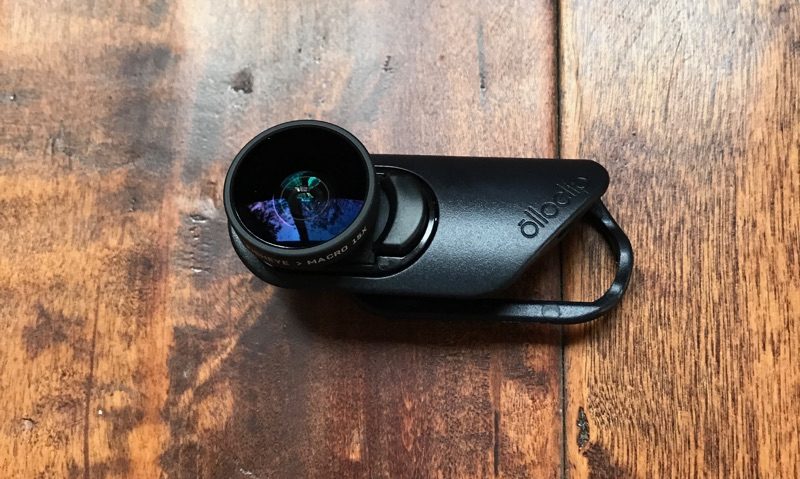
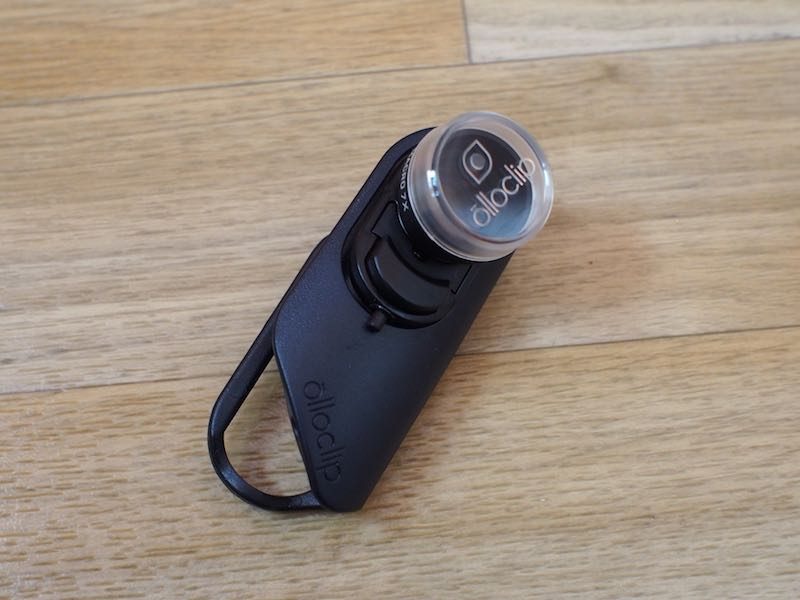
All of the Olloclip lenses share the same two-sided design. The lenses fit into opposite sides of a black plastic enclosure that’s meant to slide over the top of the iPhone. The enclosure is sized so one lens can fit over the front-facing camera and one lens can fit over the rear-facing camera, with the ability to pop it off and flip it over at will, so you can change lenses in just a few seconds.

Each lens is attached to a base with springs to fit snugly into the lens enclosure. With the springs, lenses can be swapped out, a handy feature if you’re going to buy more than one Olloclip lens set.
On the iPhone 7 Plus, the spring can also be used to pop the lens out and swap its orientation, which allows it to line up properly with the telephoto lens on the back of the iPhone. This means all of the lenses can be paired with the standard wide-angle lens or the telephoto lens on the device, but based on my experience, you’re going to want to use these mainly with the wide-angle lens, which I’ll explain a bit later.

Olloclip’s lenses do not work with third-party cases, so I had to remove my case every time I wanted to use it, something that’s definitely a hassle. I don’t use a screen protector, but if you do, it should work fine with the Olloclip so long as it isn’t thicker than 0.5mm. Olloclip does make its own cases that work with the lenses if you prefer to have a case on at all times.
The Macro Pro, Core, and Active Lens Sets are all made primarily from a lightweight black plastic, which unfortunately doesn’t quite match well with the Rose Gold, Silver, Gold iPhones, but pairs well with Jet Black and matte Black versions.

The plastic is nothing special and can even feel a bit cheap given the price of each lens set, but the lenses themselves are made from glass with a metal housing. The lenses are heavy and feel like a quality product, even if the plastic enclosure doesn’t.
Since they’re made of glass, they are breakable. If you drop them, they’ll crack, as I learned accidentally during this review. It’s best to be careful with them and put the caps on when they aren’t in use to keep them safe in case of a drop.

With the weight of the lenses, the plastic build helps keep the accessory at a lighter weight, and with the extra slide-in stand, the lens sets are portable and easy to carry with an included carabiner.
 The clip that holds the lenses when not in use double as a stand
It’s simple enough to snap the lenses on and off, but it’s still going to take a few seconds to get everything situated and lined up, so if you don’t want to miss a shot, the Olloclip will need to be on your phone most of the time. The lenses are bulky, look a little odd on the iPhone, and make it hard to fit your phone in your pocket, but they don’t get in the way of standard operation.
Core Lens Set Pictures
The wide-angle lens is perhaps the most useful lens in the Core Lens Set, capturing a 120 degree field of view that’s excellent for landscape shots and, attached to the front-facing camera, group selfies.

With the wide-angle lens paired with the standard lens in the iPhone 7 Plus, picture quality is excellent, but there is definite distortion at the edges of the images. This is most noticeable in an image where there are vertical or horizontal lines (like walls) at the edges of an image.

At the opposite side of the wide-angle lens, there’s a fisheye lens and a 15x macro lens, accessible when you detach the fisheye lens from the Core Lens Set. Both of these lenses are self-explanatory — one’s a standard fisheye with fisheye distortion and the other lets you take ultra close shots of objects.

Both the wide-angle and the fisheye lens pair well with the front-facing camera too, giving you a wider field of view for selfies, but the macro lens is only for the rear-facing camera.
Macro Lens Set Pictures
The Macro Lens Set has a 21x lens on one side and a 14x lens on the other side, which can be unscrewed to reveal a 7x lens, giving you several different magnifications to work with. The Macro Lens Set is really only suitable for the rear-facing camera unless you want a super close up picture of your pores.
I’ve always been satisfied with the performance of Olloclip’s macro lenses, and the Macro Lens Set is no exception. It can take some work getting the right distance, lighting and focus, but when everything aligns, the shots come out crisp and clear. The macro lenses come with hoods, which can be used to get the ideal distance for a solid shot. As with all Olloclip lenses, these work best in good lighting.
 7x magnification on left, 14x in middle, 21x on right
I don’t want to downplay the effort that needs to go into the Macro Lens Set — this is a lens that takes practice and effort to use effectively, though you can occasionally whip it out and get a lucky shot. It’s the most niche of Olloclip’s lenses, and may not appeal to everyone.
Active Lens Set Pictures
The 2x telephoto lens of the Active Lens Set is the largest, heaviest, and most expensive of Olloclip’s lenses. It adds noticeable weight and bulk to the iPhone and makes it harder to hold, so be careful using this one.
 Regular lens on left, telephoto lens on right
The lens offers a 2x optical zoom, which brings optical zoom to the iPhone 7 or 4x optical zoom (in the right conditions) to the iPhone 7 Plus.
 Hummingbird nest photo taken with 2x telephoto lens paired with iPhone’s telephoto lens (cropped).
The wide-angle lens is wider than the lens that comes with the Core Lens Set at 155 degrees instead of 120 degrees. That means there’s noticeable distortion in every shot, but it makes for some interesting photos.
 Regular lens on left, wide-angle on right
While the wide-angle lens works well with the front-facing camera, it’s less useful with the telephoto, but you can get some nicer-looking close-up selfies using the longer lens.
Using Olloclip Attachment with the iPhone 7 Plus Telephoto Lens
You can use the Olloclip lenses with the iPhone 7 Plus’s 56mm telephoto lens, but it’s often not worth the hassle. With Apple’s default Camera app, the “2x” mode doesn’t always activate the telephoto lens, depending on the lighting conditions.
For that reason, there’s no guarantee you’re going to get the 56mm lens when hitting “2x” mode in the Camera app, so you need to use a third-party camera app (I used Manual) to take photos with the Olloclip lenses and the telephoto lens.
 Spring for swapping lenses around on iPhone 7 Plus
The problem with Apple’s telephoto lens is that it doesn’t let in as much light, so it doesn’t really work well unless you’re in bright lighting conditions. Photos indoors often don’t come out well and end up much too dark and with too much noise.
That said, the telephoto lens can pair nicely with an Olloclip macro lens or the Olloclip telephoto lens, which gives you 4x optical zoom. It’s not really useful for any of the wide-angle lenses or the fisheye, because it defeats the purpose of using one of those lenses.
Actually flipping the lenses around to use them with the telephoto lens is fairly easy, but it’s still takes time and the result is not always worth the effort.
The Pivot Grip
Priced at $50, Olloclip’s Pivot is meant to be used with the Olloclip lenses while capturing video to keep the iPhone steady. The Pivot is made of plastic and it’s not the highest quality product (the clamp squeaks!), but it works well.

An expandable clamp adjusts to fit any size iPhone, and as the name suggests, there’s a button on the side that adjusts the angle of the accessory (there’s 225 degrees of articulation) so the iPhone can be positioned in landscape or portrait mode. A cold shoe mount is included if you want to attach accessories like a light or a microphone, and the handle is a good size and shape that’s comfortable to hold.
I was able to use the Pivot to capture good quality, shake-free video, and it seems like a decent enough option for the price, but I wasn’t a huge fan of the build quality.

The Pivot is definitely better (and less cramp inducing) than holding the iPhone by itself to take video, but it doesn’t measure up to more expensive gimbal-based options. At $50, I think it’s a little expensive for what you’re getting, so I’d pass on this unless there’s a sale.
Bottom Line
I’ve used Olloclip lenses for years, and this is the first time that I’m hesitating to recommend some of Olloclip lens sets, especially for the iPhone 7 Plus. At $99.99, the Core Lens Set is pricer than other multi-lens sets from Olloclip, and at $80 and $120, the Macro and Active sets are also more expensive.
At those price points you’re getting a stand and a new Connect system for quickly swapping lenses, but that doesn’t seem to justify the price increase.
With the Core Lens Set in particular, there’s only one macro option instead of the two that have been included on past standard sets, and the fisheye and macro lenses are more of a novelty than a utility. The wide-angle lens will get you some great shots you can’t get otherwise, but at $100, I’m not sure one wide-angle lens and two situational lenses are worth it.
If you have an iPhone 7 Plus, the Active Lens Set isn’t a great purchase because you have a built-in telephoto option, but on the iPhone 7, it can add optical zoom to put Apple’s smaller iPhone on par with the larger model.

I’ve always felt that Olloclip’s wide-angle and telephoto combo is one of the most useful lens sets because it can be used in almost any situation, and my opinion hasn’t changed on that point. For $120, you’re adding a lot of versatility to your iPhone’s camera without a fisheye or macro gimmick. It’s the best choice for an iPhone 7.
The Macro Pro Set is more of a niche lens for those who want to take macro shots of flowers, bugs, and other small objects. I always have fun with macro lenses, but they’re not something I use on a day-to-day basis and I have a hard time recommending them to the average user for $80. If you love macro photography though, this is the set to get.
All of Olloclip’s lenses suffes from the standard Olloclip drawbacks — they don’t work with the flash and they can’t be used with standard cases. There’s a slight drop in image quality compared to the standard iPhone camera, which is more noticeable in indoor/dim lighting. In my experience, the lenses also didn’t work well with the telephoto lens in the iPhone 7 Plus.
If Olloclip’s lenses were just a bit more affordable this year, I wouldn’t hesitate to say go for it, but at this price point, I think potential buyers should carefully evaluate what each lens set is capable of.
That said, if the iPhone 7 or iPhone 7 Plus is your main camera and you want to add more versatility to the kinds of things you can capture, Olloclip has a lot of lenses that can meet your needs and lens quality is solid for the price.
How to Buy
Olloclip’s Core Lens Set can be purchased from the Olloclip website for $99.99. The Active Lens Set is available for $119.99, and the Macro Pro Lens Set is available for $79.99.
Olloclip provided MacRumors with a Core Lens Set, a Macro Pro Lens Set, an Active Lens Set, and a Pivot Grip for the purposes of this review. No other compensation was received.
Tag: olloclip
Discuss this article in our forums
Images of Huawei’s rumored Honor 8 Lite leak ahead of Mobile World Congress
Why it matters to you
Huawei might further its push into the minds and wallets of budget-minded folks with the Honor 8 Lite.
Xiaomi announced it will not make any product announcements during February’s Mobile World Congress, which gives fellow Chinese manufacturer Huawei the opportunity to cement its lead over Xiaomi. Based on recent leaks, Huawei might pull this off with the help of the rumored Honor 8 Lite.
As the name suggests, the Honor 8 Lite looks to be a less powerful version of the Honor 8 that precedes it. Based on leaked images, that certainly seems to be the case in terms of aesthetics. There are two key differences between the two phones, however — the Honor 8 Lite is rumored to feature one main camera and a Micro USB port, which seem like setbacks when compared to the Honor 8’s dual rear cameras and forward-thinking USB Type-C port.
More: Xiaomi won’t announce the Mi 6 — or any products — at Mobile World Congress
 This brings us to the next reason why ‘Lite’ is part of the name: the Honor 8 Lite is rumored to cost around $300 when it launches at the end of February or early March, about $100 less than what the Honor 8 currently goes for. It is unknown whether the phone will launch in the U.S., but when it does, the phone will reportedly be available in blue, black, gold, and white.
Specifications are unknown, though the Honor 8 Lite also looks similar to the P8 Lite (2017). If internals also remain similar, expect the former to feature a 5.2-inch, 1,920 x 1,080 resolution display, Huawei’s in-house octa-core Kirin 655 processor, 3GB RAM, 16GB of expandable storage, and a 3,000mAh battery. Furthermore, the Honor 8 Lite might run Android 7.0 Nougat with Huawei’s EMUI 5.0 overlay out of the box.
Keep your eyes peeled once MWC is in full swing, however. During its MWC 2016 presentation, Huawei only announced the MateBook, the company’s first 2-in-1 tablet PC, alongside smaller announcements like the gold-colored Nexus 6P. Since MWC is mobile-centric, expect Huawei to announce at least a few mobile devices during its presentation.
Want a new turntable for your old vinyl records? Check out LOVE
Why it matters to you
As vinyl makes a resurgence, we’re in need of a modern turntable. Love is here to answer that call with its mobile-friendly, tech-forward design.
Vinyl is making a comeback, and you know what that means — the return of the turntable. After all, what good is a record without a record player? And while we may be harking back to disc formats of old, that doesn’t mean we don’t get to give those familiar turntables a 21st-century makeover. Meet LOVE, branded as the world’s first intelligent turntable, which has just launched a Kickstarter campaign to bring its technology to the masses.
With a bold attempt to put a new spin on vinyl, LOVE looks to merge traditional sound with its revolutionary technology. “Although audio technology has made incredible strides over the last 40 years, the traditional turntable has remained relatively unchanged,” said CH Pinhas, CEO of Love Turntable Inc. “Record sales have spiked over 60 percent in recent years, but nearly half of the people who own vinyl records don’t play them. Our goal is to make it simple for anyone to enjoy the natural melodies and pure traditional sound of analog through the convenience of modern-day technology.”
More: Shallow Side’s streaming chops run deep, but they love vinyl, too
Using its linear tracking sensor, LOVE can scan any record to determine its size and number of tracks, and with nothing more than a tap, users can turn the turntable on and off, or skip to the next track. LOVE actually spins on top of the record (which remains still), while employing a traditional cartidge and stylus to pay homage to the tactile experience and classic sound that true vinyl enthusiasts know and love. But because no additional weight is placed on the grooves, your records are kept in pristine condition.
And of course, because we live in the age of the smartphone, LOVE comes with an Android and iOS app that lets you control the turntable by way of your mobile device. Whether you want to start or stop a record, select a track, or adjust the volume, you can do it all from the palm of your hand.
As for sound quality, the LOVE streams analog sound via Bluetooth and Wi-Fi to audio devices including speakers, headphones, hi-fi components, and home theater systems. And if your speaker system isn’t equipped with Bluetooth, this record player comes with a 3.5mm or RCA plug-and-play Bluetooth aptX adapter.
LOVE turntables start at $299 for the first 500 backers, with your choice of three colors for the base of the turntable — black, red, and white.
Want a new turntable for your old vinyl records? Check out LOVE
Why it matters to you
As vinyl makes a resurgence, we’re in need of a modern turntable. Love is here to answer that call with its mobile-friendly, tech-forward design.
Vinyl is making a comeback, and you know what that means — the return of the turntable. After all, what good is a record without a record player? And while we may be harking back to disc formats of old, that doesn’t mean we don’t get to give those familiar turntables a 21st-century makeover. Meet LOVE, branded as the world’s first intelligent turntable, which has just launched a Kickstarter campaign to bring its technology to the masses.
With a bold attempt to put a new spin on vinyl, LOVE looks to merge traditional sound with its revolutionary technology. “Although audio technology has made incredible strides over the last 40 years, the traditional turntable has remained relatively unchanged,” said CH Pinhas, CEO of Love Turntable Inc. “Record sales have spiked over 60 percent in recent years, but nearly half of the people who own vinyl records don’t play them. Our goal is to make it simple for anyone to enjoy the natural melodies and pure traditional sound of analog through the convenience of modern-day technology.”
More: Shallow Side’s streaming chops run deep, but they love vinyl, too
Using its linear tracking sensor, LOVE can scan any record to determine its size and number of tracks, and with nothing more than a tap, users can turn the turntable on and off, or skip to the next track. LOVE actually spins on top of the record (which remains still), while employing a traditional cartidge and stylus to pay homage to the tactile experience and classic sound that true vinyl enthusiasts know and love. But because no additional weight is placed on the grooves, your records are kept in pristine condition.
And of course, because we live in the age of the smartphone, LOVE comes with an Android and iOS app that lets you control the turntable by way of your mobile device. Whether you want to start or stop a record, select a track, or adjust the volume, you can do it all from the palm of your hand.
As for sound quality, the LOVE streams analog sound via Bluetooth and Wi-Fi to audio devices including speakers, headphones, hi-fi components, and home theater systems. And if your speaker system isn’t equipped with Bluetooth, this record player comes with a 3.5mm or RCA plug-and-play Bluetooth aptX adapter.
LOVE turntables start at $299 for the first 500 backers, with your choice of three colors for the base of the turntable — black, red, and white.
Justin Long returns as a tech pitchman with the Huawei Mate 9 as his co-star
Why it matters to you
Justin Long’s employment with Huawei is a direct challenge to Apple, which used the actor in Mac commercials more than a decade ago.
Justin Long, known to many as the “I’m a Mac,” guy from those anti-PC, 2000-era Apple commercials, has shown up in his first tech commercial in years, this time promoting Huawei’s new hardware. The new commercials represent Huawei’s attempt to break out into more international markets, to fulfill its goal to become the No. 1 smartphone manufacturer in the world by 2021.
Long has been acting for almost 20 years and has starred in a number of iconic and cult classic movies like Dodgeball, Waiting, Idiocracy and if you’re a fan of director Kevin Smith’s offbeat horror films, Tusk. However, many still remember him best as the Mac in Apple’s adverts, where he would act as the cool, casual alternative to the stuffy, suited and tied PC played by John Hodgman.
That may change following new commercials for Huawei though. The first commercial to feature Long has him playing himself, not a Huawei device, but he does talk to one. The Mate 9 acts as an analogous interviewer, auditioning Long for the job of directing a Huawei commercial for the device. Throughout comments are made about how great the phone looks and seems to operate.
More: Huawei wants to beat Apple and become the world’s largest smartphone vendor
This was just the first of several commercials Long is contracted to be a part of, with the suggestion that allusions will be made to his previous Apple employment, though not explicitly stated. MacRumors has it that Huawei did initially want to make much more overt references, but was talked down by Long, who suggested they make it more subtle.
In the second advertisement, Long is auditioning hardware for various roles in his commercial and who gets the job? A new Huawei laptop, which made him remember his dear, old dog, Rip.
Although the commercials aren’t over the top, there is no denying the fact that Huawei using a formerApple pitchman to help sell its new products is an obvious challenge to MacBook maker. As one of China’s largest handset manufacturers, it is looking to international expansion, hoping that Long’s name and its contemporary, humorous commercials will help raise its profile with western audiences.
The Memo Box Mini is a smart pillbox to help you take your medication on time
Why it matters to you
With mismanagement of medication leading to thousands of cases of death in the U.S. alone, this smart pill box could be a lifesaver.
Your daily medications can save your life, but only if you remember to take them. Alas, such a critical component of our health is often forgotten — in fact, research suggests that neglecting to take medication is the cause of more than 125,000 deaths and $100 billion in preventable costs. But now, technology may have a solution for us and the health sector. Meet the Memo Box Mini, a new smart pillbox and app from TinyLogics that hopes to help with both tracking and managing medication use.
As the name suggests, this little pillbox fits in the palm of your hand, but it’s got a much ‘bigger’ brain. The connected device communicates with your phone via Bluetooth to remind you when it’s time to take your medication. Moreover, its GPS functionality ensures that you never leave home without your medication. If you leave a pre-set location — whether it’s your home, office, or somewhere else altogether — sans Memo Box Mini, you will get an alert.
More: Stanford’s Laboratory for Cell and Gene Medicine aims to ‘cure the incurable’
The pillbox also tracks your daily consumption to prevent any overdosing. “Whether a doctor prescribes you antibiotics for a two-week period or mom needs help remembering about her blood pressure medicine, Memo Box Mini is essential for keeping everyone on track,” said Shan Lu, CEO of TinyLogics, the company that developed the Memo Box Mini pillbox and app.
With 36 days left in its Kickstarter campaign, the Memo Box Mini has already surpassed its original fundraising goal, with more than 400 backers donating more than$15,000 to the project. If you or a loved one may need a gentle reminder every once in awhile to take their daily medication, you can grab one of these smart boxes yourself for the early bird price of $25. Delivery is estimated for March.
Ripple is a penny-sized safety wearable with a 24/7 support team
Why it matters to you
Using a safety wearable like the Ripple can sometimes be faster than dialing 911 when seconds count.
Safety wearables are becoming a dime a dozen. From a smart ring that lets you push a button to notify your friends, to even the Apple Watch, which lets you dial 911. Ripple is yet another wearable that’s there for you during emergencies, but the company’s approach stands out among its competitors.
Ripple looks like a small padlock, but if you click the center button once you’ll immediately receive a call from the Ripple support team. If there is a legitimate emergency, the support team acts as an intermediary to contact the relevant authorities. But you can also contact them if you’re feeling particularly vulnerable on your walk home.
More: Nimb is a smart ring that lets you secretly notify people when you’re in trouble
When setting up your Ripple, you can choose to enter information such as your picture, physical description, allergies, medical conditions, any current medications you’re taking, and more. The benefit of using Ripple as the intermediary instead of just dialing 911 is that you won’t need to waste time by detailing this sometimes critical information as the support team will already have the information pulled up.
But for moments when you can’t answer the phone, tap the Ripple three or more times. This is for emergency situations — when you build your profile you have to specify what action you want the support team to take when the Ripple is pressed repeatedly. You can either specify them to call your phone, or send an ambulance or police to you. The Ripple team will have your location via your phone’s GPS, allowing them to direct the relevant first-responders to you.
The Ripple is water-resistant, and the size of a penny. It uses Bluetooth to pair with your smartphone, and as the battery lasts up to six months, you never need to charge it. When you’re out of juice, the company will send you a replacement for free.
More: Italian engineers build a safety-first terrain park in just three hours
Ripple is able to provide this 24/7 support team thanks to a partnership with Tunstall, a connected health-care platform — but the support team isn’t free. While the company is offering free subscriptions for Kickstarter backers, 24/7 service will likely require a monthly subscription fee.
You can order a Ripple on Kickstarter now for $49, but that only nets you three months of the Ripple support service. The $129 option gives you a year of 24/7 service. The company is looking to raise $50,000 on Kickstarter, and if it succeeds, the product is expected to ship in April.

