


From the Editor’s Desk: It’s true … all of it
There’s that line in “The Force Awakens” where Han Solo gives the tl;dr of everything you missed so far. “It’s true. All of it.” Great line. I’ve seen the movie twice and the trailers a bunch of times, and somehow something always managed to get in my eye the when he said it. Weird.
Anyway. I was thinking back on something I said a few weeks ago, about Samsung simply playing on a different level as the other smartphone manufacturers. They’ve got the hardware pretty much nailed. (I’ll be interested to see if they manage to get rid of the antenna lines in the metal edges like LG has done in the G5.) The software is tolerable. I get all the residual hate for TouchWiz, and I definitely still have a few gripes (and the music controls on the lock screen and favorite contacts in the dialer are two disappointingly under-designed spots) — but I don’t think anyone can argue that this is the best Samsung’s done with software. But they really have to got to sell this thing outright in the U.S., outside the carrier system. So. Much. Junk.
Wherein I conclude that the GS7 is that good for me, and that the Android N Developer Preview isn’t for everyone.
Look at the marketing. Who else does as good (and as expensive) a job as Samsung at this point? Only Apple. LG is spending a lot of money on a phone folks can’t get for another month. And the ad spots are a little goofy at that. I’m still very much looking forward to spending some time with the G5 (should have one very soon), but let’s face it — it’s just not on the same plane of existence.
Also: I’m pretty damn proud of how my Galaxy S7 review turned out, as well as Andrew’s Galaxy S7 edge review — especially given the logistical hurdles involved. (We had our company-wide all-hands retreat smack in the middle of all that.)
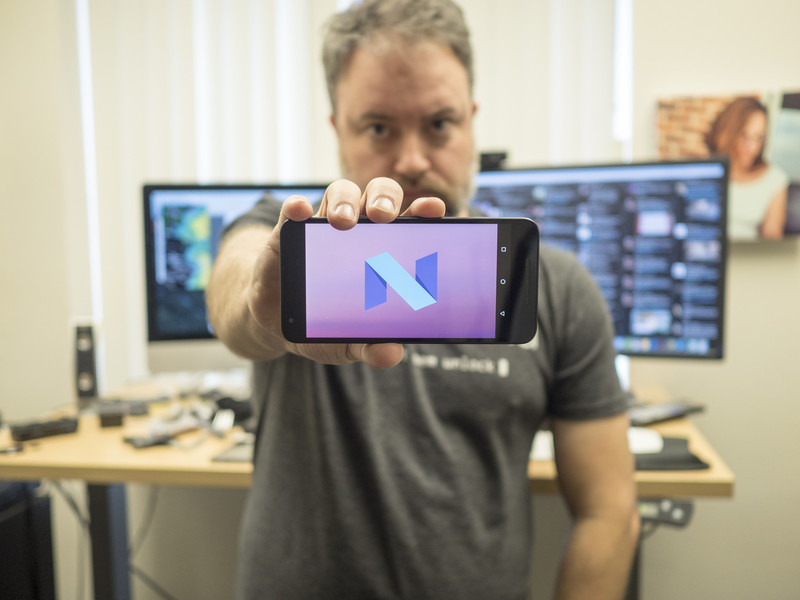
Another thing that is true: The Android N Developer Preview is here, and it’s probably not for you. Unless you’re a developer. Or are comfortable with flashing images on a Nexus device. If you don’t know how to do the latter, there’s no better time to learn. (And we’re going to help with that some more real soon.) I’ve long warned against using Nexus “toolkits” that do the work for you for that very reason. The principle of factory images isn’t all that difficult, nor are the commands to get things going. And it’s sort of like riding a bike. Once you can do it, you don’t really lose it.
I’m torn on the existence of over-the-air updates for a developer beta. It’s great that it’s available to more people now, and horrible that it’s available to more people now. (A broken OTA for some folks early on made that perfectly clear.)
And it’s also true that we need to make a very clear distinction: There are things that are new in Android N that will affect Android as a platform, and there are details new in the N Preview as seen on Nexus devices. Those are two very different things, and Nexus devices still make up a tiny (but important) fraction of what’s out there today.
A few other things that are true:
- What’s next for Nexbit now that the hype train’s left town?
- I’m back on the LG Watch Urbane. The display isn’t as nice as the Huawei Watch, but I love the heft of it with the large bracelet I’m also wearing.
- Welp, I think the commenters pretty much got this one right. We’ll have our more thorough camera shootout up this week.
- Interesting commentary in this AndroidGuys piece.
- And that’s why we have the “About this review” section in every review we do. We’re transparent about where the device came from, how we used it and where we used it.
- We tell you whether the phone is a review unit, or a retail unit, or if it fell off the back of a truck in Dubai. And we tell you the software version it’s on. (Those things sometimes can matter a great deal before a phone is released.) But in the case of the GS7, the review units essentially are retail units. Exact same software on the Verizon model I bought.
- We also tell you exactly how long we’ve been using phone before publishing the review. And even then we’re usually writing right up to the last minute. We don’t do 24-hour reviews (anymore).
- (Or 48-hour reviews of new Nexus devices.)
- How long is long enough? We generally say a week is bare minimum for a good review. Longer is usually better. But we’ve been doing this a long time. We can properly review a phone in a week. (I had the GS7 for 10 days before our review went live.)
- But sometimes issues pop up later. That’s why we often do multiple reviews of a phone. Early second opinions. Follow-ups after a month or two of use.
- Not every phone gets that treatment, sure. Some are one-offs. But you better believe the important ones aren’t just skimmed over.
- And if anyone wants to know just how much money we’ve spent on actually purchasing phones, just DM me. But that’s not the sort of thing you generally talk about polite company. (Or, if I’m lucky, our accountant.)
- And I think the really cool thing is how our review process has greatly changed over time. We’ve gotten so much better at it. (It’s painful reading back on some of our older reviews.) Growing is fun.
That’s it for this week. So much on our plates, but so much fun to be had. Catch y’all Monday.

NERDS REACT to the Galaxy S7!!!
Is it really possible for your data to leak out the holes on the bottom of the Galaxy S7 if they don’t line up just right? How does the King of all CrackBerrys feel about the next big thing? Will a die-hard Moto fangirl be wooed?
The answers to these questions — and more — as we poll some of your favorite Mobile Nations editors on the new Galaxy S7, and where it stands in the greater smartphone world.
Samsung Galaxy S7 and S7 edge
- Galaxy S7 review
- Galaxy S7 edge review
- Galaxy S7 edge with Exynos: A Canadian perspective
- Here are all four Galaxy S7 colors
- Details on the Galaxy S7’s camera
- The SD card is back on the GS7
- Join our Galaxy S7 forums
AT&T Sprint T-Mobile Verizon

Google AI finally loses to Go world champion
At last, humanity is on the scoreboard. After three consecutive losses, Go world champion Lee Sedol has beaten Google’s DeepMind artificial intelligence program, AlphaGo, in the fourth game of their five-game series. DeepMind founder Demis Hassabis notes that the AI lost thanks to its delayed reaction to a slip-up: it slipped on the 79th turn, but didn’t realize the extent of its mistake (and thus adapt its playing style) until the 87th move. The human win won’t change the results of the challenge — Google is donating the $1 million prize to charity rather than handing it to Lee. Still, it’s a symbolic victory in a competition that some had expected AlphaGo to completely dominate.
Not that Lee or other flesh-and-bone players can rest easy. Hassabis says that AlphaGo’s loss (its only loss against pros so far) will help Google eliminate weaknesses in the AI. There’s a real chance that the company’s code will eventually be near-unassailable in Go, showing that artificial intuition is consistently effective at beating the real thing. That’s ultimately helpful for us humans, though, as it could lead to neural networks that rely more on fuzzy logic than raw calculations to complete tasks.
Source: Reuters
Inhabitat’s Week in Green: BMW’s car of the future, and more!
What if installing solar panels were as easy as rolling out a carpet? That’s the promise of the Roll-Array, a powerful, flexible solar system that can be set up in two minutes flat. Meanwhile, Deltec has launched a line of solar-powered prefab homes that start under $100,000, and we spotted an amazing teardrop trailer that can operate completely off-grid thanks to roof-mounted photovoltaics. In other building technology news, Boeing debuted a new self-cleaning airplane bathroom that uses UV light to obliterate germs.
What will vehicles look like in 100 years? BMW just unveiled the car of the future: a shape-shifting dream packed with artificial intelligence and autonomous technology. Speaking of the future, a new plan could bring the first working Hyperloop to three European cities, long before the technology reaches the US. The Tesla Model S is one of the hottest zero-emission cars on the market, but a man in Singapore was just slapped with a $15,000 carbon emissions fine for importing one. Why? It turns out Singapore tracks the source of the energy used to charge electric cars. And Norway announced plans to invest almost $1 billion to build 10 bicycle superhighways.
Streetlights stay on all night and consume a lot of energy, which is why Las Vegas is upgrading to new LED lamps that are powered by the sun. In other design news, a revolutionary new graphene water filter removes bacteria and viruses nine times faster than anything on the market. Abu Dhabi celebrated the launch of the world’s first farm that can grow both fuel and food in the desert. And a London Toy Store unveiled a gigantic LEGO Iron Man made from a million bricks that weighs over a ton.
ICYMI: Sony’s sound necklace, smart music earbuds and more
Today on In Case You Missed It: Austin played host to SXSW by starting the Interactive portion of the conference with musical tech you didn’t know you wanted. We got a tour of Sony’s R&D Lab for a look at its new Arc wearable speaker, Sony’s interactive tabletop projector that the company is trying to get on the market asap tried out the smart concert earbuds Here by Doppler Labs.
There will be two more SXSW-dedicated ICYMI episodes this week, but we’ll be back on Thursday from the studio. As always, please share any interesting science or tech videos, anytime! Just tweet us with the #ICYMI hashtag to @mskerryd.
Mini review video: Our take on the Galaxy S7 Edge, in just a minute
Though Samsung’s new Galaxy S7 and S7 Edge are both great phones — each earned a score of 90 — it’s the Edge that’s improved the most over the past year. Whereas the S6 Edge’s curved screen felt like a gimmick (albeit a gorgeous one), this year’s model introduces some software tricks that do a better job taking advantage of that extra screen real estate. Even if you disagree with us on the gimmick thing, though, it’s hard to argue with everything else the S7 Edge brings to the table.
Among its finest attributes: an easier-to-hold design, waterproofing, improved camera, a bigger battery, more powerful internals and the return of the microSD slot, which was omitted in last year’s S6 series. In many ways it’s the same great phone as the regular S7, except it’s bigger, has a curved screen and costs a hundred bucks more. For the money, though, you get one seriously striking design.
Software brings your PC’s entire interface to VR
Virtual reality faces numerous challenges, but one of the biggest is having to take your headset off whenever you need to run a conventional app. What if you want to maintain that immersion, or just want to use a VR device as your only display? That’s where BigScreen thinks it can help. It’s developing software that places your entire Windows desktop in a VR environment. It’s partly for the sake of immersion (you can have a massive, wall-filling screen without spending a fortune), but it’s a bigger deal for social experiences. You can see a friend’s shared screen as a separate virtual monitor, or play games and movies with friends who sit in using personalized avatars.
You can sign up for a public beta test today, and the finished software should be available for both the HTC Vive and Oculus Rift when they’re available in April. Samsung Gear VR support is due later in 2016. BigScreen is definitely going to be a niche app on launch (you’re going to need an expensive headset and a powerful PC just to use it), but it’s an important step toward turning VR from a once-in-a-blue-moon experience into something you use every day, whether you’re catching up on Netflix or creating
worlds.
Via: Upload
Source: BigScreen
iClever has the best chargers for your devices (review)
With more of our lives running on batteries each day, we are having to charge more devices than ever. The majority of people at least have two devices that they
Dell brings Linux to its latest XPS 13 laptop
Have you coveted the Skylake-powered version of Dell’s near-borderless XPS 13 laptop, but wished it would ship with an open platform like Linux instead of Windows? Now’s your chance. Dell has released a new version of its XPS 13 Developer Edition that comes with Ubuntu Linux 14.04 out of the box. You’ll need a deep bank account to buy one right now, as your only current choices are high-end Core i7 models (with a quad HD+ touchscreen) that start at a lofty $1,550. You can finally get a Linux-based XPS 13 with 16GB of RAM, however, and there are promises of a far more frugal Core i5 system with 8GB of RAM and a non-touch display.
Pros looking for portables have reason to celebrate, too. You can now snag a Precision 3510, 5510, 7510 or 7710 mobile workstation with Ubuntu, giving you some extra computing power (including Xeon chips and a 4K display option) in your open source rig. Linux machines may still be more of a side project at Dell than the main event, but you won’t have to settle for sub-par gear.
Via: Liliputing
Source: Dell, Direct2Dell, Barton’s Blog
NASA probe should lead to quieter supersonic aircraft
There’s a good reason why it still takes hours to fly cross-country: supersonic airplanes are still so noisy that it’s utterly impractical to fly them over populated areas. That’s why the Concorde was largely relegated to overseas flights, after all. However, NASA has a new sensor that could usher in an era of quieter supersonic aircraft. The Eagle Aero Probe (the device you see in the red housing above) measures air pressure changes right near where they occur during a sonic boom, giving a near-instantaneous sense of what’s happening. Previously, the sensors were about 15 feet away in the radar dome — not exactly helpful when you need real-time data to measure a shockwave.
It’ll be a long while before the probe enters full service. Right now, the focus is on testing aboard NASA’s own F-15 Eagle aircraft. Provided it does make the grade, though, it could be extremely useful for studying the aerodynamics of new aircraft and reducing the loudness of their sonic booms. Eventually, you could see a wide range of supersonic aircraft that are relatively silent, including passenger jets — your New York-to-LA flight wouldn’t have to chew up a large part of the day.
Source: NASA
 AIVAnet