


Under Armour’s SpeedForm Gemini 2 RE connected running shoes now on sale

Under Armour’s SpeedForm Gemini 2 RE running shoes, which sport a bit of connected gadget smarts, are now on sale direct from Under Armour. For the curious, the SpeedForm Gemini 2 RE running shoes can track your runs and then upload the recorded data to the dedicated Map My Run app. The goal is to help you get extremely accurate run data so you can more efficiently tweak your training and hit your goals.
The Map My Run companion app has also been updated for the SpeedForm Gemini 2 RE launch, adding support for the shoes along with a new feature: Dynamic Training Plans. Under Armour says that Dynamic Training Plans will use your workout data to create a personal training plan and will automatically readjust to account for any changes in performance.
If you’re interested, be sure to check out our full review of the Under Armour SpeedForm Gemini 2 RE running shoes. Otherwise, you can hit up the link below to grab a pair for $150 from Under Armour.
See at Under Armour

30 Days later — a Marvel: Contest of Champions for Android follow-up
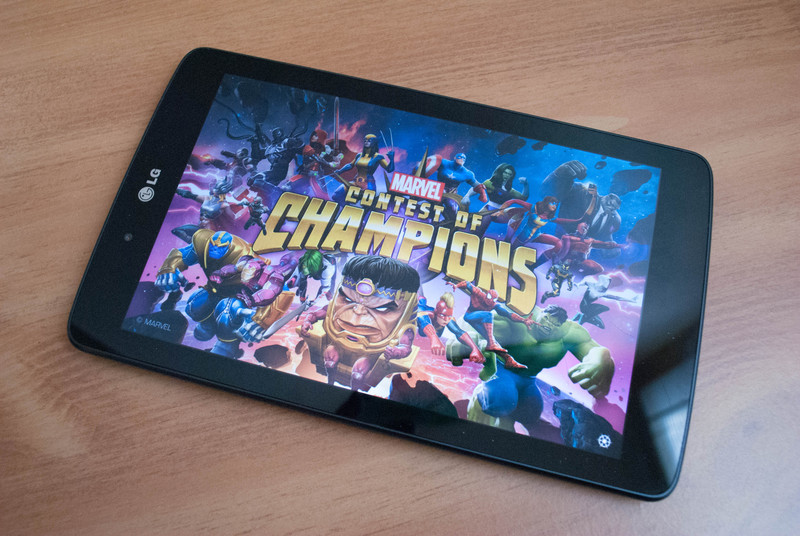
Marvel walks a fun line with their psuedo-fighter, and it keeps you coming back for more.
When I initially sat down to write about Marvel: Contest of Champions I hadn’t been playing for particularly long but I was already hooked. The access to a gorgeous and easy to play fighting game was the first draw, but I’m also a major Marvel fangirl. So, 30 days later, these are my thoughts on whether this game will keep you enjoying it after the first few days.
The first big question was whether this game was enjoyable even without In-App Purchases (or IAP for short). While Marvel: Contest of Champions does have some IAP, it’s not a game that requires you to constantly purchase new booster packs in order to enjoy the experience. After a full month of grinding and playing in Versus modes, I never wound up spending any cash to pick up in game boosts. That’s because this game finds a really good way to reward you with in-game items if you’re able to rely on some basic skills to win fights. Between the various modes of play you’ll quickly and easily earn just about everything that you need to keep moving forward. IAPs in this game are largely about shortcuts, making ti so you can avoid things that feel like grinding.
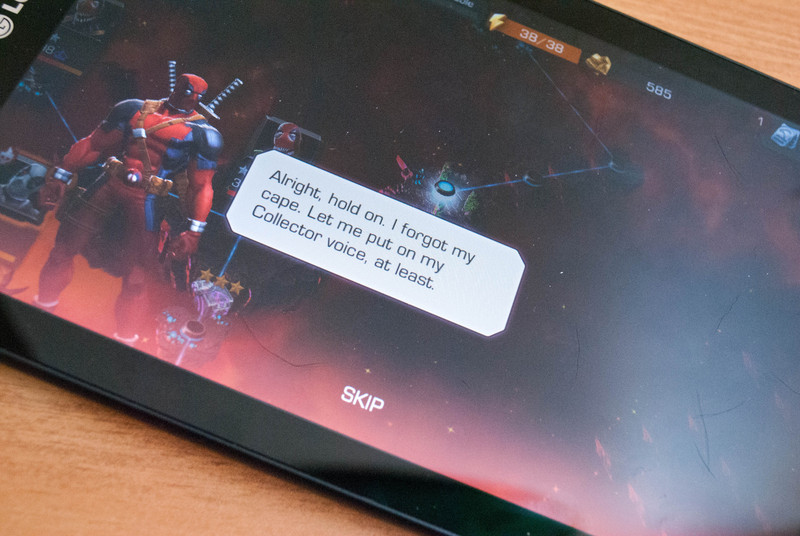
Purchasing more units would make it easier to snag those high level crystals and thus higher level champions, but I never found it was necessary in order to succeed. In fact I was only ever even reminded of those IAPs when I tried to grab a crystal that I just didn’t have the units for. Is it slower going this way? Absolutely. I grind through each level until I’ve gotten a completion award for it. By doing that my ISO-8 is always overflowing, and it’s easy to stay on top of character upgrades. The biggest bottleneck that I ran into was when I desperately needed catalysts but was unable to find them anywhere. Once you get used to jumping between campaign quests, battle quests, and versus modes — and grabbing the different loot that you get from each of these, you won’t really need to spend your hard earned money.
While an easy way to share the game — and hook my friends — never really showed up, it was easy to play across multiple devices. Depending on the day I was playing on one of three different phones, plus a tablet and the game synced perfectly across all of these without any issues. If I switched from one to another, the game would just reload itself and I was good to go. It means you need an internet connection, but that’s a reasonable trade-off for what you’re getting in this situation.
After I got a variant Deadpool this way, I make sure to check on my mail every day when I open up the game.
I play Marvel: Contest of Champions for an hour or two each day at most — spread out across the entire day of course — and there is still a ton of content that I’ve barely touched. The battle quests are timed, so every week or so there is a new one to play through. These have proven to be an excellent distraction from the main campaign and the surest way to pick up gold and loot each day. The battle quests are also occasionally themed, like Deadpool for Valentine’s Day. Each battle quest event is also accompanied by a specific crystal that you can buy for the chance of an awesome special character. These have kept me distracted enough that I’m still not even close to finishing the campaign missions.
One of the things that I didn’t check often enough when I got started was the mail being sent to me by the game team. For the most part it’s just info about current events, new features being added, and special events going on. However, every now and then they will also send you some sweet perks. These include everything from high level ISO-8 and catalysts, to 2-Star champions. After I got a variant Deadpool this way, I make sure to check on my mail every day when I open up the game.

I still don’t really interact much with the other people in my Alliance, but that’s because I prefer my gaming to be a solitary experience. Thankfully it isn’t held against me, and I can still rack up Alliance points with a tap. I’ve gotten tons of rewards for Alliance missions that I didn’t even realize I was accumulating points towards, which is always awesome. Checking in just once a day and helping people requesting aid has gotten me several Alliance crystals as well. There are still new Alliance modes out on the horizon too, and they look pretty interesting as well. Especially since a huge update dropped today adding Alliance Wars to the Alliance quest tab.
All in all, after a month’s worth of play I’m still really enjoying the game. The regular tweaks on content mean that it hasn’t gotten boring at all, and since I’m cool with grinding through a game I haven’t devolved to picking up units in the game. There are plenty of free games out there that I enjoy and return to on a regular basis, and Marvel: Contest of Champions has definitely joined those ranks. It’s different than a console fighting game, but that’s what makes it more enjoyable on a mobile platform.

McDonald’s turned its Happy Meal Box into a Cardboard-like VR headset
Yep. You read that right.
McDonald’s Happy Meal Boxes have been made into virtual-reality headsets. But don’t go rushing over to your nearest Mickey D’s just yet, as this promo is limited to one country at the moment (and it’s not the US or the UK). Oddly, it’s Sweden (of all the places!). The company has suggested to AdWeek however that this is merely the first trial run and therefore could be expanded if the box headsets end up being a hit among Swedes.
McDonald’s Sweden had dubbed its Google Cardboard-inspired creation “Happy Goggles” and plans to make 3,500 of the viewers available at 14 restaurants during the two weekends of 5 March and 12 March. They won’t be free; you’ll have to pay about $4.10 each. For that price you’ll also get access to a ski-themed VR game created by McDonalds in order to celebrate the Swedish “Sportlov” recreational holiday.
To turn the red boxes into Happy Goggles, simply tear along the perforated lines and fold. The video below demonstrates what to do. Each box also comes with a VR lens, but you’ll need your own smartphone to download and run the Slope Stars VR game or any VR mobile experience.
McDonald’s DIY VR headset made from its meal packaging follows news from last week about Coca-Cola experimenting with ways to convert old packs of Coke into viewers. Marketing gimmick? Yes. Do we care? No. Just gimme!
NY judge rules feds can’t force Apple to unlock an iPhone
A US magistrate judge in New York has ruled that the government can’t force Apple to help law enforcement unlock an iPhone using the All Writs Act. This case in question is about drug trafficking and is not related to the San Bernardino shooter case.
While the cases are different, it’s a win for Apple in its battle with the FBI and Department of Justice. An Apple senior executive told Engadget that while it’s a important precedent, it’s not a binding precedent that magistrate Judge Pym in the San Bernardino case is legally bound to follow.
In his order magistrate Judge James Orenstein states: “More specifically, the established rules for interpreting a statute’s text constrain me to reject the government’s interpretation that the AWA empowers a court to grant any relief not outright prohibited by law.”
Apple has earlier prodded Judge Orenstein to rule on the feds wanting Apple to help it unlock the phone of Jun Feng who was suspected of conspiracy to traffic methamphetamine. During a search, DEA agents seized an iPhone 5s belonging to Feng.
The government then initiated the execution of a search warrant for the contents of the phone which has a passcode. Apple then submitted an opposition to the order and after additional filings and oral arguments, we’re here. Another case with a locked iPhone that the government want’s Apple to help unlock and the company rejecting that order. Only in this case, a judge has already ruled and its in Apple’s favor.
In the brief, the judge concluded that this is an issue that should be handled by congress. If the government wants to use All Writs or CALEA to force companies to circumvent encryption, there needs to a clear law granting it that power.
One interesting bit of information to come out of today’s news is that during a conference call with reporters, an Apple senior executive insisted that Apple has never created or signed any piece of software to decrypt a phone.
The company has handed iCloud backups over to law enforcement when order by the courts. This is in line with the company’s remarks that if it has the data, it will comply with lawful orders.
Apple and Department of Justice will argue their cases in front of Judge Pym on March 22.
Malware hints that Hacking Team is back
Hacking Team has largely stayed under the radar after a gigantic leak exposed its spyware-selling ways, but the company might be on the rebound. Security researchers have noticed that recent Mac malware installs a version of Hacking Team’s Remote Code Systems tool from around October, or three months after the outfit was publicly torn apart. There is a chance that a third-party group simply obtained and reworked some of the leaked source code, but clues suggest that this wasn’t the work of amateurs.
For a start, the existence of fresh code in the sample malware is odd in itself. As SentinelOne’s Pedro Vilaça asks, why would a third-party maintain Hacking Team’s work? Also, it’s unusually sophisticated: it uses Apple’s own encryption system, making it harder to scrutinize the malware’s contents. The only significant doubt is that Hacking Team had promised to come back with brand new code — a few modifications here and there don’t really count.
You probably don’t have much to worry about at this stage. At least some antivirus scanners already detect the malware, and there’s no obvious infection mechanism. You may have to be fooled into installing a file, or else fall victim to another exploit that brings Hacking Team’s work along for the ride. If this is the company’s work, though, it’s bad news for targets of less-than-scrupulous government surveillance.
Via: Ars Technica
Source: Reverse Engineering Mac OS X, Objective-See
GoPro buys mobile app makers to help your action camera editing
It’s rarely fun to edit your action camera videos, and that’s a big problem for GoPro — it even cited that drudgery as a significant “inconvenience” to users when reporting its lackluster results in January. And now, it appears that the company is doing something about it. It just acquired the developers behind two mobile editing apps, Replay and Splice, for $105 million. While GoPro isn’t divulging its exact plans, it tells Forbes that it needs more developers to boost its (frankly humble) video editing efforts.
The respective teams aren’t uprooting themselves, but you might not want to count on their apps existing as-is when GoPro promises that it will be “impossible to miss” its presence in the future. Either way, it’s safe to say that editing GoPro clips should be easier and more sophisticated going forward, at least for everyday users who stick to the official software. Previously, you had to turn to third-party apps to make more than rudimentary edits. This would let you produce a reasonably polished clip on your phone without wondering who you should turn to, letting you share that whitewater rafting video before you’ve reached home.
Via: Forbes
Source: GoPro
Google starts selling Cardboard VR viewers through its store
Believe it or not, Google hasn’t offered Cardboard through its own online shop — you’ve had to go through third parties to get a taste of its virtual reality experience. Logic is finally prevailing, though, as Google has started offering Cardboard through its in-house store. Pay $15 ($25 for two) and you’ll get the bring-your-own-phone VR solution straight from the source. The offering isn’t alone, either. It’s joining a new VR section in the Google Store that highlights the Mattel View-Master and other VR gear. You probably bought Cardboard a while back if you were really, really eager to give it a try, but look at it this way: this is a simpler way to see what the fuss is about if you’re a relative newcomer.
Via: Manuel Clement (Twitter)
Source: Google Store
New York Judge Rules U.S. Government Can’t Force Apple to Unlock an iPhone
Alongside its battle with the U.S. government over an order to break into the iPhone owned by San Bernardino shooter Syed Farook, Apple has also been embroiled in a dispute over a similar case in New York. In late 2015, the Department of Justice asked a NY federal magistrate judge to order Apple to help authorities gain access to an iPhone seized as evidence in a drug trafficking case.
At the time, Apple explained that while it could technically unlock the iPhone in question because it was running an older version of iOS, being forced to comply with the order could “substantially tarnish the Apple brand.” This afternoon, Judge James Orenstein, who is presiding over the New York case, decided in favor of Apple (via TechCrunch), handing down a ruling that could potentially impact the much more prominent San Bernardino dispute.
According to the New York ruling, Apple cannot be forced to help law enforcement access data on an iPhone using the justification that the court has the power to make such an order under the All Writs Act, an argument the FBI also uses in the San Bernardino case. Apple has also argued the All Writs Act does not give the government a pass to “conscript and commandeer” the company.
“The established rules for interpreting a statute’s text constrain me to reject the government’s interpretation that the AWA empowers a court to grant any relief not outright prohibited by law,” writes Orenstein. “The extraordinary relief [the government] seeks cannot be considered ‘agreeable to the usages and principles of law,’” reads another section. He goes on to outline his reasoning and concludes with the opinion that the larger issue of encryption should be decided by legislation, not by the court.
In deciding this motion, I offer no opinion as to whether, in the circumstances of this case or others, the government’s legitimate interest in ensuring that no door is too strong to resist lawful entry should prevail against the equally legitimate societal interests arrayed against it here. […]
How best to balance those interests is a matter of critical importance to our society, and the need for an answer becomes more pressing daily, as the tide of technological advance flows ever farther past the boundaries of what seemed possible even a few decades ago.
But that debate must happen today, and it must take place among legislators who are equipped to consider the technological and cultural realities of a world their predecessors could not begin to conceive. It would betray our constitutional heritage and our people’s claim to democratic governance for a judge to pretend that our Founders already had that debate, and ended it, in 1789.
According to TechCrunch, a senior Apple executive has suggested that while New York case does not set a binding legal precedent in regard to the San Bernardino case, it sets “an important precedent of opinion.”
Apple has officially opposed an order that would require it to help the FBI break into the iPhone owned by San Bernardino shooter Syed Farook and will now face off against the government in court on March 22.
Note: Due to the political nature of the discussion regarding this topic, the discussion thread is located in our Politics, Religion, Social Issues forum. All forum members and site visitors are welcome to read and follow the thread, but posting is limited to forum members with at least 100 posts.
Tag: Apple-FBI
Discuss this article in our forums
HTC Vive Release Date, Price and Specs – CNET
You can now preorder the HTC Vive. The VR headset — which requires a fairly muscular PC to use — will begin shipping on April 5.
The Vive is jointly developed by Taiwanese phone maker HTC and Bellevue, Washington-based game developer Valve. The system costs $799 (£689 in the UK), but — unlike its archrival, the $599 Oculus Rift — it includes a bevy of accessories, including motion sensors and special motion controllers. Both products will need to be attached to a Windows gaming PC in the $1,000 to $2,000 range.
We’ll have more details and context on the Vive soon. In the meantime, what follows is our most recent hands-on experience with the hardware, originally published on January 5, 2016.
I was told to summon the Chaperone.
As I stood on the deck of a submerged pirate ship on the bottom of the ocean, I stepped towards the railing. Fish scattered around me. A glowing grid appeared, indicating a wall — not in the virtual world, but the real one. I’d done all this before. I tried HTC Vive, a full-room immersive VR experience for PCs coming later this year, back in early 2015. But here at CES in Las Vegas, in early 2016, there was a new twist.
Suddenly, glowing shapes appeared behind the walls: I could see the entire room I was in, like X-ray vision. The furniture, the weird Vegas carpet patterns…and my CNET video crew filming me.
HTC Vive Pre is one step closer to virtual…
See full gallery


1 – 4 of 12
Next
Prev
While Oculus readies its Rift VR system that’s just around the corner, and Sony prepares the PlayStation VR for its PS4 console, the HTC Vive feels like the third competitor in the virtual reality wars. The Vive was supposed to debut at the end of 2015, but was delayed until this April. What I got to see at CES in Las Vegas was the reason: the hardware has been revamped and improvements made. Most importantly, a new room-sensing camera has been added to the outside of the Vive’s head-worn display.

HTC Vive: room-filling VR freedom, now with better hardware.
Josh Miller/CNET
The Vive is, by far, the most ambitious virtual reality platform. It aims to be a full-room experience, a VR kit that senses an entire room and frees the user to wander around in a space up to 5 meters (16 feet) diagonally: two Yoga mats side by side, as HTC’s Dan O’Brien, VP of HTC’s Virtual Reality Group, described it during a briefing in Las Vegas.
Wandering around in a virtual world with a helmet on is dangerous, even in a sterile Las Vegas demo room. HTC and Valve developed a way for the Vive to sense walls and furniture in its previous hardware, but that wasn’t quite enough. The latest developer hardware can use its camera to look at the room and provide continuous updates on where everything is. I felt like Batman using his bat-sense vision in “The Dark Knight.”

The new camera’s on the bottom, but sees the whole room.
Josh Miller/CNET
The Vive shows the world around me when I double-click a home button on the newly revamped and lighter wireless controllers (which now last 4 hours on a charge, an improvement on the older Vive hardware). But the strange night vision-meets-X-ray graphics layer isn’t the same as a real camera feed — for latency-reducing purposes, according to Valve’s Chet Falisze. You can see a smaller picture-in-picture view of what the camera sees, but blown up large it feels like bizarro sonar.
It’s not like the sort of virtual-enters-reality feel of augmented reality, like Microsoft’s HoloLens. It’s something different: the real entering the virtual.

The Vive’s improved headset and controllers on some primo Vegas carpet.
Josh Miller/CNET
All the Vive’s parts are new and refined. The controllers now seem more like something you’d buy in a real store. The room-sensing base stations that come with Vive — laser-emitting boxes that are meant to be installed high up, like little speakers — are smaller, compact cubes. The helmet is lighter, with refined strap design and replaceable parts for better nose and face fit that HTC calls “gaskets.” The visual display has also been markedly boosted: The resolution is the same, but an engineering tweak to remove “mura” (the processing layer that dims and fades the VR image, according to HTC and Valve) resulted in much poppier, brighter, vivid colors during my brief demo.

A better-feeling headset.
Josh Miller/CNET
The fish that flitted by me down in the virtual ocean popped with detail. A slow-swimming blue whale in front of me stared back with a massive eye that seemed more real than I remembered. I stared up at sunlight through water that felt more vibrant. Another demo I never tried before — the brilliant Job Simulator game, also coming to Oculus — had me pouring coffee, plugging in my clownish computer and attempting light office work in a brightly colored cubicle that showed off how much crisper the Vive’s VR now looks. It seemed to help the pixels melt away.
This still isn’t the final hardware: According to HTC and Valve, this developer’s unit will be followed by another version before release. But it’s much further along than before. But I still wonder about HTC and Valve’s vision of full-motion, full-room VR. Vive’s two controllers, room sensors and tethered helmet — plus the required PC with the level of gaming graphics necessary — will limit the appeal of Vive no matter what the price.
HTC and Valve are clearly committed to pushing the boundaries of VR into a space that’s starting to feel almost like augmented reality, but VR — and most people — might not be ready to take that full step. Nevertheless, it’s amazing stuff.
Samsung WA52J8700 review – CNET
The Good Samsung’s $1,199 WA52J8700 Activewash washing machine has quite a few features, including a built-in sink, but it’s still easy to use. It’s also easy on the eyes.
The Bad If you don’t expect to use the sink, it will probably just get in your way. The WA52J8700 did pretty well in terms of stain removal, but not great, and the detergent dispenser is hard to reach.
The Bottom Line Samsung’s Activewash washer offers a lot, but you’ll want to look elsewhere for top-of-the-line performance.
Top load washing machines tend to get a bad rap. You can’t stack them and they’re usually limited in terms of features and storage capacity compared to their front load cousins. One benefit is that they typically cost less, but that isn’t always enough to make a top load washer purchase worthwhile.
Samsung’s $1,199 Activewash machine, model number WA52J8700AP, is giving traditional top load laundry a makeover, starting with a built-in sink and jet that lets you hand wash, prewash and directly target tough stains without having to travel to the kitchen or the nearest bathroom for a water source. Currently restricted to the US, there are actually four models in this series starting with the 4.8-cubic-foot $899 WA48J7770AW with a white finish and ending with the pricier WA52J8700AP we reviewed here.
Although this unit, finished with a silvery-gray “platinum” coat of paint, looks nice and is mostly easy to use (with the exception of the oddly placed and hard-to-reach detergent dispenser), it didn’t blow us away during testing. It performed worse than the $1,500 front load LG WM5000HVA and the $1,400 front load GE GFWR4805FMC, but better than the $1,500 top load LG WT7700HVA. And if you don’t care about the built-in sink, it’s really just going to get in the way.
Even so, I’d suggest taking a look at the $1,199 WA52J8700AP — it’s less expensive than its top load competition from LG, but performed better overall.
This washer-sink hybrid is sure to shake…
See full gallery


1 – 2 of 13
Next
Prev
A built-in sink? Why?
An attached sink struck me as a totally bizarre and unnecessary washer feature at first, as I have never presoaked anything in my life and tend to use the delicate cycle as my hand-wash catch-all. But, after spending time with Samsung’s Activewash, I’m beginning to question my current laundry technique; maybe my clothes would last longer with this sort of rig.
It works like this: Lift the washer door, make sure that the sink is lowered and press the Water Jet button. The jet will spit out a stream of water into the basin, press it again to stop the water. That’s it.
Then you can presoak any grass, wine, mustard or other stubborn stains before starting a regular wash cycle. Or you can use the sink as a complete hand wash cycle. And when you’re done, simply lift the sink and the remaining water will pour into the main tub and out through your washer’s designated drain hookup.
It’s so easy that I could imagine actually trying to presoak or hand wash certain items when previously I would’ve just shoved them in the washer. But, if you don’t plan to use it — either because you already have a standalone sink in your laundry room or because you don’t foresee a lot of presoaking in your future — this feature will just get in your way. (Do you pre-soak your clothes? Leave a comment and let me know whether you’d use a built-in sink.)
Catch more laundry coverage here:
- Whirlpool’s giant washer wants to shrink your dirty clothes pile fast
- Marathon wants to remove dryers from the laundry equation
- How we test: Washing machines
What else can this washer do?
Aside from the sink, this machine offers a lot of other features. It has a 5.2-cubic-foot capacity, which is big for a top load unit (although LG’s top load WT7700HVA is even larger, with 5.7 cubic feet of space). Samsung’s model also boasts several special settings: Heavy Duty, Bedding, Activewear, Deep Steam, Sanitize, Eco Plus and even Super Speed, which Samsung claims can complete a full cycle in only 36 minutes.
Beyond these options, this washer also happens to look nice and, at 27 inches wide by 46 inches tall with a depth of 29.3 inches, it won’t take up too much space. The Activewash’s transparent lid showcases the sink below and its sparkly gray finish and intuitive, easy-to-read display gives it a clear edge over many top load washers. That isn’t true for the LG WT7700HVA, though, which has a very similar design aesthetic.
The sensitivity of the touch display did throw me off at first, as it’s extremely responsive. My instinct to press on the display overcomplicated things, too, as a light touch is more than enough to adjust the temperature, soil level and other settings. There’s also a difference between the power and start/pause buttons and the rest of the panel. The first two are actual buttons that you press, while the rest respond to touch alone.
 AIVAnet