


Is Sony doing the right things with the Xperia line?
I’d like to start by admitting that I’m a new-ish Sony Xperia fan. Specifically, I gave the Xperia Z3 a shot last year and adored it. The only reason I switched to another phone (aside from my new-phone addiction) was to have a bigger screen.
One aspect no other OEM has been able to touch Sony on is battery life. This is something I think back to every subsequent phone I get, especially when we’re still seeing average battery performers, like the Galaxy S6.
The launch of the Xperia Z5 lineup came, making a bigger splash than the Z4/Z3+ releases earlier in the year. However, it would be illogical to expect big things from Sony. We’re accustomed to each Xperia iteration only receiving minuscule updates. On the surface, it could be perceived as the same phone, being launched for the 5th time.

But is that fair to say? From a tech-savy person, no. But those aren’t mainly from whom OEM’s make their money, is it?
So it begs the question: Is Sony moving the Xperia line forward in the right ways? Firstly, no other OEM has exemplified the idea of “if it isn’t broken, don’t fix it” more than Sony has with its smartphone design. While it’s not fair to consider that a bad thing, it is a reality. People like to see new things.

Xperia Z5 (non-premium)
Next is the fact that Sony added a new member to the Xperia family, a “premium” big brother. While this offers consumers more choice (we can now choose between small, medium, or large), it can also introduce confusion. For instance, previous Xperia flagships were already costly, does this mean that the Z5 Premium is going to be even further from reach? Or is the Premium placed where the previous flagship stood and is now going to inherit the corresponding price? This then means that the vanilla Xperia Z5 is going to be cheaper? See what I mean?
It should be appreciated that Sony is using the same internals for each variant, for the most part. The consumer essentially has to choose what size display they want (with a resolution that scales appropriately – from 720p on the Z5 Compact, to 1080P on the Z5, and all the way to 4K on the Z5 Premium). The exception here is the build quality, it increases up the chain. The Z5 Compact has a plastic chassis, the Z5 has a metal frame and plastic backing, and the Z5 Premium has a metal frame (with a shiny finish) and frosted or mirror glass backing.

Xperia Z5 Premium (Sliver)
The use of the Snapdragon 810 is questionable, but in hindsight, I’m okay with it. Sony has proven that they know how to tune the SoC so that the software runs smoothly and battery life is maximized. Yes, the 810 has to be tamed to be functional. But the matter of the fact is, even an underclocked 810 is fast.
Sony has also shown that they know what they’re doing with optics. It incorporated its newer Exmor RS sensor and quick auto-focusing technology from its well-renowned lineup of digital cameras. Sony’s smartphone camera offering has always been up there with the big boys, and now speed and quality are even better.

Xperia Z5 Compact
The point is that I see what Sony is doing and I like it. I love choice, which is why I love Android. But at the same time, Sony needs to be compelling, when consumers have to choose from a sea of devices. You can’t just be great, you need to have something that intrigues people.
Fortunately, Sony has shown they’re not as oblivious to this fact as some other OEM’s. “Mini” versions of flagships are prone to inferior specs – Sony challenged this with the Compact series. But what about value?
As we’ve seen this year with the OnePlus Two and Moto X Style/Pure, people respond to value. And when you take the fact that Sony isn’t really spending on smartphone design, it should be subtracting that from the cost of the phone. This is what Motorola appears to be doing, and it’s working.
It’s no doubt that Sony has a great set of devices, now they have to get it in more people’s hands. Do you agree?


The post Is Sony doing the right things with the Xperia line? appeared first on AndroidGuys.
Video game voice actors may go on strike

Voice acting in video games is serious and often thankless work. You have to recite hours of dialog that doesn’t always get heard, and only a handful of actors (like Nolan North, John DiMaggio and Troy Baker) have high-profile careers. However, they’re now fighting to get a bigger piece of the pie. The actor union SAG-AFTRA is considering voting for a strike that would push for more payments and greater rights for game voice actors. It’s proposing that these performers should get bonuses every time a game sells 2 million copies, and stunt pay when they have to strain their voices — think about every game where your character screamed from taking damage. The guild also wants stunt coordinators for motion capture work, and it hopes to prevent companies from both hiring their own unionless staff as well as instituting fines over relatively arbitrary faults, such as failing to audition for small roles.
A strike won’t take place unless 75 percent of voters are in favor of the proposals. If the action does go ahead, however, it’ll set up a rare and potentially significant battle between game publishers and their voice talent. That could be good for actors that sometimes get short shrift, but it could also delay more than a few titles dependent on spoken roles. The strike has supporters who would be sorely missed if they stopped working, like Jennifer Hale (the female Shepard in Mass Effect) and Wil Wheaton, so this would be no small loss.
[Image credit: Michael Bezjian/WireImage]
Via: GameInformer
Source: SAG-AFTRA (1), (2)
Babymetal will cute you to death in Rock Band 4

Earlier this summer, a trio of teenage rockers took the internet by storm with their unique blend of J-Pop effervescence and head-banging thrash metal beats. The band’s star continues to rise with both a world tour and the announcement that their first hit, “Gimme Chocolate” is coming to Rock Band 4. The song will available as a bonus track beginning October 6th (which is when the game actually hits store shelves). Unfortunately, the track is exclusive to the Xbox One platform and needs to be reserved as part of the game’s pre-order bundle.
[Image Credit: Redferns / Getty]
Via: BoingBoing
Source: XBox One
Nextbit’s cloud-friendly phone is heading to Sprint, too

After adding Verizon to its list of carriers last week, Nextbit announced today that its Robin phone would be available on Sprint as well. When it was first announced, the cloud-focused handset was only available for AT&T and T-Mobile customers, but the company tacked on two more networks since. This means customers on all four of the big-name carriers in the US will be able to pick up a Robin. With a week to go, Nextbit has raised over $1.2 million (and counting) via Kickstarter for the project. When the campaign ends, backers will be able to choose between the GSM or CDMA version of the device via a survey. Nextbit also revealed what would be included in the box with an image of the matching quick charger, charging cable and SIM pin. If you’re still considering one, you’ll have to commit $349 to secure it in the next seven days.
Hey Sprint subscribers…guess who’s coming to your network! #NextNow https://t.co/5IV98kYe15 pic.twitter.com/gP3IZKpFvW
— Nextbit (@nextbitsys) September 23, 2015

Source: Nextbit (Twitter), Kickstarter
Watch Tesla’s super-fast Model S modes square off in a drag race

When Tesla introduced its extra-fast Ludicrous Mode for the Model S, it also raised a big question: is that acceleration advantage over the already-quick Insane Mode actually meaningful? Thankfully, some owners were willing to find out. DragTimes has posted a drag race between a Model S P85D (using Insane Mode) and a P90D (using Ludicrous) to see how much that added performance really matters. And the answer is “quite a lot” — as you’ll see in the clip below, the P90D pulls ahead quickly and leaves the P85D firmly in the dust. Who’d have thought that the P85D would suddenly seem pokey? You’d expect this kind of lead when it costs at least $5,000 extra to get the Ludicrous setting, but it’s still good to have evidence that you’re getting more than just a spec bump.
Via: Tech Insider
Source: DragTimes
Microsoft’s new app ‘Outlook Groups’ has hit the Play Store
 Microsoft just submitted a new application called ‘Outlook Groups’ in the Play Store. The app makes it easy for Office 365 users to engage with your work or school on the go.
With Outlook Groups, subscribers of Office 365 will be able to share files, photos and notes more easily among their friends, family and co-workers. Best of all, it’s great for on-the-go and taking part in discussions with your team. The app makes it easier to participate in group email conversations and introduces a new featuring allowing one to share a OneNote notebook with the group and edit simultaneously. Subscribers can also co-author office documents, spreadsheets and PowerPoint presentations shared with your group. The app brings a beautiful design making everything enjoyable to interact with along with an organized layout making it easy to navigate.
The app is available to download now in the Play Store and anyone running Android 4.1 or above can get it. You can find it at the download link below.
Come comment on this article: Microsoft’s new app ‘Outlook Groups’ has hit the Play Store
Meizu Pro 5 officially announced, powered by Samsung’s Exynos 7420
 Meizu has officially announced its Pro 5 flagship handset in China. Most of the specifications match those in recent leaks.
The Meizu Pro 5 is a new high-end smartphone that will blow you away. It’s coming to select countries around the world starting next month beginning with China. Powering the handset is Samsung’s very own Exynos 7420 octa-core processor, the same used in the company’s’ recent high-end flagship models. It features a large 5.7-inch Full-HD AMOLED display for richer and more true to life colors. In addition, it’s made out of 2.5D arc glass for better durability. Users will get either 3GB or 4GB or RAM depending on how much internal storage space you desire. The 32GB variant will include 3GB or RAM, and those wanting 64GB of on-board storage space will get 4GB of RAM. Also included is a 21MP rear-facing camera, a 5MP front-facing camera, a built-in fingerprint scanner, support for 4G connectivity and a 3,050mAh battery with built-in quick charging. Meizu says users will be able to charge up to 65% in just 30 minutes time.
Following the announcement, the Meizu Pro 5 underwent an AnTuTu benchmark test that will put competitors on notice. According to PhoneArena, the handset now leads the charge as the fastest Android powered smartphone up for retail with an amazingly high score of 77,768 points, beating out Samsung’s Galaxy S6 which had a score of 68,944. The handset will be available in choice of gray, silver-white, silver-black and rose-gold color options. Users wanting the 32GB/3GB of RAM model will be set back 2799 Yuan or approx. $440 USD. If 32GB isn’t enough, the 63GB/4GB of RAM variant will set you back an additional S45 USD at 3099 Yuan or approx. $485 USD.


Come comment on this article: Meizu Pro 5 officially announced, powered by Samsung’s Exynos 7420
Facebook is bringing 360-degree videos to your News Feed

Facebook has just announced that it’s adding support for 360-degree videos in its News Feed. When you see a 360-video on the desktop, you’ll be able to click and drag your mouse around the video player to look around. When you’re on a smartphone or tablet, though, you’ll be able to tilt, twist and turn your mobile device to look around, just like you would using a virtual reality headset. You can use your finger to move the video around on mobile devices, too.
To create 360-degree videos you’ll need a special set of cameras, similar to what GoPro showed off at Google I/O a few months ago. These camera rigs can get really pricey, so you probably won’t see too many 360-degree videos show up on your feeds anytime soon.
To give us a good look at what these videos will look like on Facebook’s site, a number of publishers have already begun sharing their own 360 videos. The most interesting of the bunch is a new video based off Star Wars: The Force Awakens that takes place in the Jakku desert. If you’re a Star Wars fan, you’re probably going to want to check it out.
You should already be able to see 360-degree videos on Facebook on the web and in the Android application. This feature will roll out to iOS users in a few months.
Fighting game inspired by ‘My Little Pony’ needs cash to become reality

Them’s Fightin’ Herds started life as My Little Pony: Fighting is Magic, a fighting game created by My Little Pony: Friendship is Magic fans and starring characters directly from the show. That project was shut down when Hasbro sent the developer, Mane6, a cease-and-desist order in February 2013 — but it was reborn when Friendship is Magic producer Lauren Faust and Skullgirls studio Lab Zero Games hopped on board. Now, Them’s Fightin’ Herds is a serious fighting game starring a cast of original characters designed by Faust and running on Skullgirls‘ engine. This week, Mane6 launched a $436,000 Indiegogo campaign to fund 18 months of full-time development on Them’s Fightin’ Herds, and in two days it’s raised more than $100,000. This time around, it looks like crowdfunding is magic.
Via: Gamesradar+
Source: Indiegogo
Sony’s new A7R II brings more than just a resolution bump

Sony’s A7 range of full-frame mirrorless cameras has only been around for just under two years and yet there are already six members in the lineup. The company has wasted no time in filling the series with models tuned for different uses — from low-light performance to high-megapixel applications. The A7R II, with its 42.4-megapixel full-frame sensor, certainly falls in that latter category with specs that place it roughly in the same league as heavy hitters from Canon and Nikon. Still, bullet points on a page are one thing; using it in the field can uncover something entirely different. I spent a month with the expensive shooter ($3,200 for the body) and it turns out Sony’s latest megapixel monster can hold its own among the big boys.Slideshow-322420

While the A7R II may seem a bit beefy compared to other mirrorless interchangeable lens cameras (ILCs), it’s significantly tinier than high-end/prosumer full-frame models from industry stalwarts like Canon and Nikon. The former’s 50.6-megapixel 5DS DSLR is quite a bit larger in all dimensions and weighs in at 32.8 oz. with a battery inside — more than 10 ounces heavier than the A7R II. That’s not an insignificant difference, especially if you’re considering which one you’d rather hang off your shoulder or neck for hours at a time.
That size advantage isn’t without trade-offs, of course. The generous frame on the 5DS, for example, gave Canon room to squeeze in two memory card slots (one CompactFlash, one SD) — a popular feature for photogs who want automatic backups of every shot, or the ability to save RAW files on one card and JPEGs on the other. With the A7R II, however, we’ve got just the single SD card slot to play with. Speaking of the 5DS, there’s also more room for connections, including a faster USB 3.0 port, whereas the A7R II makes do with the more common micro-USB receptacle.
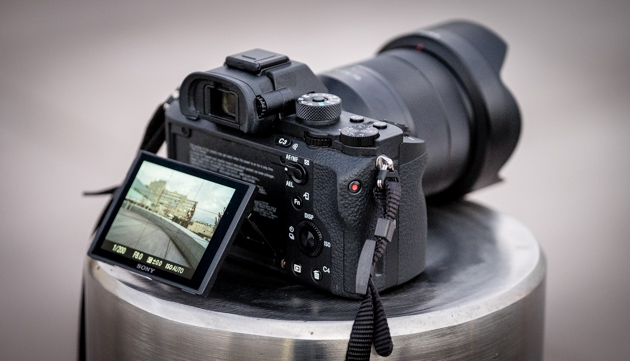
Then there’s the battery, which comes in at a relatively tiny 1,020mAh (compared to battery packs from Nikon and Canon that sport capacities of around 1,800 to 1,900mAh). While I made it through several hours of shooting without worry, I do think picking up a spare battery would be a wise investment. You could also opt for Sony’s VG-C2EM vertical grip, which adds a secondary set of controls for use when shooting vertically and support for two power packs at once. While you give up a bit of the A7R II’s size and weight advantage with the grip attached, it may well be worth it if you plan on shooting for long periods of time.
The overall image quality is impressive and those 42.4-megapixel frames result in significant detail even at 100 percent zoom. Sony’s recent announcement that 14-bit RAW support will come via a firmware update further sweetens the deal. It may not be the high-ISO king in the A7 lineup (that title belongs to the newly announced A7S II), but we do have a max ISO of 102,400 on offer here. I’d personally avoid those higher settings though. In fact, I probably wouldn’t venture much beyond about ISO 12,800, which is still impressive.

I was very curious about the A7R II’s focus performance, especially considering its high-end specs and high-end price. I’ve been a regular user of Fuji’s X-series mirrorless cameras for the past few years and I’ve been impressed with the steady improvements to autofocus performance — through both firmware updates and brand-new models. Still, they’re a step or three behind the lightning-fast focus speeds you’ll find on modern DSLRs. So, I was anxious to try out the A7R II’s focusing chops, especially its highly touted “Fast Hybrid AF” system and its whopping 399 phase-detection focal points.
An MLS rivalry match between the Seattle Sounders FC and the Portland Timbers proved to be a solid test of the A7R II’s abilities. The match also gave me a chance to try out Sony’s FE 70-200mm f/4 lens — part of a growing lineup of first-party optics. And while performance with adapted third-party lenses from Canon and others continues to improve, a wider variety of Sony-made options can only help the company’s efforts to gain a foothold among the pro ranks.Slideshow-322421
The Fast Hybrid AF mode takes advantage of those 399 phase-detection and 25 contrast-detection autofocus points. I first tried it out in the Wide setting, which tracks focal points over most of the frame. That setup worked well in certain environments, especially when the background was fairly static and my intended subject was the only thing moving. It was almost hypnotizing watching green focus squares light up across the viewfinder as my target scurried around.
In the more frenzied confines of a pro soccer match, however, the Wide mode struggled to keep up, especially with players moving in all directions. After a few shots turned out with the wrong people in focus, I switched back to my standard practice during sporting events: using only focus points in the center of the frame. With just that small zone to worry about, the Fast Hybrid AF mode performed reliably and the vast majority of my shots were in focus — even with continuous bursts of images.
I also tried it out at the Roy Pioneer Rodeo in Roy, Washington. Here, again, setting the AF system to worry about just the center of the frame let me get consistently in-focus shots very quickly. As a sports shooter, then, the A7R II’s overall focus system didn’t leave me wanting for much, which is a testament to how much mirrorless systems have advanced in just a few short years.

Slideshow-322424
Its movie modes are also pretty easy to use, and the A7R II’s 4K support gives it a leg up on Canon’s and Nikon’s full-framers. During some quick tests at the rodeo, video quality came out impressively detailed at both 4K and 1080p settings, although I did notice the frame rate of the EVF’s live preview struggling to keep up when recording at the higher setting. It didn’t affect the actual clip, but that does seem to suggest Sony’s internals are just barely able to handle the high-res movie mode.
Despite my overall pleasant experience, it’s obvious that the A7R II was not specifically designed for the sidelines — that relatively slow 5 fps continuous mode should be a dead giveaway. Also, write speeds often got in the way. I frequently ran into a “Please wait” message when trying to review shots after a quick burst of shooting. Granted, 42 megapixels is a lot of data to move, but you can never have too much speed in those situations. That bounty of pixels did come in handy when the action was just too far away for the 70-200mm lens. In fact, I snapped a few pics of a last-second free kick on the other side of CenturyLink Field and the high resolution let me significantly crop the photo while still retaining solid image quality.

It wasn’t that long ago that I wouldn’t have bothered trying to use a mirrorless camera in a high-action setting like professional sports, but the A7R II held its own for the most part — despite not really being designed as a pro-level sports cam. I wish write times were peppier and hopefully Sony’s designers find ways to cram a bigger battery and, perhaps, a second memory card slot into this line’s compact frame. But overall, I came away impressed with how far Sony’s come with this line. Both the A7 bodies and first-party lens lineups are steadily improving. And thanks to the company’s rapid pace of deployment (six new models in two years) it seems like we’ve finally reached the point where “pretty damn good for a mirrorless camera” has turned into just “pretty damn good.”
Check out our Flickr page for full-size photos — including shots of the Seattle Sounders FC match and the Roy Pioneer Rodeo.
 AIVAnet