


Hubble celebrates its 25th anniversary with space fireworks

To celebrate the Hubble Space Telescope‘s quarter century of scientific service, both NASA and the European Space Administration (ESA) have published this stunning photograph of Westerlund 2. At just 2 million years old, this 3,000-star cluster contains some of the biggest, hottest and brightest in the galaxy. The ridges and columns you see above are the result of these stars spewing out massive amounts of ultraviolet radiation that etches into the surrounding hydrogen cloud. You can see more of the Hubble’s greatest shots over the last 25 years in the video below.
Source: NASA
Next Samsung Gear smartwatch to feature round display, refreshed user interface

Select developers are receiving early access to the software development kit (SDK) for Samsung’s next Gear smartwatch. The company issued a press release today that reveals developers are already working with the technology. Also, Samsung has global partners working on creating unique experiences for the unannounced device. CNN, Yelp, Baidu, FidMe, and Apposter are all working with Samsung.
The real piece of news, though, is that the next Gear smartwatch will feature a round display and refreshed user interface. The teaser image attached to the press release shows a round display with a watch face showing weather hour-by-hour. While Samsung does not seem to be committing to Android Wear full-time, this shows that the company cares about improving its experiences for users.
Hit the break for the teaser image and the full press release.
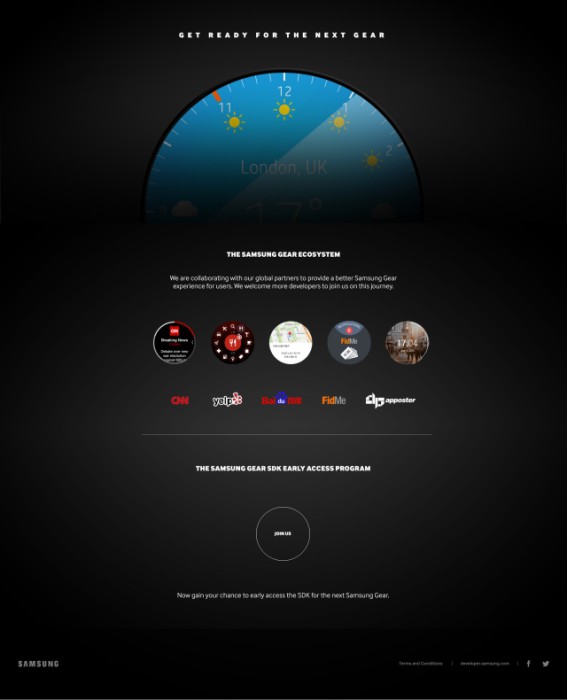
Samsung to Release SDK for Next Generation Gear
April 24, 2015
Developers receive invitation to help build next Samsung wearable prior to the product launch
Seoul, Korea – April 24, 2015 – Samsung Electronics Co. Ltd. today announced that members of global developer community can get an early access to the Software Development Kit (SDK) of the company’s next generation of the Gear device. The new wearable device will be the 7th generation of Samsung Gear with a wrist watch type. This is the first time that Samsung has released its wearable SDK to third-party developers before the official product announcement.
“Samsung has actively adapted its approach to wearable device development as the leader of the rapidly developing category,” said JK Shin, CEO and Head of IT & Mobile Communications Division at Samsung Electronics. “Through meaningful and progressive innovation, Samsung welcomes to developers and industry leaders to join this open collaboration effort to enrich and create unique user experiences for a new smart mobile life.”
To join the program, developers can become a member of the community by submitting an application at the Samsung Developer’s website. The applicants will be later notified through email along with the development resources. They will be among the first to get an up-close look into the SDK and build apps for the next Gear.
For more information, please visit http://developer.samsung.com/wearable
About Samsung Electronics Co., Ltd.
Samsung Electronics Co., Ltd. inspires the world and shapes the future with transformative ideas and technologies, redefining the worlds of TVs, smartphones, wearable devices, tablets, cameras, digital appliances, printers, medical equipment, network systems, and semiconductor and LED solutions. We are also leading in the Internet of Things space through, among others, our Smart Home and Digital Health initiatives. We employ 307,000 people across 84 countries with annual sales of US $196 billion. To discover more, please visit our official website at http://www.samsung.com and our official blog at global.samsungtomorrow.com
Come comment on this article: Next Samsung Gear smartwatch to feature round display, refreshed user interface
Razer taking pre-orders for its Forge TV set-top box, ships by April 29

The selection of Android TV devices is about to expand as the NVIDIA SHIELD and Razer Forge TV set-top boxes near their releases. Both devices are expected to arrive next month and Razer has started taking pre-orders for the Forge TV. The set-top box ships alone by April 29 and has a $99 price tag. The bundle, which includes the Serval controller, costs $149 and ships the following week by May 5. For those not interested in the controller, we suggest that you do get the bundle anyways because the controller costs $79 when purchased alone.
Are you interested in the Razer Forge TV or any other Android TV device? Let us know in the comments why or why not.
[Razer Forge TV] [Bundle] [Serval Controller]
Come comment on this article: Razer taking pre-orders for its Forge TV set-top box, ships by April 29
Solitaire returns to Windows 10: the bouncy cards are back!

To the dismay of many users, Microsoft decided to remove its Solitaire, Hearts and Minesweeper games from Windows 8. But now, to celebrate the venerated card game’s 25th anniversary (it debuted all the way back on Windows 3.0), the company is making things right. Microsoft has announced that a modernized version of Solitaire will return to the Start menu from the Windows Store where it had been relegated. Unfortunately fans of both Hearts and Minesweeper will still have to grab both of those games online and install them individually.
Filed under: Gaming, Microsoft
Via: The Verge
Source: @stroughtonsmith (twitter)
Acer’s Liquid X2 smartphone is another globetrotter’s dream

Sure, you probably don’t need a smartphone with a massive 4,000mAh battery and a trio of SIM card slots, but thanks to Acer, your author can’t stop thinking about one. Acer’s so-called Liquid X2 is clearly well-equipped to play globetrotter, but (just like the Predator tablet) the company’s spokespeople were awfully light on the details. Still, we know it comes with a 5.5-inch screen and a 64-bit octa-core processor thrumming away within its surprisingly sleek frame, along with a pair of 13-megapixel cameras nestled high along its face and back. At last, a device that takes selfies as seriously as HTC’s Desire Eye.
Can’t stop ruminating on those SIM slots, can you? It might seem a little ridiculous — because it is — but that’s nothing new for Acer. It’s been pushing tri-SIM phones since last summer when it pulled back the curtain on the Liquid E700 and now that predilection for threeway connectivity has migrated to a phone you might actually want to buy. Too bad no one was willing to talk price yet.
Alas, the only units to be found on-site were tucked away in an acrylic box, far from my prying, sandwich-stained fingers. On the upside, though, the X2 will be accompanied by a slew of Quick Flip covers in a slew of colors that leave a strip of screen unobscured to give you quick status updates and tidbits of information. With a little tweaking, you can coax them into telling you how much storage space is being eaten up by your photos and music for instance, or providing you a quick Airplane Mode toggle for when you jump on one of your interminable flights. There’s no word yet on whether the Liquid X2 will never claw its way out of Acer’s native Asia, but it’s certainly not impossible. After all, today also saw the launch of the Acer Liquid M220 — an $80 Windows Phone we first got acquainted with back at Mobile World Congress — on US shores.
Filed under: Mobile
A cheat sheet to Project Fi, Google’s mobile phone service

Rumors of Google breaking into the wireless carrier game have been fodder for scoops, breathless reports and thinkpieces for years now, and for the longest time it looked like the search giant just couldn’t make it happen. Yesterday the search giant put all that to rest. Project Fi is finally here (if invite-only and fully compatible with one phone) — here’s what you absolutely need to know about it.
What is Project Fi?
At its most basic, Project Fi is a mobile phone service that promises unlimited domestic talk and text, unlimited international messaging, tethering and 2G-only international service in over 120 countries (thanks to T-Mobile’s rather dope roaming agreements) for as low as $30 a month. You get to decide how much data you want to pay for — more on that later — and you’ll get a tidy refund for whatever data you don’t use when the month is over.
Really though, the best way to look at Fi is as an ambitious experiment in mashing up existing networks. The heart of the service is a mobile mesh that combines Sprint and T-Mobile’s coverage areas with over a million of WiFi hotspots meant to give you the most reliable service wherever you are. Some of those hotspots will pop up exactly where you expect them — like 7,000 US Starbucks stores, for instance — while plans to bolster free public WiFi networks in cities with Google Fiber are well known. And the rest? Well, they’re all open networks (your data will get routed through a Google VPN to keep it secure) that Google’s got in a quality control database. Of course, how well this’ll actually work in practice is another story.
How do I use it?

The beauty of Project Fi is that, despite all the crazy-cool network jumping going on, you just use your phone the way you always would. Once you sign up, you’ll get a new phone number or bring over your existing one, and you can access it from a slew of compatible devices. It’s sort of like what Apple’s done with iMessage and its phone-friendly Continuity features, except across any computer, tablet or smartphone that plays nice with Google Hangouts. Want to check your voicemail or send your mom a cheesy Mother’s Day text? You can do it from your office Chromebook, that iPad chilling on your coffee table, and even that Surface Pro you keep trying to use on airplane tray tables. The name of the game here is seamlessness.
Same goes for your actual phone calls. Let’s say you’re on one of Google’s approved WiFi networks — if you’re on a call and wander too far from the source, the phone will switch you onto Sprint or T-Mobile’s data network depending on which is stronger to keep things flowing sans interruptions. Thing is, Fi’s meatiest part only works with one device right now: The Nexus 6. Motorola’s phablet the only device with a radio certified to shift between Sprint and T-Mobile’s networks without batting a proverbial eyelash and it’ll cost you (but more on that later). It’s possible that Project Fi will also support the older, cheaper Nexus 5 at some point since the same phone could be activated with either Sprint or T-Mobile service, but for now N5 owners are out of luck.
OK, I’ll bite — how do I get it?

You didn’t expect Google to open this up to the masses all willy-nilly, did you? Just like Gmail, Wave and Google+ before it, Project Fi is an invite-only Early Access Program for the time being, so you’ll have to throw your name into the hat by registering here. Google hasn’t said exactly when that first batch of invites will start hitting inboxes, but you should expect a response one way or the other within 30 days of registration. The requirements are pretty straightforward, though: As long as you live an area where Fi has coverage and you own (or are willing to buy) a Nexus 6, you’re eligible to take the service for a spin. Thing is, neither T-Mobile nor Sprint have spectacular rural coverage, so those of you in more remote climes — sorry Montana — might not get your invites for a while.
Is it really such a good deal?

Erm, maybe. It all comes down to what you need, and let’s be real — Fi isn’t perfect for everyone. First off, there are no family plans here, making Fi a better choice for individual enthusiasts itching for something a little different. If that’s you, you’re going to pay $20 a month for the so-called “Fi basic” noted above. Each gigabyte of data service will cost you $10 after that, and that’s where things can get a little iffy. T-Mobile’s most basic plan with unlimited talk and text plus 1GB of high-speed data will run you $50 a month, while the same amount nets you 3GB of data across Sprint and T-Mobile’s networks on Fi. If you’re on a cushy, older T-Mobile plan though, you might be better staying put. CEO John Legere announced earlier this month that all of those juicy promo plans aren’t going anywhere (unless you’re still clinging to one with unlimited data).
Meanwhile, Sprint offers a flat $60 rate that promises unlimited talk, texting and data access each month, along with even slower international roaming in a handful of countries. It’s important to note that some of Project Fi’s broad strokes aren’t exactly new — we’ve seen upstarts like Republic Wireless and FreedomPop push the vision of a WiFi-centric mobile service for years now, so you could get a kinda-sorta similar experience for quite a bit less. Republic, for example, offers unlimited talk, text and 4G data for $40, though you’ll lose out on Fi’s network span and international chops.
All of this presumes you’re OK toting around a whopper like the Nexus 6 as your daily driver. Since Project Fi has ditched the contract model completely, there aren’t any hardware subsidies either – that means you’ll have to pay $649 for a 32GB model or $699 for the 64GB version if you haven’t already. Thankfully, you can pay for the phone in monthly installments… if you pass a credit check, anyway.
Why does this matter?

For the vast majority of people, Project Fi will just be another cool, mildly kooky thing Google cooked up, and chances are they’ll never think about it again. When Sundar Pichai said Fi was like the company’s Nexus device program, he wasn’t kidding – it’s not a mainstream service, but one geared toward people who really care about new, ambitious, arguably half-formed products. Early adopters. People who clamor for the bleeding edge, the newest of the new.
What Fi represents, though, is another story entirely. At this point it’s not clear how visible the network switches will actually be, but considering how seamless Google wants to make the process, we wouldn’t be surprised if you the user never actually know whether you’re cruising on Sprint or T-Mobile’s spectrum. If that really is the case, Google’s basically turned both carriers — carriers that hate each other, no less — into dumb pipes that deliver your texts and Japanese game show videos without you ever having to deal with a pushy salesperson. Google is very respectfully telling these companies that they’re commodities, parts of a thoughtful mobile experience the carriers themselves can’t create. More importantly, it’s showing us how the wireless landscape, the one with carriers at each others throats, sort of sucks. Whether or not Fi succeeds financially is one thing. The bigger question (and the one we can’t answer just yet) is whether the industry shifts to respond to Google’s work. Pipe dream? Wishful thinking? We’ll soon find out.
Filed under: Mobile
The amazing ‘Star Wars Galaxies’ Jedi mode that never was

“Well, my opinion is Jedi are evil.” That’s how Raph Koster, creative director of the 2003 MMO Star Wars Galaxies, begins discussing the problems that faced his design team back in the day. Jedi were too powerful, too desirable and too canonically rare to be successfully implemented in Star Wars Galaxies as a standard class — and this was precisely why so many fans ditched the game when its third major patch added Jedi as a starting character. Before launch, the Star Wars Galaxies creative team obsessed over ways to implement playable Jedi into the game, and one solution stands out to Koster as “the crazy idea I still wish we had done.” Inspired by Diablo‘s Hardcore mode, it was a system “that effectively gave a different way to play the game. A method that kept Jedi rare, powerful, and yet allowed everyone a shot,” Koster writes. This solution was, in a word, permadeath.
Koster’s idea had players start with an additional character slot locked to the Jedi class. These Jedi would start out as “weak as a kitten,” and they’d build up their powers by using and practicing the Force. The twist was, whenever a Jedi used the Force in range of anything Imperial, Darth Vader’s Death Squadron would be alerted and someone would hunt the player down with a mission to kill. It would start with Stormtroopers, then build to harder bounty hunters like Boba Fett, and eventually, Darth Vader himself. Not many people would make it to Vader, though.
“These would be brutal fights,” Koster writes. “Odds are you’d just die. So hiding and training very carefully would be essential. But it wouldn’t matter, of course. As you advanced, your powers would get ‘noisier’ and cooler.” And when you died, you died. Your stats would be posted to a leaderboard where other players could admire how far you made it, but if you wanted to be a Jedi again, you’d have to start over. Also, any Jedi that fought Darth Vader would die, guaranteed. “It would be rigged,” he says. Players who made it that far wouldn’t be totally out of luck, however: They’d get a special emote for their main character that would allow them to summon the ghosts of every Jedi who had made it to Vader.
“All the bragging rights would carry over to your other character,” Koster writes. “Heck, I had a picture in my mind of the most amazing player summoning up not one, but a whole set of them — the most badass player would have a coterie of Jedi advisors, hovering around their campfire, as they showed up.”
The powers that be, however, didn’t enjoy the idea of permadeath, so the Jedi sub-class never happened. In his blog post, Koster runs through the myriad problems that assailed Star Wars Galaxies‘ development, demonstrating once again how complex and risky it is to build any MMO. It’s an honest and enlightening read.
Source: Raph Koster
Apple Watch App Store is ready to equip your device upon arrival

If you’ve already ordered Apple’s smartwatch, it should arrive sometime in the next few weeks. To prep for that delivery, the App Store’s selection of Watch-specific apps is available for browsing on the web or with that trusty iOS device. The Wall Street Journal reports that over 3,000 software options now reside in iTunes, ready to outfit the wearable with tools for keeping tabs on scores, fitness data, news, social channels, payments and more. Of course, if you haven’t secured one yet, you won’t be able to nab the gadget at your local retail store tomorrow, so you’ll have to wait until it arrives by mail.
Filed under: Wearables, Software, Apple
Source: Apple
JXE Streams: Playing ‘Shovel Knight’ PS4 with Yacht Club Games

Shovel Knight raised a mighty pixelated fist to the sky when it came to Nintendo Wii U, 3DS and PC in 2014. Yacht Club Games created a marvelously assured debut, giving the little blue warrior and his righteous spade an adventure that felt classical in the tradition of Mega Man and Castlevania while also smartly modern. Wandering intricately detailed stages full of enemies and pits to jump over recalled the NES’ best but never felt cloying, never retro for retro’s sake. Now Shovel Knight‘s made the leap to PlayStation 4, PS4, and PS Vita so we’re checking back in with the game on today’s stream with Yacht Club Games.
We’ll be streaming a piping hot plate of Shovel Knight on PS4 starting at 3:30PM ET right here in this post, at the top of Engadget.com/gaming and over on Twitch.tv/Joystiq. Come hang out with us and ask questions of the Yacht Club Games crew as they talk about how Shovel Knight‘s changed since it first came out.
Dig the stream? Bookmark Engadget.com/gaming to keep up to date with our schedule and follow us over on Twitch.tv/Joystiq to know whenever we go live.
[We’re playing Shovel Knight on PlayStation 4, streamed through an Elgato Capture HD via OBS at 720p.]
Chinese automaker shows off country’s first EV sports car

It shouldn’t be a surprise that China is looking to zero-emission vehicles to help tackle its air-quality issues. Beijing-based CH-Auto is looking to take advantage of that push with the country’s first all-electric sports car dubbed the Event. The company used the recent Beijing Auto Show to show off its sleek two-seater EV. According to The Wall Street Journal, the Event packs a 48kWh battery and can sprint to 100KPH (62MPH) in less than five seconds. As for range, WSJ says we can expect about 155 miles on a charge, while recharging takes around six hours using a 220-volt source.
No firm price details are available yet, but analysts are expecting it to sell for roughly 700,000 yuan ($113,000). While this isn’t the first time the Event has been shown off at the Beijing Auto Show, CH-Auto is inching closer to production with a projected start date in late 2016. Of course, the high-tech sports car is just the first in what CH-Auto hopes will be a full lineup cars, including more traditional, mass-market vehicles. The company reportedly wants to churn out up to 500,000 vehicles each year some day. Before those plans get off the ground, however, it’ll have to convince local buyers to opt for its EV offering over traditional sports cars, established EV makers like Tesla and upcoming electric options from the likes of Aston Martin and others.
[Image credit: CH-Auto]
Filed under: Transportation
Source: The Wall Street Journal
 AIVAnet