



Extreme Micro Drone 2.0: Self-stabilizing quad-copter for under $75 [Deal of the Day]

Interested in getting into drone photography or videography but aren’t quite ready to shell out hundreds of dollars? The Extreme Micro Drone 2.0 is the perfect solution. This tiny quadcopter just needs to be tossed into the air and its self-righting algorithm and sensors will stabilize its flight. Safe for indoor or outdoor use, the Micro Drone runs off of a USB rechargeable battery and has a range of up to 400ft. This unit comes with a 640 pixel camera and remote control. All you’ll need to add is a memory card and you’ll be soaring the skies in no time. At just $74.99, this would make a great gift or even a treat for yourself.
Check this deal out, and many others at deals.androidguys.com!


The post Extreme Micro Drone 2.0: Self-stabilizing quad-copter for under $75 [Deal of the Day] appeared first on AndroidGuys.

Download the Droid Turbo wallpapers for your Android

With the latest Motorola smartphone, the Droid Turbo, now on the market, it was only a matter of minutes before someone extracts the wallpapers. That’s exactly what happened over the last few days; you can now grab up to 14 backgrounds to install on your own smartphone. If you’d like to grab some lower-res versions of the bundle you are encouraged to check out our Google Plus album. But, for those looking for the original versions, head to Mediafire and grab them.

The post Download the Droid Turbo wallpapers for your Android appeared first on AndroidGuys.
Making music in a Kinect-powered sandbox (video)

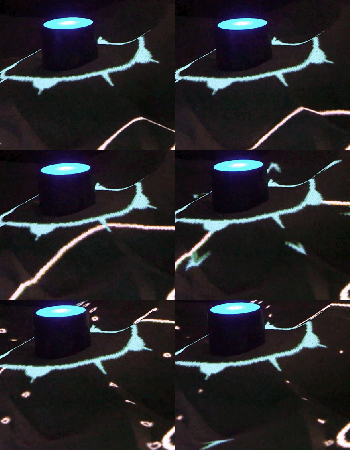
Tucked away under a tent at Expand 2014 was perhaps the coolest exhibition on the show floor: Sand Noise Device, a literal interactive sandbox experience. No, this isn’t a new Grand Theft Auto; it’s powered by hacked gaming tech, though, including an Xbox 360 Kinect sensor and a PlayStation Eye camera. Watching it in action immediately brought memories of Xbox 360 classic Geometry Wars to mind, actually. A ring radiates out from a center origin point, and when it hits the glowing, multi-colored pucks (that are tracked for position by the PS Eye), a series of particles start shooting outward.
From there, they bounce around a 4 x 3-foot sand table with physics-based reactions to changes in the substrate’s elevation and topography. Translation? The particles can get stuck in a depression you create — gaining speed as they reach the bottom — or follow a path left by raking a set of shallow grooves into the sand. You can even “catch” one in your palm and hold it there. Oh, and every movement produces sound too.
“It’s a generative music system, so you program a bunch of rules, feed it data and it creates music based on that data,” Jay Van Dyke, one of the project’s creators from The Green Cat Collective, told us. When the center origin wave hits the pucks, and the quasi-spaceships make their way outward (depending on how high or low the sand physically is), that’s how loud or quiet the sound will be (respectively). “The Kinect is basically the way we read the topography of the sand,” Van Dyke said. “It returns every frame of how people have manipulated the sand to us, and that becomes our environment.”
That environment, according to Van Dyke, could be pretty big and humans could even be a physical part in it, standing in a pile of sand on the floor. That’d have made a mess at the Javits Center, though, so the team opted instead for a wobbly table that was rated to hold some 300 pounds of the pre-glass grains. And even with that precaution, by late Saturday afternoon the cement floor in and around the tent was already fairly gritty.
The idea stems from the frustrations of wanting to play an instrument but not exactly knowing how, Van Dyke said. He mentioned that someone might come along a piano and tap a few keys here and there, but the immediate sense of gratification (one of the reasons games like Rock Band and Guitar Hero were so popular) just isn’t there. Many want a quick fix in a fleeting moment, not the years of training it takes to traditionally make music.

“You can play around with it and learn how it works in a couple of minutes and have a really good time,” Van Dyke said.
Judging by the amount of Expand attendees that crowded around the sand table at any moment throughout the weekend, it’s safe to say Van Dyke and his team were pretty successful.
Filed under: Gaming, Peripherals, Microsoft
Source: Sand Noise Device

China suspected in US Postal Service hack that exposed data on 800,000 workers

The United States Postal Service’s computer networks were breached, the USPS announced this morning. The breach was discovered back in September — it’s not clear when the actual attack(s) took place — and the Washington Post is reporting that Chinese government is responsible. The US Federal Bureau of Investigation is leading investigations into the breach; FBI officials aren’t saying who they believe is responsible.
The entire USPS staff of over 800,000 employees is affected by the breach: “names, dates of birth, Social Security numbers, addresses, dates of employment and other information” were all taken, according to USPS officials. The breach reportedly doesn’t affect USPS customers, both in-store and online via USPS.com, though some customer information (names, email addresses and phone numbers) was also taken — if you “contacted the Postal Service Customer Care Center via phone or email between January 1st and August 16th.” Officials are saying no other customer info was taken. “At this time, we do not believe that potentially affected customers need to take any action as a result of this incident,” a statement from the USPS says.
All USPS employees are being offered one free year of credit monitoring in wake of the information breach, though we’re guessing that a few of those approximately 800,000 people are seeking employment elsewhere after today’s news.
Postmaster General Donahoe says that, during the past few months of investigation, he and the FBI “have seen no evidence of malicious use” of employees’ data. Whoever breached the system was after large amounts of US government employee data rather than credit card info — “a sophisticated actor that appears not to be interested in identity theft or credit card fraud,” is how USPS spokesperson David Partenheimer described the intruder to the Washington Post.
“We have recently implemented additional security measures designed to improve the security of our information systems, including certain actions this past weekend that caused certain systems to be off-line,” Partenheimer wrote in the USPS statement. “We know this caused inconvenience and partners, and we apologize for any disruption.” USPS employees were notified this morning.
Governments engage in information espionage all the time, of course. Both the United States and China are among the world’s best at intruding foreign government computer systems and mining for data. That doesn’t make it excusable when a government is caught in the act. As former National Security Agency general counsel Stewart A. Baker told the Washington Post, “It’s perfectly appropriate for us to do everything we can to embarrass and punish the Chinese if they’re in our systems, whether or not we’re in theirs.”
[Image credit: Shutterstock]
Filed under: Networking, Internet, Software
Source: The Washington Post

Watch a rocket-powered bicycle outrun a supercar

You probably don’t think of bicycles as speed demons, but Arnold Nearcher and François Gissy would beg to differ. They’ve respectively developed and raced a rocket-powered bike that just broke a world speed record for the vehicle class, hitting a brisk 207MPH. It’s not the fastest two-wheeler of any kind, but the acceleration (maximum speed arrives in five seconds) is enough to put supercars to shame. As you’ll see in the video below, the machine can outrun a light-yet-powerful Ferrari F430 Scuderia without breaking a sweat. Given the dangers involved, you won’t be riding a rocket bike on your daily commute any time soon. Still, it’s an impressive feat — think of it as poetic justice for every time a motorist has cut you off while you’re pedaling down the street.
Filed under: Transportation

Samsung releases Smart Home videos to elaborate on its purpose
 At 2014′s IFA, Samsung chief executive BK Yoon said, “The biggest change, the biggest transformation, it will happen in our Homes, at a speed we can barely imagine.” Samsung wants to explain what they mean by that, and have released six new videos showing how Smart Home will make your life easier through their automation. The videos show how the company can make everything from powering your home appliances to watching movies a lot simplified.
You can check out all of the new videos past the break.
Source: Samsung Tomorrow
Click here to view the embedded video.
Click here to view the embedded video.
Click here to view the embedded video.
Click here to view the embedded video.
Click here to view the embedded video.
Click here to view the embedded video.
Come comment on this article: Samsung releases Smart Home videos to elaborate on its purpose

You can play classic PlayStation games on Android Wear
 Last month we showed you a Gameboy emulator that runs on Android Wear smartwatches, and today we have some more exciting news for classic game enthusiasts. A two minute clip from Youtube user “EpicLPer” shows an Android Wear smartwatch running a PlayStation emulator playing the game Croc. The emulator is called ePSXe, and seems to play pretty well on LG G Watch’s Snapdragon 400 processor.
It’s a pretty small screen to be playing a game that was meant for televisions, but it’s an incredibly portable way to play your favorite games if you’re feeling nostalgic. You can check out EpicLPer’s video past the break.
Source: Cult of Android
Click here to view the embedded video.
Come comment on this article: You can play classic PlayStation games on Android Wear

New Note 4 commercials hit YouTube
 Do you Note? That’s the question of the latest in Samsung’s newest Note 4 commercials. One shows a man in dire need of a place to relieve himself. Another shows a “photo war” between two friends. It’s nice to see that Samsung has gone away from bashing the competition and highlighting the fun you can have with Samsung’s latest large screened phone. We have the commercials for you after the break. Enjoy.
Click here to view the embedded video.
Click here to view the embedded video.
Come comment on this article: New Note 4 commercials hit YouTube

SCR Screen Recorder updated to 5.0 to allow capture without root
 One of the low-key new features in Android 5.0 Lollipop is the ability to screen record without the need to root. Since Android 5.0 has been released for developers, only a few took advantage of this feature in new apps, but now one of the most popular screen recorder apps, which used to require a rooted device to function, has updated their app to take advantage of the new API. SCR Screen Recorder has released a 5.0 version of their app, which allows you to record up to 3 minutes for free for a watermarked video, or pay for the $1 Pro version for unlimited recording.
Check out download links past the break.
Play Store Download Link (Free)
Play Store Download Link (Pro)
Come comment on this article: SCR Screen Recorder updated to 5.0 to allow capture without root

Successor to Vivo’s Xplay 3S leaks

At the end of last month Vivo was said to be toying with the world’s thinnest phone. Coming in at 3.8mm the device will usurp Gionee as the holder of the thinnest phone. Vivo’s not stopping there though as the successor to Vivo’s Xplay 3S is about ready to debut. In a leak the new handset known as the Vivo PD1305 and it boasts some decent specs.
The phone will sports a 6-inch QHD IPS display with a screen to body ratio of 79.95 percent. It will also have a 13MP rear camera with OIS and dual-tones LED flash and an 8MP wide-angle front shooter. Under the hood is a Qualcomm Snapdragon 805 quad-core processor clocked at 2.7 GHz with a Adreno 420 GPU. It will also have 3GB of RAM, 32GB of built-in storage expandable through a microSd card and it will be powered by a 3,500mAh battery. KitKat 4.4.4 will be onboard with Vivo’s Funtouch 2.0 overlay onboard.
The phone will come in at 5.68mm thick and will weigh 162g. No word on when this thing will be available — if at all in the US — or when it’ll even be debuted. That being said, it looks like Vivo’s next phablet will a decently stacked device.
source: GSM Arena
Come comment on this article: Successor to Vivo’s Xplay 3S leaks
 AIVAnet