


Google Releases “The Secrets to App Success on Google Play” Guide Book
If you are aspiring app developer, a new app developer or even an experienced app developers, everyone needs a little help and guidance occasionally. Google has created a new guide designed to specifically help you guys do your thing, get noticed, keep moving forward and build a successful business doing it.

The guide targets seven primary areas from Publishing on Google Play to Engagement & reach to Going Global.
- Publishing on Google Play — using the Google Play Developer Console to distribute your app to over 1 billion Android users worldwide.
- Quality — The fundamentals of building a great app and an insight into the Google Play guidelines and policies.
- Discoverability & reach — Maximizing your app’s discoverability and reaching the widest audience possible.
- Engagement & retention — Converting installations into active users and improving user retention.
- Monetization — Monetization strategies to generate ongoing, growing revenue streams.
- Measurement with Google Analytics — Understanding your users and improving your app experience, conversions, and marketing.
- Going global — Launching your app in local markets around the world.
The guide is available as an 11 page PDF, or you can get the 81 page Play Book version in the Play Store. Both are free, and should be a great resource for anyone who wants to, or already does, create for Google Play. As time progresses Google will be updating the books content with more information as well as be offering it in additional languages. Right now it is in English. Google also has a limited number of print copies available for free as well. You will need to reside in the US or UK to request a copy.
Head to the Play Store to grab the Play Books copy, or bounce over to the Android Developer Blog for the PDF link and printed copy links. Once you guide it a look, be sure to give Google some feedback so they can improve their offerings to help the community.
//<![CDATA[
ord = window.ord || Math.floor(Math.random()*1E16);
document.write('‘);
//]]>
The post Google Releases “The Secrets to App Success on Google Play” Guide Book appeared first on AndroidSPIN.

Five questions about the future of drones with 3D Robotics’ Colin Guinn

Everyone, it seems, is talking about drones these days. Whether it’s for industry, research or performance art, the skies have never been busier. Thanks, in no small part, to the ever-increasing number of consumer-friendly, ready-to-fly quadcopters. Colin Guinn left DJI to join one of the biggest names in commercial drones — 3D Robotics — as SVP of sales and marketing. If anyone knows about the future of our skies, it’s him. I’ll be speaking with Guinn at Expand on Saturday, November 8th, about the future of commercial, personal and hobby drones — with maybe a little onstage flying going on, too. Before that though, read on to get a little primer on the buzzing topic from the man himself.
Tell us a bit about 3D Robotics, and some of its key achievements in the drone space.
We’re North America’s largest consumer drone manufacturer, known for pioneering advanced and easy-to-use UAV technology, and for the Pixhawk, the world’s most popular autopilot platform. We introduced the world to 3PV Follow Me technology, which automatically keeps the camera on you as you move so that you stay in the center of your videos. Because all 3DR software is free and open source, designed and supported by the world’s first and largest open community of drone developers, our platforms and features have been adopted by UAV companies the world over. Our platforms also serve as robust tools for data analysis, enabling mapping, surveying, 3D modeling and more, and are currently used across multiple industries around the world, including agriculture, construction, infrastructure, search and rescue and ecological study.
Why do you think drones have become so popular with mainstream consumers in the last few years?
A lot of forces have come together. First, the technology has not only gotten better and better, but just like with computers, it’s also become much cheaper and easier to use. For instance, in terms of technology, all 3DR platforms are fully autonomous drones, which means you don’t even need to fly them yourself if you don’t want: Just draw a flight path on a tablet, and the drone goes where you tell it to. But “cheap plus easy” isn’t by itself a formula for success; the technology is also incredibly useful. Now anyone can easily and reliably capture amazing aerial photos and videos with a GoPro, seeing themselves and their world in a way that will alter their whole perspective. Also, and probably most importantly, 3DR has been committed to changing the public’s perception of drones, which is really instrumental: More and more now, people are recognizing that drones are really vehicles for good. They can help us live more sustainably, see our world in a new way, grow more and better food, work smarter and more efficiently, protect species and resources, save lives. It goes on.
What are the most interesting/exciting things you’ve seen people using drones for (be it commercial or otherwise), and how do you see them being employed in the near-future?
Photographers and filmmakers can show us ourselves and our world like we’ve never seen it before. Farmers and architects and engineers can target their action more effectively based on incredibly accurate and reliable empirical information, obtained whenever they want it. Ecologists and activists use drones to help do things like save rhinos and elephants from poachers and curb deforestation. Drones are invaluable to public servants like firefighters, S&R [search and rescue] and other first responders. The most exciting thing, really, is everything that the 7 billion people on this planet will figure out to do with the technology and platforms we’re building today. It’s like the dawn of the personal computer. If this industry were compressed into a day, we’d just be sitting down to breakfast.
Some people still worry they are dangerous, or that more drones in the air will lead to more injuries and accidents, etc. A. What do you say to those people? And B. What can we all do to prevent that (owners, legislators and manufacturers)?
We’re obviously concerned about these very same issues, and are testing the technology that will prevent them. For instance, NASA is actually actively working on an air traffic control system for drones, which would have them automatically respond to geofenced areas — not only stationary buildings, but also around a moving plane or helicopter or other drones. Crashes will be rare, but preventable scenarios that we’re working with government entities to mitigate. The technology exists to solve these problems and is actively being implemented; it is not just an idea. However, it’s crucial that the FAA gets regulation in place soon, so companies and other entities can continue to innovate and develop solutions to these pressing problems — dragging our feet on regulation will only compound these issues by trammeling our technology.
Case in point about technology: Our autopilot, unlike any other on the market, can write down all the information that happens on every flight and save it to the cloud. This is critically important because having access to this data will actively help us become a better company in cases that we may have otherwise never tested ourselves. This is new technology that users are pushing the boundaries of every day, and we have the support and development infrastructure in place to not just resolve specific scenarios, but to help our industry improve as a whole. We’d definitely like to see other manufacturers follow our lead here.
What are some of the emerging technologies/features that we can expect to see become a reality in consumer drones in the next 12 to 24 months?
We’ll see more intuitive and engaging user interfaces and hardware design, and simpler workflows. Sharing will also be huge, which means higher-quality photo and video and more powerful WiFi control and downlink. 3DR will continue to raise the bar for Follow Me technology, and we’ll see huge advancements in sense-and-avoid and optical-flow tech. We’ve also partnered with entities like Intel to develop companion computers for our systems, which is just mind-blowing — I mean, imagine if your computer could fly! These next couple of years are going to be very, very exciting.
Filed under: Misc
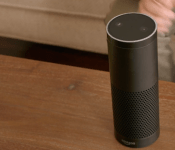
Amazon’s Echo voice-controlled speaker delivers music, news and more

Last week it was a new streaming stick, and this week it’s a speaker. Today, Amazon announced the Echo: a $199 speaker that caters to your Prime music, news and weather needs at the sound of your voice. Similar to “OK Google” command, a “wake word” gets the gadget to perk up before sorting those spoken cues like searches, setting alarms, relaying the forecast for tomorrow and more. It’s kind of like having Siri, Google Now or Cortana stuffed into a diminutive household speaker. The audio accessory is connected to the retailer’s cloud via WiFi, and it also allows for beaming Spotify or Rdio via Bluetooth. Thanks to a cylindrical design, the unit blasts out tunes and other bits in all directions so that everyone in the room can hear.
A group of seven microphones are scattered around the top of the speaker, which Amazon says allows the Echo to pick up your commands while it’s playing Taylor Swift’s 1989. What’s more, that cloud connection enables the device to get smarter as it learns your speech patterns, vocabulary and personal preferences. There’s a companion app to sort music, alarms, shopping lists and more on Fire OS and Android (also inside desktop and iOS browsers), as well as on-board controls to cue commands, adjust volume or disable the listening feature during weekend festivities.
Echo plugs in, so it’s not portable like more straightforward efforts from Jawbone or Beats. While those devices were designed to be mobile, Bezos & Co. are clearly focused on the living room here, hoping you’ll splurge for another purchase on top of the Fire TV to round out the entertainment arsenal. If you’ve been following voice-controlled gadgets, you’re likely familiar with Ubi — the compact device that plugs into a wall outlet to allow spoken commands to wrangle appliances and more. Amazon went a step further with this effort and stuffed the voice controls right into the speaker itself. Unfortunately, Echo is invite-only for now, but Prime subscribers that are lucky enough to nab one can do so at a $100 discount.
Filed under: Portable Audio/Video, Amazon
Source: Amazon

FBI shuts down black market website Silk Road, arrests its owner (again)

Just over a year after the feds shut down the original Silk Road, an online marketplace that offered anonymous drug and gun sales, they’ve apparently done the same to its successor. The FBI shut down Silk Road 2.0 and arrested its alleged founder, Blake Benthall, in San Francisco. Benthall is charged with crimes including conspiring to commit narcotics trafficking, computer hacking, trafficking in fake IDs, and money laundering. The FBI believes that the site was launched by a co-conspirator of “Dread Pirate Roberts” who founded the original website, but that Benthall took over control in late December of last year. Business Insider points out a Facebook page for Benthall listing him as a software engineer at SpaceX, while a Twitter profile is tagged “rocket scientist, Bitcoin dreamer.” Like the original site, Silk Road 2.0 used Tor to hide its origins and operators, but the FBI says an undercover agent infiltrated the site’s support staff and was able to communicate with Benthall directly that way.
Benthall, Blake Complaint by Ryan J. Reilly
Filed under: Internet
Via: Business Insider
Source: FBI

Smart Travel Router: Stay connected and charged worldwide, $34.99 [Deal of the Day]

I can’t think of many things more valuable than having a reliable source of power and internet connection when traveling. For our globetrotter readers out there, you’re undoubtedly familiar with the aches and pains of international travel in the digital age. Power adapters, socket differences, spotty internet coverage, and more. It can be quite maddening, at times. We have good news, however! You can say goodbye to the headaches and hassles with one small gadget, the Smart Travel Router.
The Smart Travel Router doubles as a charger and networking powerhouse. Fitting in electrical outlets for over 150 countries, it provides USB and AC power and is capable of charging two devices at once. Not only does it power your electronics, it also helps you connect them as well. Functioning as a router, repeater, access point, and client, the Smart Travel Router helps you connect to internet, amplify a connection, create a hotspot, and connect to ethernet-compatible TV’s and gaming consoles.
The best part is that this little lifesaver is small, weighing under 7 ounces and can easily be slipped into a backpack or travel bag. If that weren’t enough, AndroidGuys readers get 30% off, making this an extremely affordable add-on for your next trip at just $34.99. Put the Smart Travel Router on your shopping list and bring a greater piece of mind to your next travel adventure.
Check this deal out, and many others at deals.androidguys.com!


The post Smart Travel Router: Stay connected and charged worldwide, $34.99 [Deal of the Day] appeared first on AndroidGuys.

How 3D printing brings ‘Skylanders’ to life

Toys for Bob’s Skylanders franchise isn’t the only “toys to life” game in town anymore and Paul Reiche, co-founder and studio head, is well aware of the deep-pocketed competition. “We recognize that we’ve got Disney with Infinity and Nintendo with Amiibo and, you know, they have entered into this world with their own products. And it’s really our job to make sure that, through innovation, we’re leaders,” he says. The franchise, which lets players control virtual versions of their RFID-equipped figurines in-game, was the first to successfully merge physical toys and video gaming as part of a new crossover entertainment category. Given that penchant for innovation, it’s no surprise that the studio has now fully embraced 3D printing as a means of streamlining its in-house creative process.
It was during the development phase for Skylanders: Giants in 2012 that Toys for Bob began experimenting with 3D printing. “We noticed that the price [of 3D printers] was rapidly dropping down actually into our budgets for video games,” says Reiche of the studio’s decision to embrace the maker tech. “We started out buying a fairly expensive machine by our standards, printing out color versions of our toys.”
The idea behind this investment, Reiche says, was so that he and I-Wei Huang, the lead character and toy designer, could get a real sense of how their two-dimensional drawings would fare as fleshed-out 3D models. Apart from giving the creative duo more freedom to experiment and quickly iterate on designs, the tech was also helpful in determining what character poses would fit properly within the constraints of retail packaging (e.g., adjusting the grip of a character’s weapon and stance).
But it wasn’t long before the studio scrapped that particular color 3D-printing process due to the fragility of the printed models. The material, Huang explains, was too brittle and often the models would break easily. And so, Toys for Bob ditched it in favor of a more reliable (and colorless) Objet Eden printer for Skylanders character prototyping. “The next generation of 3D printers went beyond this sort of grainy, but colored surface and became very high-resolution, rigid plastic rubber,” says Reiche. “We could make durable toys; make things that look really close to final in terms of the quality of the surfacing.”
“The MakerBot we just started using. It will help us prototype early stages really well and just kind of define the size. It doesn’t have the detail levels that the Objet [printer] has,” says Huang.
More commercial 3D printers, used for lower-quality character iterations, were added to the mix later. “The Objet printer is what we use the most,” says Huang. “It’s super-high resolution. The MakerBot we just started using. It will help us prototype early stages really well and just kind of define the size. It doesn’t have the detail levels that the Objet [printer] has.” The efficiency gain, it seems, is worth it. Whereas before, it would take Huang at least four weeks to see his creations made into physical models, the inclusion of 3D printing means he can see results in-studio in about four hours. That quick turnover time means he can continue to tweak minor things like detailing for gloves or leather patterns.
“Before we started 3D printing, the process took a long time. Basically, we would draw a character. We’d have a toy team to kind of help us model it … and also prototype the actual physical toys. And that could take months and months of work before we’d actually see anything back,” says Huang.

Now, however, Huang feels freed up to experiment more with the many characters that inhabit the world of Skylanders. “As soon as a character is finalized on paper, we start modeling and instantly we can print something overnight after the model’s done. We can try different detail levels, expressions and stuff like that … different poses.” That flexibility even extends to the number of Skylanders that can be 3D printed at once, as Huang says up to five Giants or 10 core, regular-sized characters can be made on one tray within the Objet printer.
“I would love to have a 3D printer that can do everything, but it’s not something that we can develop here. We’re using consumer machines,” says Huang.
3D printing may have made the creative process more efficient for Huang and Reiche, but it’s not without its headaches. Occasionally, print head malfunctions can cause the printed models to appear melted or irregular in parts. There’s also the matter of material limitations. Since a typical Skylanders figurine is made up of more than just plastic, Toys for Bob would have to invest in either a bespoke 3D printer or purchase a multi-material industrial 3D printer to achieve a model with near-final production quality.
While 3D printers of that latter variety do exist, their costs (i.e., that printer and materials) can prove prohibitive. The Objet1000, for example, works with a variety of materials (about 100-plus) and can print using up to 14 of those at a time in one model. It’s that type of 3D printer that Toys for Bob would need to fully realize a final production-quality Skylanders model, except the cost of something on that scale easily rises above the half-million dollar mark. So, for now at least, it’s not a financially feasible option.
“I would love to have a 3D printer that can do everything, but it’s not something that we can develop here,” says Huang. “We’re using consumer machines.”

If there’s one inevitability surrounding 3D printing that Huang believes in, it’s that in the not-too-distant future, kids will be able to make their own Skylanders figurines (and other toys) at home. The idea isn’t as far-fetched as it sounds, either. Already, companies like Hasbro and Sesame Workshop are making CAD files available for consumers to download and print out their own figurines. That Toys for Bob would follow suit with Skylanders is a no-brainer, according to Huang. It’s simply a matter of the technology improving to the point of mass adoption. “With 3D printers becoming more popular, eventually one day it will probably be mainstream,” Huang says. “You know it just makes sense. You’ll have a 3D printer at home just like you do an ink jet printer.”

Lenovo is the new king of the PC and tablet hill

Did you know that Lenovo had planned to become the world’s biggest PC and tablet maker by the end of 2016? It turns out that the company’s achievement was even greater than its ambition, since the milestone has been reached six financial quarters early. In Lenovo’s latest earnings release, the company trumps its new status as king of the PC (and tablet) world, having made a healthy $262 million net profit for the three months between July and September. Some of the highlights include a big upswing in tablet and smartphone sales, as well as a big boost from the enterprise businesses its keeps buying from IBM. At the same time, Lenovo has decided to add Yahoo co-founder (and current Alibaba board member) Jerry Yang to its board, because that’s the sort of thing a company does when it’s making serious bank.
Filed under: Lenovo
Via: Reuters

Facebook taking three-pronged approach to fighting Ebola in West Africa

Facebook is extending its philanthropic arm, joining the fight against the Ebola outbreak in West Africa on three fronts. First and foremost: money. Facebook users will see a donation bug pop up in their news feed in the coming days offering options to donate to three nonprofits (the International Medical Corps, the Red Cross and Save the Children). Leveraging its enormous user base to funnel funding to nonprofits is just the base level — Facebook is also providing emergency voice/data services to medical workers in the three West African countries most affected by Ebola: Guinea, Sierra Leone and Liberia. It’s working with NetHope, a collaboration of nongovernmental organizations, to provide those services.
Facebook and NetHope are deploying 100 “mobile satellite communication terminals” — standalone computer terminals which provide broadband internet and telephone service. The devices are headed to areas with “little-to-no-existing communications capacity” with the intention of helping curb the spread of Ebola through data and communication.
Beyond connectivity, Facebook’s working with the United Nations Children’s Fund (UNICEF) to help educate the West African public on Ebola symptoms and treatment. Specifically, information will be surfaced on Facebook for users in “affected and neighboring regions.” The messages are localized based on region, and “focus on Ebola detection, prevention and treatment.” One such message can be seen below:

If you’d like to donate directly, or to learn more about fighting the Ebola outbreak in West Africa, here are some options:
- Facebook’s Ebola page, full of information and direct links to groups involved
- The Economist has an interactive map tracking the current situation
- The Red Cross has a webpage focused on the West Africa Ebola outbreak, and the organization is actively involved in recovery efforts
- As does the United Nation Children’s Fund, which is also actively involved in recovery efforts
To further understand the current Ebola outbreak, check out this great video from Discovery Networks’ TestTube:
Filed under: Cellphones, Handhelds, Wireless, Software, Mobile, Facebook
Source: Facebook

Vent your literary frustration with this punching-bag keyboard

Sometimes, writing can be hard and when your words don’t perfectly express the complex emotions that your soul is feeling, you can feel a little frustrated. In fact, if that problem continued to rage on, it might compel you to spin out some Krav Maga-style moves to smash your keyboard to pieces. Thankfully, German design studio Bless feels your pain, which is why it’s designed a “workout computer” where the keyboard has been switched in favor of a series of connected punching bags. Instead of furious finger action, prospective writers are asked to bodyslam, kick or punch each letter until their work of literature has been literally metaphorically sweat onto your screen. The designers believe that by combining the sedate act of typing with something more vigorous, they’ve blurred the lines between work and exercise. That said, we wonder what John Steinbeck would have made of this technology, since The Grapes of Wrath may have been a lot longer in the making, but at least the author would have had rock-hard abs when he was done.
[Image Credit: Bless]
Filed under: Misc, Peripherals
Via: Geek.com
Source: Istanbul Design Biennial, Designboom, ABC
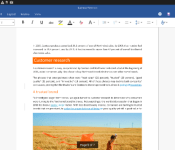
Microsoft offering sign up for Office preview on Android tablets
 Microsoft Office on Android isn’t a new thing. Users were able to view documents and have limited functionality in editing them for free. However, more advanced support and cloud functions have been something that required a valid Office 365 subscription. But that appears to be no longer the case as Microsoft is offering its suite of apps and the ability to edit documents for free.
Coming off the announcement that Microsoft and Dropbox would be partnering up to offer a better mobile solution, bringing Office to the masses for free is a step in the right direction. Those with an iPad will recognize the user interface as it closely resembles the iPad variant. On top of that Microsoft has a sign up page for those interested in previewing the software. You should be aware though, that it comes with some pretty stringent requirements.
Those interested in trying out the software will have to remain on KitKat as Microsoft is “not seeking Android tablets running Lollipop.” So in order to remain eligible — besides having a 7-10.1-inch tablet — you’ll have to abstain from updating to Android 5.0.
General availability is said for “early 2015.” So if you’d rather have the Lollipop update (I know I would) but still want to use Office sometime soon, you’ll be happy to know that it’s coming sooner rather than later.
source: Office Blog
Come comment on this article: Microsoft offering sign up for Office preview on Android tablets
 AIVAnet