


ARCHOS VR Glasses

Virtual Reality is a field that has yet to bring anything to the table that I feel is worth the money. For $200+, you get a feeling of being immersed in something, whether that’s a movie, or game, etc, that doesn’t feel comfortable enough to continue using in my opinion. At Google I/O 2014, Google released and gave out Google cardboard, which I took to essentially say “we already have the technology in our smartphones, all you need is some cardboard and rubber bands and you have yourself a VR device!” Well, ARCHOS has taken this idea and made it better.
On Thursday, ARCHOS announced via email their ARCHOS VR Glasses. Available in November on archos.com and other retailers for $29.99, this device takes your Android, Windows Phone, or iOS device (up to 6 inches) and turns it into a Virtual Reality experience. You can combine it with the upcoming ARCHOS Bluetooth game controller for an immersive gaming experience. Or watch movies on it with upcoming ARCHOS Video Player update, and you’ll feel as though you’re watching a 3D movie in a theater.
In my opinion, this is the best way to implement VR. Simple, cheap, and requires nothing more than your smartphone and its content. I think ARCHOS is on to something here.
What do you think of this device?
 |
The post ARCHOS VR Glasses appeared first on AndroidGuys.

RollerCoaster Tycoon 4 Mobile makes its debut on Android
Atari announced in June that RollerCoaster Tycoon 4 Mobile would be making its way to Android this winter. The game company has finally delivered today as they announced the titles availability in a free-to-play fashion. The mobile experience version looks and feels much like its original variants that made their first appearance in 1999. The title is a simulation that gives you the ability to build and create a running theme park. The really fun part about the title is the ability to construct and design your own roller coasters, hence the game’s name. Although, I spent many hours on previous PC versions without ever building my own custom coaster.
 RollerCoaster Tycoon 4 is free, but that also means they added in some in-app purchases for Coins and Tickets. Tickets get your rides built faster and as well as allow you to buy specialty coasters, parts, decorations and other various items that can’t be bought with coins. Coins are your more traditional currency for building and expanding. You can earn those through completing objectives and from your various rides and concessions stands earnings.


 The good news though is that you can link your park to other devices. This is either done through Google Play Games, if you choose to use it, or through a verification code that you can prompt for through the settings screen. While I enjoy the title, any hardcore work or major expansion is quite a bit easier, at least for me, on a tablet screen. Being linked though, I can make changes and collect funds while I am on the go. This does bring up another issue though. RCT4 is heavily reliant on a data connection to properly play the title. If you have no data connection you are limited to editing coasters and re-organizing where things are placed. They will sync up when you get back in service. This also means you can’t collect any profits while in offline mode either.
RCT4 will be a grinder sim for those that don’t care to spend real cash on in-game currency. While it is still playable, and I think rather enjoyable in short bursts, others who need to be able to play offline and not have to check back in ever few hours to complete something, might find it a bit irritating. It is worth a look if you are a theme park junkie, sim fanatic, or just remember playing the originals and want to take a trip back in your life on your mobile device. Hit the link below to go pick it up.
//<![CDATA[
ord = window.ord || Math.floor(Math.random()*1E16);
document.write('‘);
//]]>
The post RollerCoaster Tycoon 4 Mobile makes its debut on Android appeared first on AndroidSPIN.

Sony to bring Android 5.0 to entire Xperia Z line
Yesterday Google announced the new Motorola Nexus 6, HTC Nexus 8 and the ASUS Nexus Player devices. They also confirmed that Android L is Android Lollipop and is Android 5.0. We know the Nexus line dating back to the Nexus 4 will get an Android 5.0 update at some point. We also know a number a Motorola devices will also be picking up the sweet new treat. Now we hear from Sony what their plans for the new OS will be.

According to a blog post on the Sony site this morning, Sony plans to bring Adroid 5.0 to the entire premium Xperia Z line. That include:
- Xperia Z
- Xperia ZL
- Xperia ZR
- Xperia Tablet Z
- Xperia Z1
- Xperia Z1s (T-Mobile)
- Xperia Z Ultra
- Xperia Z1 Compact
- Xperia Z2
- Xperia Z2 Tablet
- Xperia Z3
- Xperia Z3v
- Xperia Z3 Compact
- Xperia Z3 Tablet Compact
The Xperia Z Ultra Google Play Edition will the first device to see the update. From there they will work toward the Xperia Z3 and Xperia Z2 series beginning in 2015.
Timing and availability of those updates will be announced by Sony as they become available and will trickle through specific regions and carriers too. I do have a distinct feeling though that the Xperia Z3 here in the sates will be a pretty hard push for Sony. I certainly hope the carriers play nice and make it happen quickly and without issue. It would boost the carrier images as well as get Sony rolling in the right direction stateside.
Source: Sony
//<![CDATA[
ord = window.ord || Math.floor(Math.random()*1E16);
document.write('‘);
//]]>
The post Sony to bring Android 5.0 to entire Xperia Z line appeared first on AndroidSPIN.
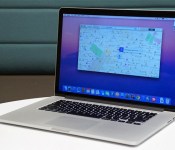
You can download OS X Yosemite for free starting today

Oh, so the prospect of some new iPads and refreshed Macs wasn’t enough for you? How about the chance to take OS X Yosemite for a spin? As expected, Apple confirmed that you’ll be able to download and install Yosemite for free later today — just keep an eye on the Mac App Store for your chance to play with what developers and beta testers have been perfecting for months. Aside from Yosemite’s flatter design, features of note include Continuity (which basically blurs the line between your Mac and your iDevices), smarter Spotlight searching and total redesigns for native apps like Mail and Safari. (Sadly, you won’t get access to Stephen Colbert’s phone number like Craig Federighi did.) We’ll keep you posted on when you can actually take the plunge, but in the meantime, take a peek at our in-depth Yosemite preview to give you one last taste of what to expect before the digital download floodgates open.

iPad Air 2 is Apple’s thinnest tablet ever

Apple’s got a new iPad, and it’s a sequel to last year’s ultra-svelte iPad Air: it’s called the Apple iPad Air 2. CEO Tim Cook announced as much this morning from Apple’s Cupertino, California headquarters with a video of a pencil being shaved down, a nod to last year’s unveiling of the first iPad Air. The iPad Air 2 is 6.1mm, “18 percent thinner than the first iPad Air,” Apple’s Phil Schiller told attendees. “It’s the world’s thinnest tablet.”
Beyond thinning it down even further, Apple’s usual suspects of upgrades are on board: the iPad Air 2 has the newest A8 processor and M8 coprocessor, which Schiller said is 12 times more powerful than the original iPad. It’s also got a brand new camera out back: an 8MP iSight camera (f/2.4 aperture) that does 1080p video, burstmode, panorama shots, and auto HDR (that takes up a bit less space). The display remains 9.7-inches, which Schiller called, “a new Retina display.” He also said the new iPad Air has Touch ID, the Home button-based security system that enables login via fingerprint. With Touch ID, iPad Air 2 also has Apple Pay, albeit enabled for online purchases only.
Head below for more specs and info as it comes out of Cupertino!
The camera upgrades aren’t limited to the rear of iPad Air 2 — the front-facing camera is also getting improved, and it’s now known as the “Facetime HD” camera (1.2MP at f/2.2 aperture, 720p HD video, and a smattering of software features). In terms of connectivity, iPad Air 2 has WiFi standards (802.11a/b/g/n/ac, dual channel with MIMO) and Bluetooth 4.0; there’s also an LTE model that costs a bit more, and it’ll work with AT&T, Sprint, T-Mobile and Verizon in the US.
The screen remains 9.7-inches diagonally and has an “optically-bonded” IPS display (the same tech used in Microsoft’s Surface) — this means there’s no gap between the screen and the body. It also reduces glare (there’s an anti-reflective coating) and travels through time. Okay, maybe not that last bit about time travel. The chip inside is an Apple-designed A8X with 64-bit architecture, and it’s bundled with the M8 coprocessor (used mostly for motion data).

Of course, those following along at home saw this coming, right? A conspicuously-timed leak yesterday — just after Google’s big Nexus announcements — saw both the iPad Air 2 and iPad Mini 3 revealed ahead of today’s big event. Apple isn’t exactly known for accidentally leaking two of its own products one day ahead of those products being announced, and Google’s big news revolved around its own Nexus devices. You don’t need to be a cynic to suspect something is up with that.
Intentionally “leaked” or not, Apple took to its own theater today in Cupertino to officially unveil the newest iPad Air. An October reveal is par for the course when it comes to Apple’s iPad line in recent years: the first iPad Air was unveiled last year on October 22nd, and the previous model iPad was revealed almost exactly one year earlier on October 23rd, 2012.
The iPad Air 2 comes in three flavors: silver, space grey and gold. It also comes in three prices: 16GB ($499), 64GB ($599) and 128GB ($699) — add $130 to any of those models for LTE instead of WiFi-only. Pre-orders apparently go live tomorrow, and they’ll “begin shipping by the end of next week.”

Apple officially outs the iPad mini 3, pre-orders start tomorrow

You knew it was coming; now it’s here. Apple just pulled back the curtain on the iPad mini 3 at its live media event in Cupertino, and so far it’s pretty much what we expected — a modestly updated tablet with some more familiar looks. The saga of the iPad mini 3 hasn’t been too spoilerific, but Apple’s “accidental” leak from the other day painted the thing with some vague strokes: We figured out what it’d be called and knew it would have a Touch ID sensor (turns out that latter bit is the most notable addition to the mix). Phil Schiller didn’t spend too much time on them — by which we mean he hardly said anything about them — mostly likely because there’s really nothing else new here.
Sadly, none of the new hardware in the iPad Air 2 (zero-gap display, upgraded A8X processor) made its way into Apple’s 7.9-inch tab. The mini 3 runs the with the same A7 processor as last year’s model, along with the same 5-megapixel iSight camera. So what is new? Well, Touch ID aside, you’ve got the addition of a gold model to match up with iPhones. That Retina display remains intact, too — Apple basically seems to have tweaked the Retina iPad mini and streamlined its name a bit. It’s maybe not the most mindblowing upgrade, but improving something that already seems well-equipped to tickle consumers’ fancies is no easy feat. Tim Cook noted that the Retina iPad mini has received 100 percent customer satisfaction ratings — can you blame Apple for not rocking the boat? (We can.)
Anyway, you can pre-order yours starting tomorrow: the 32GB model is gone for good, so expect to shell out $399 for the 16GB version, $499 for 64GB and $599 for 128GB. Itching for an LTE model? Expect to pay $130 more for that particular pleasure.
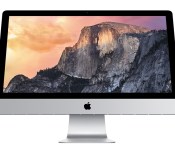
Apple reveals the 27-inch iMac with Retina Display starting at $2,499

A stable of new iPads wasn’t all Apple had up its sleeve today. The folks in Cupertino have also been hard at work on a desktop update, and the iMac is the beneficiary. If you’ll recall, Apple quietly trotted out a more affordable version of the machine back in June, but this fall’s release packs a much bigger punch. With the latest model, the company’s all-in-one option gets a boost in the screen department with the addition of a Retina panel. That 27-inch oxide TFT display is what Apple’s calling “Retina 5K,” touting a 5,120 x 2,880 resolution with 67 percent more pixels than 4K. The added real estate means that you’ll be able to do things like edit 4K video in Final Cut Pro X while still having plenty of room for all the tools you’ll need. Even with all of that new screen power, the new iMac is said to be 30 percent more energy efficient. The outer edge is also 5mm thick, keeping the trim frame all the way around.
As far as the internals go, there’s an quad-core 3.5GHz Intel Core i5 processor that can be upgraded to a 4GHz i7. There’s AMD Radeon R9 M290X graphics by default, 8GB RAM, 1TB Fusion Drive and Thunderbolt 2 ports that offer 20 Gbps transfers. For those who need more power, the new desktops can be equipped with your choice of up to 32GB of RAM, AMD Radeon R9 M295X graphics, a 3TB Fusion Drive and 1TB of PCIe flash storage. And of course, it’ll come with OS X Yosemite. The best part? You can hand over your funds for the iMac with Retina display starting today, and the base model is priced at $2,499. If you’re not convinced that you need to splurge for that newfangled display tech, the existing 27-inch option is now $1,799 and the 21.5-inch is $1,099.
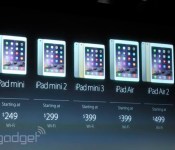
Apple drops iPad Air, iPad mini and iPad mini 2 prices by $100

Now that Apple has introduced the iPad Air 2 and iPad Mini 3, it’s time for some of the older models to get a price cut. After announcing the new tablets, the on-stage Phil Schiller, Apple’s senior VP of worldwide marketing, also revealed that the original iPad Air, iPad mini and iPad mini with Retina Display, will be sticking around once the newer versions start to ship at “the end of next week.” As a result, the iPad mini, iPad mini 2 and iPad Air now start off at $249, $299 and $399, respectively, for the 16GB, WiFi versions. On the other hand, the newly unveiled iPad mini 3 will cost $399, while the iPad Air 2 is going to be $499 — both with 16GB of storage and WiFi-only. Like always, if you want to add a 4G/LTE to that, you’ll have to shell out $130 extra per iPad.
You’ve got $2,500. Tax aside, what do you buy?
Filed under: Apple
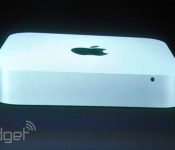
Apple finally updates the Mac Mini, lowers the price to $499

It wasn’t too long ago that we were seeing Apple unveil its new set of iPhones, but now the Cupertino company is back for another round. Just now, at its routine iPad event, Apple has taken the time to introduce new Mac Minis too, which it hadn’t done since late 2012. For starters, the starting price has dropped to $499 on the base model, compared to $599 from previous years. Internally, Apple will be offering customization options that include 4th-generation Intel Core processors, also known as Haswell, and Intel Iris and HD Graphics 5000. In addition to that, the 2014 Mac Mini is set to offer PCle-based solid-state drive options, support for 802.11ac WiFi connectivity and a pair of Thunderbolt 2 ports. Those are all the details Apple was willing to share during the presentation, but we’ll be adding any additional info to this post as soon as we have it. The new Mac Minis will begin shipping today — and yes, that means you’ll have OS X Yosemite to boot.

Here’s your first look at Apple’s new 5K iMac

We had a feeling Apple would announce a new iMac today, and indeed, the company didn’t disappoint. Here in Cupertino, we just saw Tim Cook and co. unveil a refreshed model that has basically the same slim design as the last version, except this time it packs a 5K display. I’d be lying if I said I got to spend much time with it — the demo area here is extremely crowded — but I did want to give you some early hands-on photos to look at. Have a gander at the gallery below, and keep your eyes peeled for a full review — something tells us we’ll be taking one of these bad boys for a spin very soon.
Developing…
 AIVAnet