


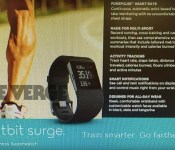
Fitbit’s new wearable looks like a watch, crams in GPS and a heart rate monitor

It’s been a while since we’ve seen a new Fitbit product, but according to a leak obtained at The Verge, that’s because the company’s been working on something a little special. The Fitbit Surge is a “fitness superwatch” that houses two must-haves for serious running types: GPS tracking and a heart-rate monitor. Crucially this would mean the wearable can monitor your activity without having to haul around your smartphone. (The likes of the Galaxy Note 4 or iPhone 6 Plus aren’t all that well-suited to a jog in the park). The leaked marketing materials also suggest it will priced at $249 and will still be able to monitor all the less intense calorie burning done on stairs and your commute to work. Borrowing from the smartwatch category, the Surge is also promising smart notifications for calls and texts, as well as music controls. According to The Verge, the watch is rumored to launch in three colors (black, slate and tangerine) in the next few weeks, likely alongside the pair of more lightweight Charge fitness trackers – also leaked in marketing materials. C’mon guys, tighten up that security. We’ve reached out to Fitbit for more.
Filed under: Wearables
Source: The Verge

Leak gives a clearer look at Motorola’s upcoming Droid Turbo

So far, the pictures we’ve seen of Motorola’s soon-to-launch Droid Turbo have been… incomplete. You won’t have to wonder exactly what this Verizon-only smartphone looks like any longer, though. Evan Blass (@evleaks) has posted a press image (available through Verizon’s web code) which provides a good look at the phone, including its frequently elusive front. In short, this is a hybrid between last year’s Kevlar-laden Droid Maxx and the styling cues of 2014 Motorola flagships like the new Moto X and Nexus 6. The biggest upgrades over the Maxx are likely to be in the guts, such as the 21-megapixel camera, the rumored Quad HD screen and a speedy Snapdragon 805 chip. Whether or not the Turbo is as tough as it looks, you’ll know the full story when the phone launches in nine days.
Filed under: Cellphones, Mobile, Verizon
Via: The Verge
Source: Evan Blass (Twitter)

New White House efforts help secure your payments

American banks and stores may already be planning to tighten your payment security, but the White House wants to give those efforts a boost. President Obama has signed an Executive Order that will require the federal government to both issue more secure chip-and-PIN (aka EMV) payment cards and upgrade terminals to match. This isn’t just for protecting day-to-day staff expenses — it also means that pensions, Social Security and veteran payments (all of which tend to go through official debit cards) should be safer. There should also be fewer risks when you’re buying from federal locations like national parks and the passport office.
Additional moves should improve protections against identity theft, whether or not you’re on the government’s dime. The order will have federal investigators share more of their evidence with companies when looking into data breaches. It will also refine IdentityTheft.gov to make it easier for you to report (and ideally, recover from) fraud, while partnerships with both Citi and MasterCard will respectively give account holders free monthly credit score updates and identity theft support. There’s only so much these new measures will do, especially when chip-and-PIN security won’t arrive in earnest until 2015, but it’s hard to object to better security.
Via: New York Times
Source: White House

Android 5.0 Lollipop’s “kill switch” only maims, not kill

It’s fairly safe to say that we’ve all got smartphones now. Perhaps more accurately, we can say that if you are reading this, it is very likely you own a smartphone. Though many of us cycle through mobile phones more often than we change wardrobes, we like to be the one to decide when we change phones. There are few things more annoying than being forced into a new phone because of breakage or theft.
Because more and more of our life data is kept on our phones now, thieves are working harder than ever to obtain our precious data. Software developers, phone manufacturers, and carriers should set ‘protecting user data’ near the top of their priority list.
One of the ways in which phones are protected is through the use of a ‘kill switch.’ Kill switches would basically give a phone owner the ability to either brick their phone (completely wipe the data), or lock down their phone at the press of a button. Locking it down would protect the user’s data, but not delete it, in the hopes the phone could be located and retrieved.

Users have been able to encrypt the data on their phones for some time. After going through a fairly lengthy encryption process, the data was protected, but only if a thief turned the phone off. When the phone was turned back on, the thief would need to know the password in order to complete the boot-up process. It’s a great feature, but not very many people turn their phones off before they get stolen, and thieves would just be sure to keep their stolen phones powered-up so they could wipe, reset, and resell them. Yeah, I know you set a 4-digit pass-code on your phone, but really, that’s as easy to crack as your glass screen.
Android 5.0 Lollipop introduced a couple features that will help in the case of theft, but there are some wholes that still need to be filled to protect user data.
- Encryption – As mentioned above, you’ve been able to encrypt your android phone for a while, but it’s been a manual process through the Security settings. With Android 5.0 Lollipop, encryption is turned on by default.
- Kill switch – Android 5.0 Lollipop introduces ‘Factory Reset Protection’ which is supposed to make stolen phones unusable. In this scenario, it would require a unique password (different than your 4-digit pass-code) to unlock the phone. Your data would still be on the phone, but thieves wouldn’t be able to access it, or perform a factory reset.
Users still have the ability to lock or erase their phone remotely using Android Device Manager.
If this isn’t enough to fulfill your security paranoia, there are always Google Play store apps to further protect your precious data.
What features do you think the next version of Android should have to protect user data?
 |
The post Android 5.0 Lollipop’s “kill switch” only maims, not kill appeared first on AndroidGuys.
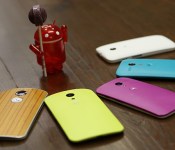
Here’s every device getting Android 5.0 Lollipop so far

If you’re a die-hard Android fan, you’re probably champing at the bit waiting for that Lollipop upgrade — when will you get it? Are you going to get it? Thankfully for you, a number of companies have already promised to upgrade some of their devices to this candy-flavored OS. Google’s Nexus 4, 5, 7 and 10 models are naturally first in line, as are Android One and Google Play Edition hardware; its outgoing Motorola brand is equally on top of things with plans to patch the Moto E, G and X alongside Verizon’s Droid Mini, Maxx and Ultra. HTC and OnePlus don’t have full details, but they’re both pledging to give their recent flagships a taste of Lollipop within 90 days of receiving finished code. NVIDIA and Sony, meanwhile, are being vague. While they’re respectively teasing plans to update the Shield Tablet and the Xperia Z series, they won’t say when just yet.
As for other manufacturers? Well, don’t hold your breath. LG tells TechRadar that it has nothing to say on “if / when” Lollipop will reach the G3, let alone older gear. The upgrade is likely coming, but the statement is far from reassuring. Mum’s the word from Samsung as well, although leaks show that a Lollipopped version of TouchWiz is in the works. It’s also reasonable to expect that relatively large brands like Acer, ASUS, Huawei and Xiaomi are on deck — just don’t be shocked if their older devices don’t make the cut.
Filed under: Cellphones, Tablets, Mobile, Samsung, Sony, HTC, Google, LG, NVIDIA
Via: TechRadar, MobileBurn
Source: HTC (Twitter), Motorola, Sony Mobile Blog

[APK Download] Play Games gets the Material Design treatment

A fair amount of updates are expected over the coming weeks as Android 5.0 Lollipop revamps the recommended design for applications. Of course, Google leads the way by updating its stock apps first. Here we have Play Games getting an update that brings the brand new Material Design look. When Google rolls out updates to its apps, it can take a very long time for it to reach everyone; therefore, you can go ahead and grab the file and do take care of everything yourself. That way you can enjoy the new flatter, more animated look of Play Games as quickly as possible.
Source: AndroidSPIN [APK Download Link]
Come comment on this article: [APK Download] Play Games gets the Material Design treatment

Lollipop’s keyboard can now be installed on any Android device without root

If you’re hankering for a taste of Android L but don’t have a Nexus device to install the SDK on, you can check out its awesome new keyboard, which is now available for almost any Android-powered device running Ice Cream Sandwich or later.
A third-party developer has extracted the keyboard APK from an official Android L developer preview build and made it available to download from a secure file sharing website. It’s free, has no ads, and does not require root access.
Hit the break for the download link and instructions on how to install the file on your smartphone/tablet.
Installing the keyboard is easy. Simply navigate to this page, tap the download button and click install when you’re prompted to do so. You may have to allow installations from third-party sources if you haven’t already. To do this head into settings, then security and check the box entitled ‘Unknown sources’ and you’re good to go.
If you happen to run into any issues along the way do be sure to drop a comment in the section below, and we’ll do our very best to get you back on track.
Download: AndroidFileHost
Via: XDA
Come comment on this article: Lollipop’s keyboard can now be installed on any Android device without root
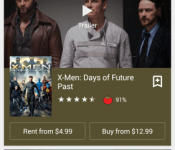
[APK Download] Play Movies & TV joins the fun with Material Design update

Alongside Play Games, the Play Movies & TV app is getting a new look. The app has been flattened and there are now large graphics for content. The icon has been altered and the red color found throughout the app is brighter with the update. Rather than waiting for the update with Material Design in the Play Store, you can download the file yourself.
Source: AndroidSPIN [APK Download Link]
Come comment on this article: [APK Download] Play Movies & TV joins the fun with Material Design update

Late 2014 Mac Mini Benchmarks Indicate Decreased Multi-Core Performance
The newly refreshed Mac mini is seeing improved single-core performance over the previous models, but decreased multi-core performance, according to a newly released GeekBench benchmark. John Poole of Primate Labs says that the upper tier Late 2012 Mac minis, which had quad-core Ivy Bridge processors, saw better multi-core performance than the new Late 2014 models, which have dual-core Haswell processors.

Unlike single-core performance multi-core performance has decreased significantly. The “Good” model (which has a dual-core processor in both lineups) is down 7%. The other models (which have a dual-core processor in the “Late 2014″ lineup but a quad-core processor in the “Late 2012″ lineup) is down from 70% to 80%.
Poole notes that Apple may have switched to dual-core processors in some Late 2014 Mac minis because Haswell dual-core processors use one socket to connect the logic board and processor while Haswell quad-core processors use different sockets. This would mean Apple would have to design and build two separate logic boards specifically for the Mac mini, while other Macs use the same logic boards across their individual line.
This trade-off didn’t exist with Sandy Bridge and Ivy Bridge processors because both of its dual-core and quad-core processors used the same socket. Another option, according to Poole, is that Apple could have went quad-core across its new Mac mini line, but it would have made it difficult for Apple to hit the $499 price point.
Despite the decreased quad-core performance, the single-core performance of the new Mac mini is in line with other Macs’ performance jumps from Ivy Bridge to Haswell.
Base configurations for the Mac mini are currently available for purchase on Apple’s online store with pricing starting at $499 and will ship in one to three days. Custom configurations ship within three to five days.

Inside Seattle’s invitation-only VR summit

Tech aficionados have been flocking to Seattle’s Living Computer Museum for the past few years to get up close and personal with relics from computer technology’s past. For one night earlier this month, though, I got a chance to peek at its possible future. Nearly two dozen exhibitors filled the museum’s first floor for SEA VR, an invite-only event meant to highlight some of the field’s biggest names and showcase the VR community.
Envelop VR played host for the evening, in part, to introduce itself. The new company is looking to both develop its own VR software and help other companies come to grips with what CEO Bob Berry called the next great wave of computing. In gathering some of the VR community’s brightest stars to the Pacific Northwest, the hope, he said, is to establish the Seattle area as a VR hub.
“Seattle is a hotbed of video game development,” Berry said. “It’s going to be a hotbed of VR development.”
Berry moved to Japan in 1998 to study VR as part of his Ph.D. work. After getting a good look at what passed for “state of the art” in the VR world of the late ’90s, he quickly realized virtual reality just wasn’t ready yet. It was only in the last year or so, he said, that various technologies started combining to make VR feasible — headlined, of course, by Oculus’ work. The next major step, he added, is developing and refining software that takes advantage of those hardware advancements.
 Attendees check out Oculus VR’s DK2 headset.
But words can only convey so much. As Berry notes, with virtual reality: Seeing is believing. And there was plenty to at SEA VR. Oculus was there showcasing its Development Kit 2 (DK2) headsets, but its gear wasn’t confined to the company’s demo area.
Atomic VR’s holodeck-style setup featured an older DK1 headset and a camera array to track users in one corner of the museum. A pair of PlayStation Move controllers became virtual lightsabers “energy swords” in a battle with a floating droid. After employees helped me put on the headset, equipment-filled backpack and headphones, I set about exploring the demo’s virtual arena.
The lag between my movements and those shown onscreen was noticeable, but hardly a distraction. After a few seconds, I was successfully blocking incoming laser blasts with my swords and dodging slow-moving missiles. The full-body tracking kept up admirably and I never felt disoriented — a significant plus considering the limited area I could explore.
“VR’s going to impact various industries; not just entertainment.”
Still, the relatively low-resolution screens and the buzz of the show floor prevented me from reaching the level of “presence” that VR developers strive to attain. Atomic VR mentioned that it hopes to increase realism when it switches to Oculus’ more advanced DK2 kit — including the use of haptic feedback in the vest and possibly the floor to provide a more immersive simulation.
The game-like applications are obvious, but the company envisions similar setups in showrooms at retailers like Home Depot, where customers can preview home remodels and landscaping projects before breaking out the hammers and shovels.
“VR’s going to impact various industries; not just entertainment,” Berry said. One look at the show floor was enough to prove that statement. While there were plenty of examples of VR as a gaming tool, there were exhibitors using it in other settings, too.
 Leap Motion showed off its finger-tracking tech.
Retailer Nordstrom showcased its Virtual Customer Experience Center, created by the company’s Innovation Labs. The software complements a real-world Customer Experience Center housed in a renovated warehouse not far from the Living Computer Museum. The Innovation Lab’s virtual version lets designers use tools like Unity and 3ds Max to create and try out new floor layouts, store designs and other physical structures before committing to actually building anything.
Elsewhere on the show floor, DeepStream VR demonstrated its work in pain research and using 3D and VR to aid in patient rehabilitation.
“The virtual world is a motivator,” DeepStream VR CEO and founder Howard Rose said. The company has been exploring different methods of incorporating virtual reality into therapy, including combining a treadmill-walking regimen with a projected screen so patients can go on a “walking meditation” through a computer-generated trail.
The company also showed off its DeepStream 3D Viewer, a shroud that attaches to a laptop screen, a Retina display MacBook Pro in this case, to provide panoramic 3D movies and environments. The viewer splits the screen into a pair of 2,600 x 900 images — one for each eye. Users can adjust the eyepieces as they would for a pair of binoculars and a nearby Leap Motion controller is used to interact with the world. In one example, I used my left hand to gather fireflies to fill a lantern. Rose said using an attachment to a laptop screen (and, later, tablets) can sometimes make more sense than the headset approach Oculus and others are taking.
 DeepStream VR’s 3D Viewer attached to a Retina display MacBook Pro.
When it comes to patients struggling with constant pain, he said, “Helmets don’t work very well.” Indeed, placing my face up to the 3D Viewer’s eyepieces and manipulating objects with a Leap Motion controller was a great deal easier than strapping on a headset and grasping physical input devices.
A quick scan across the show floor makes it clear there’s no single way to approach VR. While Oculus’ gear was certainly prevalent at various booths, Kinect sensors, GoPro cameras, PS Moves and Leap Motion Controllers spread throughout the area indicate that developers are still very much in the exploration and experimentation phase.
And while some companies are working to create fantastical environments filled with spaceships and lightsabers, others are figuring out ways to showcase parts of the real world. In one corner of the show floor, Jaunt offered up a multi-scene demo of its real-world VR capture tech. Its approach includes a multi-camera setup to record 3D video in all directions. After putting on the headset and over-ear headphones, I started out with a scene from a skate/bike park, as a bike-riding enthusiast whizzed around me. I could turn my head in practically any direction to keep track of him, while positional audio accurately clued me in to where he was.
“The VR community needs to collaborate … No company, not even (Oculus) can do it alone.”
A later scene of the Golden Gate Bridge demonstrated the powerful effect accurate audio can have in VR. Wind noise was present throughout the area, but I had no trouble pinpointing a ship’s horn blaring on the far right. I turned my head completely away from the vessel and, sure enough, the horn sounded like it was coming from behind me. Clearly, high-resolution displays aren’t the only requirement for convincing VR presence.

One thing was readily apparent at SEA VR and it didn’t require a headset or fancy camera setup. It was a sense of community. From booth to booth, company representatives chatted with one another, happily trying out competitors’ gear and sharing notes. I got the sense that many of the attendees are motivated more by the fun of experimentation and discovery than they are by the thrill of ruthless competition.
To Rose, it reminds him of the early stages of the internet, “when it was fun and exciting.” Seeing companies explore VR from different angles and coming up with new solutions, he said, is part of what he loves about the virtual reality community right now. After numerous false starts over the past few decades, it’s this cooperative, diverse approach, he said, that will be key if VR is truly going to be the next big thing.
“The VR community needs to collaborate,” Rose said. “No company, not even (Oculus) can do it alone.”
Filed under: Gaming, Peripherals
 AIVAnet