



Oppo N3’s motorized swivel camera takes selfies to the next level

If you thought Oppo was done with making eccentric selfie phones, you’re wrong; the Chinese company is back with a new model dubbed the N3 to replace the N1 from last September. The iconic swivel camera at the top is here to stay, but this time we have a 16-megapixel f/2.2 module and it’s motorised! It’s actually much cooler than it sounds: You can quickly flip the camera with a flick gesture on the screen or on the fingerprint sensor on the back — more on that later. In addition to that, the N3 comes with a new O-Click Bluetooth remote that not only acts as a remote trigger, but it also lets you adjust the camera’s angle using the extra buttons.
One other benefit that the motorized swivel camera offers is that the new camera app in Oppo’s Color OS 2.0 (based on Android 4.4) lets you install an Auto Panorama plug-in which, as you can guess, automatically takes a panorama shot while you hold the phone still. Other plug-ins include “HD Picture” (to create super detailed 64-megapixel images), “Slow Shutter,” “Beautify,” “Professional,” “Super Macro” and more.
There’s another new feature placed on the back: The old mini trackpad was apparently not that popular (we weren’t impressed, either), so it’s now replaced by a fingerprint reader — not the annoying swiping type, but the tapping type like Apple’s Touch ID button and the one on the Huawei Mate 7. Once you’ve registered your fingers, you can unlock your N3 by just clicking on the fingerprint reader — naturally with either of your index fingers given the location of the reader.
Spec-wise, the N3 has all the typical numbers you get on a modern flagship smartphone: We’re looking at a 2.3GHz Snapdragon 801 quad-core SoC, 2GB of RAM, 32GB of internal storage, a nice 5.5-inch full HD LCD (the N1 had a 5.9-inch one), NFC and a 3,000 mAh fixed battery. Speaking of which, the N3 does VOOC rapid charging with a smaller charger, meaning you can go from zero to 75 percent in just half an hour. It’s also worth pointing out that the N3 is a dual-SIM LTE phone; it takes a Micro SIM and a Nano SIM. But if you want to add a microSD memory card, you’ll have to give up your Nano SIM slot.

As with the recent Oppo devices, you still get a solid build quality on the N3. Compared to its successor, the N3 has a similar feel thanks to the aluminum alloy frame and smooth plastic coating, but it’s certainly lighter — 192g instead of 213g — and easier to hold due to the smaller screen. Like the Find 7 series, the N3 has a nice glowing “Skyline” light at the bottom for indicating notifications and charging status, except it’s placed underneath a metallic arc which is part of the phone’s aluminium frame. It looks good, but the trade-off is that it may trap some dust.
In summary, Oppo’s made a nice improvement on its N series. It may not be the best-looking smartphone, but the motorized swivel camera and the convenient fingerprint reader should be unique enough to win some people over. If you’re one of them, the N3 will be available for $649 off contract this December, though there’s no word on whether it’ll be offered by carriers with a subsidized price.
Filed under: Cellphones, Mobile
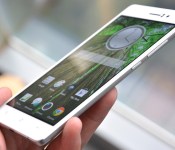
At just 4.85mm, Oppo R5 is the world’s slimmest smartphone

Step aside, Gionee, as your record for the world’s slimmest smartphone has just been beaten by a fellow Chinese manufacturer. Oppo’s R5, the successor to the Asia-only R3, comes in at just 4.85mm thick, thus beating the 5.15mm-thick Elife S5.1 from Gionee. Despite the crazy thin metallic body, the R5 still packs a handful of goodies: a 5.2-inch full HD AMOLED screen, an octa-core (quad 2.1GHz and quad 1.5GHz), 64-bit Snapdragon 615 SoC, 2GB of RAM, 5MP/13MP cameras (both with f/2.0 aperture), LTE radio and a 2,000 mAh battery. All of this comes in at just 155g heavy. Of course, there’s bound to be a trade-off: You only get 16GB of internal storage, no microSD expansion and, unlike the Elife S5.1, no 3.5mm headphone connector here — you’ll need to use the bundled micro-USB adapter or Bluetooth (there’s an optional O-Music Bluetooth clip for your headphones and for triggering the camera).

Build quality and body strength aren’t an issue on the pre-production unit we played with in Shenzhen. The metallic frame is nicely chamfered and manually polished to give a comfortable grip. What’s more, while most slim phones are known to expose more heat to the surface, the R5 uses a phase-shifting material — as featured on modern PC motherboards — to help cool the internal components; but we’ll need to probably test the phone to see if this works as well as it claims. If we must pick a fault at this stage, it’d be the main camera module that sticks out a little on the back, which can be forgiven for the sake of maintaining image quality.
Much like the N3 announced alongside it, the R5 comes with Color OS 2.0 (based on Android 4.4) which packs some handy features plus a few new ones. For one, the old gesture panel can now be toggled by dragging up from the Home button, thus letting you draw customized gestures to launch apps or open contacts. By default, you can draw a “V” to turn on the flashlight, draw a circle to launch the camera, or draw a “W” to launch WeChat.
As for the new camera app, you get a greater freedom of customization by installing your desired features as plug-ins: “HD Picture” (to make super detailed 64-megapixel images), “Slow Shutter,” “Beautify,” “Professional,” “Super Macro,” “GIF mode” and more. These are also featured on the N3, naturally.

Another common feature shared between the R5 and the N3 is the VOOC rapid charging. Using the bundled charger, the 2,000 mAh cell can go from zero to well above 75 percent in just half an hour, though the exact charging time is yet to be determined. We should know soon, anyway, as the R5 is slated for the global market this December, and it’ll come in silver, gold and grey with an off-contract price of $499.
Filed under: Cellphones, Mobile
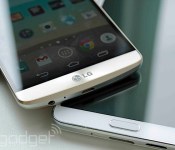
LG sells a record-breaking 16.8 million smartphones, doubles profit in the process

As Samsung struggles and Apple starts to encroach on the Android mainstay of giant screens, LG’s smartphones are doing alright. In fact they’re doing pretty darn well. Announcing a record number of smartphones sold and the best quarter in five years, LG’s sales totaled 16.8 million devices and the company announced an operating profit of $450 million, roughly double from the same period last year. Shipments of the mobile arm leapt 39 percent, although the good news was tempered (if only a little), by lower operating profits in the same quarter from its Home Appliance and a $2.44 million operating loss from its Air Conditioning arm, although LG reckons weather conditions were the cause for lower sales in its native Korea. TV and Home Entertainment profits increased five percent, with demand for LCD TVs increasing across the world. LG expects its high-end 4K displays will be responsible for some more impressive financial results later this year — and probably hopes you’re already saving up for the holiday season.
Filed under: Cellphones, LG
Source: LG

A single fiber strand could carry the world’s internet traffic

Researchers in the US and Netherlands have managed to transmit data at 255Tbps across a single strand of fiber cable over a kilometer (0.6 miles), about 2,500 times faster than any commercial fiber. They used a so-called multicore cable with seven separate channels, but the hardware alone didn’t account for the speed. They also squeezed 50 carriers down the seven cores, cranking each up to 5.1 Tbps using “spatial multiplexing.” None of that tech alone is new, but the net result of that was 255Tbps (31.8 Terabytes per second), enough to handle the world’s peak internet traffic, according to ExtremeTech. Don’t expect a speed boost at home anytime soon — there’s no way to mass produce the cables yet, and current infrastructure wouldn’t support it anyway. But at least you can look forward to a day when you could download all 317,060 movies in the IMDB in two and half hours.
Filed under: Science, Internet
Via: ExtremeTech
Source: Nature

UK’s £97 million supercomputer will predict the weather in your back yard

If someone asks you about UK weather, you can probably say “lousy” with about 75 percent accuracy. But the UK’s national weather service, the Met Office, needs a bit more precision than that, so it just purchased a £97 million ($156 million) Cray XC40 supercomputer. With 480,000 CPUs, the 140 tonne (154 ton) machine will run about 13 times faster than its current IBM system. It’ll also let the Met provide updates every hour, three times more often than it can now. All that speed will enable forecasts down to a resolution of 1.5km (1 mile), giving UK denizens the weather down to a specific London borough, for instance. It should also provide much better flood and wind warnings, along with more accurate fog, ice and snow reports for airports.

The supercomputer will also aid climate-modeling scientists, letting them see how global warming will affect specific regions of the UK compared to other parts of the world. The system will be built at the the Met Office HQ in Exeter and come on line in 2015, but won’t hit full steam until around 2017, according to the BBC. Cray’s XC40 is now its top-of-the-line commercial supercomputer, running on Intel Xeon chips with 16 petaflops of speed and 17 petabytes of storage. The Met sale is the largest it has ever made outside of the US.
[Image credit: Getty Images]
Filed under: Science
Via: BBC News
Source: Met Office, (2)
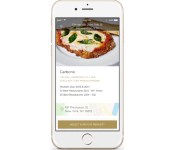
Reserve’s restaurant concierge app lets you forget about the bill

You can already organize fine dining excursions through a single app like OpenTable, but you still have to pull out your phone or wallet to pay when the night’s over. You won’t have to worry about the bill with Reserve’s new concierge service, though. The currently iOS-only platform lets you not only find and book tables based on your preferences, but automatically bills you after each meal (tip and all); you’ll be charged a $5 fee for the convenience, but that’s tiny in the world of haute cuisine. If your favorite eatery is busy, you can even offer to pay more than usual in hopes of securing a spot. Want to give it a whirl? You’ll have to eat in Boston, New York City or Los Angeles during the current beta testing phase, although San Franciscans will get to try it relatively soon.
Filed under: Cellphones, Internet, Mobile
Via: VentureBeat
Source: Reserve

Nintendo finally turns a profit thanks to ‘Super Smash Bros.’

Super Smash Bros. isn’t just fun to play, it finally gave Nintendo a fun financial quarter, as well. For the first time in a while, the Japanese company turned a profit, 24 billion yen worth ($224 million) to be exact. That’s a big u-turn over last quarter, when it managed to lose 9.9 billion yen ($97 million). Overall, Nintendo sold 3.2 million copies of Super Smash Bros. worldwide, not a bad figure considering that sales started late in the quarter. It also bodes well for the holidays, when Nintendo will launch additional Amiibo figurines that unlock more playable characters. The launch likely also pushed up Wii U sales, which increased to 650,000 units, 100,000 more than last quarter. Despite the good news, however, overall sales for Nintendo are still down 12.8 percent over last year — and Super Smash Bros. games don’t come along every day.
Source: Nintendo
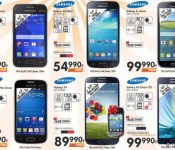
Samsung Galaxy A5 Specs and Price “Leaked” by Kazakh Retailer
 Samsung’s Galaxy A5 is the first of its kind: a mid-level device with high-level metal design. However, due to a mistake from Technodom, a retailer in Kazakhstan, the Galaxy A5 will be landing without some of the splash it could have had had certain information been kept secret.
We now know that the device will feature a Snapdragon 400 processor, 5 MP front camera, 13 MP back camera, and a 5 inch 720p display. The price in Kazakhstan will be 99,990 Tenge, or $552. Although, usually prices in America are a bit lower, so we can expect it to be in the $450-$500 range stateside.
Take a peek at the photo above and let us know what you think in the comment section below; also, are you planning on purchasing a phone from the A series? Spout off in the comments!
Source: Hi-Tech@mail.ru
Via: Sammobile
Come comment on this article: Samsung Galaxy A5 Specs and Price “Leaked” by Kazakh Retailer
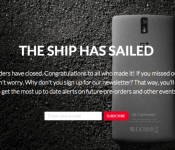
Pre-order system for OnePlus experiences issues, company once again apologizes

Nothing seems to come easy for OnePlus. There have been software issues and hardware issues with the One. However, the biggest problem is its availability. The invite system was a total mess as no one could get a hold of an invite. And there was really no reason for it. So OnePlus scrapped it in favor of a pre-order system. The company would allow prospective buyers to purchase the device at select times. Unfortunately, the pre-order system is not all that much better. The servers used experienced issues trying to handle a large influx of people.
OnePlus, focusing on being as transparent as possible, provided this explanation after apologizing:
In the lead up to opening our pre-order window, we more than doubled our server capacity to handle the expected traffic. However the amount of people signing in to submit pre-orders caused them to hang at certain points in the process, leaving many users unable to log in.
As more people signed on, the backlog of connections piled up and created a bad experience for many visitors trying to access the site. This left far too many users frustrated, disappointed and order-less. We spent the past 24 hours identifying the weak points that to this and mapping out a strategy to address them.
The next pre-order window to purchase the OnePlus One will open on November 17 at 12:00PM EST.
Source: OnePlus
Come comment on this article: Pre-order system for OnePlus experiences issues, company once again apologizes
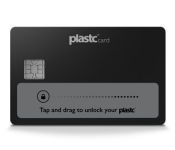
Plastc Card pre-orders surpass $5.2 million worldwide

Across the world, there are people who want thinner wallets and more secure payment options. This kind of desire is so strong that Plastc Card, which stores everything digitally into one card, has generated $5.2 million in pre-orders after just one week. Top markets for pre-orders were the United States, United Kingdom, Canada, Australia, and Malaysia. Simple math shows that roughly 33,000 people pre-ordered Plastc Card. Clearly, there is a real demand. It is now up to the company to actually deliver.
Plastc Card is scheduled to ship in Summer 2015.
Plastc Hits Record High The First Week of Pre-Order Campaign Selling over $5.2 Million in Plastc Cards
Global Adoption Continues to Grow for the Intelligently Designed and Secure Digital Card
PALO ALTO, CALIF. October 28, 2014 Plastc creator of the Plastc Card, the most intelligently-designed, secure digital card ever invented, announced today the success of its preorder campaign. In the first week of launch, Plastc sold over $5.2 million of Plastc Cards to people worldwide looking for a simple and elegant way to store their many credit & debit cards, loyalty and gift cards, access cards and more in a single, minimalist card. The Plastc Card retails for USD $155 and is available for pre-order on http://www.plastc.com. Plastc will ship its first Plastc Cards in Summer 2015.
“The growing worldwide demand for Plastc Card illustrates the real need people have to bridge the physical and digital wallet,” said Ryan Marquis, chief operating officer and co-founder of Plastc. “Our intuition was correct, based on our customers’ feedback and the preorders we have received so far.“
In addition to huge pre-orders from the U.S., the company also witnessed strong preorder sales in top international markets, including Canada, the United Kingdom, Australia and Malaysia. Plastc Card’s robust technology features include:
- PlastcCard comes with an E-Ink ink Touchscreen, a proprietary wafer thin digital display using the technology that shows your name, credit card, barcodes and much more.
- The Rewritable magnetic strip enables the behavior of the card to change depending on which card you select.
- PlastcCard will ship with Chip and PIN hardware which means that it will work globally after a Plastc firmware update in late 2015.
- Rewriteable NFC/RFID technology that lets Plastc Card mimic any RFID access cards.
- Low energy Bluetooth (BLE) is included within Plastc Card for connecting with the accompanying Wallet app.
- If your Card is left behind or away from your phone for a predetermined amount of time, Plastc Card will remote wipe your data to prevent fraudulent activity.
- Return Me Modehelps your card find its way back to you by displaying a message on the e-ink screen when it’s lost.
- Built in flash memory allows for you to store up to 20 cards at once.
- Plastc Card will display your photo ID and signature on the E-Ink touch screen so you are giving additional forms of identification to the retailer.
- 30-Day Battery Life + Wireless Charging you will experience about 30 days of battery life.
- A built in light sensor detects when Plastc Card is in or out of your wallet, allowing Plastc Card to save battery life and only display information while in use.
“We are inspired by all of our Plastc fans out there. We didn’t fully expect the volumes of pre-orders that we’re seeing on a daily basis. We are fully committed to delivering on our promise of producing the industry’s most intelligent, secure digital card ever invented, and are looking forward to getting the Plastc Card to market,” stated Marquis.
Fast Facts on Plastc Pre-Order
Plastc experienced a number of additional notable milestones for its launch in the first week of launch including:?
- Plastc’s video saw over 1.3 million views and continues to rise
- Top buyers of Plastc Card were early adopters, ranging in age of 25-34 years of age
- 45.8% of preorder sales came from female buyers, while 55.2% were male
- U.S. cities where people ordered the most include New York City, San Francisco, Los Angeles, Chicago and Seattle
Plastc’s Refer a Friend Program
On top of Plastc Card’s tremendous growth numbers, Plastc’s referral campaign has also led to success. At launch, Plastc introduced a give $20 get $20 referral program. Those that pre-order Plastc Card will have the option to refer as many friends and family to purchase Plastc Card as well, and for each person that accepts the offer the original purchaser will receive a $20 Amazon gift card at the time of shipping, and the referred will receive $20 off the purchase of their Plastc Card. There is no limit to the referral program at this point.
For additional details please see http://www.plastc.com/share.
About Plastc
Plastc (www.plastc.com) is a Fin Tech company focused on designing innovative products that improve the lives of everyday people.
Plastc Card is the most intelligently designed, full-featured, and secure payment device on the market. In conjunction with the Plastc Wallet app, the Plastc Card can store credit, debit, gift, loyalty, membership, and even access cards on a single device. Each Plastc Card is equipped with a secure PIN lock, proximity alerts, and a unique ‘Return Me’ mode, making it more secure than both traditional credit cards and other payment technologies.
Plastc was founded by entrepreneurs and technologists Ryan Marquis and Mark Stubbs in 2012 and is based in Palo Alto, California.
Come comment on this article: Plastc Card pre-orders surpass $5.2 million worldwide
 AIVAnet