


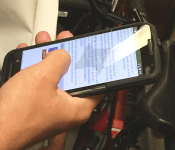
Supposed Nexus 6 caught on camera, just a few things to see really
We must be nearing the official launch announcement of the new Nexus 6. It always seems that “leaks” start to pick up more and more the closer we get to a device launch. The Nexus 6 has been suspected for a mid-October release, or at least announcement. We have heard rumored specs, reportedly confirmed specs, seen renders and now we have what appears to be a full-fledged Nexus 6 in use versus the image we saw earlier last week of the rear.

I know, there isn’t a heck of a lot to see. What you can see though does confirm a few a things from the leak the other day though. For instance you can make out the signal strength in the notification at the top and see that it appears to be solid vs the usual individual bars. You can also make out the dual speaker grills on the top and the bottom. On the bottom of the screen you can also see the Android L navigation buttons, well, one button, as the rest are hidden by the holders hand. That lays credence to the buttons being more spaced out. Along with those you can see the volume rocker and power button sitting more towards the center of the device, they appear to be metallic too.
It doesn’t look as huge as some might be thinking it will be. Some of the devices size, in this image, is due to the case that it resides in. Who ever is holding the device doesn’t seem to be having any issues holding it with one hand pretty easily.
It certainly looks like the it could be the Nexus 6 to me, or at least, it looks like the renders and other information that has made its rounds.
Source: Android Police
(image was slightly modified to hide any potential identifiers)
//<![CDATA[
ord = window.ord || Math.floor(Math.random()*1E16);
document.write('‘);
//]]>
The post Supposed Nexus 6 caught on camera, just a few things to see really appeared first on AndroidSPIN.
.CPlase_panel display:none;

ARM attempts to speed up ‘internet of things’ adoption with new platform

It’s the year 2014, and we’ve yet to have our flying cars and commuter jet packs. But we do have a glimpse of the future with the advent of the “internet of things.” It’s essentially the idea of connecting everyday objects — be it thermostats or kitchen appliances — to the web, in an effort to make our lives easier. As wonderful as that sounds though, development of new IoT technologies can be slow, due in part to the multiple different protocols in existence today and how tiresome it is to create an ecosystem from scratch.
That could soon come to an end, however, thanks to ARM. The chipmaker has just announced a brand new IoT-specific device platform that includes both a free operating system (tailor-made for ARM’s Cortex-M processor based devices, of course) plus a server-side software product that ties it all together. Based on the mbed hardware and software ecosystem, the platform basically gives manufacturers the tools and building blocks necessary for IoT devices and services, thus making it that much faster and cheaper for them to bring their ideas to fruition.
The mbed OS, for example, already comes packaged with security, communication and device management features along with built-in support for key standards like Bluetooth Smart, LTE, Wi-Fi and Thread, while the mbed Device Server offers straightforward integration with cloud services. Plus, it’s all based on open standards, which could mean different smart gadgets from different manufacturers will finally be able to communicate with one another.

And it’s not just limited to the home either. ARM was keen to point out the potential this would have in a city-wide application. Zach Shelby, the director of technical marketing at ARM, says that when implemented with street lights, for example, the technology would be able to detect the number of people that are in certain areas during certain times of day. On its own, that data doesn’t mean much, but if collected on a large scale, it could provide valuable data on crowd congestion, street occupancy and how flow in a city works. Another important application area would be with wearables, but not in the realm of an Android Wear device or an Apple Watch — think more low-power stuff like heart rate sensors and connecting them to cloud so you can easily track your progress with apps.
Of course, ARM is certainly not the first to come up with an IoT platform or operating system. But ARM sees its mbed device platform in a class of its own, because it can work across all devices with a Cortex-M processor, which is pretty ubiquitous (both the Pebble and the Nest, for example, have a Cortex M3), and it provides both the OS and a server-side solution. It certainly benefits those who’ve already invested in ARM chips and of course it behooves ARM to make the platform open.
While ARM already has plenty of partners signed up, we’re told that we likely won’t see devices with mbed until some time next year. “The Internet of Things has turned into this fragmented world,” says Mike Muller, ARM’s CTO. “So we decided we’re going to put this out there. We’re going to make it free so that it’s something that everyone can use.”
Filed under: Misc
Source: ARM
.CPlase_panel display:none;

Trouble sleeping? A snooze-inducing cap might help

If you can’t get to sleep at night, then you’ve probably been told to avoid cheese, say no to caffeine after lunchtime and drink a cup of warm milk before bed. That was good advice, or at least it was, until the advert of the Sleep Shepherd, which is a beanie that promises to gently send you to sleep and wake you up at the right time. Equipped with a variety of sensors, the headgear monitors your brain activity and sends a soothing pulse to your noggin to convince you that it’s time to stop thinking about what Dave at the office said to you that morning.
According to its creator, Dr. Michael Larson, there’s a part of our brain called the Medial Superior Olive, which we use to pinpoint the location of sounds. For instance, if someone speaks by our left ear, the sound reaches the left hemisphere of the MSO first, and we use the delay between that and when it reaches the right hemisphere to understand the location. The Sleep Shepherd takes advantage of this by sending a series of left-right pulses that trick your MSO into thinking that you’re rocking back and forth on a hammock. This, apparently, causes your brain into lowering the frequency of your brainwaves, and will eventually send you to sleep.
Once you’ve nodded off, the Sleep Shepherd will deactivate, but will continue to monitor your brainwaves, so if you start to wake up, the hat will resume activity. The company’s Kickstarter page doesn’t go into a lot of detail about how it does this, but given the (now defunct) Zeo was able to shrink a simple EEG unit into a headband, we’d guess that this takes a similar approach. There’s also no word on how you’d set the device to rouse you in the morning, but hopefully a companion app is in the offering. Perhaps, instead, the plastic section at the top of the beanie that houses the rechargeable lithium ion battery has a set of manual controls, although I think an app is more likely.
As we mentioned, this device is on Kickstarter, and the company is hoping to raise $50,000 to go into mass production. A pledge of $140 will bag you a regular version of the Sleep Shepherd, or you can buy one for you and your partner for $270. The company is planning to ship by March 2015 and have demonstration models ready in time for CES this January, and you can bet that we’ll be catching up with them at the show.
Filed under: Wearables
Source: Kickstarter
.CPlase_panel display:none;

The Big Picture: Japan’s bullet train turns 50

The bullet train is a Japanese trademark. It is, in other words, a landmark in motion. Today, 50 years to the time it made a trip for the first time, between Tokyo and Osaka, Japan is celebrating a major milestone in the history of its beloved bullet-shaped train. The Shinkansen, as it’s known in The Land of the Rising Sun, has had a great run throughout its 50-year tale, like being the fastest high-speed train at one point — China’s CRH380A now holds that title. Even so, Shinkansen is still responsible for carrying more than 300 million passengers every year in Japan, making it one of the most important forms of transportation in the world, not only in its home soil.
[Image credit: AFP/Getty Images]
Filed under: Misc, Transportation, Alt
.CPlase_panel display:none;

Verizon Offers Double the Data for ‘MORE Everything’ Plans [iOS Blog]
Following in the footsteps of AT&T and Sprint, Verizon today announced a promotion to expand the amount data available through its MORE Everything plans.
Customers on the 12GB plan will now get 15GB of data for the same $110 per month, while customers on the 16GB plan will now get 30GB of data for $130. Verizon has increased available data across the board, delivering up to double the data for consumers at no additional cost.

“We know that no matter how much data you have, it’s only as good as the network it’s on, and Verizon Wireless’ network is second to none,” said Ken Dixon, chief marketing officer at Verizon Wireless. “We know our customers — from families to businesses — crave more data to help them keep up with their busy lifestyles, and these new promotions, together with other offers like our industry-leading trade- in program, give them even more during the month of October.”
Customers will be able to get the expanded MORE Everything plans beginning on October 2, with customers able to sign up through October 31.
.CPlase_panel display:none;

The Elite Android Hacker Bundle: Lifetime access to developer mastery courses 92% off [Deal of the Day]

With its rapid proliferation and global popularity, most developers would be wise to add Android programming to their repertoire. Considering the time and financial constraints of everyday life, not everyone has access to the resources necessary to develop an expertise in the craft. The Elite Android Hacker Bundle steps in as the perfect solution for folks looking to create their own apps.
This bundle contains over 52 hours of tutelage curated from expert professors, studios, and academies. For most courses, you’ll simply need a browser that supports Java and an Android device. For only $39, you’ll receive specialist guidance through the creation process with certification upon completion.
Check this deal out, and many others at deals.androidguys.com!
Deals, Discounts, Freebies, and More! Click here to save today!
The post The Elite Android Hacker Bundle: Lifetime access to developer mastery courses 92% off [Deal of the Day] appeared first on AndroidGuys.
.CPlase_panel display:none;
The Pure Watch Face app gives you exactly what it’s moniker implies: A simple watch face [‘Watch’ This App]
If you’re someone who is currently looking for a plain smartwatch face, then it could just be time to take a look at the Pure Watch Face app. It provides you with a watch face that can be either analogue or digital, but only displays the time and date, and only comes in a grey color… Read more »
The post The Pure Watch Face app gives you exactly what it’s moniker implies: A simple watch face [‘Watch’ This App] appeared first on SmarterWatching.
Deals, Discounts, Freebies, and More! Click here to save today!
Read the rest at SmarterWatching.com!
The post The Pure Watch Face app gives you exactly what it’s moniker implies: A simple watch face ['Watch' This App] appeared first on AndroidGuys.
.CPlase_panel display:none;
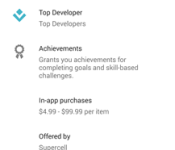
Google Play Store now shows in-app purchase prices and developers address

Recently there’s been quite a stir going on regarding Google’s new requirement for developers to provide an address for any paid apps to be displayed on the app page in the Play Store. Now it seems app pages have been updated to display the developer’s address, along with a price range for in-app purchases.
The issue with displaying developer’s addresses isn’t big until you get to the developers that are just a single person working out of their home. While you’ve always had access to these addresses in Google Wallet after purchasing said app, it was not out in the open for the whole world to see. So now, John Smith who created a new paid game in the Play Store has to provide his home address for it to be displayed on his app’s page.
However, the range of in-app purchase prices is a nice touch. Now you can be ready for whatever temptation may arise after downloading that free game, but with in-app purchases costing $15. No more excuses.
What do you think about the address debacle? And are you glad you can now see in-app purchases?
via Android Police
Deals, Discounts, Freebies, and More! Click here to save today!
The post Google Play Store now shows in-app purchase prices and developers address appeared first on AndroidGuys.
.CPlase_panel display:none;

Verizon: We can do double data, too!

As if we didn’t expect this to happen, Verizon on Wednesday got into the whole double data promotion, too. A post on the carrier’s newsroom tells us that effective October 2, subscribers of the MORE Everything plans will get twice the normal allotted data. It, like the deal offered by AT&T and Sprint, is a limited time gig that will be offered through October 31.
“We know our customers – from families to businesses — crave more data to help them keep up with their busy lifestyles, and these new promotions, together with other offers like our industry-leading trade- in program, give them even more during the month of October.”
Plans of 12GB or higher will get more data for the money; however, those at 20GB and above will see double data.

Deals, Discounts, Freebies, and More! Click here to save today!
The post Verizon: We can do double data, too! appeared first on AndroidGuys.
.CPlase_panel display:none;

Sprint goes for the “Double Data” promotion, also runs through October 31st
Just the other day AT&T announced that they are offering up double data for the same price on their Mobile Share Value plans.Their promotion runs through October 31st for new and existing customers. Not to be out done, Sprint has announced a similar deal for their customers that starts today and runs through October 31st as well.

The double data promo will take your 32GB, 40GB, and 60GB shared packages and doubles them. Well mostly. The 32GB package only jumps to 60GB instead of 64GB. The others jump to 80GB and 120GB. Sprint is also going to extend the offer to business customers starting October 3rd. To top off the promotion Sprint is also going to be waiving the line access charge per-line through 2015. Not that 3 months is a heck of a lot of time, but it still saves a little more money until after the new year.
“This is yet another example of Sprint standing behind its commitment to offer the best value in wireless,” said Marcelo Claure, Sprint CEO.
As I mentioned before, you have through October 31st to take advantage of the double data deal. Sprint won’t just “put it on your account’ you will need to swing into a store or give them a call to sign-up. Once you have gotten things rolling they say you will be able to keep it as is until you change your plan or alter the data offering. In a nutshell, get it now and don’t ever make a change to your account again.
Via Sprint
//<![CDATA[
ord = window.ord || Math.floor(Math.random()*1E16);
document.write('‘);
//]]>
The post Sprint goes for the “Double Data” promotion, also runs through October 31st appeared first on AndroidSPIN.
.CPlase_panel display:none;
 AIVAnet