



Lenovo Product Engineer Ashton Kutcher ‘Not Concerned’ About Upcoming iPad Launch
Lenovo today launched the Yoga Tablet 2, which comes equipped with either Android or Windows 8. Available in three different sizes ranging from 8 to 13 inches, the tablets are priced from $249 to $499. On the smaller end, the 8 and 10 inch tablets (Windows or Android) have a resolution of 1,920 x 1,080, while the larger 13-inch Pro version (Android only) has a resolution of 2,560 x 1,440.
The tablets come equipped with a 180-degree kickstand and the 13-inch Pro model comes equipped with a built-in pico projector that can project an image up to 50 inches on a wall as its defining feature. The tablets and two new two-in-one Yoga laptops have been created by Lenovo in conjunction with Ashton Kutcher, a “product engineer” at the company. Along with serving as one of Lenovo’s product engineers, Kutcher also famously starred as Steve Jobs in “Jobs,” the biographical movie directed by Joshua Michael Stern.
 Lenovo Yoga Tablet 2 Pro image courtesy of Engadget
In an interview with The Wall Street Journal, Kutcher sat down to talk about the creation of the Yoga Tablet 2 Pro and give his thoughts on Apple’s upcoming iPad lineup. According to Kutcher, he traveled to China to brainstorm a product consumers want. with the aim of making a “great entertainment device.”
For that reason, the Pro tablet comes equipped with a subwoofer and an 8-watt speaker, along with a 13-inch screen. “Because people use it in the home, we don’t need to create this super portable device,” Kutcher said. And with the projector, users don’t need to look for an HDMI cord or use AirPlay, because there’s a “built-in 50-inch screen.”
When asked about the upcoming iPad, Kutcher said he wasn’t worried about the competition as it would be unlikely to approach the features found in the Lenovo tablet.

Not at all. I’m not concerned about it in the least bit. Maybe it will be an iPhone Plus Plus. I think Apple has their fingers in a lot of things. We are really focused on this space and this product. I will be really surprised if they launch anything that approaches what we have here.
While Apple is said to be working on a larger 12.9-inch iPad, its upcoming October 16 launch event will focus on new versions of its already existing tablets, the iPad Air and the Retina iPad mini. Rumors have suggested the new iPad Air will receive an updated A8 processor, an improved camera, a gold color option, a new anti-reflective screen, and possibly 2GB of RAM.
Apple’s 12.9-inch iPad, meanwhile, is currently on hold with production delayed until Apple can meet demand for the iPhone 6 Plus. Lenovo’s smaller Android Yoga tablets are available now, while the larger projector-equipped version will launch later in October.
.CPlase_panel display:none;
Lenovo intros the Android-powered Tablet 2 and Tablet 2 Pro

Lenovo has just announced a few premium tablets to their YOGA lineup. Let’s take a look to see what they’ve just released.
Lenovo YOGA Tablet 2
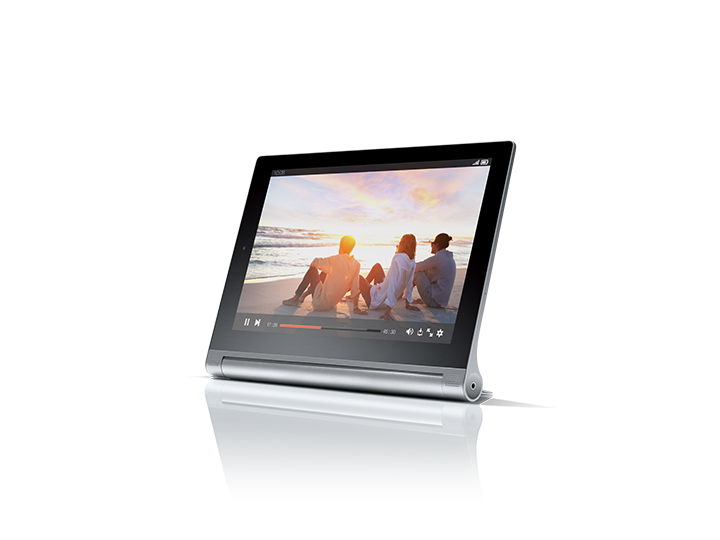
The YOGA tablet lineup has long been a frontrunner in unique design, offering a kickstand with the majority of the offerings. The Tablet 2 is no exception, now with a kickstand that can rotate almost 180 degrees for maximum comfort. The big feature here is the new Hang Mode, which basically means it can be positioned anywhere comfortably. The Tablet 2 also offers two big front-facing Dolby Audio speakers, a 1080p display, and an Intel Atom quad core processor.
The YOGA Tablet 2 comes in two different sizes: 8 or 10 inches. Both tablets also have an 8MP rear-facing camera, 1.6MP front-facing camera, 2GB of RAM, and 16GB on board storage, with MicroSD card support for up to 64GB. Check out the full list of specs below.
Processor: Intel® AtomTM Processor Z3745 (2M cache, 4 cores, up to 1.86 GHz)
Operating System: Android 4.4 KitKat
Display/Resolution: 8-in or 10.1-in Full HD (1920×1200) IPS display with 10-point multitouch & 178o wide viewing angle
Color: Platinum Silver
Memory: 2GB LP-DDR3 memory
Storage: 16GB, Supporting Micro SD card up to 64 GB
Audio: 2x front large-chamber speakers, Dolby® Audio, Wolfson® Master Hi-Fi
Ports: Micro USB (OTG), 3.5 mm audio jack, Micro SD card
Connectivity: 802.11b/g/n Dual-Band Wi-Fi (2.4 and 5 GHz) , Optional 4G (in select countries, not US): WCDMA (900/2100 MHz)1, GSM/EDGE (900/1800/1900 MHz)1, Integrated Bluetooth® 4.02
Camera: 8MP f2.2 rear camera with Auto-focus, 1.6M HD front camera
Battery: Extended battery life with up to 18 hours on a single charge
Weight: 8-in model: 0.92 lbs (419 g), 10-in model: 1.36 lbs (619 g)
Dimensions: 8-in model: 8.3 in x 5.9 x (.1 – .3) in [210 mm x 149 mm x (2.7 – 7.0) mm], 10-in model: 10.0 in x 7.2 in x (.1 -.3) in inches [ 255 mm x 183 mm x (3.0-7.2) mm]
Lenovo YOGA Tablet 2 Pro

The YOGA Tablet 2 Pro aims to give users a unique home theater experience. It offers a 13.3-inch Quad HD screen, along with a built-in projector to create a 50-inch home theater experience on any wall. The Tablet 2 Pro also has the same kickstand as the Tablet 2 offerings, able to rotate almost 180 degrees. These new kickstands aim to give users more options while using it. The included “modes” that are possible are Hold, Stand, Tilt, or Hang.
The Tablet 2 Pro has an 8MP rear-facing camera, 1.6MP front-facing camera, 2GB of RAM, 32GB of on-board storage, with MicroSD card support for up to 64GB. Let’s take a look at the official spec list:
Processor: Intel® AtomTM Processor Z3745 (2M cache, 4 cores, up to 1.86 GHz)
Operating System: Android v4.4 KitKat
Display/Resolution: 13.3-in Quad HD (2560×1440) IPS display
Color: Platinum Silver
Memory: 2GB LPDDR3
Storage: 32GB, Supporting Micro SD card up to 64GB
Audio: 2x front large-chamber speakers with 1.5W output each, plus a 5W rear JBL®subwoofer for a total 8W surround system. Dolby® Audio, Wolfson® Master Hi-Fi
Ports: Micro USB (OTG), 3.5 mm audio jack, Micro SD card
Connectivity: 802.11b/g/n Dual-Band Wi-Fi (2.4 and 5 GHz) , Optional 4G1 (in select countries, not US): WCDMA (900/2100
Camera: 8MP f2.2 rear camera with Auto-focus, 1.6M HD front camera
Projector: 40-50 Lumen Pico Projector with WVGA (854×480) Resolution
Battery: Extended battery life with up to 15 hours on a single charge
Weight: 2.09 lbs (950 g)
Dimensions: 13.1 in x 8.8 in x 0.1-0.5 in (333 mm x 223 mm x 3.7-12.6 mm)
Check out more coverage on the Lenovo YOGA Tablet lineup in the future here at AndroidGuys!
Deals, Discounts, Freebies, and More! Click here to save today! |
The post Lenovo intros the Android-powered Tablet 2 and Tablet 2 Pro appeared first on AndroidGuys.
.CPlase_panel display:none;

Google+ are adding the ability to add polls to your posts

It seems Google has been listening to the community and are in the process of adding a long asked for feature to Google+.
Finally users will be able to add polls to their posts, meaning you no longer have to link to an external poll site to gauge your friends’ opinion on important matters.
Google say that the functionality is being phased in gradually and will be distributed in stages starting with Android devices and the web in the next few days, before eventually being pushed to iOS.
Will you be using the new poll feature?
Deals, Discounts, Freebies, and More! Click here to save today! |
The post Google+ are adding the ability to add polls to your posts appeared first on AndroidGuys.
.CPlase_panel display:none;

If you’d like to hate yourself, you should play Daddy Long Legs

Everyone remembers Flappy Bird. It was so frustrating. It was so simple. Tap to fly, and that’s it. Yet, we all continuously played it, expecting more to come from the game. There’s a new game out that offers the same amount of frustration, but packaged in a well-illustrated, simple, and beautiful package. It’s called Daddy Long Legs.
The goal of the game is simple: walk. That’s it. Walk as far as you can. When you fall, you start back over again. You play as a spider, or, a spider with only two legs, rather. Tap the screen to move a leg, and tap it again to switch to the other leg. It takes awhile to get used to the momentum of the spider, but there is a groove to it. 
This game is frustrating. There’s nothing to it. But I can’t stop playing it. You can download it for free on Google Play from the link below, if you dare.
Deals, Discounts, Freebies, and More! Click here to save today! |
The post If you’d like to hate yourself, you should play Daddy Long Legs appeared first on AndroidGuys.
.CPlase_panel display:none;
Lenovo Yoga Tablet 2 8″ and 10″ upgrades displays, moves to Intel processors and keeps 18 hour battery life
Lenovo has been doing a pretty good job of listening to what consumers and users want or need. The first line of Yoga tablets, both the 8 and 10, came with Mediatek processors and paltry screen resolution. They still won my heart because they were decently fast and the battery lasted 18+ hour on a single charge. That gives me and my son all day strong games and movies. Shortly after the launch of both tablets Lenovo refreshed the Yoga 10 with the Yoga 10 HD+. They swapped out the Mediatek processor for a Qualcomm chip and upped the screen resolution to 1920 x 1200. It also offered louder speakers, a larger kickstand and a number of other improvements.

This years Yoga tablet 2’s keep moving in the right direction, in my opinion at least. The screen resolution on the 8-inch tablet has moved up from the 1280 x 800 to 1920 x 1200 HD display with a 178 degree wide viewing angle. While new 10-inch remains the same from the 10 HD+ at 1920 1200. The processors have been swapped out from the Mediatek and Qualcomm offerings to the quad-core Intel Atom Z3745 (bay trail) clocked at 1.33 GHz with a clock of 1.86GHz on turbo mode. You will get 2GB of RAM, 16GB of on board storage with micro SD card slot, larger speakers and a bigger kickstand that rotates 180 degree and allow you to hang it.

 The dual front-facing speakers are Dobly certified with Wolfson Master Hi-Fi. They both bring dual-band Wi-Fi 802.11b/g/n and an option 4G variant of the device in select countries ( not the US). They gain the updated camera at 8MP f2.2 and a 1.6MP front shooter. The camera also have glare-reducing glass and an advanced BSI-2 sensor to reduce flare and provide more lifelike color. Battery life still clocks in at the amazing 18 hours. Just like its predecessors, they support Micro USB OTG and allow you to charge your other devices from the tablets battery.
There would be a pretty good speed improvement across the boards with both tablets as compared to last year. Partly due to the processor choice this go round. The Intel chip boosts from the past 1.2 GHz mediatek 533MHz 1MB cache to 1.33GHz with turbo automatically pushing to 1.86GHz and 1066GHz 2MB cache. The RAM has been upgraded as well. While it is still 2GB of RAM, it is now DDR3 vs DDR2 and is 1066 MHz vs the previous 800MHz. These guys should cook right along. I don’t have my hands on them yet to give you a hands on idea of the improvements, but I will soon and will compare them to the previous three versions.
Along with the tablet, they also announced the new Bluetooth keyboard cover accessory. It has a curved magnetic arm that will attach to the battery cylinder to give you a keyboard and a cover for the tablet.
Lenovo keeps the price point that the original tablets launched with. That pegs the 8-inch for $249 and the 10-inch at $299. Don’t forget, if you are looking for an even bigger and badder tablet, Lenovo also just announced the 13.3-inch Yoga Tablet 2 Pro with a pico projector and an unheard of 15 hours of battery life starting at $499.
Go check them out at Lenovo.com
p.s. They also made a Windows 8.1 version as well. All the same specs, just running Windows.
//<![CDATA[
ord = window.ord || Math.floor(Math.random()*1E16);
document.write('‘);
//]]>
The post Lenovo Yoga Tablet 2 8″ and 10″ upgrades displays, moves to Intel processors and keeps 18 hour battery life appeared first on AndroidSPIN.
.CPlase_panel display:none;

Snapchat won’t be ad-free forever

Snapchat made the news just a few days ago when it became public knowledge that Yahoo was looking to invest in the disappearing message app. At the time it made me wonder why since Snapchat was free and didn’t implement ads. The company is estimated at $10 billion, but still, investing means return. Now it makes sense. Snapchats co-founder and chief executive Even Spiegel spoke at a conference yesterday and broke the news that ads are imminent.
“They’re not fancy. You just look at it if you want to look at it, and you don’t if you don’t,” Spiegel said.
So who is going to be serving up the ads? Snapchat has been in talks for sometime with various media companies in relations to ads, but my gut says it will be the Yahoo Bing! network that drives the ads. From what I gather, at least at this current time, ads will be slipped in between your chats. They won’t be targeted on user data leaving you get random ads. Not so sure that will work out to well when it comes to potential click-through. We will have to wait and see when and how Snapchat implements ads to the app. Gotta make some coin for the investors somehow, right?
//<![CDATA[
ord = window.ord || Math.floor(Math.random()*1E16);
document.write('‘);
//]]>
The post Snapchat won’t be ad-free forever appeared first on AndroidSPIN.
.CPlase_panel display:none;

Google+ flips the switch on polls after its recent purchase

Last month, Google nabbed a polling startup in order to boost the tools of its social network. Well, the folks in Mountain View didn’t waste any time, as polls are already set to make their debut on Google+. The new feature is rolling out now, in case you need to crowdsource info for your next excursion or are curious to see which team the masses think will win the World Series. Polls can include up to five options with photos for each, and one click displays the ongoing results. Android and web users can expect to see the option “over the next few days,” while it’s said to be “coming soon” to iOS.
Source: Dennis Troper (Google+)
.CPlase_panel display:none;

Lenovo’s new ‘Yoga’ tablets run Android and Windows, one has a built-in projector

Lenovo’s original, kickstand-toting Yoga Tablet was kind of a flop, thanks to a poor display, sluggish performance and heavily skinned version of Android. (Naming Ashton Kutcher as a “product engineer” probably didn’t help either.) Not to be deterred, the company is going all in: Lenovo just announced new versions of the Yoga Tablet, including a big-screen model with a built-in projector, and two that run Windows (it’s also still available with Android). Starting with that weird projector edition, called the Yoga Tablet 2 Pro, it’s not the first gadget we’ve seen with a built-in lamp, but it’s the first we’ve seen in quite some time. In this case, what we have this time around is a 13-inch Android tablet with a 2,560 x 1,440 screen sharp enough to play movies on its own, though you could also use the in-built Pico projector to create a 50-inch image on the wall.
Speaking of the sort, the tablet is about as flexible as other Yoga tablets, which is to say it has a rotating hinge that doubles as a kickstand. Here, though, there’s also an option to hang it from a wall while you project, if that’s somehow more convenient than standing it upright. On the inside, the tablet makes use of an Intel Atom processor, helped by 2GB of RAM. There’s also an 8-megapixel rear camera, along with dual 1.5-watt speakers a 5-watt JBL subwoofer. For storage, you get 32 gigs built in, along with a microSD card capable of supporting cards as large as 64GB. The battery, meanwhile, which is built into the hinge, is rated for up to 15 hours of runtime. So is something this innovative worth a second look? Depends: How do you feel about spending $500-plus on your next tablet? We’ll give you a few weeks to think on that — this won’t actually go on sale until the end of the month.
If you’re just fine with a regular tablet, thank you very much, the refreshed Yoga Tablet 2 still comes in 8- and 10-inch sizes, just like the last version. Now, though, it’s available with either Android 4.4 or Windows 8.1. All told, this is a pretty iterative upgrade — the design is fundamentally the same — though there are nonetheless a few welcome spec bumps. For starters, Lenovo upgraded from a MediaTek processor to an Intel Atom chip, which should hopefully address those performance issues. Two, all of the tablets in the series, even the 8-inch models, now have 1,920 x 1,200 screens, a step up from the 1,280 x 800 on the last-gen models. Additionally, the kickstand is said to be sturdier on the 10-inch model, while all of the models now have that same new “Hang” mode as the Yoga Tablet 2 Pro. Finally, there’s a 4G option for all the Android models, along with the 10-inch Windows version.
If you do buy one of the Windows configurations, you’ll also get a free one-year subscription to Office 365. Unfortunately, Lenovo didn’t make many changes to the Android version, which is to say it still runs a heavily skinned version of KitKat. In particular, Lenovo’s take on Android is so heavy-handed, that it’s actually more like iOS in some ways — there isn’t even an app drawer! Just all your apps, hanging out on the various home screens. In any case, if you are interested in the Android version, that’s available today starting at $250 for the 8-inch model and $300 for the 10-incher. The two Windows models will arrive throughout the fall, with the 10-inch model going on sale later this month for $400, and the 8-inch edition landing in November for $300.
Nicole Lee contributed to this report.
.CPlase_panel display:none;

Lenovo Yoga 3 Pro Ultrabook brings a thinner and lighter design

Remember how Intel recently unveiled a new family of chips designed to make 2-in-1 laptops much thinner and much lighter? Of course you do. Anyway, get ready to see lots of machines coming out this holiday season with extra-compact designs. Case in point: Lenovo’s new Yoga 3 Pro Ultrabook, which launched today with a chassis that’s 14 percent lighter and 17 percent thinner. All told, it weighs in at just 1.19kg, or 2.62 pounds. That’s impressive even for a 13-inch Ultrabook, and it’s definitely an improvement over the last-gen Yoga 2 Pro, which came in at 3.06 pounds.
Otherwise, the Yoga 3 Pro is similar to the last model: It still has a 3,200 x 1,800 display, and the industrial design and keyboard layout have barely changed either. Of course, too, this is fundamentally still a Yoga, which is to say it has a 360-degree hinge allowing you to fold the screen back into tablet mode (and also “Stand” mode, and “Tent” mode). As before, the battery life is rated for up to nine hours, not that we ever got close to that on the Yoga 2 Pro. Hopefully Lenovo actually means it this time. As for performance, this is an ultra-low-voltage Intel Core M processor, which means in exchange for slimmer designs and long battery life, you may experience a slight dip in performance versus a standard-voltage system. That said, it shouldn’t stop you from using the machine as your daily driver.
Additionally, in less important news, Lenovo announced the ThinkPad Yoga 14, the company’s first convertible Ultrabook with that particular screen size. Like the original ThinkPad Yoga, which has a 12.5-inch screen, this newer model has a self-flattening keyboard that locks up when the machine is in tablet mode. As a relatively big-screen Ultrabook, the specs are a bit more heavy-duty than you’d otherwise expect from an ultraportable, including discrete NVIDIA GeForce 840 graphics, 1TB of storage and 8GB of RAM. Despite that horsepower, though, Lenovo says you can still get up to eight hours of runtime on a charge. Both laptops arrive at the end of this month, with the Yoga 3 Pro priced from $1,349, and the ThinkPad Yoga 14 starting at $1,199.
Nicole Lee contributed to this report.
.CPlase_panel display:none;

Yahoo wants to poach YouTube’s biggest ‘stars’

Despite what some corners of the internet thought, Tumblr hasn’t changed all that much since Yahoo officially bought it over a year ago. That may not be the case for much longer, if a report from Business Insider holds true, though: it suggests that the company’s executives have been looking at Tumblr as a way to push back against YouTube’s online video dominance.
To hear BI’s Nicholas Carlson tell the tale, Yahoo’s tentative fight for video relevance involves using Tumblr (that billion dollar hub of GIFs and drama) as a video hub for internet stars the company has lured away from YouTube. The process of luring that talent away from YouTube’s clutches has been underway for at least a few months now (according to re/code, at least), and involved promises to improve ad revenue payouts — after all, what video creator on the cusp of making it big couldn’t use a few more bucks? No one’s sure that Yahoo will ever actually pull the trigger on these plans, but really — it could go either way. Best case scenario, poaching YouTubers and giving them channels on Tumblr could help the social network retain its cool cachet among its legions of younger fans (not to mention generating some cash for Yahoo in the process). And the worst case? People do what they usually do: they move on and find other people to watch on YouTube.
Source: Business Insider
.CPlase_panel display:none;
 AIVAnet